
Strategic workforce and talent planning is essential for organizational success in today’s dynamic business environment. This guide provides a comprehensive, step-by-step guide to developing a solid foundation for strategic workforce planning.
TL;DR
- Strategic workforce and talent planning connect talent with business goals. It helps organizations have the right skills, roles, and capacity. This keeps them agile during changes in demographics, automation, and talent shortages.
- Strong employer branding, supported by effective workforce planning, attracts and retains top talent. This reduces turnover and enhances competitiveness in a challenging labor market.
- The McKinsey report shows that businesses that manage their talent well perform significantly better. They can earn up to 300% more revenue per employee. This demonstrates that effective workforce planning enhances long-term performance and resilience. By partnering with specialists like Sunbytes—leveraging 15+ years of experience in Vietnam—you can accelerate your ability to build an agile, future-ready workforce.
What Is Strategic Workforce & Talent Planning?

Strategic workforce planning is a systematic, data-driven process that enables organizations to align their workforce with both short-term needs and long-term goals. It involves:
- Analyzing current workforce capabilities
- Forecasting future talent needs
- Identify skill gaps and develop targeted acquisition and development strategies
- Adjusting plans as business conditions change.
To optimize human capital and build competitive advantage, ensure your organization has the right size, skills, cost, and agility to meet current and future demands.
Talent planning puts workforce strategy into practice using four interconnected levers: Talent Pipeline, Talent Mapping, Employee Benefits, and Succession Planning.
- Talent pipelines identify and attract qualified candidates.
- Talent mapping shows available skills and readiness.
- Employee benefits play a crucial role in employee retention and engagement.
- Succession planning ensures leadership continuity.
Together, these actions help create a resilient workforce prepared to meet long-term organizational goals.
Why Workforce Planning Matters in Today’s Business
Today’s talent market presents challenges that make strategic workforce planning essential not only for employer branding but also for achieving business wins.
The Future of Jobs report for 2025-2030 states that 63% of surveyed employers view skill gaps as the main barrier to business transformation. To address this, organizations should focus on building employer branding to attract talent and enhance competitiveness, rather than competing for a limited pool of available talent.
Furthermore, the labor market is undergoing a significant transformation. Millennials and Generation Z now comprise the majority of the workforce, and they have different expectations than previous generations. They seek better career opportunities with flexible schedules, a work-life balance, purpose-driven recruitment, and prospects for advancement.
Technology presents another challenge. A McKinsey study says that up to 30% of jobs could be automated by 2030. This will change the types of jobs and the skills needed. Without a long-term personnel strategy, it is easy to become complacent and struggle to adjust to market changes, resulting in the loss of personnel, underutilization of resources, and ultimately, a loss of competitive advantage.
That’s why embedding SWP into business-as-usual companies can better anticipate workforce needs, respond to changing demands, and ensure long-term agility and resilience

Strategic workforce planning processes
Discover essential processes for workforce planning that will help businesses maintain a competitive advantage, such as strategic alignment and technological innovation.
Workforce analysis
Workforce analysis is the first step in strategic workforce planning. It helps us understand the current talent in the organization and find areas that need improvement. This process involves several key activities:
- Gap Analysis
Conduct a gap analysis to compare your existing labour skills, competencies, and productivity against future business requirements. Identify areas where employees lack critical skills, underperform, or where redundancies exist to highlight the immediate and long-term development needs. - Identify Critical Roles and Talent Risks
Identify which roles are crucial for achieving strategic objectives and which positions are most susceptible to turnover or skills shortages. Understanding these critical roles helps prioritize workforce planning efforts and succession strategies. - Competency Mapping
Develop a competency map to clarify the skills, behaviors, and knowledge within the organization, linking them directly to job roles. This map helps identify high-potential employees and pinpoint gaps that affect performance or succession planning.
A detailed workforce analysis provides HR decision-makers with insights for informed hiring, training, and retention decisions. This ensures optimal job matching at all times.
Workforce planning
Workforce planning builds on workforce analysis to ensure the organization has the right talent in place to meet both current and future business objectives. It involves anticipating needs, balancing supply and demand, and modeling different workforce scenarios. Key components include:
Forecasting (Short-term vs. Long-term)
- Short-term forecasting focuses on immediate staffing needs, such as filling upcoming vacancies or addressing seasonal workload fluctuations.
- Long-term forecasting projects workforce requirements over several years, taking into account business growth, market trends, and strategic objectives.
Internal vs. External Supply
HR professionals must understand both internal and external factors that can impact workforce requirements
- Internal supply: assess existing employees’ skills, potential, and readiness for promotion or lateral moves.
- External supply: review market conditions, talent availability, and recruitment pipelines to meet anticipated demand.
Workforce Scenario Modelling
Develop multiple scenarios to understand how different business changes may impact workforce needs:
- Growth scenario: expansion into new markets or launching new products.
- Restructuring scenario: organizational changes, downsizing, or role consolidation.
- Market entry scenario: entering new geographies with different talent landscapes.
Each scenario helps anticipate challenges, prioritize critical roles, and align talent strategies with business objectives. Efficient workforce planning should result in the identification of skill gaps, the prioritizing of workforce objectives, and a clear assignment of duties for implementing those programs.
Workforce strategy
A well-defined workforce plan should be founded on an in-depth understanding of the organization’s present and future demands, as well as the skills and capabilities required to meet them.
Build a Skills-First Strategy
HR professionals should prioritize skills and competencies over job titles when making hiring, promotion, and development decisions. Focus on the capabilities that drive business outcomes, and ensure the workforce is equipped to adapt to evolving market demands.
Buy–Build–Borrow Model
To fully utilize resources, a labor strategy adopts a balanced approach to talent acquisition:
Buy: recruit externally to fill immediate skill gaps or critical roles.
Build: develop internal talent through training, mentoring, and career development programs.
Borrow: leverage contractors, consultants, or temporary staff to access specialized skills as needed.
This flexible model allows organizations to respond quickly to changing business needs while optimizing costs.
Role Segmentation
In addition to having a balanced approach in talent acquisition, HR professionals need to categorize roles based on their strategic importance to have specific directions.
Retention Strategy for High-Value Workforce
HR also needs to create retention programs for key employees. These should include competitive pay, chances for career growth, recognition programs, and good benefits packages. A strong retention strategy helps secure high-value talent, reduce turnover, and maintain institutional knowledge.
By integrating these components, workforce strategy ensures the organization can attract, develop, and retain the talent needed for long-term success while maintaining flexibility to respond to market changes.
Workforce development
Workforce development initiatives should be based on the insights gained from workforce analysis and the priorities established in the workforce strategy. These initiatives may include focused recruitment campaigns to find potential candidates. They may also have upskilling programs to close skill gaps. Additionally, there will be leadership development programs to create a strong group of future leaders.
To ensure the success of workforce development initiatives, HR professionals should establish clear goals and metrics for measuring progress. This may involve tracking key performance indicators such as time-to-hire, retention rates, and employee engagement scores. Regular monitoring and reporting on these metrics can help identify areas for improvement and ensure that workforce development efforts are aligned with the organization’s strategic objectives.
Strategic Action Planning: Bridging the Workforce Gap
Action planning is the process of designing specific strategies to address skill gaps identified during your workforce analysis. To turn analysis into action, HR professionals should focus on three core areas:
Prioritize Based on ROI: Not all initiatives are equal. Prioritize tasks based on their potential impact and practicality. Perform cost-benefit assessments to determine the ROI of each initiative and engage key stakeholders early to secure necessary resources.
Define Success Metrics: A solid plan requires a clear timeline and a workforce dashboard. Establish Key Performance Indicators (KPIs) to track progress and accountability.
Risk Mitigation & Contingency: Identify potential disruptions such as skill shortages, high turnover, or market shifts. Prepare contingency plans, such as alternative sourcing channels, interim staffing, and cross-training programs, to ensure business continuity.
Workforce implementation
Workforce implementation is the stage at which strategic plans are translated into concrete actions, ensuring that the organization’s workforce strategy is executed effectively throughout the organization. HR professionals should establish clear timetables, allocate tasks, and communicate progress frequently to ensure that initiatives remain on track. Key activities include:
- Recruitment Program Rollout
Execute hiring plans based on workforce forecasts, focusing on critical roles and skills gaps. Coordinate with HR, talent acquisition teams, and external partners to ensure timely onboarding of qualified candidates. Read more: Developing Talent Pipeline for High-Impact Roles in Evolving Industries - Learning & Development (L&D) Roadmap Execution
Deploy training and development programs aligned with skill gaps, succession planning, and career development plans. Track participation and learning outcomes to ensure employees are acquiring the skills necessary for their current and future roles. - Read more: The Complete Guide to Effective Talent Mapping
- Benefits & Rewards Adjustments
Implement or update compensation, employee benefits, and recognition programs to attract and retain high-value talent, while also enhancing employee engagement. Tailor packages to workforce segmentation and strategic priorities.
- Successor Development Execution
Develop high-potential employees for critical roles through targeted coaching, mentorship, and stretch assignments. Ensure readiness for leadership continuity and organizational resilience. - Policy & Governance Implementation
Apply HR policies, compliance measures, and governance frameworks consistently to support fair, transparent, and effective workforce management. Ensure alignment with legal requirements and internal standards.
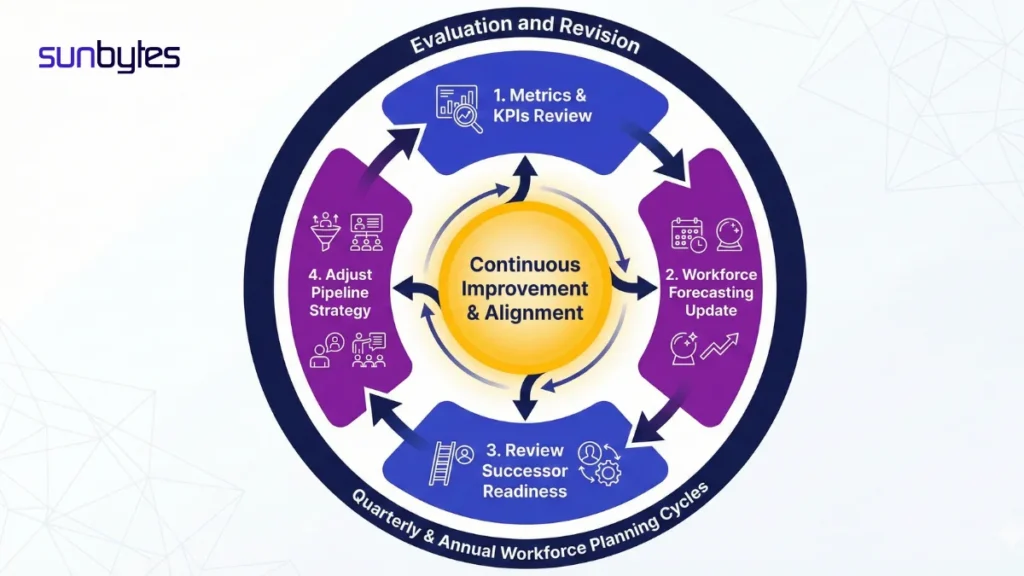
Evaluation and revision
Evaluation and revision ensure that workforce plans remain relevant, effective, and responsive to changing business needs. Key activities include:
- Metrics & KPIs Review
Monitor key workforce indicators, including headcount, retention, performance, pipeline health, and skill coverage, to assess the effectiveness of the implementation. - Workforce Forecasting Update
Update short-term and long-term workforce forecasts to reflect changes in business strategy, market trends, or internal dynamics. - Review Successor Readiness
Evaluate progress in succession planning and readiness of high-potential employees to step into critical roles. - Adjust Pipeline Strategy
Refine talent pipeline initiatives, including internal development and external recruitment, to ensure continuous alignment with skill demands. - Quarterly & Annual Workforce Planning Cycles
Conduct regular reviews and planning sessions to ensure that the workforce strategy remains agile and responsive, fostering continuous improvement.
Strategic Guidance for Workforce Planning in the AI Era
Treat Talent as a Strategic Asset
Leaders should evaluate workforce capabilities in conjunction with financial investments. Strategic workforce planning allows organizations to:
- Prioritize talent development and retention initiatives
- Build robust talent pipelines
- Benchmark workforce capabilities against industry peers to inform expansion or restructuring decisions
Focus on Critical Capabilities
In the era of AI, HR professionals should identify high-impact roles and emerging competencies required for AI and technological advancements. Conduct skills mapping and scenario-based assessments to understand where internal capabilities are sufficient and where upskilling, reskilling, or external hiring is necessary.
We have compiled an article on the impact of AI on the job market, which you can read here: The AI Impact on Job Market in Vietnam
Plan for Multiple Scenarios
Scenario modeling ensures preparedness for various business outcomes:
- AI-driven productivity changes
- Automation or role evolution
- Market entry or expansion
Forecast workforce supply and demand across functions, and align headcount and skills planning.
Recruitment Outsourcing Process (RPO) and Employer of Record(EOR) enable organizations to quickly scale talent according to business needs, providing flexibility in workforce planning. For short-term projects, technology-driven initiatives, or sudden workload spikes, recruitment services help source specialized talent rapidly, while EOR enables hiring globally without the need to set up local entities. Building a flexible talent pool is essential, including:
- Full-time employees with adaptable skills
- Part-time or contract staff
- Freelancers and gig workers
- Talent accessible through EOR or alumni networks
These services ensure workforce availability across various scenarios, enabling organizations to remain agile, compliant, and responsive to evolving market and technological demands.
Leverage Analytics and AI Tools
HR can utilize AI and predictive analytics to:
- Forecast talent supply and demand
- Identify emerging skill gaps
- Optimize recruitment and internal mobility
This ensures data-driven workforce decisions that support long-term strategic goals.
Build a Continuous Learning Ecosystem
Develop skill-based learning paths to prepare employees for future roles. Focus on reskilling employees whose current roles may evolve due to the impact of AI or automation, ensuring a future-ready, high-performing workforce.
Strategic Workforce Planning: A Continuous Journey
Successful workforce planning is not a one-time exercise; it is a continuous cycle of analysis, adjustment, and alignment. This ongoing process ensures that your strategy evolves in tandem with organizational goals and adapts to unexpected market changes.
A well-designed workforce strategy is the competitive differentiator between struggling to keep up and leading the pack in your industry.
Accelerate Your Strategy with Sunbytes
While internal planning is vital, collaborating with specialized HR services partner can significantly fast-track your success.
Sunbytes professionals bring over 15 years of experience supporting the smooth launch and expansion of businesses in Vietnam. By partnering with us, you gain:
Deep Market Insights: Tools and techniques tailored specifically to the Vietnam business landscape.
Agile Implementation: Strategies to build a staff that is flexible, engaged, and ready to face future challenges.
Long-Term Success: A proactive approach that complements your internal expertise to secure the right people.
Ready to build a future-proof workforce? Contact Sunbytes’ knowledgeable team today for a detailed guide tailored to your specific business needs.
FAQ
Why should talent acquisition align with organizational strategy?
It implies that the company’s long-term objectives serve as guidance for hiring decisions. Talent acquisition focuses on developing the leadership, skills, and competencies necessary to execute the strategic plan, rather than simply filling unfilled positions.’
How can workforce planning & employer brand deliver tangible business wins?
Workforce planning and a strong employer brand collaborate to transform talent initiatives into verifiable business outcomes.
Improve your ability to attract top-tier talent
Organizations can attract highly competent people more quickly by clearly outlining workforce needs and promoting a compelling employer brand. This ensures that the appropriate personnel are in the right positions to execute strategic projects.
Increase staff retention and loyalty
A transparent workforce strategy and a positive employer reputation promote trust and engagement. Employees are more inclined to stay, which reduces turnover costs and preserves institutional knowledge.
Ensure better company performance
Organizations benefit from hiring the appropriate people and having a motivated team. Effective personnel planning ensures that business objectives are consistently met by a capable and engaged staff.