

Some business leaders don’t struggle to find development teams. They struggle to choose the right one to trust with their product long term. On paper, many dedicated software development teams look similar: comparable tech stacks, competitive rates, polished case studies. In reality, small differences in alignment, ownership, and delivery discipline determine whether a team accelerates growth or quietly slows it down. The opportunity is clear: when chosen correctly, a dedicated team becomes an extension of your engineering leadership, not a delivery bottleneck.
This article will provide a rigorous, multi-step framework for evaluating and selecting a dedicated development team that ensures technical alignment, cultural synergy, and long-term operational stability.
To understand what Dedicated Software Development Team means, read our blog: Dedicated Software Development Team: Everything You Need to Know
TL;DR
- Choosing a dedicated software development team is a strategic decision that directly impacts delivery speed, product quality, and long-term scalability.
- The most reliable selection criteria combine technical alignment, delivery maturity, cultural fit, and the ability to scale without losing architectural control.
- A structured evaluation framework helps decision makers avoid hidden risks such as knowledge silos, inconsistent quality, and team churn.
- When selected correctly, a dedicated development team operates as a true extension of your internal engineering organization, not an external vendor.
Why Should You Consider a Dedicated Software Development Team?

As products grow, internal teams often reach a point where hiring locally becomes slow, expensive, or too rigid for changing roadmaps. A dedicated software development team offers a way to extend capacity without sacrificing focus, ownership, or delivery standards. Instead of constantly onboarding short-term contractors, you gain a stable team that learns your domain, users, and technical constraints over time.
This approach is especially valuable for long-term initiatives such as core product development, platform modernization, or continuous feature expansion. Dedicated teams deliver consistency in velocity and quality while allowing leaders to retain control over architecture, priorities, and decision-making.
For a clearer view of the business and delivery advantages this model offers, read our blog “5 key benefits of a Dedicated Software Development Team”.
What Are the Core Software Development Team Selection Criteria?
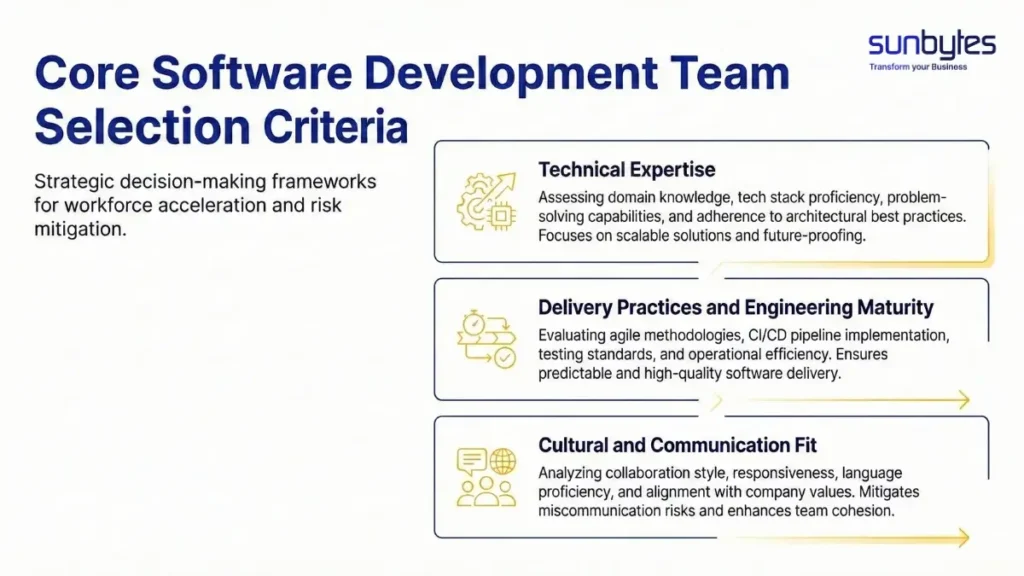
Choosing a dedicated software development team is about ensuring long-term alignment and reliable execution. The right selection criteria help you determine whether a team can integrate into your organization and scale with your product.
Technical Expertise That Matters in a Dedicated Software Development Team
Assess technical expertise by how well the team can operate inside your existing architecture. Ask for concrete examples of working with similar system complexity, legacy constraints, or scalability requirements. Review how they handle code ownership, architectural decisions, and technical debt. A strong team can explain why certain approaches were chosen—and how they would adapt them as your product evolves.
Delivery Practices and Engineering Maturity
Mature delivery is visible in execution details. Look for teams that run consistent sprint cycles, maintain a prioritized backlog, and enforce mandatory code reviews. Ask how testing is integrated—unit, integration, and regression—not treated as an afterthought. Teams with real engineering maturity can show you how they track predictability, manage changes without chaos, and continuously improve their delivery process.
Cultural and Communication Fit
Cultural fit becomes clear in how teams communicate under pressure. Validate this by understanding their meeting cadence, documentation habits, and escalation process when blockers appear. Strong teams share progress proactively, document decisions in writing, and flag risks early. Aligning on working hours, feedback loops, and decision authority upfront prevents misalignment as the team scales.
How Do You Evaluate Region and Hiring Strategy When Choosing a Dedicated Software Development Team?
Where your dedicated software development team is based directly affects cost structure, collaboration quality, and long-term scalability. Region choice is a trade-off between efficiency, communication, and access to sustainable talent pools. To evaluate this properly, focus on total ownership cost and day-to-day collaboration realities.
Cost of Ownership vs Efficiency
Lower hourly rates don’t automatically translate into lower costs. Consider the full cost of ownership: onboarding time, management overhead, rework, and team stability.
Regions with mature delivery ecosystems often deliver higher efficiency per developer, reducing hidden costs caused by delays or quality issues. The goal is not the cheapest team, but the team that delivers the most reliable output per euro or dollar spent.
Communication Clarity, Time Zones & Cultural Compatibility
Time zone overlap and cultural alignment directly impact execution speed. Limited overlap increases reliance on documentation and asynchronous communication—something not all teams handle well.
Evaluate how teams structure handovers, decision-making, and escalation across time zones. Cultural compatibility, especially around feedback, accountability, and transparency, determines whether collaboration feels frictionless or constantly requires intervention.
How Do You Choose the Right Provider for a Dedicated Software Development Team?
Evaluating supplier maturity, reputation, delivery history
- Assess how the provider operates beyond sales conversations.
- Look for signs of maturity such as standardized onboarding, clear governance models, and low team turnover.
- Review case studies that show long-term engagements—and ask how teams evolved as products scaled.
- Independent reviews, repeat clients, and transparent references are indicators that delivery performance holds up under real conditions.
What to Ask in Vetting Conversations
- Use vetting discussions to test how the provider thinks, not what they promise.
- Ask how they handle architectural disagreements, shifting priorities, or underperforming team members.
- Request examples of how they’ve replaced or scaled engineers without disrupting delivery. The quality of these answers reveals whether the provider is prepared for long-term partnership—or optimized only for short-term staffing.
If you want to benchmark your options before making a decision, reviewing a curated list of top dedicated software development team providers can help you compare experience, delivery reliability, and regional strengths side by side.
What Contract Types Should You Consider When Choosing a Dedicated Software Development Team?
The contract you choose defines more than pricing—it sets expectations for ownership, risk, and flexibility. When working with a dedicated software development team, the right contract structure should support long-term collaboration while protecting delivery quality and accountability.

Dedicated Team Agreements vs Hosted or Limited Liability Contracts
Dedicated team agreements typically offer the highest level of control and continuity. The team works exclusively on your product, follows your processes, and scales with your roadmap. This model suits long-term development where architectural consistency and stable velocity matter.
Hosted or limited liability contracts can reduce administrative overhead but often shift more risk to the client. Decision authority, quality ownership, and team stability may be less clearly defined. When evaluating contract types, focus on how responsibility is shared—especially around quality standards, team replacement, and knowledge retention
How to Scale Your Dedicated Software Development Team
Effective scaling focuses on maintaining clarity, architectural consistency, and team stability as demand grows.
When Is the Right Time to Scale a Dedicated Software Development Team?
Scale only once the team demonstrates stable velocity, clear ownership, and a well-prioritized backlog. Premature scaling amplifies existing inefficiencies, while late scaling creates bottlenecks and burnout. Use delivery predictability—not roadmap pressure—as the signal to grow.
How to Scale a Dedicated Software Development Team by Role, Not Headcount
Prioritize adding roles that remove constraints: QA to improve release confidence, DevOps to stabilize environments, or specialists for security and performance. Scaling by capability ensures each addition increases throughput instead of creating coordination friction.
Maintaining Architectural Consistency While Scaling a Dedicated Development Team
As teams grow, architecture becomes harder to govern informally. Establish clear technical guidelines, code ownership, and review standards before scaling. Consistency protects long-term maintainability and prevents fragmented implementations.
Scaling Across Time Zones Without Impacting Collaboration
Plan scaling around overlapping working hours and documented workflows. Increase reliance on written decisions, shared dashboards, and asynchronous updates to avoid meeting overload. Strong documentation becomes critical as communication paths multiply.
How a Dedicated Software Development Partner Supports Sustainable Scaling
Experienced partners anticipate scaling needs through talent pipelines and structured onboarding. They reduce disruption by preserving team continuity, accelerating ramp-up, and maintaining delivery rhythm as new engineers join.
How Sunbytes Helps You Choose and Build the Right Dedicated Software Development Team
Choosing a dedicated software development team is only effective when selection and execution are tightly connected. Sunbytes supports leaders by combining structured team selection with delivery models built for long-term stability. For a concrete example, read the TeamViewer success story to see how we assembled a dedicated software development team that increased engineering velocity while staying fully aligned with their technical standards and delivery goals.
If you’re ready to evaluate or build a dedicated software development team with confidence, exploring Sunbytes’ dedicated team services is a practical next step.
Why Sunbytes (Transform · Secure · Accelerate)
Sunbytes is a Dutch technology company (HQ: the Netherlands) with a delivery hub in Vietnam. For 14 years, we’ve helped international teams deliver Digital Transformation—building and modernizing digital products with dedicated software development teams that are delivery-focused, dependable, and built for long-term impact (custom development, QA/testing, maintenance & support).
What makes our Digital Transformation stronger is that it’s reinforced by our other pillars:
- Cybersecurity strengthens Digital Transformation: our Secure by Design approach reduces risk without slowing delivery—so modernized systems don’t become fragile systems. Security is considered early, aligned with real architectures and delivery constraints, and turned into practical improvements your team can sustain.
- Accelerate Workforce strengthens Digital Transformation: scaling transformation requires the right capabilities at the right time. We help you add capacity and critical skills efficiently, so your roadmap stays on track and your delivery model remains stable as demands grow.
With Sunbytes, Digital Transformation isn’t just “building software”—it’s reliable execution with security and scalability built in. Schedule a free consultation to talk with our experts now.