
If you’ve started Googling “NIS2 registration,” you’ve probably noticed something frustrating: the answers don’t look consistent.
That’s not because NIS2 is vague. It’s because NIS2 is a directive, and every EU Member State turns it into national law in its own way (timelines, portals, authorities, exact wording). So what looks like “registration” in one country may look like “self-identification” or “entity listing” in another.
This article is intentionally not a step-by-step filing tutorial. We’re a cybersecurity partner—not a legal filing desk. Instead, this is a trust-first guide to help you:
- understand what “registration” typically means in NIS2 terms,
- avoid common mistakes that waste weeks,
- and find the right competent authority in your country—fast.
If you haven’t confirmed scope yet, start here: check if NIS2 applies to your organisation.
TL;DR
- NIS2 “registration” is usually about helping national authorities identify which organisations are in-scope and should be supervised.
- Because NIS2 is transposed into national law, the where/how differs by country.
- Your fastest path is: confirm scope → find the competent authority for your country → follow that authority’s official process.
- While registration is important, it’s not the hard part. Most real risk lives in Article 21 controls and Article 23 incident reporting readiness.
Related reads:
- NIS2 readiness checklist for EU SMEs
- NIS2 incident reporting (Article 23): the 24–72–30 playbook
- Article 21: security measures in plain English
What “registration” usually means under NIS2
In many countries, “registration” under NIS2 is less about paperwork for its own sake—and more about visibility.
Authorities need to know:
- who is in scope,
- how to contact them during incidents,
- and which entities should fall under supervision.
In practice, that often translates to an organisation providing a baseline set of details so the authority can maintain an up-to-date picture of essential/important entities.
A good mindset: registration is the “front door.” Compliance readiness is the “house behind it.”
What information is typically requested (high level)
We’ll keep this deliberately general (because national forms differ), but you can expect questions around:
- Basic organisation identity and contact details
- Sector / service type (how you map to NIS2 sectors)
- Countries where you operate / provide services
- Key points of contact for security/incident communications
- Sometimes: technical identifiers relevant to operations (varies by country)
If this feels unclear, that’s normal. The point isn’t to guess. The point is to use the right authority source for your country.
Why registration differs across countries (and why you shouldn’t fight it)
A common mistake is trying to find “the one EU-wide portal.” NIS2 doesn’t work that way. Member States implement and operationalise requirements through their own competent authorities, national CSIRTs, and national processes. That’s why search results can feel like a patchwork.
So the goal isn’t to find a universal answer. The goal is to build a repeatable approach:
- “Which country’s law applies to us?”
- “Who is the competent authority?”
- “What’s their official guidance or portal?”
How to find the right competent authority (a simple 3-step method)
This is the part that saves time—without turning you into a legal researcher.
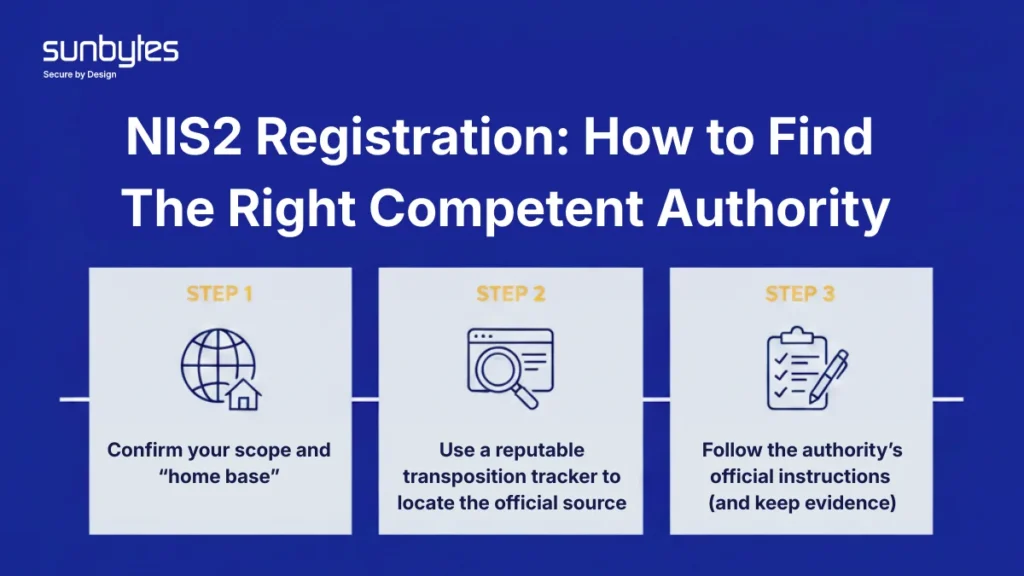
Step 1: Confirm your scope and “home base”
Start with the simplest question: are you in scope—and under which country’s supervision are you most likely to fall?
If you’re not sure, don’t guess. Use the scope test first: check if NIS2 applies to your organisation.
Step 2: Use a reputable transposition tracker to locate the official source
Instead of relying on random blog posts, use a reputable tracker to find the correct national references (competent authorities, implementation status, pointers to official pages).
(We include suggested resources at the end of this article.)
Step 3: Follow the authority’s official instructions (and keep evidence)
Once you land on the official authority source, follow their latest instructions—and keep a simple internal record of:
- when you checked,
- what version/date the guidance was,
- and what you submitted (or attempted to submit).
That small evidence trail becomes useful later if rules change or questions come up.
The big misconception: “Registration = compliance”
It’s an understandable assumption. You “register,” you’re done. Except… you’re not. Registration is usually administrative. The heavier lift is building operational readiness:
- Article 21 is about baseline risk management measures—policies, controls, governance, supplier risk, monitoring, and the evidence that proves you actually run them. See: Article 21 security measures in plain English.
- Article 23 is about being ready to report significant incidents fast—especially under pressure. See: NIS2 incident reporting (Article 23): the 24–72–30 playbook.
- For an end-to-end view, start from the hub: NIS2 readiness checklist for EU SMEs.
If your aim is business confidence (and not just paperwork), that’s where the real work lives.
Want clarity without turning this into a legal project?
We won’t pretend to be your filing agent. But we can help you confirm scope, align your security measures with NIS2 expectations, and build the evidence you’ll need if supervision or incidents happen
Bullets:
- Scope confirmation and practical readiness roadmap
- Evidence-first implementation aligned to Article 21 and Article 2

• ISO 27001-minded delivery process • GDPR-aware by design • Experience supporting ISO 27001
About Sunbytes: Transform · Secure · Accelerate
Sunbytes is built around three pillars that strengthen each other:
- Transform: We help teams modernise products and delivery—so growth doesn’t come with hidden fragility.
- Secure: We make cybersecurity practical and operational, so risk management becomes part of how you deliver.
- Accelerate: We help organisations scale with the right people and systems, so speed doesn’t trade off against quality or compliance.
Together, these pillars help you go beyond “registration” into real-world readiness—where trust is earned under pressure.
FAQs
In practice, many Member States use some form of entity listing or identification process. The exact mechanism differs by country, so always rely on your national competent authority’s guidance.
Because NIS2 is a directive. Each Member State transposes it into national law and operational processes, including which authorities run supervision and portals.
Typically high-level organisation details, sector mapping, and incident contact points. The exact fields depend on national implementation.
No. Registration is usually administrative. Most compliance effort sits in operational measures (Article 21) and incident readiness (Article 23). Start from NIS2 readiness checklist for EU SMEs.
Start with scope first: check if NIS2 applies to your organisation.
Let’s start with Sunbytes
Let us know your requirements for the team and we will contact you right away.