

Traditional hiring can’t keep up with today’s delivery pressure—skills are scarce, timelines are tight, and business priorities shift faster than recruitment cycles. As a result, leaders are forced to choose between slowing down, overloading internal teams, or experimenting with alternative hiring models that may dilute control. Staff augmentation has emerged as a popular option, but its real value—and its real risks—are often misunderstood when compared to in-house hiring or outsourcing.
This article will walk you through how staff augmentation works, its key pros and cons, how it compares to other hiring models, and when it makes sense—or doesn’t—for your business.
TL;DR
- Staff augmentation extends internal teams with external specialists, allowing companies to scale skills and capacity without outsourcing control or ownership.
- The main advantages are speed, flexibility, and cost efficiency, especially for filling skill gaps, accelerating delivery, and avoiding long-term hiring commitments.
- The key risks include integration challenges, management overhead, and security concerns, which require strong leadership, onboarding, and governance to mitigate.
- Staff augmentation is most effective for time-bound needs, scarce expertise, and fast-moving initiatives, and works best when organizations have clear ownership and management readiness.
How Does Staff Augmentation Actually Work in Practice?
Staff augmentation allows companies to add external specialists directly into their internal teams, rather than outsourcing delivery to a third party. These professionals work under the client’s leadership, processes, and tooling, giving businesses the flexibility to scale skills and capacity while maintaining full control over priorities, quality, and outcomes.
For a deeper, end-to-end explanation of the model, you can read our IT Staff Augmentation: A Complete Guide for Businesses.
What Are the Key Pros of Staff Augmentation?
When delivery pressure increases, the real advantage of staff augmentation isn’t just flexibility—it’s control without delay. Used well, it allows leaders to move faster without locking the business into long-term commitments or surrendering ownership.
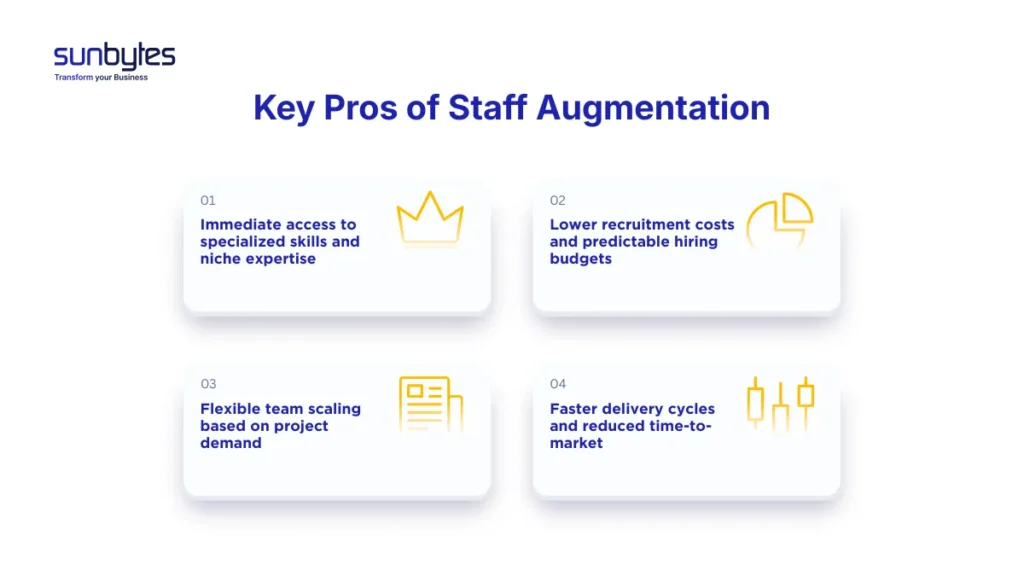
Immediate access to specialized skills and niche expertise
Staff augmentation enables companies to bring in specific expertise exactly when it’s needed, without waiting months for permanent hires. This is especially valuable for senior or hard-to-find roles such as cloud architects, cybersecurity specialists, data engineers, or legacy system experts. Teams gain capability instantly, without reshaping the entire organization.
Example: A fintech scaling its platform may need a senior cloud security engineer for six months to meet compliance requirements—without needing that role long term.
How to leverage this benefit
- Use staff augmentation for hard-to-hire or short-term specialist roles
- Prioritize senior profiles who can contribute with minimal ramp-up
- Pair augmented experts with internal staff to accelerate knowledge transfer
Lower recruitment costs and predictable hiring budgets
Compared to full-time hiring, staff augmentation reduces recruitment friction and long-term financial exposure. There are no permanent payroll obligations, benefits, or severance risks, making costs easier to forecast and control. For leaders managing tight budgets, this predictability is often as important as speed.
Example: Instead of hiring five full-time developers for a transformation project, a company augments its team for 9–12 months and scales down once delivery stabilizes.
How to leverage this benefit
- Use staff augmentation for project-based or uncertain workloads
- Budget based on total delivery cost, not just hourly rates
- Regularly review performance to decide whether to extend or reduce roles
Flexible team scaling based on project demand
Staff augmentation allows teams to scale up during peak workloads and scale down when priorities shift. This flexibility is well-suited for MVP development, platform migrations, and digital transformation phases where capacity needs fluctuate. The organization stays lean while delivery momentum is maintained.
Example: A product team increases QA and frontend capacity ahead of a major release, then reduces the team once the launch stabilizes.
How to leverage this benefit
- Align team size with delivery milestones, not headcount targets
- Define clear entry and exit criteria for augmented roles
- Keep internal teams focused on core, long-term responsibilities
Faster delivery cycles and reduced time-to-market
By removing lengthy hiring cycles, augmented teams can start contributing within weeks rather than months. This accelerates execution, reduces bottlenecks in critical projects, and helps businesses respond faster to market changes—without overloading internal teams.
Example: A scale-up uses staff augmentation to accelerate MVP development, validate the product faster, and avoid missing a market window.
How to leverage this benefit
- Prepare onboarding materials in advance to reduce ramp-up time
- Assign clear ownership to internal product and tech leads
- Focus augmented staff on delivery-critical tasks, not exploratory work
What Are the Main Cons of Staff Augmentation?
Staff augmentation is not a plug-and-play solution. Without the right structure and leadership, its disadvantages can quickly outweigh its benefits. Understanding these risks—and how to mitigate them—is essential before scaling with external talent.
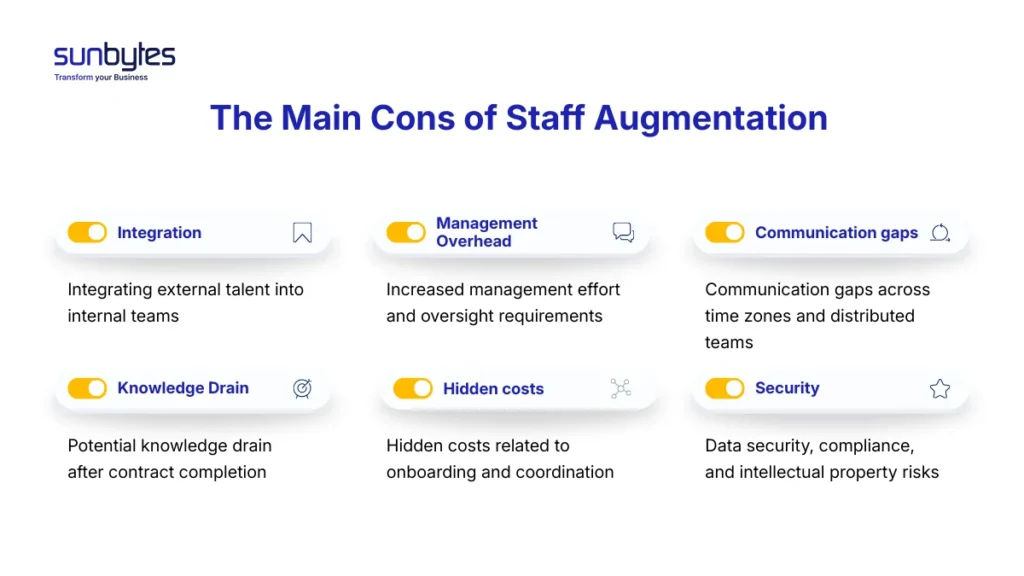
Challenges integrating external talent into internal teams
Augmented staff often join without full context—business domain, decision logic, or informal team dynamics. When integration is weak, productivity drops and internal teams slow down instead of speeding up.
Business impact
- Slower onboarding than expected
- Friction between internal and external contributors
- Reduced collaboration and ownership
How to address it
- Onboard augmented staff into the why behind the product, not just tasks
- Assign a clear internal counterpart responsible for alignment
- Integrate them into the same rituals, reviews, and communication loops as internal staff
Increased management effort and oversight requirements
Staff augmentation does not reduce leadership responsibility—it increases it. If internal product or engineering leadership is already stretched, augmented staff may lack direction and consistency.
Business impact
- Decision bottlenecks
- Inconsistent delivery quality
- Managers spending time coordinating instead of leading
How to address it
- Scale staff augmentation only when leadership capacity is in place
- Define ownership clearly: who decides, who reviews, who is accountable
- Focus performance management on outcomes, not hours worked
Communication gaps across time zones and distributed teams
Time zone differences and remote collaboration amplify unclear requirements and delayed feedback. Without strong communication discipline, small issues compound into delivery delays.
Business impact
- Longer feedback cycles
- Increased rework
- Reduced team velocity
How to address it
- Design workflows around asynchronous communication, not constant meetings
- Establish clear documentation standards for decisions and changes
- Ensure overlap hours for roles critical to delivery flow
Potential knowledge drain after contract completion
Augmented staff often take on critical technical responsibilities. If knowledge stays with individuals instead of being embedded in the team, continuity is at risk when contracts end.
Business impact
- Loss of technical or domain knowledge
- Increased dependency on external resources
- Slower transition to internal ownership
How to address it
- Require knowledge transfer as part of delivery, not an afterthought
- Pair augmented staff with internal team members
- Plan exits early and treat handover as a formal milestone
Hidden costs related to onboarding and coordination
While recruitment costs drop, internal time spent onboarding, aligning, and coordinating is often overlooked. This leads to unrealistic expectations around speed and ROI.
Business impact
- Slower-than-expected ramp-up
- Hidden internal costs
- Frustration from perceived underperformance
How to address it
- Account for onboarding time in delivery planning
- Reuse standardized onboarding playbooks
- Regularly reassess whether each role still delivers value
Data security, compliance, and intellectual property risks
Granting external access to systems and data increases risk, especially without clear controls. This is critical for regulated industries or IP-sensitive products.
Business impact
- Compliance violations
- IP leakage risk
- Reputational and legal exposure
How to address it
- Use strict access control and role-based permissions
- Define IP ownership and security obligations contractually
- Work only with partners that follow recognized security standards
How Does Staff Augmentation Compare to Other Hiring Models?
Staff augmentation vs in-house hiring
In-house hiring builds long-term internal capability, while staff augmentation prioritizes speed and flexibility without increasing permanent headcount.
Choose staff augmentation when
- You need skills or capacity now, not in 6–9 months
- The work is time-bound or demand is uncertain
- Hiring permanently would create long-term cost or risk
Choose in-house hiring when
- The capability is core to your business long term
- Cultural integration and retention are critical
- Delivery speed is less urgent than stability
If you’re weighing flexibility against long-term ownership, this deeper comparison on Dedicated Teams vs In-House Teams: Which Deliver Better ROI? breaks down cost, control, and delivery impact in more detail.
Staff augmentation vs project-based outsourcing
Staff augmentation keeps delivery ownership inside your team. Outsourcing moves responsibility for a defined scope to the provider. Use staff augmentation when priorities are still moving, architecture decisions need to stay internal, or knowledge retention matters. Use outsourcing when the scope, acceptance criteria, handover, and delivery accountability are clear enough for a vendor to own the outcome.
For a deeper ownership-by-ownership comparison, read our guide to IT staff augmentation vs outsourcing.
Staff augmentation vs managed services
Managed services focus on operational continuity, while staff augmentation supports change, growth, and development.
Choose staff augmentation when
- You’re building or evolving products and platforms
- Scope and direction will change over time
- You need hands-on expertise embedded in your team
Choose managed services when
- Workloads are stable and predictable
- Outcomes can be clearly defined in SLAs
- You want to reduce operational responsibility
For a broader perspective on when to choose staff augmentation, outsourcing, or managed services, this IT Outsourcing Models: How to Choose the Best Fit guide offers a clear decision framework.
See more: When to use IT Staff Augmentation
How Can You Implement Staff Augmentation Successfully?
Staff augmentation only works when it’s treated as a delivery model, not a hiring shortcut. The difference between success and frustration usually comes down to preparation, ownership, and governance.

Clear business objectives and role definitions
Companies start with “we need more developers” instead of defining what outcomes need to improve. This leads to misaligned roles and underutilized talent.
What successful teams do
- Define business and delivery outcomes before defining roles
- Translate outcomes into clear responsibilities (not generic job titles)
- Decide upfront what augmented staff will own, support, or hand over
If outcomes aren’t clear internally, adding external capacity will amplify confusion—not speed.
Careful vendor selection and technical vetting
Vendor selection focuses on rates and speed, while technical depth, communication quality, and delivery maturity are underweighted.
What successful teams do
- Vet for problem-solving ability, not just CVs
- Assess how candidates communicate trade-offs and risks
- Choose partners with experience operating inside client-led teams
You’re not buying capacity—you’re extending your execution capability. Treat vendor selection accordingly.
Structured onboarding and team alignment
Augmented staff are expected to “figure things out” on their own, slowing productivity and creating unnecessary friction.
What successful teams do
- Prepare onboarding materials before day one
- Align on tools, workflows, coding standards, and decision paths
- Introduce augmented staff to the context behind priorities, not just tasks
Every week lost to poor onboarding is a week where staff augmentation delivers negative ROI. This guide on How to Successfully Onboard a Dedicated Team outlines a practical, step-by-step approach that also applies to staff augmentation.
Performance tracking and delivery governance
Performance is measured by hours logged rather than outcomes delivered, leading to activity without impact.
What successful teams do
- Track delivery metrics that matter: velocity, quality, cycle time
- Run regular reviews tied to milestones and objectives
- Address performance gaps early, not at contract renewal
Staff augmentation demands more clarity, not less, around accountability.
Legal, compliance, and security safeguards
Security and compliance are treated as legal formalities instead of operational requirements.
What successful teams do
- Define IP ownership, NDAs, and termination clauses clearly
- Apply role-based access to systems and data
- Work with partners that align with your security and compliance standards
The more integrated augmented staff are, the more intentional security governance must be.
For a broader view on governance and control, Staff Augmentation Best Practices: How Leaders Scale Teams Without Losing Control explains how experienced organizations manage risk while scaling delivery.
What Does the Future of Staff Augmentation Look Like Beyond 2026?
Staff augmentation is evolving from a tactical staffing option into a strategic workforce model. Beyond 2026, its value will be defined less by cost arbitrage and more by how well organizations integrate external talent into long-term delivery and governance models.
AI-driven talent matching and skills forecasting
The way companies source talent is shifting from reactive hiring to predictive capability planning. AI-enabled platforms are increasingly used to match skills, seniority, and domain experience to real delivery needs.
What this means for leaders
- Faster access to the right expertise, not just available profiles
- Better alignment between skills and project risk
- Less reliance on trial-and-error staffing
Increased demand for hybrid and remote augmentation models
Remote work has normalized distributed teams, but the future lies in hybrid augmentation models—combining onshore leadership with nearshore or offshore execution.
What this means for leaders
- Greater flexibility in team composition
- Stronger emphasis on communication, documentation, and governance
- Location matters less than delivery maturity and reliability
Stronger focus on security, compliance, and IP protection
As augmented staff become more deeply embedded in core systems, security and compliance will move from legal checklists to operational design principles.
What this means for leaders
- More rigorous access controls and monitoring
- Clearer accountability for IP ownership and data protection
- Preference for partners with proven security and compliance practices
How Do You Decide If Staff Augmentation Is Right for Your Business?
Staff augmentation is neither a default choice nor a silver bullet. It works best when the organization is ready to lead delivery, not outsource responsibility. The questions below help determine whether the model fits your current situation.
- Do you have internal product/tech leadership? Staff augmentation assumes that direction comes from inside the organization. If product ownership, architecture decisions, or delivery priorities are unclear, adding external talent will amplify confusion rather than solve it.
- Is the need temporary or permanent? The model is designed for time-bound or variable demand, not permanent capability building. Staff augmentation is a good fit if you need skills for a defined period or your demand fluctuates over time
- How critical is speed vs control? Staff augmentation is most valuable when speed matters, but control cannot be compromised. Consider staff augmentation if speed matters more than direct control as well as scope is fixed and outcomes can be delegated.
- Can your organization manage external contributors effectively? Augmented staff succeed when they are actively integrated and managed, not treated as plug-and-play resources. If your teams can onboard, align, and collaborate effectively or you have governance processes in place, staff augmentation is a good fit.
Ready to Strengthen Your Team with Staff Augmentation?
By this point, it should be clear that staff augmentation is not about hiring faster—it’s about scaling delivery without losing control. When applied with the right structure, leadership, and governance, it becomes a powerful way to move quickly while protecting quality, security, and long-term ownership.
The most successful teams treat staff augmentation as part of a broader delivery strategy, adapting the model as their needs evolve—from short-term capacity boosts to more stable, long-term team setups when continuity becomes critical.
If you’re curious how this transition works in practice, see how TeamViewer scaled from staff augmentation to a dedicated team—and what changed along the way.
Why Sunbytes?
Sunbytes is a Dutch technology company headquartered in the Netherlands, with a delivery hub in Vietnam, supporting clients globally for over 14 years. We help organizations turn strategy into execution by combining strong engineering, practical security, and flexible workforce models without losing control over delivery.
- Our approach to Digital Transformation focuses on building and modernizing digital products with senior, delivery-driven engineering teams across custom development, QA/testing, and long-term support.
- Cybersecurity is embedded into how we work, helping clients reduce risk and meet compliance requirements without slowing down delivery.
- Through Accelerate Workforce, we support growth with scalable team and talent solutions—making staff augmentation a controlled, outcome-focused extension of internal teams rather than a short-term fix.
Evaluating staff augmentation or other scaling models and wanting an objective view on what fits your delivery goals? Get in touch with Sunbytes for a focused, no-obligation conversation.