

Legacy systems rarely fail overnight, but they quietly drain speed, inflate costs, and limit your ability to compete. In fact, CIOs estimate that technical debt can account for 20–40% of the total value of their technology estate. What once supported your growth now slows every release, turning innovation into a negotiation between risk and resources. The longer this gap persists, the more technical debt compounds, reducing agility while increasing the cost of change. Application modernization shifts that equation, transforming rigid systems into scalable, high-velocity platforms built for continuous delivery.
This article will talk about how application modernization reduces technical debt, the key methods behind it, and a practical roadmap to help you regain speed, control, and long-term scalability.
TL;DR
- Application modernization reduces technical debt by replacing high-maintenance legacy code with agile, automated, and scalable architectures.
- There are 5 ways to Mitigate Debt through app modernisation: Cloud-Native Refactoring, Code Optimization, Tech Stack Alignment, DevSecOps Automation, and Data Architecture.
- The 6-Step Modernization Roadmap covers from Assessment, Planning, Execution, Communication, Validation to Governance.
- Ready to stop paying interest on your legacy systems? Sunbytes provides expert-led application modernization services to help you identify, prioritize, and eliminate technical debt.
If you’re still building your foundation on these topics, we recommend starting with our core definitions. Our deep dives into What is technical debt and App Modernization Explained provide the essential context for the roadmap below.

Why can app modernisation reduce technical debt?
Application modernization reduces technical debt because it eliminates the root causes, not just the symptoms. Legacy systems are often tightly coupled, outdated, and hard to maintain, so every change adds more complexity and cost.
By modernizing, you replace or refactor high-maintenance components into modular, scalable architectures. This makes systems easier to update, test, and extend, reducing the effort required for every future change. It also shifts teams away from constant maintenance. In many enterprises, up to 70–80% of IT budgets are spent just keeping legacy systems running, leaving limited room for innovation. Instead of spending most of their time fixing legacy issues, they can focus on building new features, reducing the ongoing “interest” of technical debt.
Finally, modernization aligns your tech stack with current standards, ensuring better performance, lower risk, and long-term maintainability, so new debt grows slower and stays under control.
What are 5 ways that application modernization reduces technical debt?

Application modernization reduces technical debt by systematically removing the structural, technological, and operational constraints that make systems hard to change. Instead of incremental fixes, it redefines how the system is built, deployed, and scaled, so debt doesn’t keep compounding. Here are five high-impact ways this happens:
1. Cloud-Native Refactoring & Infrastructure Modernization
Legacy systems often rely on on-premise infrastructure and monolithic architectures that are expensive to maintain and difficult to scale. Every upgrade or change requires significant coordination, increasing both risk and cost.
Modernization shifts these systems to cloud-native architectures (e.g., microservices, containers). This decouples components, allowing teams to update or scale parts of the system independently. As a result:
- Infrastructure-related constraints are removed
- Downtime and deployment risks are reduced
- Scaling no longer requires system-wide changes
Technical debt tied to infrastructure rigidity is eliminated at its core.
2. Code Optimization and Refactoring
Over time, legacy codebases become cluttered with quick fixes, inconsistent logic, and outdated patterns. This “spaghetti code” slows down development and increases the likelihood of defects. Modernization focuses on cleaning and restructuring the codebase:
- Breaking large code blocks into modular components
- Standardizing coding practices
- Removing redundant or unused logic
This leads to:
- Faster development cycles
- Easier debugging and testing
- Lower maintenance overhead
Clean, modular code reduces both existing debt and the risk of introducing new debt.
3. Technology Stack Alignment
Outdated technologies such as unsupported frameworks or legacy languages, create long-term risks. They limit hiring options, reduce compatibility with modern tools, and increase security vulnerabilities.
Modernization replaces these with current, well-supported technologies:
- Actively maintained frameworks
- Scalable backend and frontend stacks
- Tools that integrate with modern ecosystems
The impact:
- Improved system performance and security
- Easier integration with third-party services
- Access to a larger talent pool
This removes “obsolescence debt” and ensures the system remains viable long-term.
4. Automating the Pipeline (DevSecOps)
Manual deployment, testing, and security processes are a major source of hidden technical debt. They introduce inconsistencies, slow down releases, and increase the chance of human error. Modernization implements DevSecOps practices, including:
- Continuous Integration / Continuous Deployment (CI/CD)
- Automated testing and code quality checks
- Integrated security scanning
This results in:
- Faster, more reliable releases
- Early detection of bugs and vulnerabilities
- Consistent development standards across teams
Automation prevents new technical debt from accumulating during the development lifecycle.
5. Data Architecture Modernization
Legacy systems often rely on siloed, rigid databases that are difficult to scale and integrate. Data inconsistencies and limited accessibility create bottlenecks across the organization.
Modernization transforms this into flexible, scalable data architectures:
- Migration to cloud-based databases, data lakes, or NoSQL solutions
- Improved data integration and accessibility
- Real-time data processing capabilities
The outcome:
- Better decision-making through accessible data
- Reduced complexity in data management
- Systems that can scale with business growth
Data-related technical debt is reduced by making information structured, accessible, and adaptable.
In essence, application modernization doesn’t just reduce technical debt. It changes the system so that debt becomes easier to manage, slower to accumulate, and far less expensive over time.
What is the process of modernising applications to reduce Technical Debt?
Reducing technical debt through modernization requires a structured, end-to-end approach. Without a structured approach, organizations risk continuously diverting resources, often over 20% of their technology budget, just to manage existing debt instead of building new capabilities.
Here’s a proven 6-step process:
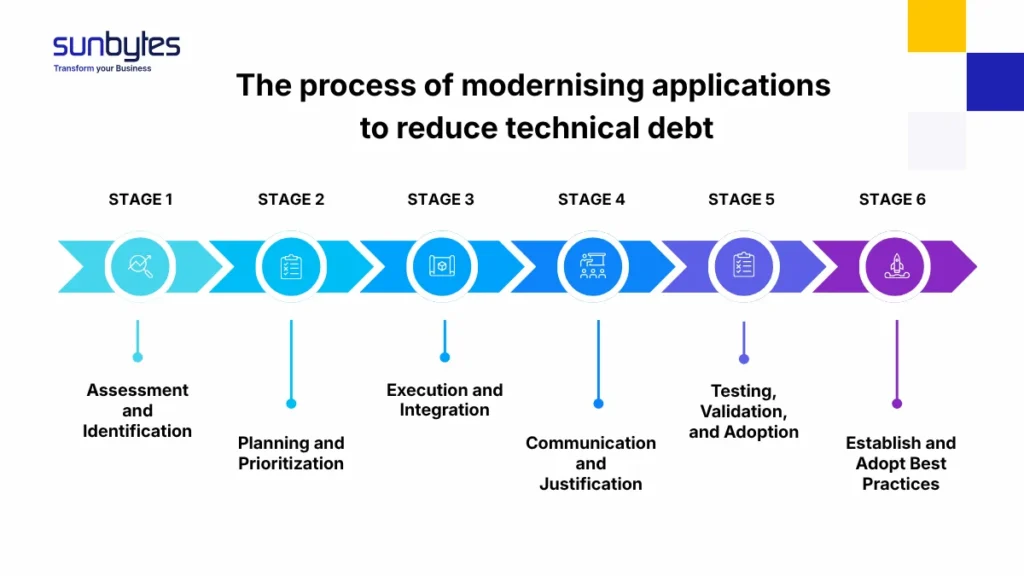
Step 1: Assessment and Identification
Start by making technical debt visible. Most organizations underestimate how much debt exists and where it impacts the business.This step focuses on:
- Auditing legacy systems, code quality, and architecture
- Identifying bottlenecks (performance, scalability, security)
- Mapping technical issues to business impact (cost, delays, risk)
The outcome is a clear view of where debt is concentrated and how “expensive” it is.
Step 2: Planning and Prioritization
Not all technical debt should be addressed at once. Some areas deliver far higher ROI when modernized. At this step, the teams need to:
- Prioritize systems based on business criticality
- Decide the right approach (refactor, replatform, rebuild, replace)
- Define timelines, resources, and expected outcomes
This ensures modernization efforts are strategic, not reactive.
Step 3: Execution and Integration
This is where modernization happens, incrementally, not all at once. Key actions include:
- Refactoring or rebuilding components
- Migrating to cloud or modern infrastructure
- Integrating new services with existing systems
The focus is on reducing risk while delivering continuous improvements, rather than large, disruptive overhauls.
Step 4: Communication and Justification
Modernization often requires alignment across technical and business stakeholders. This step ensures:
- Clear communication of goals, progress, and impact
- Justification of investment based on ROI and risk reduction
- Alignment between engineering, product, and leadership
Without this, modernization efforts can stall or lose priority.
Step 5: Testing, Validation, and Adoption
Modernized systems must be stable, secure, and usable. Teams validate by:
- Running automated and manual tests
- Ensuring performance and security standards
- Supporting user adoption and internal onboarding
This guarantees that technical improvements translate into real operational value.
H3: Step 6: Establish and Adopt Best Practices
Modernization is not a one-time project—it’s a shift in how systems are built and maintained. This final step focuses on:
- Implementing coding standards and architectural guidelines
- Adopting DevSecOps and continuous delivery practices
- Setting governance to prevent future technical debt
The goal is to control and minimize debt moving forward, not just reduce what already exists.
In practice, successful modernization is continuous. The organizations that move fastest are those that treat technical debt as a managed asset, systematically reduced, continuously monitored, and prevented from slowing down future growth.
Reduce Technical Debt with Subytes
At Sunbytes, we start by identifying high-impact debt across your systems, mapping it directly to delivery delays, operational risk, and scalability limits. From there, we design a modernization approach that prioritizes what matters most, so you reduce complexity without disrupting ongoing development.
We also help you build a sustainable model to manage technical debt long-term. This includes setting up dedicated teams, such as Fix-it or Platform Teams, to continuously improve system stability and performance, while your core teams stay focused on growth. The result is a more balanced engineering effort, where technical debt no longer adds hidden costs or slows down innovation, but is actively managed as part of your scaling strategy.
Why Sunbytes?
Sunbytes is a Dutch technology company with a strong delivery hub in Vietnam, bringing over 15 years of experience helping global organizations transform, secure, and accelerate their digital systems. We don’t approach modernization as a one-off project—we combine strategy, execution, and long-term capability building to ensure your systems stay scalable, secure, and ready for growth.
Our approach is built around three core pillars:
- Digital Transformation Solutions: We design, build, and modernize digital products with senior engineering teams—covering everything from custom development to QA, maintenance, and continuous improvement.
- CyberSecurity Solutions: We embed security into every stage of modernization, helping you reduce risk and meet compliance requirements without slowing down delivery.
- Accelerate Workforce Solutions: We scale your capabilities with the right talent and team structures, ensuring you have the capacity to modernize effectively while maintaining business momentum.
Ready to reduce technical debt and accelerate your product delivery? Contact Sunbytes to explore how we can support your modernization journey.