
Learning and development (L&D) is the organizational function responsible for building employee capability, supporting career progression, and creating the conditions for people to grow within the company rather than leave it. When structured as a strategy rather than a catalog of courses, it reduces attrition, strengthens recruitment, and builds the internal talent pipeline that sustainable growth depends on.
This guide covers what an effective L&D function looks like, how it connects directly to recruitment and retention outcomes, and what international companies managing teams need to know to build one that actually works.
TL;DR
- L&D strategy reduces attrition by giving employees a visible reason to stay. Companies with structured L&D functions retain employees twice as long and fill more roles internally, reducing the cost and disruption of external hiring.
- L&D is now a recruitment tool. Candidates in 2026 evaluate career growth infrastructure before they evaluate compensation. A company that can not show a credible development path loses offers to those that can.
- L&D needs to be built into the employment structure from day one: onboarding, performance reviews, and career pathway documentation. Structured programs that connect to promotion criteria are the ones employees actually use.
What is learning and development in HR?
“Learning and development in HR is the strategic function that designs, delivers, and measures programs that build employee skills, support career growth, and align workforce capability with organizational goals. It is distinct from training in scope and intent.”
L&D vs training: Why the distinction changes everything
Training is a one-time event with a defined endpoint: a new employee learns the software, a team completes a compliance module, and a manager attends a leadership workshop. L&D program is an ongoing system that connects skill development to career progression, organizational strategy, and retention outcomes.
The distinction matters because organizations that run training programs without an L&D strategy get compliance completion rates but not capability growth. They spend the budget and see no retention impact because the programs are not connected to anything the employee cares about: their growth, their career, their future at the company.
L&D program investment without career pathway documentation is training spend, not retention spend. Employees need to be able to draw a line from what they are learning to where it takes them. Without that line, the learning does not signal organizational investment. It signals box-checking.
The three core goals of an L&D function
A structured L&D program function serves three distinct goals, each measurable independently. The first is skill building: ensuring employees have the technical and behavioral capabilities their current role requires. The second is culture: using learning programs to reinforce the behaviors and values the organization claims to hold. The third is retention: giving employees a visible reason to stay.
Your L&D program likely covers skill-building adequately. Culture and retention are where most programs stop delivering. This is why most L&D program investments do not move retention metrics.
Why L&D is no longer a cost center but a retention investment
Replacing a mid-level employee costs between 50 and 200 percent of their annual salary when recruitment, onboarding, and productivity ramp-up are included. A structured L&D program that delays attrition by 12 months pays for itself in replacement cost savings alone, before any productivity or cultural benefit is counted.
The framing that treats L&D as a budget line to be cut during downturns misunderstands the math. When L&D program investment drops, attrition climbs, and attrition is significantly more expensive than the L&D budget that was cut.
For companies looking at how leadership capability connects to succession and retention, the guide to a leadership development program explains how structured manager development directly feeds into organizational stability.
Why learning and development directly impacts recruitment
L&D for recruitment is not about listing “training opportunities” in job postings. It is about building a credible, visible development infrastructure that candidates can evaluate before they accept an offer. In 2026, that infrastructure is a differentiator.

L&D as employer branding: what candidates look for in 2026
Candidates in 2026 evaluate career growth infrastructure before they evaluate job titles. This is particularly true for mid-level and senior candidates, who have enough career experience to know that a company that can not show how people grow is a company where they will not grow. They evaluate L&D strategy during the interview process, not after joining.
The signals candidates look for are specific: can the interviewer describe how someone in this role has advanced? Are there documented learning pathways? Has the company invested in external certifications or advanced training for existing employees? Generic answers about “a culture of learning” are no longer sufficient.
How visible career paths reduce time-to-fill and improve offer acceptance
Time-to-fill and offer acceptance rate are the two recruitment metrics most directly affected by L&D program visibility. When candidates can see a clear career path from the role they are being offered to the role they want in three years, conversion at the offer stage increases. When they can not, they hedge by keeping other processes open, and offer acceptance rates drop.
Organizations with documented career ladders and active internal mobility programs fill senior roles 40 percent faster than those without, because they surface internal candidates who already know the organization, reducing the external recruitment cycle for positions above entry level.
Hiring for potential vs hiring for skills: the L&D-enabled approach
An organization with a strong learning and development strategy can hire for potential and develop for skill. One without it must hire fully formed candidates, which narrows the talent pool and increases the compensation required to attract candidates who arrive with everything the role needs. The L&D-enabled approach reaches candidates who are not yet qualified but will be, and who choose this organization because it will get them there.
For companies hiring in Vietnam, this distinction is operationally significant. The Vietnam talent market has strong technical foundations in engineering and finance but a shortage of candidates with specific domain expertise in some sectors. Hiring for potential with a credible L&D program accesses a significantly larger pool than hiring for fully formed expertise.
How to weave L&D into job descriptions, interviews, and EVP
L&D should appear in three places in the recruitment process.
- In the job description: One paragraph describing specifically what development looks like in this role and in the first year, not a general statement about the company’s commitment to learning.
- In the interview: A question from the candidate about development should prompt a specific, evidenced answer, not a generic one.
- In the EVP: Development is positioned alongside compensation and flexibility as a concrete offering with examples.
Succession planning is the organizational outcome that L&D investment makes possible. The guide to succession planning connects learning investment to leadership pipeline development at the organizational level.
How L&D programs improve employee retention
Employee retention is strongly influenced by how much opportunity people have to learn, grow, and advance within an organization.
The data: Companies with strong learning cultures retain employees twice as long
LinkedIn’s Workplace Learning Report consistently shows that employees in companies with strong learning cultures stay almost twice as long as those in companies without. Learning and development for employee retention works through a specific mechanism: not the learning content itself, but what the learning investment signals: that the organization is committed to the employee’s future, not just their current output.
The retention effect of L&D is strongest among high performers, which is precisely the population that organizations can least afford to lose. High performers have the external options that low performers do not. They stay where they can grow, and they leave when growth stalls.
Upskilling and reskilling as alternatives to external hiring
Upskilling and reskilling workforce programs are the most cost-effective talent acquisition strategy available to most organizations. The cost of developing an existing employee into a more senior or different role is consistently lower than the cost of recruiting externally, even when training investment is included.
Upskilling existing employees in high-demand skills such as data analysis, technical project management, or advanced engineering disciplines reduces dependence on a competitive external talent market. Companies that invest in internal development compete less intensely for the same senior profiles that everyone else is recruiting.
Internal mobility: How L&D enables promotion from within
Internal mobility is the organizational practice of filling open roles with current employees through promotion or lateral movement. It is one of the strongest retention mechanisms available, because it signals that the company sees and invests in long-term potential. Organizations with active internal mobility programs see 41 percent lower attrition than those that primarily recruit externally.
L&D enables internal mobility by building the capabilities that employees need to qualify for the next role. Without structured development, internal candidates are perpetually underprepared, and roles get filled externally by default. That external hiring pattern sends a visible signal to existing employees: growth here requires leaving.
The first 90 days: Why L&D investment at onboarding drives long-term retention
Employees who experience structured development in the first 90 days, not just compliance training but genuine role-relevant learning, show significantly higher one-year retention rates than those who do not.
The onboarding L&D signal is not about volume of learning. It is about specificity and connection. A new employee who leaves their first 90 days with a clear development plan, a named learning pathway, and at least one completed development milestone has evidence that the organization is invested in their future. That evidence anchors retention.
The downstream organizational impact of L&D investment on succession readiness is examined in detail in the guide to the impact of succession planning, which quantifies how internal development reduces leadership vulnerability.
Types of learning and development programs
L&D programs for employees are not one format. The most effective learning and development strategies combine three learning types in proportions calibrated to the organization’s structure, culture, and pace of change.
Formal learning: structured courses, certifications, and external programs
Formal learning is the structured, intentional component: courses, certifications, external workshops, and degree programs. It is the component most organizations over-invest in relative to its retention impact. Formal learning builds specific, verifiable skills and credentials that improve employability. And makes it valuable for attraction and for filling defined skill gaps.
The limitation of formal learning as a primary L&D mechanism is that it is disconnected from daily work. Completion rates for formal programs that are not embedded in the workday are consistently low, and retention of content without application decays quickly. Formal learning works when it is connected to a specific role challenge the employee is currently facing.
Social learning: mentoring, coaching, and peer-to-peer development
Social learning is the development that happens through human interaction: mentoring relationships, coaching conversations, peer feedback, and collaborative problem-solving. Research consistently shows that social learning drives deeper capability development than formal learning alone, because it is embedded in real work context and relationships.
For distributed teams, social learning requires more deliberate design than it does in co-located environments. Mentoring programs need to be structured with clear expectations and meeting cadence. Peer learning communities need a designated space and facilitation. Without deliberate structure, social learning happens only for employees with the strongest networks, which typically means the most senior or co-located ones.
Experiential learning: stretch assignments, rotations, and project-based growth
Experiential learning is the most effective component of the 70-20-10 model and the most underused. Stretch assignments, cross-functional projects, temporary rotations into other roles, and leadership of significant initiatives build capabilities that no formal course replicates, because they require applying judgment in real situations with real consequences.
For international companies with teams in Vietnam, experiential learning is also the most powerful tool for increasing the visibility of high-performing Vietnamese employees within the global organization. A Vietnam-based developer who leads a cross-functional initiative with European stakeholders becomes visible in a way that completing an online certification does not achieve.
The 70-20-10 model applied to L&D program design
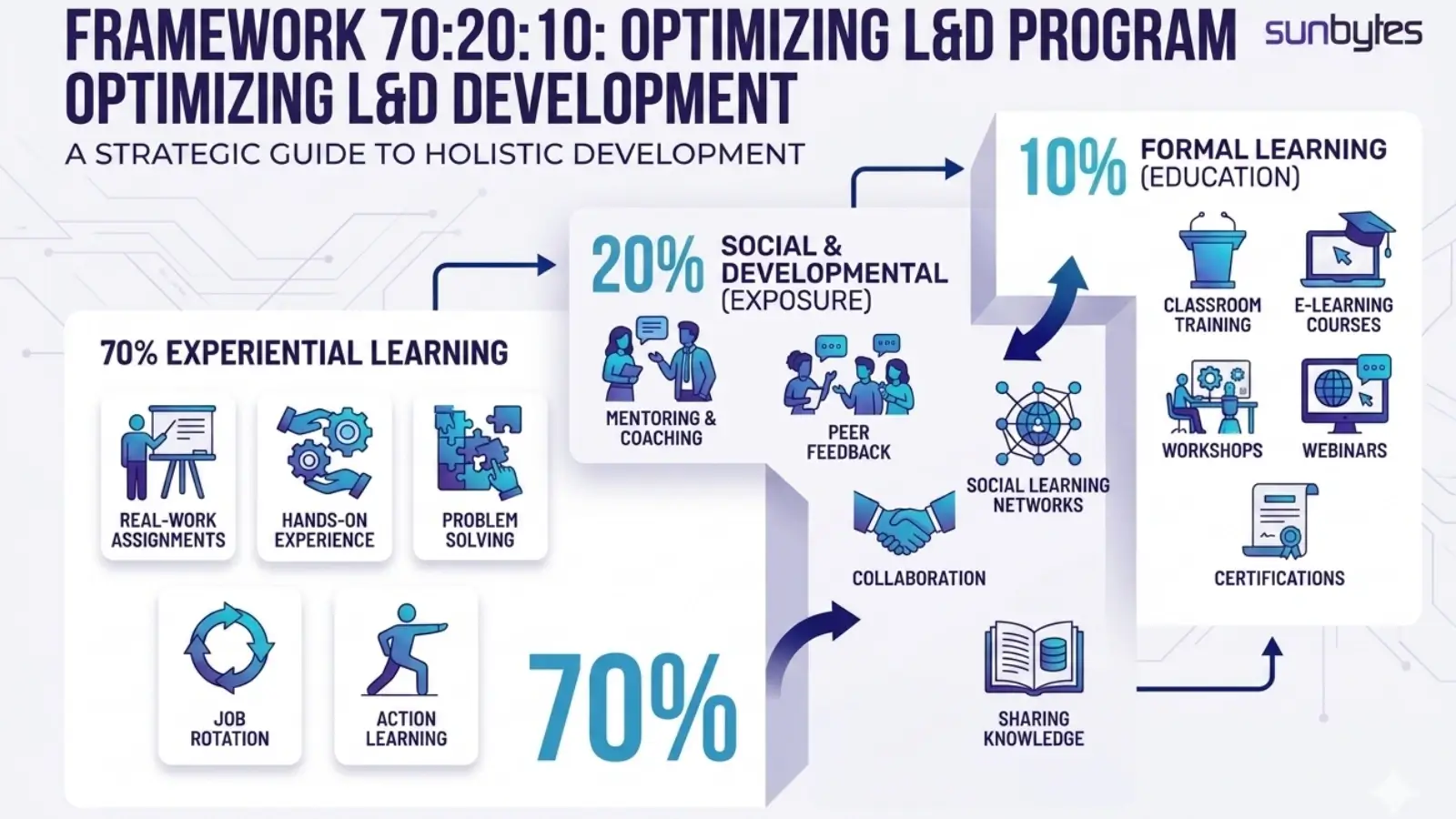
The 70-20-10 model is the standard framework for balancing learning types in an L&D strategy. Seventy percent of development should come from on-the-job experience, twenty percent from social learning, and ten percent from formal training. The model is not a rigid formula; it is a reminder that organizations that spend the majority of their L&D budget on formal training are investing in the least effective component of the learning mix.
| Learning type | Share of development | Examples | Primary benefit |
|---|---|---|---|
| Experiential | 70% | Stretch assignments, rotations, cross-functional projects | Deepest capability development, highest retention signal |
| Social | 20% | Mentoring, coaching, peer learning, feedback | Context-embedded, relationship-building |
| Formal | 10% | Courses, certifications, workshops | Verifiable credentials, specific skill gaps |
How to build an L&D strategy that works for recruitment and retention (5 Steps)
Building an effective employee development plan for an organization or team follows a defined sequence. Each step informs the next, and skipping early steps produces L&D programs that are well-designed but wrong for the context they are operating in.
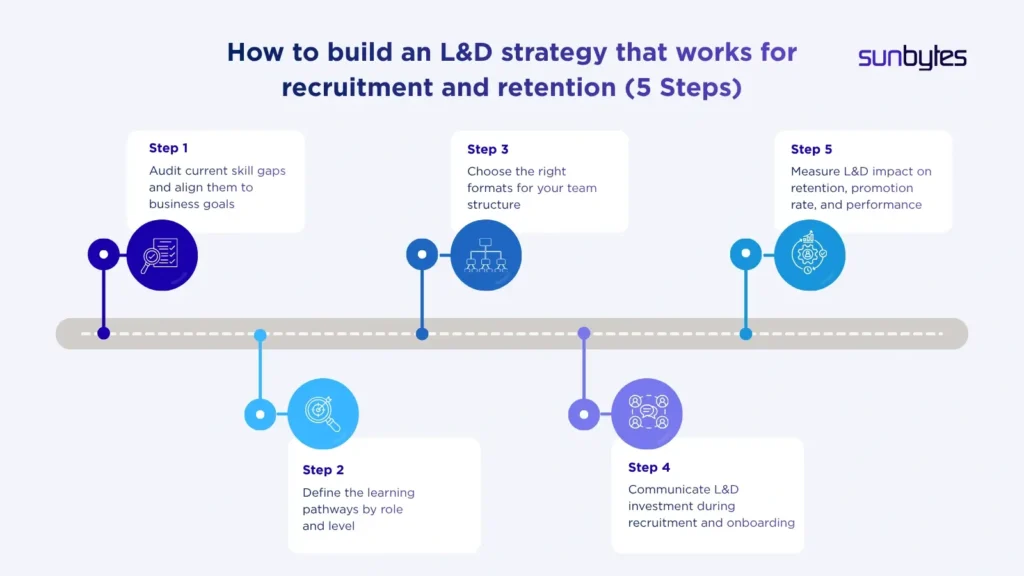
Step 1. Audit current skill gaps and align them to business goals
The skill gap audit is the foundation of every L&D strategy that actually changes outcomes. It identifies the distance between what the workforce can currently do and what it needs to do to meet the organization’s objectives over the next 12 to 24 months. Without this audit, L&D programs address what is easy to deliver rather than what the business needs.
The audit should cover three levels: individual role skills, team capability, and organizational leadership bench strength. For Vietnam-based teams, the audit should explicitly account for skills that are high in demand locally, such as technical capability, and skills that may need more development investment, such as cross-cultural communication for roles with international stakeholder exposure.
Step 2. Define the learning pathways by role and level
Learning pathways are the documented routes from one role or level to the next, with the specific skills, experiences, and milestones that each transition requires. They are the primary mechanism by which L&D connects to retention, because they make career visibility concrete and specific rather than abstract and promised.
Effective learning pathways are role-specific, not generic. A pathway for a junior software engineer to reach senior level should list the technical certifications, the types of projects, the mentoring relationships, and the leadership experiences that define the transition. A generic “take any three courses from our catalog” does not create the same retention signal.
Step 3. Choose the right formats for your team structure
Format selection follows from team structure, not from preference. A co-located team can use in-person workshops and spontaneous peer learning effectively. A remote or distributed team needs async learning content, structured mentoring with explicit meeting cadence, and virtual delivery for any synchronous components. The format that works for one team structure will underperform in another.
For international companies with Vietnam-based remote teams, format selection must account for timezone overlap, language of instruction, and the cultural preferences for learning that shape engagement. Self-paced content with clear milestones tends to outperform cohort-based programs in distributed environments where scheduling across timezones is operationally difficult.
Step 4. Communicate L&D investment during recruitment and onboarding
The L&D strategy only becomes a recruitment and retention tool when it is communicated clearly and specifically. In recruitment: interviewers should be able to describe the learning pathway for the open role, including the first-year development milestones, without referring to documentation. In onboarding: the new employee’s individual development plan should be ready before day one, not assembled during the probation period.
The goal of L&D communication during recruitment is not to impress candidates. It is to give them enough specific information to make an informed decision about joining. And the candidates who join with accurate expectations about their development trajectory stay longer than those who joined on optimistic assumptions that were never validated.
Step 5. Measure L&D impact on retention, promotion rate, and performance
Measuring learning and development ROI requires connecting learning activity data to business outcomes, not just completion rates. The three metrics that directly link L&D investment to organizational performance: attrition rate in the 12 months following program participation, internal promotion rate compared to external hiring rate, and performance rating distribution across employees with high versus low L&D engagement.
For teams in Vietnam where attrition has historically been a structural challenge in competitive sectors, the attrition metric is the most important. An L&D program that reduces annual attrition from 35 percent to 22 percent in a 20-person team saves the equivalent of 2.6 annual salaries in replacement costs per year, which justifies most L&D budgets independently.
With Sunbytes’ Employee of Record (EOR), onboarding is completed within 14 days, giving the L&D program a stable employment foundation from day one rather than months into the engagement.
For context on the full cost of turnover and how recruitment efficiency connects to L&D investment, the guide to recruitment costs provides the financial framework that makes the L&D ROI calculation concrete.
Learning and Development: What international companies should know
Companies hiring in Vietnam face a specific talent market context that shapes how L&D programs should be designed, communicated, and delivered. Understanding that context is what separates L&D programs that move retention metrics from those that sit in the policy folder.
Why L&D is a primary retention lever for professional talent
Vietnam has one of Southeast Asia’s most competitive professional talent markets, particularly in technology, finance, and engineering. Voluntary attrition in these sectors runs 20 to 35 percent annually in Hanoi and Ho Chi Minh City. Compensation alone does not retain in this environment, because the external market consistently offers comparable or better compensation to employees who choose to move.
What the external market can not offer as easily is organizational investment in an individual’s specific growth. An L&D program that connects to an employee’s documented career goal, delivered by a manager who references it in regular one-on-ones, creates a retention dynamic that salary matching can not replicate. It is the evidence of being seen, not just paid.
Designing L&D programs that employees actually use
Program completion rates are the primary indicator of whether an L&D program is designed correctly. Low completion rates are not a motivation problem; they are a design problem. Programs that employees actually use share three characteristics: they are directly relevant to the work the employee is doing right now, they are accessible in the time available within the workday, and they produce a visible credential or milestone that the organization explicitly recognizes.
For Vietnam-based distributed teams, accessibility means mobile-compatible delivery, content available in or translated to Vietnamese for employees whose working language preference is Vietnamese, and learning that fits within the workday rather than requiring overtime. Programs that require employees to invest personal time in organizational capability building generate resentment, not engagement.
Connecting L&D to performance, career progression, and compensation
The L&D program that produces the strongest retention outcomes is the one that connects explicitly to the employee’s compensation and promotion timeline. When learning and development program completion is a documented criterion for promotion eligibility, engagement and completion rates increase because the stakes are clear. Then, employees invest in learning when they can see what the investment returns.
This connection requires explicit policy: which L&D milestones are required for which transitions, what the timeline is, and who the decision maker is. Without that policy, L&D exists in a parallel system that feels optional, because it is.
How EOR structures support scalable L&D without a local entity
International companies using an Employer of Record to engage Vietnam-based employees can build L&D programs without establishing a local entity. The Employer of Record(EOR) handles the employment compliance, SHUI registration, and payroll infrastructure. The client company designs and delivers the L&D program. The two functions are operationally separate.
An L&D program only delivers retention outcomes when the employment infrastructure underneath it holds. Late payroll signals instability rather than investment. Missing contracts mean there is no documented career pathway. Incorrect SHUI registration means the employee has no legal protection in the role the company is developing them into.
When those conditions are in place, L&D spending reinforces trust. When they do not, L&D spend accelerates exits because the employee now possesses better skills and better options.
Building an L&D program for your Vietnam team?
Sunbytes helps international companies build compliant, scalable teams in Vietnam through EOR, staffing, and people operations support. From employment contract setup to SHUI registration and payroll compliance, we create the stable employment foundation on which L&D programs are built.
Explore Accelerate Workforce Solutions
How Sunbytes supports L&D ready teams in Vietnam
A learning and development strategy only works when employees are stable, properly compensated, and operating under a compliant employment structure. Administrative failures at the payroll or contract level erode the trust that L&D programs are designed to build.
Sunbytes creates the employment infrastructure that makes scalable L&D possible for international companies operating in Vietnam, without the cost and timeline of entity setup.
Why Sunbytes?
Founded in the Netherlands in 2011, Sunbytes has supported over 300 client projects across 20+ countries from its Ho Chi Minh City hub. We bring international operational standards and deep local knowledge of Vietnam’s labor market, compliance environment, and talent landscape.
Here is how we help:
- Digital Transformation Solutions – For technology teams where L&D is built around technical skills, certifications, and engineering growth paths, we source and onboard developers, engineers, and technical leads in Vietnam through a compliant employment structure that supports long-term development investment.
- CyberSecurity Solutions – Security teams require continuous L&D in a field where threats and compliance requirements change faster than annual training cycles can address. We help growing teams build security skill development into their operations from the team-building stage.
- Accelerate Workforce Solutions – Our EOR, Contractor of Record, payroll, and staffing services ensure employment contracts are compliant, SHUI contributions are correct, and payroll runs on time from day one. When the employment foundation is stable, managers can invest their attention in L&D and performance, not administrative repairs.