
Platform choice drives a significant share of your mobile app budget, often 30–40% of total development cost. It’s also a decision most teams make early, with limited data, and then spend the rest of the project adapting to. IOS, Android, or cross-platform is not just a technical preference. It changes how many engineers you need, how fast you can ship, how much rework you absorb, and how your product performs under real-world conditions. This guide explores the mobile app cost breakdown by platform and what you’re really paying for beyond the initial estimate.
TL;DR
A mobile app cost breakdown by platform shows how your budget changes across iOS, Android, cross-platform, and PWA builds. The real difference is not only build cost. Platform choice changes QA scope, team size, performance tuning, maintenance, and 3-year ownership.
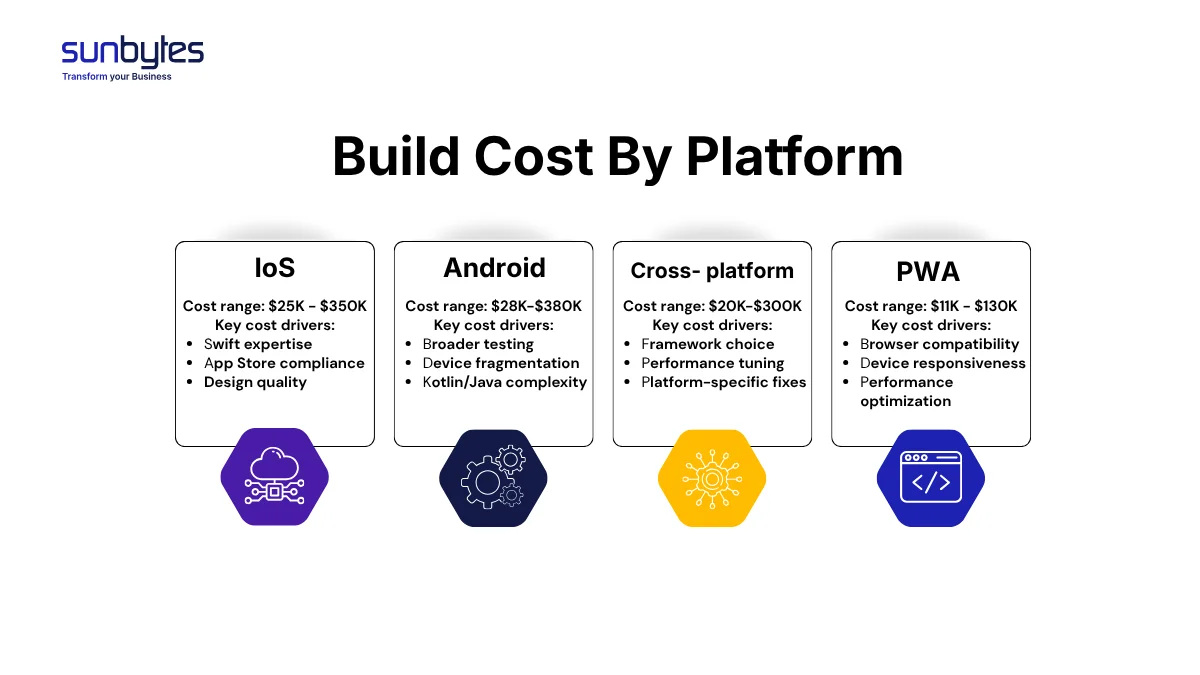
- iOS apps typically range from €23,000 to €322,000+, while Android apps range from €26,000 to €350,000+. Cross-platform development usually falls between €18,000 and €276,000+, with savings coming from reduced duplication.
- PWAs range from €10,000 to €120,000+ when full native functionality is not required, with the lowest 3-year TCO of any approach.
- Cross-platform usually lowers initial cost, but native can cost less over time when hardware access, performance, or platform-specific UX is central to the product.
Why platform choice changes your budget more than any other single decision
Platform choice doesn’t just affect how your app is built, it determines where time, effort, and budget accumulate throughout the project. The differences between iOS, Android, and cross-platform show up across four key areas:
Development time
Native development (iOS and Android separately) typically means building and maintaining two codebases. That increases initial timelines and team size.
Cross-platform frameworks reduce duplication by allowing teams to build shared features across iOS and Android from a common codebase. In Sunbytes delivery estimates, that usually means 70–90% of product code can be shared when the app has limited native hardware dependency.
Testing scope
Each platform introduces its own testing complexity.
With native apps, you test separately for iOS and Android environments with different devices, OS versions, and performance behaviors. That doubles QA effort in many cases.
Cross-platform reduces some duplication, but not all. You still need platform-specific testing, especially for UI consistency and hardware interactions, which can surface edge-case bugs.
Design complexity
Platform choice also impacts how much design work is required.
Native apps often follow platform-specific UI and UX guidelines, which means teams may need separate design adaptations for iOS and Android. This increases design effort, prototyping time, and front-end implementation work, especially for products focused on premium user experience.
Cross-platform frameworks allow more design consistency across platforms, but maintaining a fully native feel on both iOS and Android can still require additional customization.
Maintenance costs
Maintenance is where platform decisions compound over time.
Two native codebases mean parallel updates, bug fixes, and feature rollouts. Over multiple releases, this often adds 30–40% more effort compared to a shared codebase.
Cross-platform simplifies updates in many cases, but can introduce hidden costs when dependencies break or when platform updates require custom fixes.
Security patches, OS policy changes, and evolving compliance requirements such as GDPR or ISO-guided security controls can also increase long-term maintenance effort, especially when managing separate native codebases.
Team size & cost
Platform choice directly shapes both team size and cost efficiency, not only through the number of engineers required but also by the type of developers and their regional availability.
With native development, companies often need separate teams of 2–4 iOS engineers and 2–4 Android engineers, along with dedicated QA resources for each environment. In contrast, cross-platform development allows a unified team of 3–5 engineers to support both platforms simultaneously, with a single QA team covering shared codebases.
Developer rates can also vary depending on expertise and location. Native iOS and Android engineers may have different market availability across regions, while cross-platform developers can sometimes offer broader platform coverage with fewer specialized roles.
Build mobile app cost breakdown by platform: what the numbers actually look like in 2026
Whether you choose to build for iOS, Android, or adopt a cross‑platform framework, each approach carries distinct development expenses, timelines, and trade‑offs. Understanding these differences helps businesses and startups allocate budgets wisely and align technical choices with their target audience.
iOS-only: cost structure and what drives it
iOS app development typically ranges from €23,000 to €322,000+, depending on complexity, feature set, and team location. More advanced apps, such as those with real-time features, integrations, or custom UI, can exceed this range.
This cost structure is largely shaped by how Apple controls its ecosystem. Development is typically done in Swift within a tightly integrated environment, which reduces compatibility issues and helps teams move faster once the architecture is set. The limited range of devices and OS variations also allows for more focused testing and maintenance effort tends to stay relatively stable over time.
However, this same hardware consistency comes with trade-offs. Developers have limited control over distribution and fewer options to customize beyond Apple’s ecosystem constraints, which can be restrictive if a product requires rapid iteration or broader device coverage. In addition, Apple releases major iOS updates every year, which means apps often require ongoing compatibility updates, regression testing, and UI adjustments to meet evolving App Store standards. Over time, these maintenance requirements can increase long-term development and support costs.
Android-only: why it is not automatically cheaper than iOS
At first glance, building for Android seems like the budget-friendly choice. Publishing on the Google Play Store ($25 one-time fee) is cheaper than Apple’s App Store ($99/year for the Apple Developer Program), and Android gives you access to the largest global user base. But when it comes to development, the real cost driver isn’t the store fee, it’s device diversity.
Supporting hundreds of screen sizes, manufacturers, and OS versions adds overhead from the first sprint onward. As a result, the average cost of Android app development ranges from €26,000 to €350,000+. Testing across 200+ device/OS combinations quickly becomes a major expense, and optimization must account for performance differences between high-end and mid-range hardware. This complexity expands both development effort and QA scope, while ongoing maintenance demands grow as you support multiple OS versions and hardware profiles.
In practice, the choice between iOS and Android is rarely just about cost. It’s about where your users are and how quickly you need to scale. For a deeper analysis, see iOS vs Android: which platform should you build first?
Cross-platform (React Native and Flutter): when the saving is real
Compared to building separate native apps, cross-platform development usually falls in the range of €18,000 to €276,000+), with cost savings coming primarily from reduced duplication rather than lower complexity.
Instead of maintaining two codebases, teams can reuse a large portion of the code across both iOS and Android, which cuts down development time and ongoing effort. Frameworks like React Native and Flutter can reduce delivery timelines by 20–40%, making this approach especially effective for MVPs or products that need to launch quickly on both platforms.
This approach works best when the app does not require deep native hardware integration, the design system stays largely consistent across platforms, and the team already has strong React Native or Flutter experience.
The savings start to shrink when the product depends on performance-critical features or direct access to hardware APIs such as camera, Bluetooth, or NFC. Platform-specific UI expectations can also increase development effort, as iOS and Android users often expect different navigation patterns and interactions.
Progressive Web App (PWA): the low-cost option and its real limits
Progressive web apps normally range from $11,000 to $130,000+ (€10,000 – €120,000+), making them the lowest-cost approach for businesses that do not require full native mobile functionality. Because PWAs are built as web applications that run in a browser, teams can avoid the cost of maintaining separate iOS and Android apps while reusing existing web development workflows.
The trade-off is capability. PWAs do not offer the same level of hardware access as native apps, and offline functionality can be more limited depending on the use case. Distribution is another constraint: PWAs are not positioned in the App Store in the same way as native mobile apps, which reduces visibility for consumer-facing products. Push notification support on iOS also remains more limited and less consistent than on Android.
For Dutch B2B internal tools where device environments are known and tightly controlled, PWAs can be a highly practical and cost-efficient choice. But for consumer-facing apps that rely on App Store visibility, advanced mobile features, or fully native user experiences, native or cross-platform development is usually the more sustainable long-term approach.
3-year total cost of ownership by platform
Initial development cost is only part of the equation. Over a three-year period, platform choice also affects maintenance effort, testing scope, OS compatibility updates, and long-term operational overhead. The table below compares estimated 3-year total cost of ownership (TCO) across the most common mobile app development approaches.
| Platform | Year 0 build | Year 1 maintenance | Year 2–3 average annual | 3-year TCO |
|---|---|---|---|---|
| iOS-only | €23,000 – €322,000+ | €4,000 – €48,000+ | €4,000 – €42,000+ | €35,000 – €454,000+ |
| Android-only | €26,000 – €350,000+ | €6,000 – €58,000+ | €6,000 – €52,000+ | €44,000 – €512,000+ |
| iOS + Android native | €55,000 – €700,000+ | €12,000 – €95,000+ | €12,000 – €85,000+ | €91,000 – €965,000+ |
| Cross-platform (React Native/Flutter) | €18,000 – €276,000+ | €5,000 – €40,000+ | €5,000 – €36,000+ | €33,000 – €388,000+ |
| PWA | €10,000 – €120,000+ | €2,000 – €18,000+ | €2,000 – €15,000+ | €16,000 – €168,000+ |
*Estimated ranges based on Sunbytes delivery benchmarks, Clutch and GoodFirms public app development cost data, Apple and Google platform fees, and analysis of European/offshore mobile app delivery models. Final cost depends on scope, team seniority, integrations, QA coverage, and maintenance requirements.
Need a platform estimate before you commit to native or cross-platform? Sunbytes can map build cost, QA scope, and 3-year maintenance effort across iOS, Android, React Native, Flutter, and PWA options. Talk to a mobile app expert.
The cross-platform saving myth: four scenarios where native costs less over 3 years
Cross-platform development can reduce initial build cost by 30 – 40%. But that saving is conditional, not guaranteed. In some projects, the operational complexity starts erasing the advantage before the product even reaches year two.
1. App with heavy camera/hardware integration
Apps that depend heavily on camera processing, Bluetooth, NFC, biometric authentication, or real-time background services often run into performance and integration issues once the product matures. What starts as a shared codebase usually turns into native rework by sprint 6 or 7, especially when reliability becomes a production issue instead of a prototype concern.
2. App serving iOS and Android with divergent UX requirements
Cross-platform works best when iOS and Android experiences stay largely aligned. That breaks down when the product requires platform-native navigation patterns, gestures, animations, or design behaviors. Teams often end up maintaining two UI implementations anyway, while still carrying the complexity of a shared architecture underneath.
3. Teams lacking React Native or Flutter experience
The framework only accelerates delivery if the team already knows it well. Small teams learning React Native or Flutter during delivery can lose the expected efficiency to onboarding, debugging, dependency management, and architecture mistakes that experienced native teams would avoid earlier.
4. App with high transaction volume
Apps with high user volume, complex state management, or performance-sensitive interactions usually spend more time on optimization after launch. In those cases, native performance improvements reduce crashes, rendering issues, and maintenance overhead from year one onward. Over a three-year lifecycle, that operational stability can offset the higher initial native build cost surprisingly quickly.
Choosing the right platform for your app type: a decision framework
The cheapest platform is not always the lowest-cost decision over three years. The right choice depends on how the app will be used, how much hardware access it needs, and whether speed-to-market matters more than long-term platform optimization.
| App type | Recommended platform approach | Why it fits | Typical cost implication |
|---|---|---|---|
| App type | Recommended platform approach | Why it fits | Typical cost implication |
| B2B enterprise tool | Cross-platform or PWA | Users are known, workflows are controlled, and feature consistency matters more than native polish. Choose cross-platform when the tool needs mobile app distribution. Choose PWA when browser access is enough. | Lower build and maintenance cost. PWA is usually the lowest-cost option if app-store distribution and advanced hardware access are not required. |
| B2C consumer app | Native or cross-platform | Use native when UX polish, performance, or platform-specific behavior affects retention. Use cross-platform when speed-to-market across iOS and Android matters more than deep platform optimization. | Cross-platform lowers Year 0 cost. Native may reduce optimization and rework costs later if performance is central to the product. |
| Internal company tool | PWA or cross-platform | Internal tools usually run in more controlled device environments. App-store visibility is less important, and the product often needs reliable workflows more than native mobile features. | Lowest 3-year TCO when hardware access is limited. Cross-platform adds cost but improves mobile usability if field teams depend on phones or tablets. |
| Marketplace or platform app | Cross-platform first, native later if needed | Early-stage marketplaces need fast iteration across both sides of the platform. Cross-platform helps validate user behavior before investing in separate native builds. | Reduces duplicate build cost during MVP and early scale. Native modules or native rebuilds may be needed later for performance-heavy features. |
| IoT-connected app | Native or cross-platform with native modules | Bluetooth, NFC, background services, camera access, and device APIs often need platform-specific reliability. A shared codebase can work only if native modules are planned from the start. | Higher initial build cost, but lower rework risk if hardware reliability is core to the product. Native is usually cheaper over three years when device performance drives user trust. |
How Sunbytes approaches platform decisions for clients
Platform decisions are rarely just about technology, they’re about aligning cost, timeline, and product goals from the start. At Sunbytes, we approach this as a structured decision.
Instead of starting with a preferred framework, we begin by understanding the product context: who the target users are, which markets matter most, and how quickly the product needs to launch. From there, we evaluate how each platform impacts development effort, testing scope, and long-term maintenance. Sunbytes also tracks delivery outcomes using DORA metrics like deployment frequency and change failure rate to give you a baseline on how platform choice is affecting delivery health from sprint one.
This allows us to recommend an approach that fits not just the initial build, but how the product will evolve, balancing speed, cost efficiency, and scalability over time.
If you’re evaluating your options or planning a new app, get in touch with our team to discuss the best approach for your product.
About Sunbytes
Platform choice only reduces cost when the delivery system behind it is controlled. A shared codebase, native build, or PWA can all become expensive if architecture decisions are undocumented, QA scope is unclear, or the right team is added too late.
Sunbytes is a Dutch technology company headquartered in the Netherlands with a delivery hub in Vietnam. Through our Digital Transformation Solutions, we help Dutch and European teams design, build, and scale mobile products with dedicated senior teams operational within 2–4 weeks. Delivery is ISO-guided with ISO 27001-certified controls, so architecture decisions are documented from sprint one.
That delivery model is reinforced by our other two pillars. Cybersecurity Solutions embeds Secure by Design controls early, reducing the cost of retrofitting security fixes after launch and keeping platform decisions aligned with GDPR, DPA, and audit requirements. Accelerate Workforce Solutions supports the people layer behind delivery, helping teams add engineers, QA specialists, or platform-specific expertise when roadmap pressure increases.
Outcomes are DORA-tracked from the first sprint: deployment frequency, change failure rate, and mean time to restore give you a delivery baseline before the first release. Across 300+ projects for Dutch and European clients, this helps teams compare iOS, Android, cross-platform, and PWA options by total ownership cost, not only initial build estimate.
Sunbytes offers EUR-transparent pricing, code ownership from day one, a signed DPA, and a 4–5 hour NL–VN time zone overlap. Talk to Sunbytes about your mobile app platform estimate.
FAQs
Yes, a PWA is usually cheaper when the product does not need App Store visibility, advanced hardware access, or a fully native mobile experience. The 3-year TCO is typically lower because one web-based product can serve multiple device types. For internal tools, dashboards, and controlled B2B environments, this can be the most cost-efficient option.
Most mobile app development projects take 3 to 9 months to reach production. A focused MVP can be delivered in 8–12 weeks, while more complex builds (custom backend, integrations, real-time features) can extend to 6–12 months.
Yes. Many teams start with a single platform to launch faster and validate demand, then expand once core features are stable. This reduces upfront cost and avoids duplicating unnecessary features across platforms.
The main hidden cost is rework, often adding 30–40% to the original estimate. Other common costs include third-party services (APIs, payments), ongoing maintenance, infrastructure, and app store compliance fixes after review.
Yes, rates vary by region, but lower hourly cost does not always mean lower total cost. Teams that require more corrections tend to slow down delivery and increase overall project cost. Delivery quality and team maturity matter more than location alone. That’s why many Dutch companies outsource to Vietnam, not just for competitive rates, but for the combination of skilled talent, reliable delivery, and strong team maturity.
Costs typically range from €22,000 to €530,000+ for most business apps. MVPs sit on the lower end, while apps with integrations, real-time features, or custom backends move toward the higher range. MVPs sit on the lower end, while apps with integrations, real-time features, or custom backends move toward the higher range.
Let’s start with Sunbytes!
Let us know your requirements for the team and we will contact you right away.