
The iOS vs Android build first decision is not about which platform is “better.” It is about sequencing: which platform gets your app in front of the right users first, with the least delivery risk.
For Dutch and European companies, the answer depends on two separate questions. First, where are your target users? Second, which platform lets your team validate faster?
For many Dutch B2B apps aimed at senior professionals, iOS-first is still a strong validate-first route. But the latest public Dutch market data does not support a blanket “iOS dominates the Netherlands” claim. StatCounter shows Android at 61.77% and iOS at 38.08% of Dutch mobile OS market share in April 2026. That means Android coverage must be taken seriously when the app targets the full Dutch market.
For broader planning, read this article together with how much it costs to build a mobile app, how platform choice affects your development cost, and which framework to use: React Native, Flutter, or native.
TL;DR
- Build iOS first when your first users are premium, professional, subscription-driven, or easier to validate through a controlled device set.
- Build Android first when your first users are mass-market, field-based, logistics-heavy, or tied to an Android device fleet.
- Use cross-platform when you need both platforms eventually, but still want one controlled first launch before expanding to the second platform.
For Dutch/EU B2B apps, start with the platform your first validation group actually uses not the platform with the highest global market share.
Why “build for both at launch” is a sequencing trap

“Let’s launch on both iOS and Android” sounds safe. It is often the slowest way to learn.
The issue is not whether your app should eventually support both platforms. Many apps should. The issue is whether both platforms need to go live on day one. A dual-platform launch increases QA scope, release coordination, app store review handling, analytics setup, device testing, support preparation, and bug triage. Even with React Native or Flutter, you still have two app stores, two release tracks, two sets of device behaviour, and two user groups producing feedback at the same time. That creates noise before the product has learned anything.
A cleaner first launch asks a sharper question: Which platform gives us the best first learning cycle?
That is the validate-first question. It matters because your first version is rarely the final product. The first launch should test onboarding, feature priority, retention, support load, performance, and user behaviour. If the team spends extra weeks preparing two launches before any real user feedback arrives, the product learns later.
For a Dutch company working toward a board review, investor update, procurement milestone, or customer pilot, that delay has a cost. Not only in development budget, but in decision quality.
The goal is not to avoid Android or avoid iOS. The goal is to avoid launching more surface area than the team can learn from.
Two questions most teams ask as one: market first vs validate first
Most platform discussions collapse two different questions into one.
The first question is market first: which platform reaches the users you need first?
The second question is validate first: which platform lets the team test, release, and learn fastest?
Those answers can point in different directions.
For example, if your app targets the full Dutch consumer market, Android cannot be treated as secondary. StatCounter’s April 2026 Netherlands data shows Android at 61.77% and iOS at 38.08% for mobile operating systems. Europe overall also leans Android, with StatCounter showing Android at 59.17% and iOS at 40.7% in April 2026.
But if your first users are a controlled group of B2B decision-makers, paying SaaS customers, or internal knowledge workers, total national market share is not enough. You need audience-specific data: CRM records, customer interviews, app analytics, LinkedIn audience data, pilot-user devices, or the client’s MDM policy.
That is where many Dutch B2B apps still lean iOS-first for validation. Not because iOS owns the whole Dutch market. It does not. The reason is narrower: iOS can be easier to test first, easier to support first, and often more relevant for premium or senior-user cohorts.
That is why the platform decision should not be made from national averages alone. Use public data to set the baseline, then check the first validation group. If the first 50–100 users are iOS-heavy, iOS-first is defensible. If the first users are field teams on managed Android devices, Android-first is the only practical answer.
The 5-factor decision framework
Use these five factors before you ask for a development quote. For the cost side of the decision, read how platform choice affects your development cost.
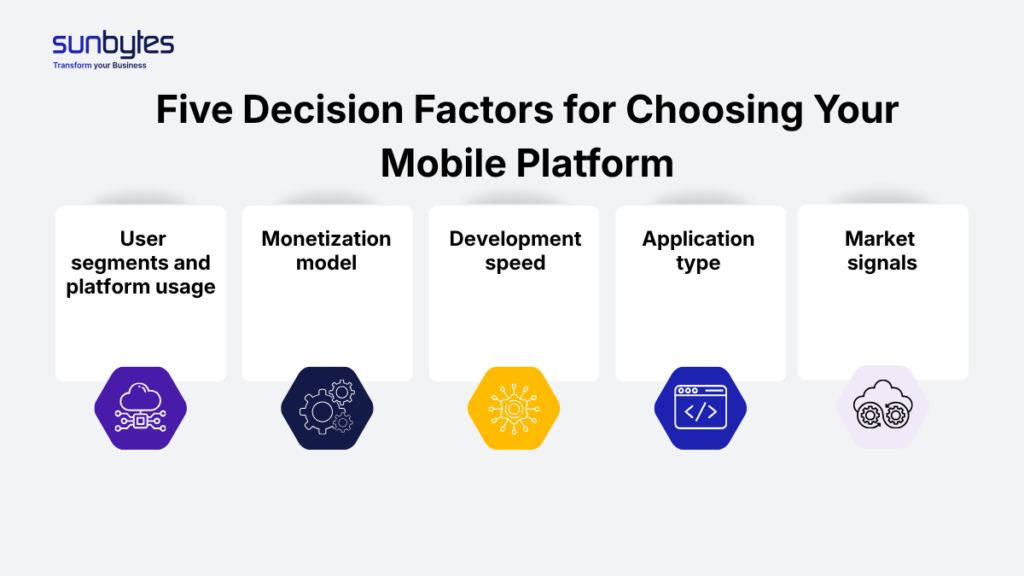
Factor 1: Who are your users and what devices do they carry?
Start with the users who matter in the first 90 days after launch.
Not the total population. Not global market share. Not the device your founder uses.
The practical question is: what phone does your first meaningful user group carry during the moment they need the app?
For a Dutch B2B app, that user group may be sales leaders, procurement managers, HR managers, clinicians, logistics supervisors, field technicians, or existing SaaS customers. These groups do not always follow the same device pattern.
A senior executive app, private client portal, or paid professional tool may justify iOS-first validation. A warehouse workflow app, transport planning tool, retail workforce app, or broad customer-facing app may point to Android first.
The Netherlands also has very high mobile adoption. DataReportal reported 25.3 million cellular mobile connections in the Netherlands in early 2025, equivalent to 138% of the population, with 99.6% of connections considered broadband. That means mobile reach is not the question. User-device fit is.
Signal: If your first users are senior professionals or premium accounts, this factor may point to iOS. If your first users are broad-market, field-based, or operational workers, this factor often points to Android.
Factor 2: How does your app make money?
Revenue model changes the platform signal.
If the app depends on paid subscriptions, premium features, or high customer lifetime value, iOS often deserves early attention. Sensor Tower reported that global in-app purchase revenue across iOS and Google Play reached $150 billion in 2024, with non-gaming revenue growing 23% year over year and Europe’s in-app purchase revenue growing 24% year over year. That supports the point that monetisation quality matters, not only install volume.
But not every business app monetises through the app store.
For many B2B apps, the mobile app supports a SaaS contract, service agreement, membership, or invoiced enterprise relationship. In that case, App Store vs Google Play payment behaviour is less important than user fit and deployment control.
If your app is ad-supported, marketplace-based, or dependent on large-scale adoption, Android’s Dutch and European reach becomes harder to ignore. If the app supports an existing B2B product, platform choice should follow the customer base, not app-store spending patterns.
Signal: If revenue depends on premium users, subscription behaviour, or a controlled B2B customer group, iOS may be the stronger first test. If revenue depends on scale, ad inventory, or wide consumer adoption, Android has a stronger claim.
Factor 3: How fast do you need to ship your first version?
Speed is not only about writing code. Speed includes testing, release preparation, store submission, bug fixing, analytics, and support readiness.
This is where iOS often has a validate-first advantage. Apple controls a smaller set of active devices and OS combinations. Android reaches more device types, screen sizes, OEM customisations, OS versions, and hardware behaviours. That wider coverage is valuable, but it adds QA work.
For a first launch, that difference matters. If the team needs a controlled pilot in 8 to 12 weeks, iOS-first can reduce the number of unknowns. The app can be tested on a smaller device set, released to a defined pilot group, and improved before Android adds more device variability. But this advantage is not automatic. If your internal team already has strong Android engineering, Android QA labs, and a client fleet of known Android devices, Android may be faster for your specific setup. This is why “iOS is faster” is too broad. The better version is: iOS is usually faster to validate when the team does not already have a controlled Android environment.
Signal: If your launch deadline is tight and the team does not have a fixed Android fleet, this factor points to iOS. If the team already owns Android expertise and test coverage, this factor may be neutral or Android-first.
Factor 4: Is this a consumer app or an enterprise tool?
Enterprise tools do not follow public market share. They follow deployment policy.
If a client says, “Our field workers use Android Enterprise devices,” the decision is made. If the client manages Apple devices through Apple Business, Jamf, or Microsoft Intune, that may point to iOS first. If the company uses Microsoft Intune across Android, iOS/iPadOS, macOS, Windows, and other platforms, the release sequence should follow the deployment environment, not a generic platform debate. Microsoft states that Intune supports mobile device management for Android, and its broader device-management documentation covers Android, iOS/iPadOS, Linux, macOS, and Windows.
Android Enterprise is also built for managed business devices, including zero-touch enrollment, managed Google Play, app controls, and device-role configuration.
Apple Business brings Apple Business Manager, Business Essentials, and Business Connect into one platform, with device setup and business management capabilities under Apple Business.
For B2B apps, this means the most important question may not be “iOS or Android?” It may be “What does the client’s device policy allow us to deploy first?” Consumer apps are different. They need market coverage, acquisition economics, app-store performance, user behaviour, and retention data. A Dutch consumer app should not default to iOS just because the product team uses iPhones.
Signal: If the app is an enterprise tool, MDM policy decides. If the app is consumer-facing, revenue model and Dutch market coverage decide.
Factor 5: What does the Dutch and European market data tell you?
The Dutch market data changes the tone of this article. The sample brief assumed a near-even Dutch split and a higher iOS share among B2B/professional users. Current public StatCounter data shows a stronger Android position in the Netherlands overall: Android 61.77%, iOS 38.08% in April 2026. Europe overall is similar, with Android 59.17% and iOS 40.7%.
That does not automatically mean “build Android first.” It means public national market share cannot be used to justify iOS-first by itself.
For Dutch B2B apps, the better approach is to split public data from audience data:
| Data type | What it tells you | How to use it |
|---|---|---|
| Public Dutch OS market share | Android has stronger overall reach in the Netherlands | Use it for consumer and broad-market assumptions |
| European OS market share | Android also leads Europe overall | Use it for regional expansion planning |
| CRM/customer data | What your actual accounts use | Use it for B2B sequencing |
| MDM policy | What enterprise users can install | Use it for enterprise deployment |
| Pilot-user device audit | What your first users will test on | Use it for MVP release order |
If you are building for the full Dutch market, Android needs serious attention. If you are building for a defined B2B audience, your own audience data may still support iOS-first. This is the defensible position for a CTO: do not pick the platform from global averages. Pick it from the first user group you need to learn from.
Signal: If your app targets the full Dutch or EU market, this factor points toward Android or cross-platform. If your app targets a controlled B2B audience and your own data shows iOS concentration, this factor can still support iOS-first.
Not sure which platform is right for your specific app?
The 5 factors above give you the framework. Applying them to your app type, users, device reality, and launch timeline usually takes one focused scoping conversation. Walk through your mobile platform sequence with Sunbytes
Decision matrix: iOS first vs Android first
| Decision factor | iOS-first signal | Android-first signal |
|---|---|---|
| Target users | Senior professionals, premium customers, executive users, controlled B2B pilots | Full Dutch market, public users, retail, logistics, field-service, operational workforce |
| Revenue model | Subscription, premium pricing, B2B SaaS support, high-LTV users | Ad-supported, high-volume, marketplace, broad acquisition model |
| Time to ship MVP | Smaller device matrix, faster first QA cycle, controlled pilot group | Strong Android team, known Android fleet, Android-first user base |
| App type | Knowledge-worker tool, premium client portal, internal B2B app | Field app, warehouse app, transport app, frontline tool |
| Dutch/EU market data | Only when validated by your own B2B audience data | Public Netherlands and Europe OS data both lean Android overall |
| Enterprise deployment | Apple Business, Jamf, iOS/iPadOS-heavy MDM | Android Enterprise, Samsung Knox, Android-heavy Intune fleet |
For Dutch B2B apps, Factors 2 and 3 often support iOS-first validation. Factor 5 no longer supports a broad iOS-first claim from public Dutch data alone. Factor 4 is the most likely reason to override every other signal.
When Android first is genuinely the right answer
Android first is not a fallback. In many cases, it is the correct first move.
1. Your enterprise client has an Android fleet
If the client has Android devices enrolled through Android Enterprise, Samsung Knox, or Intune Android management, Android is the first platform. This is common in field service, logistics, warehousing, facilities, transport, and retail. The devices may already be purchased, configured, locked down, and assigned to workers. In that case, an iOS MVP would test the wrong environment.
2. Your app targets the full Dutch consumer market
If the app needs broad Dutch adoption, Android cannot wait too long. The current Netherlands market share numbers show Android well ahead of iOS overall. A consumer app that launches iOS-only may miss too much of the reachable market, especially if the product relies on network effects, daily use, referrals, or high-volume acquisition.
3. Your app depends on Android-specific hardware or deployment flexibility
Some use cases depend on Android capabilities, device formats, rugged hardware, scanning devices, kiosk modes, NFC workflows, custom peripherals, or device management options that fit Android better. This is not an edge case. It is normal in operational software. For these apps, Android first reduces deployment risk because it tests the product in the environment where it will actually be used.
The sequenced cross-platform approach: one codebase, one first launch
Cross-platform development changes the platform question, but it does not remove it. React Native or Flutter can help you build one shared codebase for iOS and Android. But you still need to decide which app store goes live first, which users receive the first release, which support team handles first feedback, and which platform gets the first go-to-market push.
A practical sequence looks like this:
- Build cross-platform from day one
- Release to one platform first
- Run 6 to 12 weeks of real user validation
- Fix onboarding, performance, retention, and core workflows
- Release the validated version to the second platform
For many Dutch B2B teams, that sequence means cross-platform build with iOS-first validation. For broad-market consumer or field-workforce apps, it may mean a cross-platform build with Android-first validation. The advantage is not “both platforms instantly.” The advantage is controlled learning without closing the path to the second platform.
Use which framework to use: React Native, Flutter, or native for the framework decision. Companies also choose to hire dedicated development teams to build a strong, reusable foundation. By investing in specialised expertise early, you ensure the architecture can support future growth while minimising the risk of costly rework.
How Sunbytes approaches the platform sequence decision
For Dutch and European B2B apps, the platform decision should be made before the first sprint because it shapes QA scope, release order, analytics, support, and go-to-market timing.
Sunbytes helps teams define that build path through Digital Transformation Solutions codebase strategy, release sequencing, sprint structure, QA planning, and DORA-tracked delivery.
- Accelerate Workforce Solutions supports the people layer with dedicated senior teams, team setup, EOR support, and payroll infrastructure, so the mobile team can execute without waiting on hiring or admin.
- Cybersecurity Solutions supports the control layer with ISO 27001-certified delivery, access governance, secure handling of user data, and secure-by-design practices for apps connected to enterprise systems.
The result is one connected decision before build starts: which platform ships first, which team delivers it, and what controls must be in place before the second platform goes live.
Sunbytes has delivered iOS-first, Android-first, and cross-platform mobile apps for Dutch and European B2B clients. Dedicated senior teams are typically operational within 2 to 4 weeks. Delivery is ISO-guided, outcomes can be tracked through DORA metrics, and enterprise apps are supported by secure-by-design delivery practices. Headquartered in Utrecht under Dutch law. 300+ projects delivered across Dutch and European clients. EUR-transparent pricing. 4 to 5 hour NL-VN timezone overlap.
FAQs
If your app targets the full Dutch market, Android needs serious priority because StatCounter shows Android at 61.77% and iOS at 38.08% of the Dutch mobile OS market share in April 2026. If your app targets a controlled B2B audience, do not use national averages alone. Check your CRM, pilot users, MDM policy, and customer device data before deciding.
Yes. React Native or Flutter can reduce duplicated development work, but you still need a first release target. You must choose which app store to submit to first, which users receive the first launch, and where your go-to-market effort starts. Use which framework to use: React Native, Flutter, or native for the framework decision.
Look at the primary deployment environment. If most users are knowledge workers with managed iPhones, iOS may go first. If most users are field workers using Android devices, Android should go first. If both groups matter equally, use cross-platform but still phase the rollout by user group.
Platform choice affects cost through engineering scope, QA scope, release management, maintenance, and device testing. A native dual-platform build costs more than a single-platform MVP. A cross-platform build can reduce duplicated work, but it does not remove platform-specific testing.
Yes, but the cost depends on your build approach. If you built native iOS only, Android is a new build. If you built native Android only, iOS is a new build. If you built cross-platform from day one, the second launch is easier, but it still needs platform-specific QA, store setup, and release planning.
The Dutch-language version of the question has the same structure: first identify your user group, then your validation path. For a Dutch B2B pilot, iOS-first may be right when the first users are premium or professional accounts. For a Dutch consumer or operational app, Android or cross-platform deserves earlier priority because Dutch public market data leans Android overall.
Let’s start with Sunbytes!
Let us know your requirements for the team and we will contact you right away.