Artificial intelligence feels both familiar and new. Its main ideas, like automation, pattern recognition, and machine learning, have been part of computer science for years. What’s new is that today’s AI is no longer limited to labs or specialized business tools. Now, it’s part of daily business decisions, workflows, and the way people work.
In Vietnam, this shift is happening faster than many organizations expected, yet slower than global frontrunners. Recent estimates suggest that only 27% of organizations in Vietnam are fully prepared to deploy and scale AI-powered technologies. This gap between potential and readiness defines the current moment: AI is no longer a future concept, but the AI impact on the job market is still unfolding.
As digital transformation accelerates in both public and private sectors, a key question arises for leaders, HR teams, and IT departments: So what is the actual impact of AI on the job market as a whole?
TL;DR
- AI is changing Vietnam’s workforce, not replacing it. Automation is transforming the way work is done, creating increased demand for roles that utilize AI and putting pressure on repetitive, task-based jobs, particularly in IT and digital services.
- The impact on jobs is more about changes in structure than just job losses. Some roles may disappear, but Vietnam’s ICT market is growing rapidly and creating new jobs in AI engineering, data science, cybersecurity, and roles that combine technical and business skills.
- To use AI successfully, companies need good workforce management. Businesses that combine AI automation with reskilling, compliance, and clear ways of working, supported by partners like Sunbytes, are better prepared to grow in Vietnam.
Impact of AI on the Workforce in Vietnam
How AI Is Reshaping the Vietnamese Workforce
AI is not just changing which jobs are available; it is also changing how work is done. In many industries, tasks that were once manual, repetitive, and time-consuming are now automated or enhanced by intelligent systems. This change is shifting the Vietnamese workforce toward models where people and machines collaborate.
For employers, AI brings higher productivity and lower costs. For employees, it can cause uncertainty, but it also opens up new career paths. The results depend more on how organizations change roles, invest in their people, and manage automation well than on the technology itself.
Currently, many foreign-invested companies entering Vietnam have similar questions about their workforce. Our Vietnam Market Entry – Recruitment in Vietnam guide gives a deeper look at how labor strategy and compliance intersect during expansion.
Impact of AI on Job Roles
Job Roles Most Affected by AI Automation
In Vietnam’s IT and digital services sector, AI tools are already changing daily work. Automated code review, testing tools, data processing systems, and AI-powered customer support have significantly enhanced work efficiency. At the same time, they have lowered the need for some repetitive jobs.
Jobs like manual QA testing, basic tech support, data entry, and rule-based processing are most at risk. Some estimates suggest that up to 40% of IT jobs in Vietnam could be automated by 2030, particularly those involving routine, repetitive tasks.
This does not mean jobs will disappear immediately, but it does indicate a gradual shift. Jobs that do not adapt may become obsolete, while those that utilize AI in their work will be more competitive.
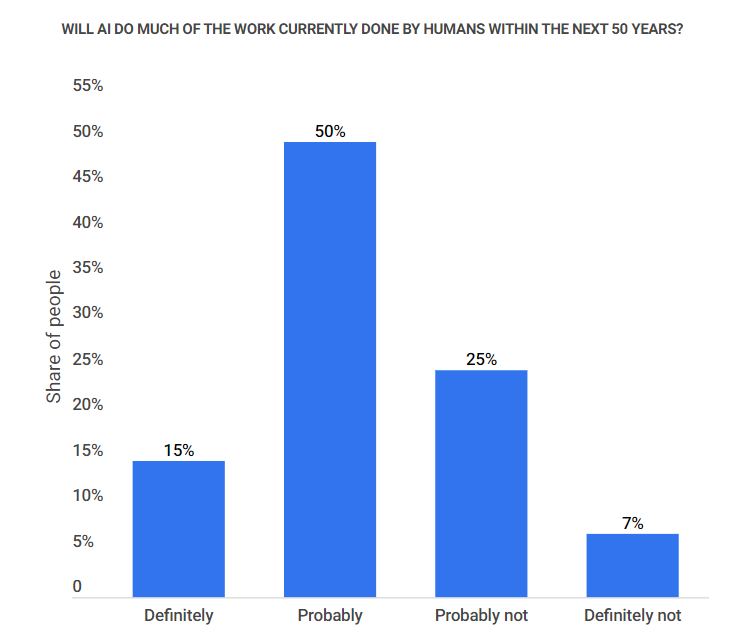
Source: Investguiding
Impact of AI on Employment in Vietnam
Will AI Reduce or Create Jobs?
The impact of AI on jobs is rarely a simple yes or no. In the short term, some workers, especially those early in their careers and in jobs that can be easily automated, may lose their positions. Over time, however, history shows that new technologies typically alter the types of jobs available rather than eliminating work entirely.
The most significant change is in the types of jobs people hold. There is a growing demand for roles that combine technical skills with in-depth knowledge of a specific field. Employers seek professionals who understand both the technology and the business challenges they must address.
As AI accelerates change in the job market, traditional hiring models are no longer flexible enough to keep pace. Job roles evolve faster, skill requirements shift continuously, and workforce demand becomes harder to predict.
To adapt, companies increasingly need workforce models that can scale, reskill, and redeploy talent efficiently, while maintaining control over compliance, cost, and operational risk as roles change.
This is why Recruitment Process Outsourcing (RPO) and integrated workforce operating models are emerging as a natural response to AI’s impact on the labor market—helping organizations align talent strategy with automation, governance, and long-term growth.
Read more: Recruitment Process Outsourcing (RPO): How It Works, Benefits, Cost and When to Use
Vietnam’s Employment Outlook in the AI Era
Vietnam’s ICT market is expected to grow to over USD 17 billion by 2027, thanks to digital services, software development, and AI-powered solutions. As the market grows, there is a greater need for AI engineers, machine learning experts, data scientists, cybersecurity professionals, and new roles focused on AI governance and ethics.
These jobs show that the market is growing. Companies now view AI not just as a technical tool, but as something that needs to be managed in a responsible, secure, and transparent manner.
AI Business Automation in Vietnam
How Vietnamese Businesses Are Using AI Automation
Companies in Vietnam are now using AI for real business tasks, not just experiments. In HR, AI aids in resume screening and workforce planning. In operations, robotic process automation helps remove bottlenecks and makes work more consistent and predictable. Customer service teams utilize chatbots and voice assistants to answer numerous questions, while finance teams leverage AI for forecasting and detecting fraud.
All these uses of AI share the same goal: to help businesses grow without needing to hire additional staff.
Read more: Accelerate Strategic Workforce and Talent Planning Full Guide for Bussinesses
Benefits of AI Automation for Businesses
When implemented well, AI automation delivers measurable benefits. Costs decline as efficiency improves. Decision-making becomes faster and more data-driven. Organizations gain the ability to scale operations sustainably, even in tight labor markets.
From a leadership perspective, automation also creates space. Teams spend less time on routine execution and more time on strategic, value-creating work.
Risks of Poorly Implemented Automation
If automation is not managed well, it can cause problems. Poor communication can lead to employees pushing back. Without sufficient training, workers may lack the necessary skills. Weak oversight can also lead to legal and ethical issues.
This is why strong leadership is important. When utilizing AI, companies must clearly define roles, provide training for new skills, and maintain open communication with employees.
New Opportunities with AI: What’s Lying Ahead?
Despite the fear of job losses, AI is also paving the way for new job roles related to its development and implementation. Entirely new job categories are emerging, while existing roles are becoming more complex and strategically important.
For individuals, AI rewards adaptability. Those who invest early in learning and cross-functional skills often find accelerated career growth. For organizations, AI creates a chance to redesign work around innovation rather than volume.
The Evolving Skillset Landscape
Stagnation is not a word in the AI era. New roles being created mean that IT professionals must adapt and acquire new skills to stay relevant.
Essential skills for the future of Vietnam’s IT workforce include data analysis and interpretation, proficiency in programming languages for AI development, and machine learning and deep learning expertise.
A competent hire should also have a comprehensive understanding of AI ethics and responsible development. With demands surging, Vietnamese universities are increasingly pushing AI programs to prepare young people for the changing landscape. The Vietnamese government also shows supportive signs towards this transition by heavily investing in the sector.
This proactive approach is crucial, but how can organizations support this transition? Turns out, continuous learning and development is key.
What Jobs will AI NOT Replace?
According to the World Economic Forum’s Future of Jobs Report 2025, while AI and automation will reshape many occupations, numerous jobs that depend on human judgment, creativity, empathy, and complex interpersonal interaction are much less likely to be fully replaced even if AI assists with certain tasks. The report highlights that roles centered on emotional, creative, or people-focused skills will continue to be in demand globally through 2030.
Healthcare and Medical Professions
Healthcare jobs represent one of the most AI-resistant sectors because they require human empathy, complex decision-making, and personalized care that machines cannot replicate. Nurses and nurse practitioners are particularly secure, with nurse practitioners projected to grow by 45.7% by 2032, the highest growth rate among AI-proof jobs. Other protected healthcare roles include:
- Doctors and specialists like psychiatrists, therapists, and ob-gyns
- Physical therapists and occupational therapists
- Mental health counselors (projected 22.1% growth)
- Pharmacists and veterinarians
- Medical and health services managers (93 AI resistance score)
These positions require not just technical knowledge but also the ability to provide bedside care, emotional support, and make nuanced medical decisions in unpredictable situations.
Creative and Artistic Fields
Professions that involve original creativity, storytelling, and aesthetic judgment remain difficult to automate because:
- AI can generate content but lacks intrinsic imagination and emotional nuance.
- Human artists interpret culture and experience in ways machines cannot predict.
Examples include:
- Artists, designers, and musicians
- Writers and journalists crafting narrative context
- Creative directors and choreographers (e.g., ~29.7% growth)
Education and Training
Instructors, teachers, and trainers leverage human adaptability, motivation, and emotional engagement areas where AI can assist but not replace the human role. Key positions include:
- Training and development specialists (61 AI resistance score)
- Nursing instructors (projected 21.5% growth)
Legal and Professional Services
Lawyers top the list with a perfect 100 AI resistance score because legal work demands human judgment, ethical reasoning, and interpretation of complex laws. The legal profession requires skills that AI cannot replicate, including nuanced argumentation and understanding of gray areas in law.
Skilled Trades and Manual Labor
Jobs requiring manual dexterity and physical problem-solving remain highly secure from AI replacement. These include:
- Electricians, plumbers, carpenters
- Construction workers and field technicians
- Massage therapists and hair stylists
Current AI technologies are not advanced enough to handle intensive manual work that requires adaptability to unpredictable physical environments.
Management and Leadership Roles
Leadership positions requiring human judgment and interpersonal skills are well-protected:
- Human resources managers (87 AI resistance score)
- General and operations managers (75 AI resistance score)
- First-line supervisors (64 AI resistance score)
Personal Services
Service jobs that rely on human touch and personal interaction remain AI-resistant:
- Personal trainers and coaches (projected 20% growth)
- Athletic trainers (17.5% growth)
- Hairdressers and cosmetologists
- Tattoo artists and manicurists
Specialized Technical Fields
According to Bill Gates, three specific technical fields remain particularly AI-resistant:
- Coders and programmers – AI still needs human oversight for complex architecture and creative problem-solving
- Energy experts – Managing power grids involves too much risk for full automation
- Biologists – Scientific discovery requires creativity that AI lacks
Sales and Client Relations
Sales professionals and account managers remain protected because closing deals requires relationship-building, understanding client needs, and human rapport that AI cannot replicate. The personal connection and trust-building aspects of sales are fundamentally human skills.
The common thread among all these AI-resistant jobs is their reliance on skills that remain uniquely human: emotional intelligence, creativity, complex problem-solving, manual dexterity, and the ability to build meaningful relationships. While AI will continue to serve as a powerful tool to assist these professionals, it cannot fully replace the human elements that make these roles essential.
Education and Training Initiatives to Adopt in 2025
To meet this demand for new skills, educational institutions and companies play a crucial role in upskilling the workforce.
Initiatives such as AI training programs and certifications, collaboration between universities and tech companies, and government support for workforce development are vital. For instance, the Vietnamese government’s National Program on Digital Transformation by 2025 aims to provide AI training for over 100,000 IT professionals.
Why should businesses invest in these training initiatives? Because an empowered, well-trained workforce is the backbone of innovation and competitive advantage in the AI era.
How Sunbytes Supports AI Workforce Transformation
At Sunbytes, we see AI transformation not as a technology project, but as a workforce transition that must be carefully designed, governed, and sustained over time. Our approach combines a strong people-first mindset with leadership-level structure—ensuring that innovation moves forward without compromising operational control or workforce stability.
About Sunbytes
Sunbytes is a Dutch technology company headquartered in the Netherlands, with a delivery hub in Vietnam. For over 14 years, we have helped clients worldwide Transform · Secure · Accelerate—turning strategy into reliable execution, with governance and security built in from the start.
From AI Skills to AI-Ready Operating Models
As automation reshapes job roles and skill requirements, companies need more than talent acquisition; they need predictable, compliant, and scalable workforce frameworks that allow AI adoption to strengthen—not fragment—the organization. In practice, this means supporting both people and platforms. Internally, Sunbytes invests in AI workshops for technical and non-technical teams, ensuring shared understanding across engineering, product, and business functions. We also organize hands-on AI hackathons that allow teams to experiment with emerging technologies in a structured, low-risk environment—bridging theory and real-world application.
For our clients, this experience translates into practical support across three closely connected domains:
- Accelerate Workforce Solutions
We help companies scale AI-capable teams in Vietnam with recruitment, payroll, and employment compliance built in. This model reduces hiring and governance risk while providing leadership-level visibility into cost, capacity, and workforce performance. Sunbytes is best suited for organizations building long-term, high-impact teams, not one-off transactional hires. - Digital Transformation Solutions
Our senior engineering teams support the development and modernization of digital products, including custom software development, QA and testing, and long-term maintenance and support. These capabilities allow clients to operationalize AI and automation initiatives with reliable delivery and architectural alignment. - Cybersecurity Solutions
As AI systems become more embedded in core operations, security and compliance cannot be afterthoughts. Sunbytes helps organizations reduce risk without slowing delivery through practical cybersecurity services and compliance readiness—ensuring that innovation scales safely.
Final Words
As AI changes the way we work, we believe real success means moving quickly but still caring for people, and welcoming new ideas while staying in control. This balance guides how Sunbytes helps businesses with AI workforce transformation. Get in touch with us to get started!
FAQs
AI is automating repetitive tasks and reshaping job roles, particularly in the IT and digital services sectors. While some early-career and task-based roles face displacement, overall employment is shifting toward higher-value, AI-assisted, and hybrid roles.
Jobs that involve predictable and repetitive tasks, like manual QA testing, basic technical support, and data entry, face the highest risk. On the other hand, positions that require judgment, creativity, leadership, or strong interpersonal skills are more likely to remain secure.
Companies need clear workforce models that bring together AI automation, reskilling, compliance, and governance. Partners like Sunbytes help facilitate this shift by combining technology delivery with ongoing workforce, payroll, and compliance support.
Let’s start with Sunbytes
Let us know your requirements for the team and we will contact you right away.