
Many leaders still evaluate a dedicated software development team cost by looking at hourly rates, then wonder why delivery slows, quality drifts, or scaling becomes painful. The problem isn’t the model; it’s how cost is framed, compared, and justified. When cost decisions ignore team stability, engagement design, and long-term execution, they quietly erode ROI. For many decision makers, the real risk is not paying too much, but optimising for the wrong thing.
This article will help you clearly evaluate whether the cost of hiring a dedicated software development team delivers real business value and supports an ROI-driven decision.
To understand what Dedicated Software Development Team means, read our blog: Dedicated Software Development Team: Everything You Need to Know
TL;DR
- Dedicated software development team cost varies widely by region, engagement model, team composition, technology stack, and commitment duration
- Focusing only on hourly rates hides the total cost of ownership, including ramp-up, coordination, and long-term delivery efficiency
- Dedicated teams deliver the highest value when time-to-market, scalability, and cost predictability are business-critical
- C-level executives should evaluate business outcomes and ROI, not pricing tables, when deciding on a dedicated team
What does a dedicated software development team cost in today’s market?
At a high level, the cost of a dedicated software development team depends on how—and where—you build it. Market rates vary significantly between Europe, the US, the UK, and offshore regions such as APAC, but headline numbers rarely tell the full story. What matters for executives is not the average rate, but whether the cost structure supports predictable delivery and long-term value.
The key mistake many companies make is treating cost as a static number. In reality, a dedicated software development team cost is shaped by multiple variables that compound over time—some visible, others less so.
What’s included in dedicated development team pricing?
A properly structured dedicated team cost typically includes more than just developer salaries. Mature providers bundle operational components that would otherwise sit on your internal balance sheet:
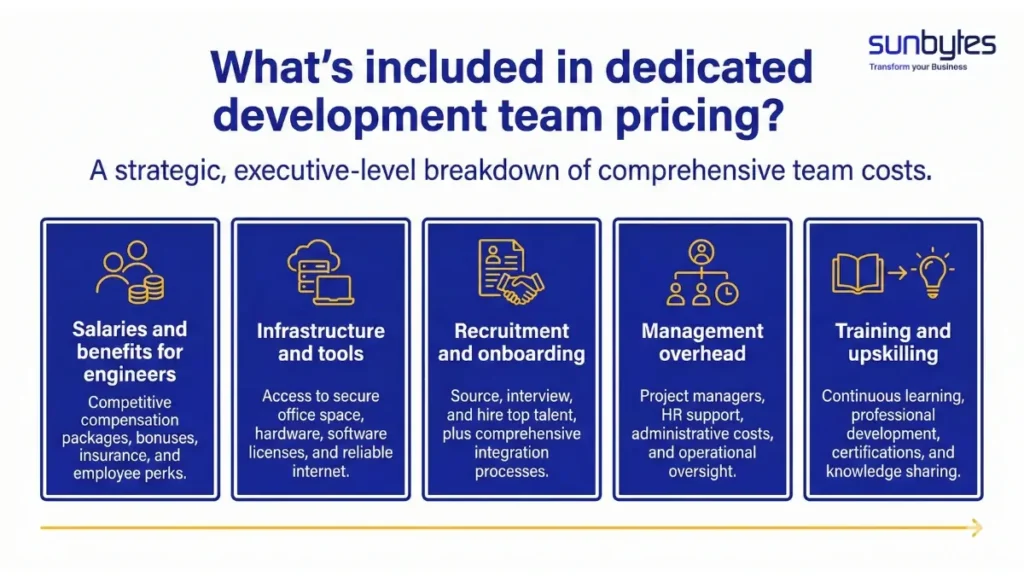
- Salaries and benefits for engineers, QA, and technical leadership
- Infrastructure and tools, including development environments and licenses
- Recruitment and onboarding, reducing time-to-productivity
- Management overhead, such as delivery leads or engineering managers
- Training and upskilling to keep the team aligned with your technology stack
When these elements are missing or fragmented, costs resurface later as delays, rework, or management strain.
Key factors influence the cost of hiring dedicated development team
Several structural factors explain why dedicated software development team cost varies so widely across vendors and regions:
- Region: Europe, the US, and the UK command higher rates than APAC, but offshore teams can deliver stronger cost-efficiency when engagement is well designed
| Region | Countries | Rates |
|---|---|---|
| Western Europe | Netherlands, UK, Belgium, France, Norway, Germany, Ireland, Sweden, and Switzerland | $50–$199 |
| Eastern Europe | Ukraine, Bulgaria, the Czech Republic, Hungary, Poland, Romania, Slovakia, Latvia, and Estonia | $25–$149 |
| Central Asia/Western Asia | Kazakhstan, Azerbaijan, Georgia, Armenia, Uzbekistan, and Tajikistan | $25–$99 |
| East and South Asia | Japan, Indonesia, Malaysia, Philippines, Vietnam, Thailand, and Cambodia | <$25–$149 |
| North America | USA, Canada | $50–$300 |
| Latin America | Mexico, Colombia, Brazil, and Argentina | $25–$199 |
| Africa | Morocco, Kenya, Nigeria, Egypt, and Ethiopia | <$25–$99 |
| Australia | Sydney, Melbourne | $50–$199 |
Offshore Software Development Rates by Country (Source: Clutch.co)
- Engagement model: Fully dedicated, long-term teams cost less per unit of output than short-term or hybrid setups
- Team composition: Seniority mix, leadership roles, and cross-functional balance directly affect both cost and velocity
- Technology stack: Niche or legacy technologies typically increase cost due to talent scarcity
- Duration and commitment: Longer commitments reduce churn, ramp-up time, and overall cost of ownership
For C-level decision-makers, the takeaway is simple: cost benchmarks only become meaningful when evaluated in the context of delivery model, stability, and business objectives.
What hidden costs should you consider when hiring a dedicated software development team?
Hidden costs emerge when the engagement is poorly structured, under-managed, or treated as a short-term staffing fix rather than a delivery model. For executives, these costs don’t always show up on invoices, but they surface as delays, rework, and lost momentum.
Two categories matter most: time lost before real delivery starts, and friction introduced during execution.
- Knowledge transfer and ramp-up time
Even experienced engineers need time to understand your domain, architecture, and product constraints. When onboarding is rushed or undocumented, ramp-up stretches longer than planned—silently increasing total cost. - Rework caused by unclear requirements or weak governance
Gaps in product ownership, decision-making authority, or acceptance criteria often lead to work being redone. The cost isn’t just extra development hours—it’s delayed releases and eroded confidence. - Communication and coordination overhead
Time zone gaps, fragmented tools, or unclear escalation paths increase coordination effort. When alignment depends on constant meetings, productivity drops while costs stay fixed. - Delivery management gaps
Teams without strong technical leadership or delivery oversight tend to drift. Issues surface late, risks compound, and leadership is pulled into operational firefighting—an indirect but very real cost. - Short-term engagement design
Frequent team changes, rotating engineers, or unclear commitment periods reduce continuity. Each reset reintroduces ramp-up cost and weakens accountability.
Hidden costs are a signal to design the engagement properly—around stability, ownership, and long-term delivery efficiency. When those elements are in place, the hidden costs largely disappear, and the model delivers on its promise.
How does the cost of a dedicated software development team compare to hiring in-house?
At first glance, hiring in-house often looks cheaper. Salaries are visible, teams sit closer to the business, and control feels higher. But when you compare total cost over time, the equation changes—especially for companies scaling products or operating in competitive markets.
A dedicated software development team shifts cost from fixed, long-term commitments to a more flexible delivery model. The real difference lies not in monthly spend, but in how risk, speed, and overhead are distributed.
| Cost Dimension | Dedicated Software Development Team | In-House Development Team |
| Recruitment & hiring | Recruitment, onboarding, and replacement handled by the partner | Ongoing recruiting effort, agency fees, long hiring cycles |
| Retention & attrition risk | Team continuity managed at the provider level, reducing single-person dependency | High impact when key engineers leave; replacement cost and knowledge loss |
| Cost structure | Variable and scalable based on delivery needs | Fixed cost regardless of workload or roadmap changes |
| Time to productivity | Faster onboarding with established processes and ready teams | Slower ramp-up due to hiring, onboarding, and internal alignment |
| Management overhead | Delivery management and team coordination included | Requires continuous people management and leadership attention |
| Operational burden | HR, compliance, and infrastructure handled externally | Internal HR, payroll, legal, and compliance responsibilities |
| Scalability | Capacity can be adjusted without long-term commitments | Scaling requires new hires, contracts, and extended timelines |
| Risk exposure | Shared delivery risk with a structured engagement model | All delivery and people risks remain internal |
For a deeper breakdown of when each model fits best, read our detailed guideline: Dedicated Teams vs In-House Teams: Which Deliver Better ROI
How do you calculate the real value of a dedicated software development team?

For a dedicated software development team, real value only becomes visible when you look beyond rates and evaluate how the team performs across delivery, stability, and scalability.
Here are key value drivers of a dedicated software development team that put into consideration:
- Long-term expertise and team stability: A stable, long-lived team retains product and domain knowledge, reducing handover friction and repeated onboarding costs.
- Faster time-to-market from a well-coordinated team: Dedicated teams develop working rhythms, communication patterns, and shared ownership—shortening delivery cycles.
- Scalability and flexibility without rehiring: Capacity can be adjusted as roadmaps evolve, without restarting recruitment or restructuring internal teams.
- Access to diverse skill sets on demand: Specialized skills can be added when needed, without long-term employment commitments.
- Strong project focus and accountability: Dedicated teams are aligned to defined outcomes, not scattered across competing internal priorities.
- Cost-effectiveness over long-term engagements: Reduced churn, stable velocity, and predictable planning lower total cost of ownership over time.
- Reduced administrative and management burden: Less internal overhead allows leadership to focus on strategy rather than day-to-day team operations.
If you want a deeper, practical view of how these value drivers play out in real delivery models, we’ve outlined them in detail in 5 Key Benefits of A Dedicated Software Development Team.
How do you calculate ROI when hiring a dedicated software development team?
Calculating ROI for a dedicated software development team requires shifting from a cost-accounting mindset to a value-based one. The goal is not to justify spending, but to understand whether the team accelerates outcomes that matter to the business, faster releases, lower risk, and more predictable execution.
ROI formula for a dedicated software development team
A practical way to calculate ROI is to compare total investment against the business value created over time:
- ROI = (Business value delivered − Total cost of ownership) ÷ Total cost of ownership
Business value may include faster time-to-market, revenue enabled by earlier releases, avoided hiring costs, or reduced operational risk. Total cost of ownership should include team cost, onboarding, management overhead, and engagement duration.
Key metrics to measure ROI of a dedicated team
To make ROI measurable and comparable, executives should track a small set of outcome-focused indicators:
- Time-to-market: How quickly features move from concept to production
- Delivery velocity: Stability and predictability of output over time
- Quality indicators: Defect rates, rework, and post-release issues
- Cost predictability: Variance between planned and actual spend
- Scalability efficiency: Speed and cost impact of scaling the team up or down
When these metrics improve together, ROI becomes visible—not as a spreadsheet exercise, but as a sustained improvement in execution.
How should you evaluate your needs before hiring a dedicated software development team?
A dedicated software development team delivers value only when it’s matched to the right business context. Before committing, executives need clarity on what the team is expected to enable. Skipping this step often leads to overstaffing, underutilisation, or misaligned expectations. Prioritise these evaluation criteria for hiring a dedicated software development team:
- Project scope and technical complexity: Complex, evolving products benefit most from stable, long-term teams that retain context over time.
- Long-term product vision: A dedicated model makes sense when you’re building and iterating continuously—not delivering a one-off project.
- Budget constraints and delivery timelines: Clear guardrails help determine the right team size, seniority mix, and engagement duration.
- Internal resources and leadership capacity: Dedicated teams still require product ownership and decision-making on your side to move fast.
- Communication and collaboration requirements: Time zone overlap, language proficiency, and working cadence should match how your organisation operates.
When these elements are aligned, a dedicated software development team becomes an extension of your organisation—rather than an external dependency.
How industry leaders optimise dedicated software development cost

TeamViewer
Originally engaging Sunbytes for IT consultancy, TeamViewer scaled to a dedicated team of eight developers fully integrated with their internal technology organisation. This dedicated team supported feature development, performance improvements, and aggressive delivery timelines tied to global marketing campaigns. Rather than juggling internal hiring cycles or external contractors, TeamViewer gained consistent bandwidth and technical quality, enabling deadlines to be met reliably while sharing expertise and reducing the burden on in-house engineers.
DWS
Sunbytes partnered with DWS to build a dedicated team of four developers that transformed manual, paper-based workflows into modern digital tools tailored to internal operations. The team delivered solutions such as a vendor price comparison engine handling nearly 800,000 products daily and automated invoice analysis, dramatically reducing manual effort and errors. By embedding an expert dedicated team instead of ad-hoc hires, DWS achieved ongoing enhancements without extra recruitment overhead, maintaining control over scope and impact while benefiting from predictable delivery and cost efficiency.
Flexpress
Flexpress started with a single offshore developer, but with Sunbytes’ support expanded to a nine-member full-stack dedicated team located in Vietnam and the Netherlands. This team went beyond initial migration tasks to deliver hundreds of new platform features, build reusable migration tooling, support analytics workflows, and manage systems handling over 2 million users. The dedicated model enabled continuous delivery of high-impact enhancements while avoiding repeated recruitment and ramp-up costs, delivering scalable, high-quality results at a lower total cost of ownership.
Explore how other leaders optimise dedicated software development: Success Stories
How do you choose the right dedicated software development partner?
Once you’ve decided that a dedicated software development team makes sense financially, partner selection becomes the single biggest lever influencing both cost and results. Two teams with similar rates can produce vastly different outcomes depending on how delivery is structured, supported, and governed.
This is why mature organisations treat partner selection as a strategic decision. They look beyond rate cards and assess whether the partner can sustain delivery over time, adapt as the product evolves, and protect total cost of ownership as complexity grows.
Because this decision carries long-term impact, we’ve broken it down in depth in a separate guide. If you’re actively evaluating vendors or preparing for due diligence, continue with How To Choose The Best Dedicated Software Development Team for a structured, step-by-step approach.
How does Sunbytes help balance dedicated software development team cost and value?
Balancing cost and value requires more than access to offshore talent. It requires a delivery model that protects quality, speed, and continuity while keeping total cost of ownership under control. This is where many dedicated team setups fall short, and where Sunbytes is intentionally different.
From a cost perspective, Sunbytes combines APAC-based delivery teams with European leadership and standards, giving clients access to high-quality engineering without Western cost structures. From a value perspective, teams are embedded into client roadmaps, delivery cadences, and quality expectations—so output translates directly into business progress.
Explore more about our Dedicated Software Development Team services.
Why Sunbytes (Transform · Secure · Accelerate)
Sunbytes is a Dutch technology company (HQ: the Netherlands) with a delivery hub in Vietnam. For 14 years, we’ve helped international teams deliver Digital Transformation—building and modernizing digital products with dedicated software development teams that are delivery-focused, dependable, and built for long-term impact (custom development, QA/testing, maintenance & support).
What makes our Digital Transformation stronger is that it’s reinforced by our other pillars:
- Cybersecurity strengthens Digital Transformation: our Secure by Design approach reduces risk without slowing delivery—so modernized systems don’t become fragile systems. Security is considered early, aligned with real architectures and delivery constraints, and turned into practical improvements your team can sustain.
- Accelerate Workforce strengthens Digital Transformation: scaling transformation requires the right capabilities at the right time. We help you add capacity and critical skills efficiently, so your roadmap stays on track and your delivery model remains stable as demands grow.
With Sunbytes, Digital Transformation isn’t just “building software”—it’s reliable execution with security and scalability built in. Schedule a free consultation to talk with our experts now.
FAQs
The cost of a dedicated software development team depends on several factors, including region, team size, seniority mix, technology stack, and engagement duration. Teams based in Europe, the US, and the UK typically cost more than offshore teams in APAC, while long-term, stable engagements generally reduce the total cost of ownership compared to short-term setups.
It depends on context. In-house teams often appear cheaper when looking only at salaries, but dedicated teams frequently reduce long-term costs by eliminating recruitment cycles, lowering attrition risk, and providing scalable capacity without fixed overhead. For companies prioritising speed, flexibility, and predictable delivery, dedicated teams often deliver stronger ROI.
Most dedicated software development team engagements start with a minimum commitment of three to six months. This timeframe allows teams to onboard properly, build product context, and deliver measurable value. Longer commitments typically improve cost efficiency, team stability, and overall delivery outcomes.
Let’s start with Sunbytes
Let us know your requirements for the team and we will contact you right away.