

Hiring frontend developers today is no longer just a talent challenge. It’s a business risk that directly impacts speed, scalability, and user experience. Many companies invest heavily in hiring, only to face delays, inconsistent code quality, or teams that struggle to translate design into high-performing interfaces. The cost of a wrong hire goes beyond salary, it slows product delivery, increases technical debt, and affects revenue outcomes. Without a clear strategy, even experienced leaders can find themselves navigating a fragmented hiring landscape with limited visibility into what truly defines top-tier talent.
This article will talk about how to hire frontend developers effectively, evaluate the right skills, choose the best hiring model, and build a high-performing team that drives measurable business results.
TL;DR
To hire top-tier frontend developers, prioritize these five strategic pillars:
- Success starts with a defined tech stack (React, Next.js, or Vue) and a clear roadmap, ensuring your project is broken into sprints with established compliance and NDA protocols before interviewing.
- Look beyond basic coding; top candidates must demonstrate mastery in Core Web Vitals, performance optimization, and the ability to translate complex UI/UX designs into responsive code.
- Structure your interviews to cover technical logic, real-world architectural scenarios, and “soft skills” essential for high-velocity, asynchronous remote environments.
- Budgeting for frontend talent is a three-dimensional calculation based on experience level, engagement model and geographic region.
- If speed-to-market is critical, partnering with Sunbytes to access pre-vetted, high-performing frontend engineers to build high-performing websites.
What Does a Front-End Developer Do?

A front-end developer acts as the bridge between design and technology—turning UI/UX concepts into functional, interactive digital experiences that users engage with directly. Their core responsibility is to ensure that every visual element, from layout to micro-interactions, works seamlessly across devices and browsers.
Beyond writing code, they handle responsive design, state management, and API integration, ensuring the interface is not only visually consistent but also fast, scalable, and connected to backend systems. In practice, this means translating design files into clean, maintainable code while optimizing performance and usability.
Building a high-performance interface requires adherence to modern frontend development and best practices to ensure the codebase remains scalable as your product grows.
What to Define Before You Start Hiring Front-End Developers
Hiring frontend developers without clear direction often leads to mismatched expectations, delays, and costly rework. Before starting the hiring process, decision-makers need to align on three critical factors that directly impact project success and team efficiency.
Defining Your Tech Stack: (React.js, Vue.js, Angular, or Next.js?)
Your tech stack determines not only who you can hire, but how fast they can contribute. Choosing between frameworks like React, Vue, Angular, or Next.js should be based on your product requirements, scalability goals, and existing architecture. A well-defined stack ensures you target candidates with the right expertise and reduce onboarding time.
Project Scope: Breaking Down the Project into Sprints
A clear project scope helps translate business goals into actionable development tasks. Breaking the project into sprints allows you to define priorities, set realistic timelines, and evaluate developer performance in stages. This structure is especially important when working with distributed or external teams.
Compliance: Identifying Legal Requirements and NDAs
Frontend developers often have access to sensitive product logic and user data through APIs and integrations. Establishing legal frameworks such as NDAs, IP protection, and compliance requirements (e.g., GDPR)—ensures your business is protected from the start. This is particularly critical when hiring across different regions or working with external partners.
What are Three Hiring Front-End Developers Models?
Choosing the right hiring model is a strategic decision that impacts cost, speed, and scalability. Here’s a clear comparison of the three main options: Inhouse Front End Developers, Freelance Front End Developers, and Outsourced Front End Developers
| Model | Definition | Pros | Cons |
|---|---|---|---|
| In-House Front End Developers | Full-time developers hired as part of your internal team | Full control over team and processes Strong product ownership Better long-term alignment | Longer hiring time (6–12 weeks)- Higher costs (salary, benefits, overhead) Limited access to global talent |
| Freelance Front End Developers | Independent contractors hired for short-term or project-based work | Fast hiring and onboarding Flexible and cost-efficient for short-term needs- No long-term commitment | Limited availability and reliability- Less control and consistency Weak long-term product alignment |
| Outsourced Front End Developers | External teams or developers provided by a service partner | Rapid scalability Access to pre-vetted global talent- Reduced hiring complexity | Requires strong vendor management- Potential communication gaps Less direct control compared to in-house |
Sunbytes: A Flexible Approach to Cover Every Hiring Need
In practice, many organizations combine these models to balance control, flexibility, and speed. Sunbytes supports all three approaches—helping you align your hiring strategy with your business goals.
- Recruitment services: For in-house hiring, Sunbytes provides recruitment services to secure the right frontend talent.
- Employer of Record (EOR) services: If you need developers in regions where you don’t have a legal entity (Asia, Europe, LATAM), Sunbytes offers an Employer of Record (EOR) solution.
- Contractor of Record (COR) services: For freelance or contractor needs, Sunbytes enables seamless engagement through a Contractor of Record (COR) model.
- IT Staff Augmentation: And if you want to scale with outsourced developers, Sunbytes delivers through IT Staff Augmentation, giving you access to pre-vetted engineers ready to contribute.
This approach ensures you’re not locked into a single model, giving you the flexibility to scale as your business evolves.
How to Evaluate a Top-Tier Front-End Developer
Not all front-end developers deliver the same business impact. At the decision stage, the goal is to find someone who can build scalable, high-performing user experiences that support your product and revenue goals. To choose the right fit front end developer, we need to evaluate both hard skills and soft skills.
Hard Skills
Top-tier frontend developers go beyond basic coding. They demonstrate strong fundamentals and the ability to apply them in real-world scenarios:
- Core Languages: Solid expertise in HTML5, CSS3, and modern JavaScript (ES6+)
- Framework Proficiency: Hands-on experience with frameworks like React, Vue, Angular, or Next.js in production environments
- Performance Optimization: Ability to improve loading speed, optimize Core Web Vitals, and debug performance bottlenecks
- UI/UX Sensibility: Understanding of accessibility (A11y), responsive design, and mobile-first development
A strong frontend developer doesn’t just follow designs. They interpret and enhance them to ensure usability and performance at scale. They are also the final gatekeeper of your user experience. Understanding the nuances of UX UI Design meanings, differences, and processes allows you to hire someone who can actually advocate for the user.
Soft Skills
In distributed and fast-moving teams, technical skills alone are not enough. The best developers also demonstrate:
- Problem-solving and adaptability: Ability to navigate ambiguity and propose practical solutions
- Clear communication: Especially important when working across teams (design, backend, product)
- Asynchronous collaboration: Experience working effectively in remote or global environments
For business leaders, this is what separates a capable developer from a reliable long-term contributor, someone who can integrate seamlessly into your team and consistently deliver results.
These soft skills are closely tied to cultural fit—how well a developer aligns with your team’s working style, communication norms, and pace of execution. A strong cultural fit often determines whether a developer can collaborate effectively and deliver consistently over time.
What are Top Interview Questions to Ask Front-End Developers?

A strong interview should combine technical logic, real-world scenarios, and soft skills assessment to give you a complete picture of the candidate.
Technical Logic Questions
These questions assess core knowledge and the ability to apply it in production environments.
Key questions to ask:
- Can you explain how you optimize a web application for performance (e.g., Core Web Vitals)?
- How do you manage state in a large-scale frontend application?
- What strategies do you use to ensure cross-browser compatibility?
- How do you structure a scalable and maintainable frontend architecture?
- Can you walk us through a complex feature you built and your technical decisions?
How to ask effectively:
- Ask candidates to use real examples, not theoretical answers
- Follow up with “why” and “what trade-offs did you consider?”
- Request them to explain decisions in business terms (impact on users or performance)
How to evaluate:
- Look for depth, not buzzwords
- Strong candidates explain trade-offs and constraints, not just solutions
- They connect technical decisions to performance, scalability, or user experience
Scenario-Based “How Would You Handle…” Questions
These questions reveal how candidates think under real-world conditions—where constraints, trade-offs, and ambiguity exist.
Key questions to ask:
- How would you improve a slow-loading, high-traffic website?
- How would you handle conflicting requirements from design and backend teams?
- How would you approach refactoring a legacy frontend codebase?
- How would you ensure a seamless user experience across devices and screen sizes?
- How would you prioritize tasks under tight deadlines without compromising quality?
How to ask effectively:
- Add context (e.g., traffic scale, deadlines, team size)
- Encourage candidates to think out loud
- Ask what they would do first, next, and why
How to evaluate:
- Look for structured thinking and prioritization
- Strong candidates balance speed, quality, and business impact
- They demonstrate ownership and decision-making, not hesitation
Questions to Test Soft Skills in a Remote Environment
In modern teams, especially distributed ones, soft skills directly impact delivery speed and team performance.
Key questions to ask:
- How do you communicate technical issues to non-technical stakeholders?
- How do you handle feedback or disagreements during code reviews?
- How do you stay aligned with a remote team across different time zones?
- Can you describe a time you took ownership of a problem beyond your role?
- How do you ensure accountability and productivity when working remotely?
How to ask effectively:
- Ask for specific past situations, not hypothetical answers
- Use follow-ups like “what was the outcome?” and “what would you do differently?”
How to evaluate:
- Look for clarity, ownership, and accountability
- Strong candidates show proactive communication and collaboration
- They demonstrate the ability to work independently without losing alignment
Key Takeaways for C-Level Decision Makers
- Don’t rely on a single interview—combine technical, scenario, and behavioral assessments
- Prioritize candidates who can translate technical work into business impact
- Look for consistency across answers—top candidates think systematically, not randomly
- When speed matters, consider working with partners who provide pre-vetted developers already tested across these dimensions
What is The Step-by-Step Hiring Front-End Developers Process?
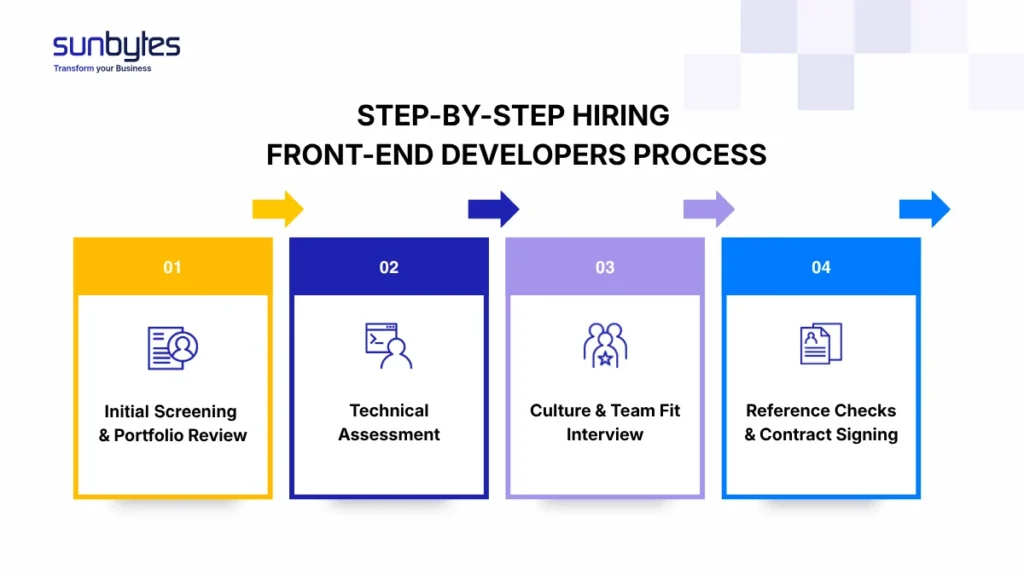
There are four key steps in the hiring process that help you systematically evaluate and secure the right frontend talent.
Step 1: Initial Screening & Portfolio Review
Start by filtering candidates based on relevant experience and proven results.
- Review portfolios for real-world projects, not just UI visuals
- Look for evidence of performance optimization, scalability, and business impact
- Assess alignment with your tech stack and product domain
Tip: Prioritize candidates who can clearly explain what they built, why they built it, and the results achieved.
Step 2: Technical Assessment (Live Coding or Take-Home Test)
Validate whether candidates can apply their knowledge in practice.
- Use realistic tasks (e.g., building a small feature, fixing performance issues)
- Focus on code quality, structure, and problem-solving approach
- Evaluate how they handle edge cases and trade-offs
Tip: Avoid overly complex tests—keep them relevant to the actual work they will do.
Step 3: Culture & Team Fit Interview
Ensure the candidate can collaborate effectively within your team.
- Assess communication style, ownership, and adaptability
- Evaluate experience working in remote or cross-functional teams
- Align on expectations, workflows, and pace of execution
Tip: Strong cultural fit often determines long-term success more than technical skills alone.
Step 4: Reference Checks & Contract Signing
Validate past performance and finalize the hiring decision.
- Conduct reference checks focused on reliability, collaboration, and delivery quality
- Confirm availability, expectations, and contractual terms
- Ensure legal compliance (NDAs, IP protection, regional requirements)
Executing this entire cycle internally offers maximum control. If your roadmap requires immediate momentum, Sunbytes can help you navigate these stages more efficiently by acting as an extension of your hiring team to find the right technical fit.
How Much Does it Cost to Hire a Front-End Developer?
The cost of hiring a frontend developer is not a fixed number—it’s a strategic investment influenced by experience level, location, hiring model and compliance.
Salary by Experience Level (Junior vs. Mid-Level vs. Senior)
| Level | Typical Cost (Annual) | What You Get |
|---|---|---|
| Junior | $20,000 – $50,000 | Basic implementation, requires supervision |
| Mid-Level | $50,000 – $100,000 | feature ownership, balanced speed and quality |
| Senior | $100,000 – $180,000+ | Architecture, performance optimization, leadership |
Source: Glassdoor Salary Insights (global frontend developer salaries)
Cost Comparison by Region (Global Talent Market)
| Region | Typical Cost (Annual) | Key Considerations |
|---|---|---|
| US / UK | $100,000 – $180,000+ | High cost, strong expertise |
| Eastern Europe | $50,000 – $100,000 | Cost-efficient, strong engineering talent |
| Asia | $20,000 – $60,000 | Highly scalable, diverse skill levels |
| LATAM | $40,000 – $90,000 | Time zone alignment with US |
Source: Glassdoor Salary Insights (global frontend developer salaries)
If you’re exploring LATAM, especially Brazil – offers a large pool of skilled frontend developers with competitive rates and increasing experience working with international teams, hire Brazilian developers to balance quality, cost, and time zone alignment with US clients.
Then, explore the top 10 countries with the highest frontend developer salaries to ensure your offers are competitive in a polarized global market.
Model Comparison: Freelancers vs In-House vs Outsourcing
| Model | Cost Structure | Impact on Budget |
|---|---|---|
| In-House | Salary + benefits + overhead | Highest total cost, long-term investment |
| Freelancers | Hourly or per project | Flexible but variable cost |
| Outsourcing | Monthly rate or contract | Predictable cost, scalable |
Compliance Comparison (Hidden Costs and Complexity)
When hiring across borders, compliance becomes a critical cost and risk factor. Here’s a more detailed comparison:
| Factor | In-House (Global Hiring) | Freelancers / Contractors | Outsourcing / EOR / COR |
|---|---|---|---|
| Legal Entity Requirement | Required in each country | Not required | Not required |
| Payroll & Tax Compliance | Fully managed internally | Limited responsibility but risk of misclassification | Managed by provider |
| Employment Laws & Benefits | Must comply with local labor laws | Risk of non-compliance | Covered by provider |
| IP Protection & Contracts | Fully controlled internally | Requires careful contract setup | Standardized and managed |
| Administrative Overhead | High (HR, legal, finance) | Low to medium | Low |
| Risk Level | Medium–High (if unfamiliar with region) | High (misclassification, legal gaps) | Low (compliance handled externally) |
Hire Front-End Developers Efficiently with Sunbytes
Hiring frontend developers is often a trade-off between speed, quality, and risk. Sunbytes removes that trade-off by giving you access to pre-vetted frontend engineers who are ready to contribute from day one—aligned with your tech stack, product goals, and delivery timelines. Instead of navigating fragmented hiring processes, you get a streamlined approach that reduces time-to-hire while maintaining high technical standards.
With a focus on transparent pricing, flexible engagement models, and rapid scalability, Sunbytes helps you build frontend teams that can grow with your business. Whether you need to fill a critical gap or scale quickly across regions, the process is designed to keep your roadmap moving without compromise.
Why Sunbytes?
Sunbytes is a Dutch technology company with a global delivery model, helping organizations hire frontend developers who not only meet technical requirements but also deliver secure, scalable, and high-performing digital experiences. With 15 years of experience, Sunbytes combines structured processes with practical execution to turn hiring strategies into reliable outcomes.
- Transform Business Solutions: Build and modernize digital products with experienced frontend developers, supported by senior engineering teams across development, QA, and maintenance.
- Cybersecurity Solutions – Hire frontend developers with confidence through compliance readiness, ensuring your teams meet security and regulatory standards without slowing down delivery.
- Accelerate Workforce Solutions – Scale your frontend capabilities quickly with flexible workforce solutions, from recruitment to fully managed team extension.
Ready to move forward? Talk to our experts to find the right front end developers for your project growth.
FAQs
Business leaders should prioritize business impact over technical checklists. This includes a developer’s ability to build scalable, high-performing interfaces, collaborate across teams, and contribute to key metrics such as user engagement, conversion rates, and performance. Strong alignment with your product goals and team structure is just as important as technical expertise.
It depends on your strategic priorities. In-house teams offer greater control and long-term alignment, while outsourcing provides faster access to talent and scalability. Many companies adopt a hybrid approach—keeping core capabilities in-house while leveraging external partners to accelerate delivery and reduce hiring time.
Common mistakes include hiring based only on technical skills, overlooking cultural fit, and underestimating the importance of performance and UX. Another critical mistake is choosing the lowest-cost option instead of focusing on long-term value, which often leads to rework, delays, and increased total cost.
Hiring timelines vary by model. In-house hiring typically takes 6–12 weeks due to sourcing and evaluation stages, while outsourcing or staff augmentation can reduce this to 1–4 weeks by providing pre-vetted candidates. Speed depends largely on how clearly your requirements and evaluation process are defined.
High-quality frontend developers deliver ROI through faster time-to-market, better user experience, and improved conversion rates. They also reduce technical debt and ongoing maintenance costs by building scalable, maintainable code from the start—making them a strategic investment rather than just a cost.
Let’s start with Sunbytes
Let us know your requirements for the team and we will contact you right away.


