
Every successful MVP looks simple in hindsight. Every failed MVP started with reasonable intentions.
Founders rarely fail because they lack ideas. They fail because their execution model couldn’t keep up with uncertainty. Decisions were slow. Feedback arrived too late. Teams optimized for delivery instead of learning. An MVP is not a smaller product. It is a decision-making system. And like any system, its outcome depends on how it’s structured. That’s why startups that build MVPs with dedicated software development teams consistently reach validation faster than those relying on fragmented, ad-hoc, or prematurely in-house setups.
If you’re new to MVPs or want a quick refresher on what they are, how they’re built, and typical costs, this guide on MVP development explains the fundamentals in detail.
TL;DR
- MVP success depends on decision speed and learning velocity, not how fast teams ship features
- Dedicated software development teams outperform in MVP stages because they are structured to handle uncertainty, iteration, and change
- The right MVP team combines clear ownership, senior technical judgment, and fast feedback loops to avoid costly early mistakes
- Dedicated teams are best for early validation, while in-house teams make sense after product direction is proven
- Leaders should evaluate MVP investment based on risk reduction and clarity gained.
Why Startups Choose MVP Dedicated Development Teams
At the MVP stage, uncertainty is your biggest cost. The right team model doesn’t eliminate uncertainty — it processes it faster.

Cost-Effective Talent Without Sacrificing Quality
The real cost of an MVP is false confidence.
Hiring junior or generalist teams often looks cheaper on paper, but it increases the probability of:
- Rewriting core architecture after validation
- Misinterpreting early user feedback
- Delaying go/no-go decisions
Dedicated MVP teams reduce this risk by embedding experience early, when decisions have the highest leverage. Paying more per month to learn the right answer sooner is cheaper than paying less to learn the wrong answer confidently.
Time Zone Compatibility
When founders must wait 24 hours to resolve a product question, MVP cycles stretch, assumptions linger, and momentum stalls. Dedicated teams operating in compatible or overlapping time zones enable:
- Same-day clarification of product decisions
- Real-time trade-off discussions
- Faster iteration after user feedback
Strong Tech Ecosystem
MVPs don’t fail because of missing features. They fail because early technical decisions box the product in. Dedicated teams typically bring:
- Architects who know which shortcuts are safe
- QA engineers who prevent misleading validation signals
- DevOps practices that support iteration, not fragility
This ecosystem matters most before product-market fit, not after.
Faster Time-to-Market
Speed isn’t about shipping faster — it’s about learning faster. Dedicated MVP teams are structured to:
- Run parallel workstreams (design, build, test)
- Ship usable increments weekly, not monthly
- Turn user behavior into concrete product decisions
This is how startups compress validation timelines without gambling on assumptions.
How to Hire and Manage a Dedicated MVP Software Team Truly Effective?
Focused Product and Technical Expertise
Great MVP teams follow one main rule: They treat every feature as a test, not a promise.
This approach helps to:
- Tell the difference between learning goals and feature requests
- Avoid building extra features just in case they might be needed
- Wait to make big, final decisions until there is real evidence
Key point for leaders: The real value of an MVP team comes from the smart decisions they avoid, not just the features they build.
Iterative MVP Delivery and Rapid Feedback Loops
High-performing teams see MVP development as a set of experiments instead of following a fixed plan.
They do a few key things:
- They design features that help test their assumptions.
- They set up analytics early in the process.
- They adjust the project scope based on real evidence, not just opinions.
This prevents the most common MVP trap: polishing the wrong solution.
Key point for leaders: Iteration is not just redoing work; it is a way to learn in a controlled manner.
Time Zone Alignment for Real-Time Collaboration
Working together every day leads to:
- Faster trade-off decisions
- Stronger ownership
- Fewer misunderstandings that cause extra work
Founders can stay involved with the product without needing to micromanage.
What leaders should remember: Being involved matters more than controlling everything at the MVP stage.
Integrated Communication and Team Ownership
Dedicated teams do their best work when they have the freedom to:
- Challenge requirements
- Flag risks early
- Take responsibility for results, not just tasks
This helps the team become a true partner, not just a vendor.
Key point for leaders: If your team never challenges you, they aren’t really looking out for your MVP.
MVP Development Team: Key Roles and Ideal Team Structure
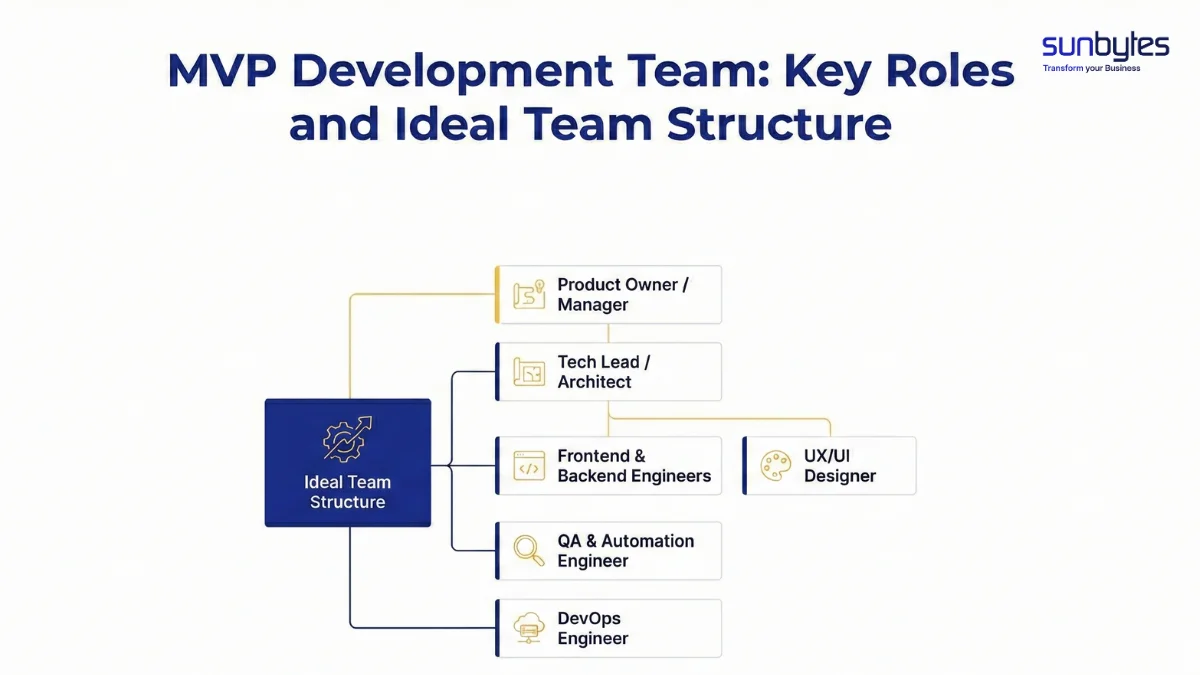
An MVP doesn’t fail because the team lacks skills. It fails when roles are unclear, decisions are fragmented, or no one owns the outcome end to end. At this stage, structure matters as much as talent. Each role exists to reduce a specific type of risk.
Product Owner or Product Manager
This role connects your vision to the team. They make sure the product solves the right problem, stays aligned with business goals, and doesn’t drift into feature overload. More importantly, they help translate assumptions into clear priorities, so development effort is spent learning what truly matters—not building what feels intuitive.
Tech Lead or Software Architect
This person safeguards your future while enabling speed today. They guide early technical decisions, choosing solutions that are simple enough to move fast but flexible enough to evolve after validation. Their job isn’t to design the perfect system—it’s to prevent early shortcuts from becoming long-term constraints.
Frontend and Backend Engineers
These engineers turn ideas into something users can actually interact with. At the MVP stage, their focus isn’t completeness, but clarity—building core functionality that makes the value of the product immediately understandable. Strong engineers also flag when a feature adds complexity without adding learning.
QA and Automation Engineer
Validation only works if the product behaves reliably. This role ensures bugs and performance issues don’t distort user feedback or undermine early trust. Instead of slowing things down, good QA keeps iteration honest by making sure teams are testing real behavior, not broken flows.
UX/UI Designer
This role ensures users understand the product without being told how it works. In MVPs, design isn’t about polish or branding—it’s about removing friction and guiding users to the core value quickly. A strong designer helps teams learn faster by making user behavior easier to interpret.
DevOps Engineer
This role keeps iteration cheap and safe. By enabling smooth deployments, monitoring, and rollback, DevOps support ensures teams can release often without fear. That stability allows founders to experiment, adjust, and respond to feedback without slowing momentum. An MVP team doesn’t need to be large, but it does need to be complete. Each role exists to eliminate a different kind of uncertainty—product, technical, operational, or user-related.
Dedicated Software Team vs In-House Resources for MVP: When to Choose Each
At the MVP stage, most decisions are still provisional. Requirements evolve, assumptions get tested, and priorities shift quickly. Dedicated software development teams are designed for this reality. They provide experienced talent, flexible scope, and faster learning cycles without locking the business into long-term commitments too early.
In-house teams become more effective once the product direction is clearer. They work best when the focus shifts from discovery to execution, optimization, and long-term ownership. For many startups, the most effective path is sequential: use a dedicated team to reach validation, then build internal capability to scale what’s proven.
| Criteria | Dedicated Software Development Team | In-House Team |
|---|---|---|
| Best suited for | MVP and early validation stage | Post-validation and scaling |
| Speed to start | Fast, minimal setup | Slower due to hiring and onboarding |
| Flexibility | High — scope and team can adapt | Lower — roles and capacity are fixed |
| Cost structure | Predictable monthly investment | High fixed costs and long-term commitments |
| Experience level | Immediate access to senior expertise | Depends on hiring success |
| Risk exposure | Lower early-stage risk | Higher risk if direction changes |
| Ownership focus | Outcome and delivery-oriented | Long-term product ownership |
To evaluate this decision in more depth—including ROI, cost models, and long-term trade-offs, read our guide Dedicated Teams vs In-House Teams: Which Deliver Better ROI to choose the right one for your business.
How to Hire an MVP Development Team
At this stage, the wrong hiring decision doesn’t just waste money—it locks you into assumptions that are hard to reverse. The goal is to choose a team that helps you learn quickly, decide confidently, and stay in control.

Define Your Goals and MVP Success Metrics
Before talking to any vendors, be clear on what success actually looks like. An MVP is not successful because it ships on time—it’s successful because it answers critical questions about your market, users, or business model.
Strong teams will push you to articulate:
- What assumptions need to be tested first
- What signals will tell you to continue, pivot, or stop
- What not to build yet
If a team jumps straight into features without discussing learning goals, that’s a warning sign.
Research the MVP Development Market
When evaluating options, look beyond branding and case studies. Pay attention to how teams talk about:
- Validation and experimentation
- Trade-offs and constraints
- Past MVP failures, not just successes
Teams that have navigated uncertainty before tend to explain it clearly.
Choose the Right Team Model
MVPs rarely fit neatly into fixed scopes. Requirements evolve as soon as users interact with the product.
Dedicated team models work well when you expect:
- Changing priorities
- Ongoing discovery
- Iteration based on real feedback
Fixed-scope models can work for well-defined problems, but they often break down when learning becomes the priority instead of delivery.
Review Contracts and Pricing Models
Contracts shape behavior. If the agreement rewards output over insight, teams will optimize for shipping—not learning. When reviewing pricing models, focus on:
- How change requests are handled
- Whether the scope can evolve without friction
- How transparency and reporting are structured
The best MVP contracts create room for adjustment without renegotiation at every turn.
Define the Team’s Working Model
Clarity here prevents most delivery issues later.
Align early on:
- Who owns prioritization
- How often decisions are reviewed
- How feedback flows between founders and the team
A good working model keeps founders close to decisions without pulling them into daily execution.
Set Up Tools and Infrastructure
Tools don’t create alignment, but the absence of them creates friction.
Strong MVP teams establish:
- Clear project tracking
- Shared documentation
- Visibility into progress, blockers, and decisions
This transparency builds trust and allows leaders to stay informed without micromanaging.
Start with a Discovery Phase
A discovery phase is not a delay—it’s a risk filter. It helps teams:
- Validate assumptions early
- Identify technical constraints
- Align on scope and priorities before heavy development
Teams that skip discovery often move faster at first, only to slow down later when assumptions break.The best MVP teams don’t promise certainty. They create a structure that helps you earn it.
Common Mistakes Startups Make When Building MVPs (And How Dedicated Teams Prevent Them)
Most MVP failures don’t look like failures at first. They look like progress. Code is shipped. Features are added. Timelines move forward. But beneath that activity, learning stalls—and by the time teams realize it, they’ve already invested too much to change direction easily.
These are the mistakes that quietly derail MVPs, and why dedicated teams are better equipped to prevent them.
Overbuilding Before Validation
One of the most common traps is treating the MVP as an early version of the final product. Teams keep adding features to “make it complete,” assuming more functionality will produce better feedback.
In reality, overbuilding delays learning. It makes results harder to interpret and increases emotional attachment to unproven ideas. Dedicated MVP teams counter this by constantly asking what each feature is meant to validate—and what can safely be left out for now.
Making Irreversible Early Technical Decisions
Early architectural choices have long shadows. When teams optimize too early for scale, performance, or edge cases that don’t yet exist, they reduce flexibility later—right when it’s needed most.
Dedicated teams bring experience with early-stage trade-offs. They know which shortcuts are safe, which decisions can wait, and how to keep the system adaptable until product-market fit is clearer.
Lacking Clear Ownership and Iteration Discipline
MVPs often involve multiple stakeholders, opinions, and shifting priorities. Without clear ownership, teams drift. Decisions slow down. Feedback turns into debate instead of action. Dedicated teams work best when ownership is explicit—someone is responsible for priorities, learning goals, and decisions. This structure keeps iteration focused and prevents momentum from dissolving into alignment meetings.
For a deeper breakdown of these pitfalls, and how experienced teams avoid them—this guide on MVP Software Development: Common Mistakes That Lead to Failure explores real-world failure patterns in more detail.
Why Choose Sunbytes Dedicated Software Development for Your MVP
Sunbytes approaches MVP development with a validation-first mindset. We help founders and leadership teams structure their MVP as a learning system—one that reduces uncertainty before capital, hiring, or scale commitments are made.
Our dedicated software development teams are built to:
- Translate business goals into clear MVP learning objectives
- Move quickly without sacrificing architectural discipline
- Maintain European quality standards while staying flexible
- Operate with clear ownership, transparency, and accountability
Curious how that team was structured and scaled? Read how we helped build a dedicated software development team for DWS.
Why Sunbytes (Transform · Secure · Accelerate)
Sunbytes is a Dutch technology company with delivery teams in Vietnam, and for more than 14 years we’ve supported international organisations in building MVPs through dedicated software development teams designed for focus, speed, and long-term continuity. This delivery model helps teams move quickly while maintaining clear ownership, technical consistency, and alignment as products evolve.
What reinforces this approach is the way MVP development is supported beyond engineering output alone:
- Through a Cybersecurity Solutions, security considerations are introduced early, ensuring MVPs can scale without exposing organisations to avoidable risk.
- Our Accelerate Workforce Solutions allows teams to add the right capabilities at the right time, so MVP momentum isn’t lost as products transition from validation into full-scale delivery.
For teams building an MVP with a dedicated software development team, Sunbytes provides the structure, discipline, and execution depth needed to turn early validation into sustained product progress. Contact us for a free consultation.
FAQs
Most MVPs are delivered within 8 to 16 weeks, depending on scope, learning goals, and iteration speed. The timeline is usually driven less by development effort and more by how quickly assumptions can be tested and decisions made.
For MVPs, dedicated teams are typically more effective than freelancers. They offer stronger ownership, continuity, and coordination—critical when requirements change and learning matters more than task completion.
Yes. Dedicated teams are designed to scale up, scale down, or transition into an in-house setup after validation. Many startups use this model to move from MVP to product-market fit without rebuilding teams from scratch.
Let’s start with Sunbytes
Let us know your requirements for the team and we will contact you right away.