
Remote work opens access to wider talent pools, faster scaling, and lower operational overhead, but without the right structure, it can quickly create communication gaps, inconsistent onboarding, and culture fragmentation. For business leaders, the challenge is no longer whether remote work is viable, but how to build a system that keeps distributed teams productive, aligned, and engaged. This guide walks through how to hire, onboard, and manage a remote team with a lifecycle approach that supports sustainable growth.
TL;DR
- Build a remote-first hiring and management framework with clear role scorecards, structured onboarding, and output-based KPIs so distributed teams can ramp up quickly and stay aligned.
- Advantage of having a remote team are flexible with working, reduce business costs for office space, relocation, and infrastructure and supports for employee well-being
- Partner with Sunbytes to streamline the entire remote team lifecycle with compliance and professionalism, including sourcing, hiring, onboarding, performance support, and long-term team continuity in global markets.
What Does It Mean to Hire and Manage a Remote Team?

What is a remote team?
A remote team involves creating a workforce model in which employees, contractors, and specialists collaborate effectively without a shared physical office.
For growing businesses, this approach is not just about location but a strategic approach to accessing specialized talent, streamlining hiring, and enabling market expansion.
Remote vs hybrid vs distributed teams
A remote team primarily works remotely. A hybrid team combines office-based and remote employees. A distributed team often spans multiple cities or countries, making timezone coordination and documentation even more critical. Understanding which model fits your growth stage helps determine the right hiring, management, and legal setup.
Benefits of hiring a team remotely
Remote work is increasingly attractive to today’s workforce, offering flexibility, autonomy, and the ability to work from anywhere. As a result, companies can enhance talent attraction and retention by providing remote opportunities.
Remote teams can boost productivity when employees have clear goals, effective communication, and appropriate collaboration tools. At the same time, businesses can reduce costs for office space, relocation, and infrastructure, resulting in measurable savings as teams grow.
Remote work also supports employee well-being. Eliminating daily commutes and offering greater schedule control can reduce stress, lower burnout risk, and decrease sick days over time.
Collectively, these benefits position remote workforce models as a strategic growth tool for startups and scaling businesses seeking to expand efficiently without sacrificing performance or employee experience.
This is especially powerful for fast-growing companies that need niche tech or leadership talent quickly. Learn more about how this model supports lean expansion for startup growth with remote teams guide.
Challenges of hiring and managing a remote team
The main challenges in remote team success typically arise from unclear systems and inconsistent management, rather than talent quality. Poorly defined communication channels lead to information gaps, duplicated work, and slower decisions. Limited opportunities for collaboration can leave remote employees feeling isolated or disengaged.
In global teams, poor documentation causes delays, and time zone differences complicate meetings and handoffs. Hybrid environments add complexity, risking a fragmented culture if leaders do not foster inclusive practices. Without clear boundaries on workload and availability, burnout becomes a long-term risk.
The most effective approach is a remote management model focused on disciplined communication, centralized documentation, and output-based leadership to keep teams aligned without unnecessary control.
How to hire remote employees
The best remote hiring strategies start by defining success outcomes before opening a role. Rather than focusing only on technical capability, hiring teams should evaluate whether candidates can work autonomously, communicate clearly in writing, adapt quickly to change, and collaborate effectively in asynchronous environments. A streamlined remote hiring process should set clear interview expectations from the start, prepare backup plans for technical disruptions, and use role scorecards tied to outcomes so every interviewer measures the same success criteria. To improve long-term fit, include scenario-based assessments that mirror async collaboration and prioritize culture add over culture fit, ensuring new hires strengthen the team’s ways of working instead of simply matching existing personalities.
How to onboard remote employees
Effective remote onboarding begins well before a new hire’s first day. The objective is to foster clarity, connection, and confidence, enabling employees to become productive without feeling isolated. Rushed or fragmented onboarding often leads to unclear expectations, delayed access to tools, and a diminished sense of belonging, which can slow ramp-up and increase early attrition.
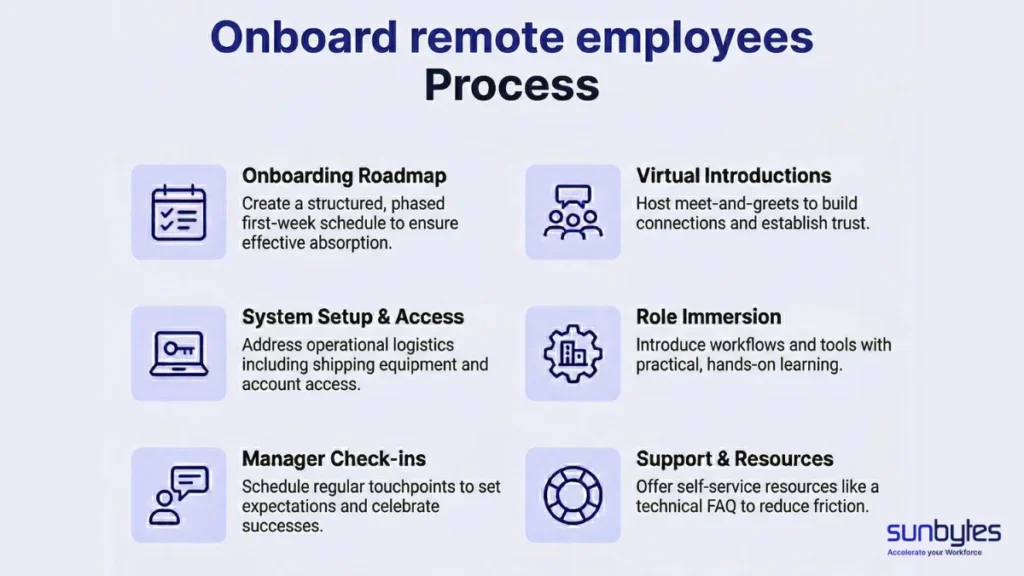
The first step is to ensure each remote employee is fully prepared before their start date. This involves shipping equipment, activating accounts, granting permissions, and confirming their home workspace supports focused work. Addressing these operational needs early allows new hires to focus on learning their role rather than troubleshooting logistics. Choosing the right collaboration and onboarding systems early is critical, especially for distributed teams.
Explore our guide to the best tools for collaborating with your remote teams
From there, companies should create a structured onboarding roadmap that spreads sessions, training, and introductions across the first week instead of compressing everything into one day. A phased approach gives employees time to absorb systems, understand workflows, and build confidence through practical role immersion.
Virtual meet-and-greets with managers, peers, and cross-functional teams are especially important because they help establish trust and a human connection from the start.
Regular check-ins are key to turning onboarding into long-term retention. Managers should schedule touchpoints during the first week and continue with milestone check-ins to reinforce expectations, address obstacles, and support early achievements. Providing a simple FAQ for common technical issues can further reduce friction and enhance the remote employee experience.
When executed effectively, remote onboarding serves as the foundation for engagement, productivity, and long-term team continuity.
How to manage and maintain a remote team

Tips to Help You Manage Remote Global Teams
- Create async communication rules
The most effective way to manage remote global teams is to create a consistent operating system that employees can rely on regardless of location or time zone.
As teams expand across markets, companies should establish asynchronous communication guidelines to enable progress without waiting for meetings. This is especially important when managing different time zones, defining overlap hours, and minimizing handoff delays.
- Mesure outcomes
Strong remote cultures focus on output rather than online presence. Leaders should measure productivity by outcomes, ownership, and independent problem-solving, not status indicators or meeting hours.
- Protect work-life balance boundaries
Sustainable performance also depends on supporting work-life balance, maintaining realistic workloads, and setting clear boundaries to reduce burnout.
- Preserve engagement for all locations
To preserve engagement, managers should also organize virtual team-building rituals, create space for informal learning, and consistently recognize employee contributions across all locations. These small leadership habits strengthen a sense of belonging and help remote teams maintain momentum even as they scale globally.
How do I maintain engagement with a partially remote team?
Partially remote teams often face a cultural challenge. Office-based employees gain informal context through in-person conversations, while remote employees may feel excluded from relationship-building and spontaneous decisions. Over time, this imbalance can reduce engagement and create an “inner circle” that weakens trust.
The best way to prevent this is to intentionally design for inclusion. Leaders can schedule regular virtual watercooler sessions, encourage cross-location coffee chats, celebrate milestones equally, and document all key decisions in shared systems rather than through informal conversations. In hybrid meetings, it is essential to avoid “room advantage” so remote employees have equal opportunities to contribute.
When inclusion is a consistent leadership habit rather than an occasional activity, partially remote teams are more likely to sustain engagement, trust, and a consistent culture.
Success stories from fully remote companies
The strongest proof of effective remote team management comes from real delivery outcomes. At Sunbytes, distributed collaboration between Vietnam and the Netherlands has helped enterprise clients scale innovation, improve continuity, and accelerate execution.
For DWS, our dedicated remote team partnered with the client’s internal experts to digitize paper-based workflows, automating large-scale price comparisons across 800,000 products daily and streamlining the processing of 150,000+ invoices from multiple suppliers. This remote delivery model significantly improved operational accuracy and reduced manual workload.
For the TeamViewer case study, Sunbytes built a dedicated team of eight developers to support its global website ecosystem across 21 localized versions. By working as an embedded remote extension of the internal engineering team, we helped improve performance, maintain clean-code standards, and accelerate delivery for a platform serving more than 600,000 customers worldwide.
These cases demonstrate that remote-first team models are not simply a cost-saving approach. When supported by strong documentation, clear sprint ownership, and disciplined communication, dedicated developers, dedicated teams, and staff augmentation services can become a strategic way to accelerate digital transformation while preserving engineering quality and business agility.
Learn how Accelerate Workforce Solutions with the full employee lifecycle
Successfully hiring and managing a remote team requires more than filling roles. It demands a robust workforce infrastructure to ensure compliant hiring, efficient onboarding, and long-term team stability.
Sunbytes’ Accelerate Workforce Solutions addresses these needs. As a with headquarters in the Netherlands and a delivery hub in Vietnam, we have 15 years of experience helping international teams across more than 20+ countries scale efficiently and sustainably through recruitment and workforce support.
Our approach stands out due to its strong foundation. With expertise in Digital Transformation Solutions and Cybersecurity Solutions, Sunbytes understands what high-performing teams need to scale quickly, operate securely, and align with business objectives.
Whether you need Recruitment services, Staffing Service, Employer of Record (EOR), / Contract of Record Services, Sunbytes helps you build a remote team with compliance that integrates seamlessly and evolves with your business roadmap.
FAQs
Define the role’s business outcomes, communication needs, and timezone expectations before sourcing candidates. In addition to technical skills, evaluate autonomy, written communication, and asynchronous collaboration. Use a structured pre-hire scorecard and clear goals to improve hiring quality and accelerate ramp-up.
Remote workers give businesses access to a wider global talent pool, faster hiring speed, and greater flexibility for hard-to-fill roles. They can also improve productivity, reduce office overhead, and strengthen retention by offering employees better work-life balance and location flexibility.
The most sought-after remote skills blend technical expertise with strong self-management. Employers also value written communication, accountability, problem-solving, adaptability, and effective collaboration across asynchronous and cross-time-zone settings.
Let’s start with Sunbytes
Let us know your requirements for the team and we will contact you right away.