The impact of AI in leadership is becoming more visible every day. It is not only changing how leaders make decisions, but also how they support their teams, build trust, and create meaningful direction.
The impact of AI on leadership refers to how artificial intelligence influences how leaders think, communicate, make decisions, and guide teams in a fast-changing environment. Instead of focusing only on control and oversight, leaders are now expected to use AI as a support tool while staying deeply connected to people.
Many organizations still struggle to grow, even with strong strategies and talented teams. Often, the challenge comes from internal friction, unclear direction, or lack of trust. As AI reshapes how work is done, leaders who rely only on traditional, top-down approaches risk losing both their people and their ability to innovate.
Going forward, leaders who combine practical technology understanding with empathy and clear communication will be best equipped to build safe, learning-focused workplaces with a shared purpose.
TL;DR
- Transition from task management to decision guidance: As AI handles reporting and coordination, prioritize leadership that fosters clarity, trust, and effective team decision-making.
- Balance AI-driven insights with strong human leadership: Lead with empathy, ethical judgment, and clear direction, especially during periods of uncertainty.
- Develop systems that enable effective collaboration between people and AI: Establish straightforward, well-governed processes to help teams work efficiently with AI while maintaining alignment, compliance, and support.
How AI Strengthens Day-to-Day Leadership
As business changes in 2026, AI literacy is no longer just a technical bonus – it is now essential for leaders. For leaders, this change is not just about learning new technology. The impact of AI is shifting leadership from task supervision to context-setting, trust-building, and AI-supported decision-making. By embracing this shift, leaders move away from managing routine tasks and focus more on judgment, governance, emotional intelligence, and managing hybrid human-AI teams.
Traditional Leadership vs AI-Supported Leadership
To better understand the change, here is a simple comparison:
| Traditional Leadership | AI-Supported Leadership |
|---|---|
| Focus on control and supervision | Focus on guidance and clarity |
| Decisions based on limited data | Decisions supported by real-time insights |
| Time spent on reporting and coordination | Time spent on strategy and people |
| Hierarchical communication | Transparent and shared communication |
| Reactive problem-solving | Proactive planning and early detection |
This shift is not about replacing leadership, it is about freeing leaders to focus on what matters most: people and purpose.
4 Key Pillars: How AI Augments Modern Leadership
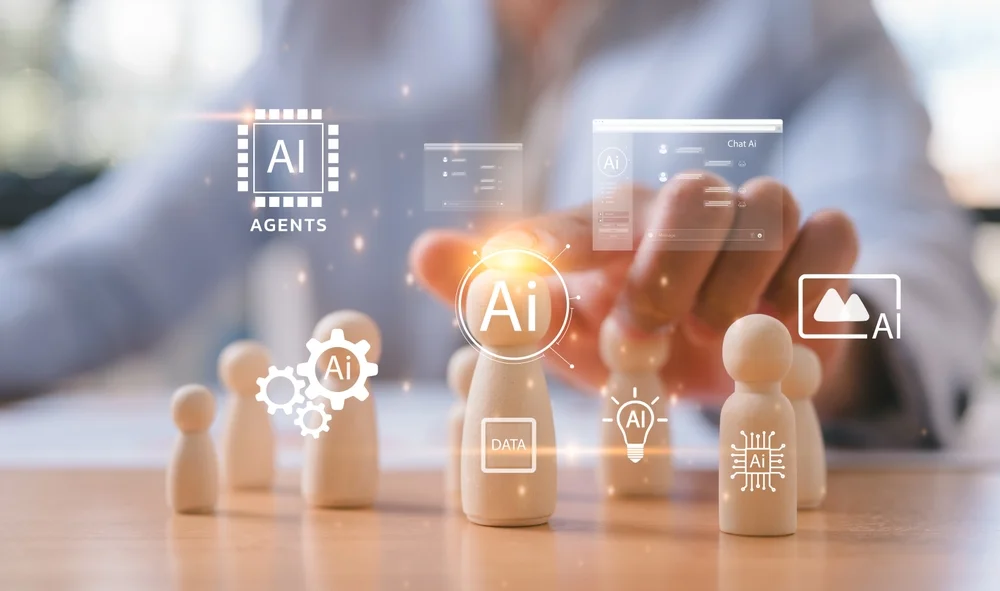
Leading with purpose involves seeing AI as more than a technical tool. When applied effectively, AI strengthens organizational health by streamlining tasks and enabling smoother collaboration across teams.
Enhance your strategic thinking
AI helps you move from reacting to problems to anticipating them. It finds patterns and trends in your company that you might miss, giving you the chance to address issues before they grow. This helps you lead your team with confidence.
Enhance your decision-making
When teams use different information, it can cause confusion. AI provides one reliable source, so Marketing, Sales, and Finance stay on the same page. This clear view is key for workforce and talent planning, helping you match your people to your business goals using real data.
A thinking partner
Leadership can be isolating, but AI acts as a strategic partner. It simulates business scenarios and challenges your strategies, allowing you to focus on mentoring your team and building a culture of trust.
Foster transparent, high-level communication
AI can make you a better communicator by turning complex data into simple stories your stakeholders can understand. It can also check how your team is feeling, so you can respond with care. When you use AI to clarify your message, everyone in your company understands your vision, reducing confusion and building a shared sense of purpose.
The Leadership Skills AI Can’t Replace
As AI becomes more integrated into planning, reporting, and decision support, leadership value is shifting from information control to uniquely human capabilities. AI does not replace executives; instead, it increases the importance of skills only humans offer.
Leaders who achieve long-term competitive advantage will not be those who use the most AI tools, but those who combine AI with human judgment, empathy, and strategic direction.
Emotional Intelligence and Trust-Building
AI can analyze sentiment, summarize conversations, and flag team risks, but it cannot match the emotional depth needed to build trust during uncertainty.
As automation expands, employees may fear changes to their roles, shifting performance expectations, and a loss of relevance in an AI-driven workplace. Here, emotional intelligence becomes a decisive leadership advantage. Leaders must assess team sentiment, address resistance early, and foster psychological safety so employees view AI as support rather than a threat.
The World Economic Forum highlights that as AI usage rises, 76% of workers seek more human connection, reinforcing that empathy and communication are key leadership differentiators.
In practice, emotionally intelligent leaders strengthen cross-functional trust, change resilience, conflict resolution, and employee confidence during AI adoption.
These outcomes directly determine whether transformation efforts succeed at scale.
Ethical Judgment and Governance
AI can generate recommendations at scale, but it cannot assume accountability for fairness, compliance, or reputational risk. That responsibility remains with leadership.
As a result, ethical judgment is one of the most essential executive skills in the AI era. Leaders must decide:
- When AI recommendations should be challenged
- How bias is identified and audited
- Where privacy boundaries must be enforced
- Which decisions require mandatory human escalation
Strong governance is no longer a technical function alone. It is a leadership discipline.
As hybrid teams of humans and AI agents become more common, governance-first leadership is now a strategic necessity to protect trust, maintain transparency, and align automation with company values.
Organizations that scale AI responsibly are those whose leaders embed ethics into workflows, decision rights, and oversight models.
Vision, Purpose, and Influence
AI can optimize execution, but it cannot define the organization’s purpose or direction.
In the age of AI, a leader’s key responsibility is to provide meaning to teams. As automation handles tactical tasks, employees need a clear link between their contributions and the company’s long-term purpose.
Purpose-driven leadership helps teams understand: Why AI is being introduced, how roles are evolving, what human strengths become more valuable, and where the business is heading next
This clarity reduces resistance and builds momentum for transformation. The strongest leaders use AI to accelerate operations while doubling down on human influence storytelling, alignment, inspiration, and belief-building across the organization. Human-centric leadership models increasingly show that long-term AI success depends on leaders who can balance profitability with people impact.
Navigating Ambiguity and Change
AI speeds up change, but leaders still need to guide people through what the data cannot fully explain.
Markets shift quickly, roles evolve continuously, and not every strategic decision comes with complete information. In this environment, leadership strength lies in making sound decisions amid uncertainty.
AI may accelerate signals, but leaders remain responsible for interpreting trade-offs, managing human responses to change, and moving the organization forward with confidence.
Leading Through the Disruption of AI

AI’s impact on leadership extends beyond faster reporting or improved forecasts. It is fundamentally reshaping leadership within modern organizations.
As AI automates coordination, analysis, and routine decision support, leaders must move beyond traditional management practices. The old model based on control, hierarchy, and information ownership is shifting toward guiding hybrid teams, building trust, and providing clarity amid rapid change.
The World Economic Forum highlights that AI is forcing companies to rethink leadership and organizational models, moving away from siloed structures toward intelligence-driven collaboration. This means the real disruption is not the tool itself, but the leadership mindset required to scale it.
Rethink Your Leadership Role
AI reduces the time leaders spend collecting updates, consolidating reports, and coordinating routine workflows. As these tasks become automated, leadership shifts from supervising tasks to designing outcomes.
This shift requires leaders to invest more energy in aligning teams around priorities, interpreting signals from AI systems, and making judgment calls when data alone is not enough. Rather than being the center of all decisions, the modern leader becomes the designer of better decision environments.
Leaders are now responsible for defining decision rights, escalation paths, and human review checkpoints to ensure AI increases speed without reducing accountability.
Adopt New Leadership Identities
AI introduces significant identity-level changes for leaders.
Many executives were trained to lead through expertise, control, and certainty. In AI-enabled organizations, however, leadership credibility relies more on asking insightful questions, challenging assumptions, and fostering collective intelligence than on having all the answers.
This shift gives rise to the AI-augmented leader, who combines machine-driven insights with emotional intelligence, ethical judgment, and business foresight.
As hierarchies flatten and AI democratizes information, authority increasingly rests on interpretation, influence, and trust rather than on position. This shift is already changing leadership structures in high-performing organizations.
Create New Meaning for Teams During Transformation
Technology initiatives often fail not due to weak systems, but because people lose clarity about their roles.
As AI takes over repetitive tasks, leaders must help teams rediscover the meaning of their work. Employees need clarity on the increasing value of human contributions such as critical thinking, empathy, creativity, relationship-building, and contextual judgment.
For this reason, change management and human oversight are now essential leadership disciplines in AI transformation. Successful organizations approach AI rollout as a cultural journey rather than a software deployment.
Effective leaders turn disruption into confidence. They help teams understand what is changing, why it matters, how roles will evolve, and where new growth opportunities arise.
When leaders create that meaning early, AI adoption feels less. When leaders establish meaning early, AI adoption is seen less as replacement and more as an expansion of capabilities.
4 AI Leadership Pitfalls to Avoid

AI’s impact on leadership extends beyond speed and automation. It also includes the risks that arise when adoption outpaces governance.
Many organizations deploy AI quickly to boost productivity, reporting, or decision support, but leadership challenges often emerge after implementation. Without clear ownership, robust data controls, and defined accountability, AI may amplify existing weaknesses rather than resolve them.
The OECD highlights that trustworthy AI depends on strong governance, privacy alignment, and accountability mechanisms across the full lifecycle. This is why AI risk should be treated as a leadership responsibility, not simply a technical concern.
Don’t Expect AI to Solve Every Leadership Problem
AI can improve forecasting, workflow visibility, and operational decision support, but it cannot repair deeper structural issues such as weak ownership, poor collaboration, or misaligned incentives. When leadership problems are cultural, AI often reveals these issues faster than it can address them.
Effective leaders address business challenges directly. They determine where AI should enhance clarity, where human judgment is essential, and which outcomes need to change. This approach ensures AI supports leadership execution rather than increasing confusion.
Don’t Ignore Bias Across the Decision Chain
Bias rarely originates in the final output. It often arises earlier through incomplete data, inconsistent performance measures, or assumptions about success. This makes bias a leadership design issue, not only a technical one.
As AI recommendations influence hiring, performance reviews, succession planning, and customer prioritization, even minor distortions can quickly lead to unfairness. Leaders should establish regular review checkpoints, transparent escalation paths, and cross-functional governance before allowing AI insights to shape critical decisions.
Don’t Be Careless With Data Privacy
AI is only as trustworthy as the data boundaries leaders create around it. When organizations integrate AI with workforce analytics, customer systems, and leadership dashboards, sensitive information moves across more tools and processes. Without clear rules and oversight, this increases privacy risks, data misuse, and erodes trust among employees and customers.
For companies operating in Europe or partnering with it, compliance with the GDPR (General Data Protection Regulation) is essential. GDPR ensures personal data is managed responsibly, transparently, and with respect for individual rights.
Beyond compliance, leaders should treat data privacy as a foundation for long-term trust. Strengthening internal safeguards, such as access controls, data monitoring, and secure systems, helps ensure AI is used safely and responsibly.
If your organization is building or expanding AI capabilities, effective protection is essential. Our Cyber Security Services help teams create secure, compliant environments that protect data and maintain trust.
Don’t Use AI Outputs Without Human Review
One of the most dangerous leadership assumptions is confusing speed with certainty.
AI can produce convincing outputs that lack context, values, or business nuance. This is especially risky when leaders use these outputs for personnel decisions, strategic planning, or sensitive operations without proper review.
The strongest leadership model keeps AI as an accelerator, while human oversight remains responsible for consequences.
This balance protects accountability, preserves trust, and ensures leadership judgment remains the final decision layer.
How Sunbytes Helps Build Future AI-Ready Leaders
Recognizing AI’s impact on leadership is only the beginning. The greater challenge is transforming this awareness into a scalable leadership system across teams, decision levels, and workforce structures.
Many organizations see that AI is reshaping how leaders think, prioritize, and guide teams. Progress is often slowed not by technology but by the absence of a practical operating model that enables leaders to apply AI confidently, with strong governance and workforce alignment.
Sunbytes addresses this gap with a distinct advantage.
As a Dutch company with a delivery hub in Vietnam with more than 15 years of experience, Sunbytes combines Digital Transformation Solutions, Cybersecurity Solutions, and Accelerate Workforce Solutions into one connected advisory and execution model. This allows us to build AI maturity not only at the system level but also at the leadership and workforce levels.
Instead of viewing AI leadership solely as an advantage, Sunbytes supports organizations in redesigning decision-making, managing hybrid teams, and building trust in data-driven execution for future leaders.
Building Workforce Systems That Support Better Leaders
Future-ready leadership must be supported by robust workforce systems. As AI shifts role boundaries and decision-making autonomy, companies require stronger foundations in hiring, payroll governance, capability mapping, and talent development. The Sunbytes Accelerate Workforce Solutions helps businesses establish these foundations, allowing leadership teams to focus on strategy rather than operational challenges.
Backed by hands-on experience with digital product teams, this model provides organizations with practical insight into which leadership skills to prioritize, such as data literacy, ethical oversight, and managing hybrid human-AI workflows.
This results not only in stronger AI adoption but also in a more resilient leadership pipeline ready for long-term business growth.
Turning Leadership Change Into Business Momentum
The true impact of AI in leadership is reflected in post-training changes: faster decisions, greater accountability, improved trust across teams, and clearer workforce direction.
Sunbytes turns these outcomes into scalable systems by linking leadership development with execution readiness. From AI-ready role design to governance-aligned team expansion, the focus remains on supporting organizational growth while maintaining clarity and control.
For companies developing the next generation of leaders, this provides a significant advantage: leaders who are comfortable with AI and able to drive sustainable business performance. Schedule a free consult with our expert to find your best fit for boosting your growth!
FAQs
The impact of AI in leadership is changing how executives make decisions, manage teams, and respond to risk. AI speeds up reporting, forecasting, and scenario planning, allowing leaders to focus more on strategic judgment, trust-building, and workforce alignment.
No. AI can automate reporting and decision support, but it cannot replace human leadership skills such as vision, ethical judgment, empathy, and accountability. The future belongs to AI-augmented leaders who combine machine intelligence with human direction.
As AI improves technical execution, human leadership skills become more valuable. Strategic thinking, emotional intelligence, communication, ethical oversight, and the ability to lead through uncertainty are the key differentiators in AI-driven organizations.
Let’s start with Sunbytes
Let us know your requirements for the team and we will contact you right away.