Mis-hires don’t happen because candidates lack experience – they happen because hiring decisions rely on gut feel instead of evidence. This article will provide an evidence-based pre-hire scorecard that replaces subjective impressions with structured criteria, helping teams hire with clarity and confidence
TL;DR
- What it is: A pre-hire scorecard is a structured interview evaluation tool that scores candidates against role-specific, evidence-based criteria.
- Why it works: Evidence-based pre-hire scorecards reduce interview bias, improve hiring accuracy, and align hiring decisions with real job performance.
- When to use it: Apply structured interview scorecards for technical, leadership, or high-impact roles where consistent and data-backed hiring decisions matter.
What Is a Pre-Hire Scorecard?
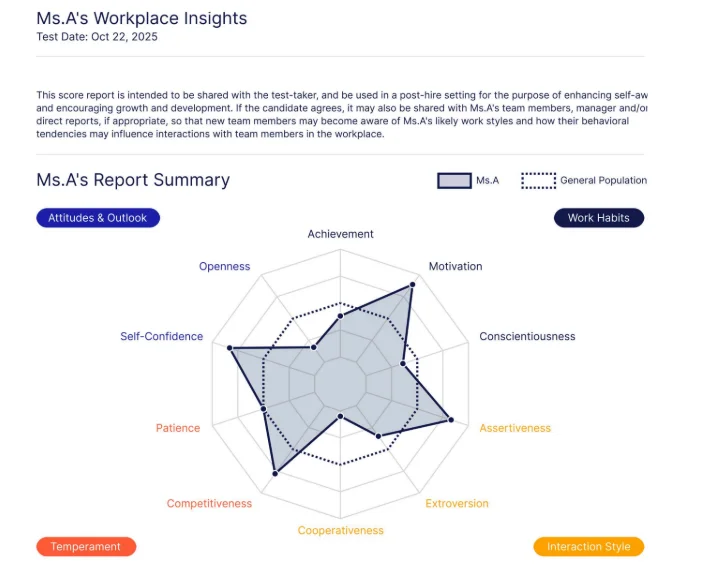
A pre-hire scorecard is a structured interview evaluation tool that scores candidates against role-specific, evidence-based criteria such as skills, cognitive ability, behavior, and performance risk. It helps hiring teams replace gut feeling with consistent, data-backed decisions.
Unlike a resume, which only shows past experience, a scorecard evaluates how a candidate thinks, behaves, and performs.
A comprehensive scorecard, like the Sunbytes Sample, combines four critical “Talent Signals”:
- Cognitive Aptitude (CCAT): Can they perform and learn quickly?
- Personality Profile (EPP): Will they fit the team culture?
- Workplace Productivity (WPP): Are there hidden risks like low integrity?
- Talent Signal: A consolidated, weighted average for easy comparison.
Where a Pre-Hire Scorecard Fits in the Recruitment Process
- Screening validation
- First structured interview
- Technical / leadership interviews
- Final hiring decision alignment
Why Traditional Interviews Fail Without Scorecard
Traditional interviews often fail for one reason: there is no shared definition of success.
Without a scorecard:
- Each interviewer evaluates candidates using their own mental model
- Feedback varies wildly in depth and quality
- Decisions are made based on confidence, charisma, or familiarity
A structured interview scorecard eliminates ambiguity. It brings clarity before interviews begin and consistency during them.
The Purpose of Interview Scorecards in Modern Hiring
Used correctly, interview scorecards serve four essential purposes in modern recruitment:
Scorecards make interviews more structured and less subjective.
They ask hiring teams to decide what success looks like before meeting candidates and to rate everyone using the same standards. Technical skills, problem-solving, behavior, and role fit are carefully measured rather than relying on gut feeling.
Increase hiring success and retention by evidence-based
The Evidence-Based Pre-Hire Scorecard framework, for example, brings together different talent signals like cognitive ability, personality fit, reliability, and performance risk into one process. This helps hiring managers answer important questions clearly:
- Can this candidate perform under real work pressure?
- Will they fit the role, the team, and the delivery environment?
- Are there hidden risks that interviews alone cannot reveal?
This change is important because the best hires are never just one thing. Someone might look great on their resume and seem confident in interviews, but still not have the thinking skills, honesty, or reliability the job needs. Without a structured scoring system and clear signals, these risks often stay hidden until after the person is hired.
Interview scorecards also bring fairness and transparency into the hiring process.
By focusing on observable evidence rather than personal impressions, they reduce unconscious bias and ensure candidates are measured equally. Decisions become explainable, defensible, and repeatable in regulated environments and high-stakes roles.
Accelerate time-to-hire
By identifying strengths, gaps, and risks early, teams can avoid additional interviews, reach an agreement faster, and hire with greater confidence. This leads to fewer hiring mistakes, quicker onboarding, and better long-term results.
How to Use a Pre-Hire Scorecard for Better Talent Assessment

Using a pre-hire scorecard effectively is not about adding another form to the interview process. It is about changing when and how hiring decisions are made.
Most hiring failures happen because teams assess candidates too narrowly, focusing on experience, confidence, or isolated skills while overlooking how people actually think, behave, and perform under pressure. An evidence-based pre-hire scorecard corrects this by guiding hiring managers through a structured, repeatable decision flow.
Step 1 Define Role-Specific Hiring Criteria
The first and most important step occurs before any recruitment process begins.
Instead of relying on generic traits like “strong communicator” or “team player,” hiring teams must define what success in the role looks like. In the Evidence-Based Pre-Hire Scorecard framework, this means aligning criteria with real delivery demands, not job description language.
Effective role-specific criteria typically include:
- Core technical or functional skills required to perform the job
- Behavioral competencies that predict on-the-job performance and reliability
- Cognitive or problem-solving ability, especially for roles requiring learning agility
Each criterion must be measurable and relevant to real outcomes. For example, cognitive aptitude is used early to assess how quickly a candidate can learn and adapt, while behavioral and reliability indicators help surface risks that interviews alone often miss.
When criteria are defined clearly, interviews stop being opinion-driven and start reflecting the actual demands of the role.
Step 2 Design Structured Interview Questions
Once the hiring criteria are clear, interview questions should be designed to deliberately test them.
Structured interview questions create consistency across candidates and interviewers. Instead of improvising, interviewers use a defined set of questions mapped directly to scorecard criteria.
Common formats include:
- Behavioral questions, such as “Tell me about a time when you had to solve a complex problem under pressure.”
- Scenario-based questions that simulate real work situations
- Technical or case-based challenges aligned with role benchmarks
Each question exists for a reason. If a question cannot be linked to a scorecard criterion, it does not belong in the interview. This discipline ensures that interviews collect usable evidence, not just conversation.
Step 3 Interview, Score, and Document Evidence
The interview itself is where objectivity is most often lost and where scorecards add the most value.
During interviews, candidates should be scored against each criterion immediately after the relevant discussion. Interviewers document what the candidate demonstrated, not how they felt about the interaction.
Best practices include:
- Scoring candidates immediately after each interview section
- Recording concrete examples or observed behaviors
- Avoiding discussion with other interviewers until all scoring is completed
This approach preserves independence between evaluations and reduces the risk of groupthink. In evidence-based hiring, documentation is not bureaucracy; it is protection against bias and memory distortion.
Step 4 – Make the Hiring Decision Using Data, Not Gut Feel
Once interviews are complete, hiring decisions should follow the data.
Scores from multiple interviewers are aggregated and reviewed collectively. Instead of debating individual opinions, teams look for patterns across cognitive ability, behavioral fit, and risk indicators. This is where evidence-based scorecards provide a decisive advantage.
Red flags such as low integrity signals, poor cognitive alignment, or inconsistent responses are surfaced early, before offers are made. In the Evidence-Based Pre-Hire Scorecard sample, this approach prevented the hiring of a technically qualified but high-risk candidate whose assessment data revealed issues that interviews missed.
Intuition is not eliminated, but it is reframed. Data leads the decision. Gut feel becomes a secondary signal, used only to validate or question what the evidence already shows.
When applied early in the hiring process, pre-hire scorecards change how decisions are made and what outcomes teams can expect. Organizations reduce costly mis-hires, accelerate time-to-hire, and make fair, defensible decisions that support long-term performance. Most importantly, hiring becomes predictable. Teams stop guessing and start hiring with confidence.
Pros and Cons of Using Interview Scorecards

Interview scorecards can be very effective, but only if you use them with intention. Their value comes from how well they are designed and implemented.
Pros
- Reduced hiring bias
Scorecards help focus decisions on set criteria and clear evidence, moving interviews away from personal impressions and hidden bias. - Higher predictive accuracy
Scorecards that use evidence bring together different signals, such as skills, thinking ability, behavior, and reliability. This makes it easier to predict how someone will perform on the job. - Faster, clearer decision-making
When teams can clearly see strengths, gaps, and risks, they reach agreement faster and avoid dragging out the interview process. - Improved hiring transparency
Documenting and explaining every decision builds trust among hiring managers, leaders, and candidates.
Cons
- Initial setup requires time.
It takes effort at the start to define criteria and benchmarks for each role, but this work saves time later by helping avoid hiring mistakes. - Interviewers need training
If interviewers are not guided, they might score candidates inconsistently or rely too much on gut feeling. - Poor design leads to poor results.
Generic or misaligned scorecards only formalize bad decisions rather than improve them.
Interview scorecards do not, by default, fix hiring. Thoughtful design and consistent use are what turn them into a competitive advantage.
Download the Evidence-Based Pre-Hire Scorecard Sample
The pre-hire scorecard aligns with how hiring managers make decisions and consolidates diverse talent signals into a single, clear framework. This helps teams make decisions based on evidence rather than guesswork. The sample includes insights from cognitive aptitude, personality fit, behavioral reliability, and other talent signals, so hiring teams get a full view that goes beyond just experience and credentials.
What’s inside the sample
- Evaluation criteria based on the role and real job needs
- Clear scoring scales to keep assessments consistent and easy to compare
- Sections to record evidence, helping teams make fair and well-supported decisions
How you can make it your own
You can quickly adjust the scorecard for technical, non-technical, or leadership roles by changing the benchmarks and the weight each part carries, while keeping the main structure the same.
Download the Evidence-Based Pre-Hire Scorecard Sample to move from gut-feeling hiring to confident, data-driven decisions.
Sunbytes – Accelerate and Streamline Your Workforce with Evidence-Based Pre-Hire Framework
At Sunbytes, hiring is a delivery decision, not just an HR formality. It has a direct effect on speed, stability, and long-term results.
For 14 years, Sunbytes has helped international teams Accelerate workforce solutions by quickly and sustainably scaling capacity through recruitment and workforce support. As a Dutch technology company with a delivery hub in Vietnam, we support global organizations that need to grow quickly while maintaining quality and control.
Our evidence-based pre-hire scorecards check interviews against real performance signals, such as how candidates think, behave, and perform under pressure. This shifts hiring from gut feeling to data-backed decisions.
We support this approach with our core delivery foundations:
- Digital Transformation Solutions: real product and engineering insight enables sharper role definitions, better fit, and faster ramp-up.
- Cybersecurity Solutions: Secure-by-Design standards ensure teams scale with reliability, integrity, and compliance in mind.
With Sunbytes, companies do more than add headcount. We build delivery-ready teams that fit in smoothly and grow along with your plans.
FAQs
Yes. Pre-hire scorecards help assess problem-solving ability, cognitive skills, and role-specific competencies beyond technical keywords.
They standardize interview criteria and require evidence-based scoring, minimizing subjective judgments and personal bias.
They are most effective when used consistently across all interview stages, from screening to final hiring decisions.
Yes. Resumes show past experience, but scorecards assess how candidates think, behave, and perform under real job conditions, making them more predictive of success.
Yes. Even small teams benefit because scorecards reduce hiring mistakes and save time by making decisions clearer and faste
Sunbytes’ Pre-Hire Scorecard Sample
Download Sunbytes Pre-Hire Scorecard Sample to helps leaders make confident decisions before the offer is signed