

Creating innovative products goes beyond just having new ideas; it’s about how effectively you can bring those ideas to life. With AI and machine learning transforming various industries, understanding the product development process is essential for any business that aims to remain competitive.
In this guide, we will explore a comprehensive approach to the modern product development life cycle, detailing how AI enhances each stage. From defining your product idea to prototyping, testing, and launching it in the market, here’s how to navigate each step with AI as your ally.
TL;DR
The product development process is how a team turns a customer need into a tested product and a market launch. AI can help teams analyse research, compare options and produce early drafts. Moving to the next stage still requires evidence that a named person has checked.
- Six stages remain: idea screening, concept testing, business analysis, prototyping, validation, and launch followed by feedback.
- AI fits bounded tasks with checkable inputs and outputs, such as grouping interview notes or drafting test cases.
- Human checkpoints approve customer evidence, investment, technical feasibility and release readiness; a working prototype alone does not justify production use.
Essential stages of the product development process
The product development process follows six stages in this guide, with AI supporting the work and a named person approving the evidence at each handoff.
Every successful product follows a structured journey before it reaches the customer. This journey, known as the product development process, consists of several critical stages, each of which AI can enhance.
As AI changes team responsibilities and skill needs, agree who validates each output before the team uses it to make a product decision.
Here’s a look at these stages, how AI fits in, and how you can maximize each phase.
Idea generation and screen
The foundation of any great product is a solid idea. Traditionally, businesses rely on brainstorming sessions, market analysis, and feedback from existing customers to generate ideas. AI can elevate this stage by analyzing large volumes of data to identify trends, customer needs, and potential market gaps.
- How AI enhances idea generation: AI algorithms analyze industry data, social media, customer reviews, and competitor insights to predict market demands.
For instance, in the healthcare sector, AI can identify emerging needs in telemedicine or patient management based on recent trends and data insights - Screening ideas: AI assists in filtering these ideas by evaluating feasibility, market potential, and alignment with your business goals. Through predictive modeling, AI can forecast which ideas are most likely to succeed, saving valuable time and resources.
Where AI helps: Group interview notes and support tickets by recurring problem, then link each theme to its source material. Use only research data approved for the tool.
Human checkpoint: The product manager checks whether the pattern represents the target customer and records which problem deserves concept testing. A repeated phrase without customer context is a research lead.
Concept development and testing
Once you have a viable idea, the next step is to transform it into a product concept. Here, you define who the product is for, what problem it will solve, and how it will stand out in the market.
- AI-powered concept testing: AI tools can simulate different scenarios to test product concepts, helping you understand how potential customers might respond. Machine learning models can run tests on virtual focus groups and analyze responses to ensure the product concept resonates with your target audience.
- Refining the product concept: AI-driven sentiment analysis can evaluate customer reactions to similar products, guiding you in refining your concept based on feedback and expectations.
Where AI helps: Draft alternative user flows and questions for a concept test. Treat simulated responses as assumptions to investigate with customers.
Human checkpoint: Product and design leads validate the concept with target users and define what result would support further investment. A model’s positive response cannot establish customer demand or willingness to pay.
Business analysis and market strategy
Now that the product concept is ready, it’s crucial to determine if it is financially viable. The business analysis stage examines the product’s profit potential, target pricing, and resource requirements. AI streamlines this process, making it faster and more accurate.
- Market forecasting with AI: By analyzing historical data and current trends, AI tools can predict future demand, pricing fluctuations, and potential obstacles. This helps businesses make data-driven decisions about pricing, profitability, and resource allocation.
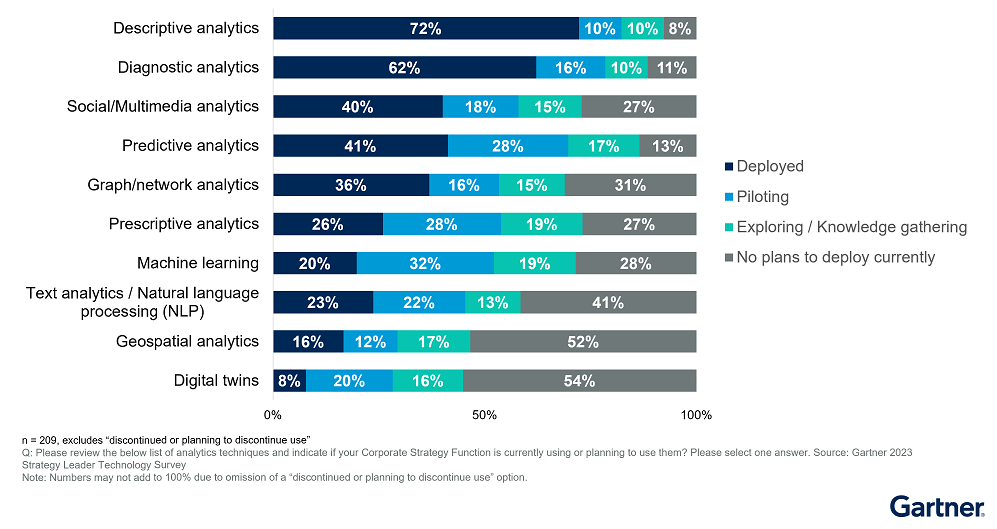
Gartner survey on how companies use AI for their strategy planning & analysis
- Risk assessment: Machine learning algorithms can evaluate risks by analyzing variables like competitor actions, economic shifts, and even customer sentiment, providing a clearer picture of the challenges ahead.
Where AI helps: Compare scenarios using assumptions the team provides, such as expected adoption and delivery capacity. Keep the inputs visible so finance can challenge the output.
Human checkpoint: Finance and the product lead approve the business case and downside scenario before engineering capacity is committed. Where historical data is weak, record the uncertainty instead of presenting the forecast as a prediction.
Product development and prototyping
After you’ve developed a solid concept and a compelling business case, it’s time to turn that vision into reality. This is where the magic of design and engineering combine to craft a working prototype that embodies your idea.
- AI in prototyping and design: With AI helping to refine prototypes quickly, it optimizes designs for both usability and cost, ensuring every detail is just right.
- Vibe coding lets teams describe a workflow in natural language and generate an early software prototype. Use the result to test the concept before committing to a production design.
- Simulated testing: By pinpointing flaws before any physical model is built, this not only saves time and resources but also allows your team to iterate quickly, minimizing the need for multiple physical prototypes.
Where AI helps: Generate interface variants or a small workflow for a prototype, using test data in an isolated environment.
Human checkpoint: The engineering lead checks feasibility, integrations and which prototype components can be retained. Separate the concept decision from permission to expose the software to customers.
When an AI-built prototype is being considered for production, our guide to AI-generated code in production explains why a review is needed before release.
Product testing and validation
Once your prototype is polished, the next crucial step is to confirm that it meets the necessary quality standards and satisfies the needs of your customers. This phase is all about rigorous testing to ensure the product’s functionality, durability, and safety.
- Enhanced testing with AI: Artificial intelligence comes to automate everything from software tests to assessing the durability of physical products. Machine learning can uncover trends in the testing data, highlighting potential issues that might slip through the cracks in manual assessments.
- User feedback analysis: Another great application of AI is in analyzing customer feedback from early versions or beta releases. This empowers you to make swift changes grounded in real user experiences.
Where AI helps: Draft test cases from requirements and group defects by affected workflow. Have QA review the proposed tests before treating their results as evidence.
Human checkpoint: QA and product leads check acceptance criteria and unresolved defects; the appropriate technical or security owner approves risks within their remit. If AI also powers a live feature, assess its outputs against a separate set of representative cases.
Market launch and commercialization
The last leg of the product development journey is launching it into the marketplace. At this point, your attention shifts to marketing strategies, distribution channels, and capturing initial feedback from your customers.
- AI-driven launch strategies: AI offers valuable insights for crafting effective marketing strategies by analyzing customer demographics, identifying optimal launch windows, and crafting tailored messages. Monitoring customer responses in real time further allows for on-the-fly adjustments to enhance the launch strategy.
- Sales forecasting and inventory management: Machine learning can also play a pivotal role in anticipating demand variances after launch, helping you keep inventory in check and logistics running smoothly, all while avoiding overproduction.
Where AI helps: Analyse beta feedback and draft launch messages, with the final copy checked against verified product capabilities.
Human checkpoint: The product lead and engineering or operations owner approve the release scope and support handoff. Name who monitors the launch and who can pause it, then feed actual usage and customer feedback into the next iteration.
AI across the product development process at a glance
Across six stages, AI can prepare inputs for a decision, while a human checkpoint determines whether the team has enough evidence to proceed. Use the risk column to decide what the reviewer must challenge.
| Stage | AI use | Human checkpoint | Risk to challenge |
|---|---|---|---|
| Idea screening | Group research themes | Product manager checks customer evidence | A frequent theme hides the wrong customer segment |
| Concept testing | Draft flows and test questions | Product and design leads validate with target users | Simulated approval is mistaken for demand |
| Business analysis | Compare assumption-based scenarios | Finance and product lead approve the business case | Weak inputs create a convincing forecast |
| Prototyping | Generate an early workflow | Engineering lead checks feasibility and reuse | A working demo is treated as production-ready |
| Validation | Draft tests and group defects | QA, product and relevant risk owners check acceptance | AI-written tests repeat the build’s assumptions |
| Launch | Analyse feedback and draft messages | Product and operations owners approve the handoff | Nobody owns monitoring or a decision to pause |
How to introduce AI into your product development process
Introduce AI into one bounded workflow, with a reviewer and a baseline for comparison. The useful benefit is a shorter path to a checked decision, measured alongside the correction work the AI output creates.
Start where the team already has material to assess, such as interview notes, prototype feedback or test requirements. Agree what the AI should produce and who will check the result before the first trial. Keep customer validation and investment approval with the people accountable for those decisions.
Record the time spent preparing and reviewing the work, plus the corrections needed. Compare those measures with the existing workflow. If preparation becomes faster but review effort rises, narrow the task or change the inputs before expanding AI use.
Set data limits before sharing research with a tool. For Dutch and EU teams processing personal data, GDPR Article 5(1)(c) requires data minimisation. Removing unnecessary identifiers is one practical step; the team must also check whether the tool is approved for the intended data use.
Expand only when the trial meets the agreed quality criteria without adding unacceptable review work. Carry the reviewer, evidence requirements and data rules into the next workflow.