

An NDA covers confidentiality. It does not decide who can enter production, whether a developer may download customer data, or how quickly access disappears when an engagement ends. Those controls must exist before the first sprint. IT staff augmentation security is the set of contractual, technical and operating controls that govern how external developers access code, systems and personal data while the client retains day-to-day delivery control. A secure engagement gives every access right an owner, every exception an approval path and every security claim evidence that the client can review.
TL;DR
- Secure IT staff augmentation requires role-based access, managed identities, peer review, incident escalation and tested offboarding before sprint one.
- GDPR Article 28 applies when the provider acts as a processor. Netherlands-Vietnam data access may also require Chapter V safeguards such as Standard Contractual Clauses.
- ISO/IEC 27001 certification supports due diligence only when the certificate is current, its scope covers the delivery operation and the vendor can show operating evidence.
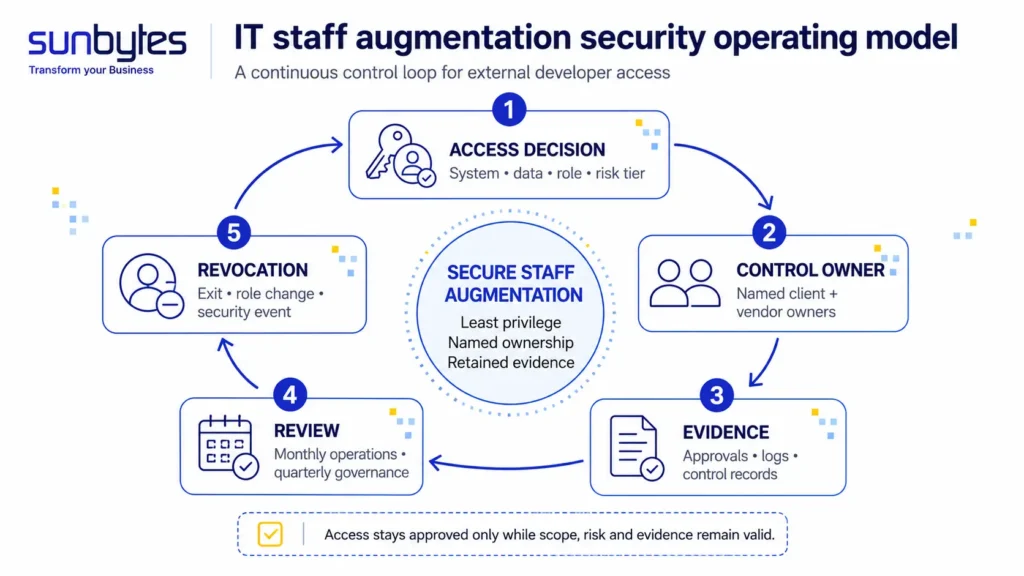
What secure IT staff augmentation requires
Secure IT staff augmentation requires a written responsibility split before onboarding. The client should retain authority over data classification, architecture, access approval, production release and risk acceptance. The provider should be accountable for the people, devices and operating evidence it controls.
That split matters because staff augmentation differs from managed outsourcing. External engineers join the client’s delivery system and work under the client’s priorities. If you are still defining the model itself, the IT staff augmentation complete guide explains the control and management differences.
A workable responsibility model has three layers:
- Client-owned decisions: which repositories and environments the role needs, whether production access is allowed, which data categories may be used, who accepts exceptions and who reports a personal data breach to the supervisory authority.
- Vendor-owned controls: identity verification, confidentiality commitments, security training, managed-device controls, joiner and leaver processes, and timely escalation when vendor personnel or systems are involved in an incident.
- Shared operating controls: code review, secure development rules, incident exercises, access reviews, evidence collection and offboarding confirmation.
The client cannot outsource accountability for its own systems. The provider cannot treat security as the client’s problem simply because the client directs daily work. Before signing, use a broad staff augmentation provider checklist to confirm commercial and delivery fit, then apply the security evidence matrix later in this guide.
The access model: who gets access to what
The access model should connect every permission to a named role, system owner and expiry condition. “Developer access” is too broad. A backend engineer may need a source repository, a development database and selected logs, but no standing access to billing data or the production console.
Start with four access zones: collaboration tools, source code and CI/CD, non-production infrastructure, and production or sensitive data. For each zone, document the allowed role, authentication method, approval owner, logging requirement and removal trigger.
Five controls do most of the work:
- Give each person an individual identity. Shared accounts remove attribution and make offboarding unreliable.
- Require SSO and multi-factor authentication where the platform supports them. Privileged access should use a separate administrative identity.
- Default to no production access. Grant time-bound access for an approved task when production work is necessary.
- Keep secrets outside source code and local files. Use an approved secrets manager and record who can retrieve each secret.
- Review access after every role change and at least quarterly for long-running engagements. Remove access at the agreed end time, then record completion.
Access control also depends on team routines. The client engineering lead must know who approves pull requests, who can change pipeline rules and where exceptions are recorded. The guide to managing augmented IT teams covers the post-onboarding ownership and review cadence in more detail.
GDPR and processor obligations
GDPR obligations depend on the actual processing relationship, not the label “staff augmentation.” The first step is to determine whether the provider processes personal data on behalf of the client or only supplies personnel who act under the client’s direct authority.
The European Data Protection Board’s controller and processor guidance explains that these roles follow the parties’ real activities and decision-making. A vendor does not become a processor merely because its employee joins a sprint. A vendor may be a processor when its organisation processes personal data for the client under documented instructions. Legal and privacy teams should confirm the role before the contract is signed.
When the provider is a processor, GDPR Article 28 requires a binding contract that defines the subject, duration, purpose, data types, data subjects and the parties’ rights and duties. The processor must also provide sufficient guarantees for appropriate technical and organisational measures. Article 32 then connects those measures to the risk, including confidentiality, integrity, availability and the ability to restore access to personal data.
The DPA should cover documented instructions, confidentiality, security measures, subprocessor approval, support for data-subject requests, incident support, deletion or return of data, and the client’s right to receive compliance information. The IT staff augmentation contract guide explains where those requirements sit beside IP ownership, liability, replacement and offboarding terms.
Netherlands-Vietnam data access
Remote access from Vietnam needs a separate transfer check when EU personal data is made available to an organisation outside the EU or EEA. GDPR Chapter V requires an approved transfer mechanism and safeguards that continue through onward transfers.
The European Commission provides Standard Contractual Clauses for EU to non-EU transfers. The due-diligence file should identify the correct SCC module, the data exporter and importer, subprocessors, transfer locations, security measures and any additional safeguards identified by the transfer assessment. A DPA and SCCs solve different parts of the problem; one does not replace the other.
This section provides operational due-diligence guidance, not legal advice. The client’s DPO or legal counsel should approve the role assessment and transfer mechanism for the real data flow.
ISO 27001 evidence to ask from a vendor
Ask for the certificate first, then test whether its scope matches the engagement. ISO/IEC 27001 certification is evidence of an audited information security management system, not a guarantee that every developer, delivery hub or client environment is covered.
The official standard is ISO/IEC 27001:2022. A useful certificate check records the legal entity, certified locations and services, issue and expiry dates, certification body, accreditation status and current surveillance cycle. “ISO aligned” and “certified to ISO/IEC 27001:2022” are not equivalent claims.
Request operating evidence for the controls that will affect the engagement:
- the joiner, mover and leaver procedure for assigned developers;
- an access-control and privileged-access procedure;
- security training records for the people in scope;
- managed-device, encryption, patching and endpoint-monitoring requirements;
- the secure development and peer-review process;
- the incident classification, contact and escalation workflow;
- the subprocessor register and change-notification process;
- a redacted risk or control summary that shows how supplier delivery is monitored.
A vendor may reasonably protect internal audit reports and detailed security architecture. Accept a redacted document, a controlled review under NDA or an auditor’s attestation when the alternative still proves the control. Refusal to provide any evidence is different from protecting sensitive evidence.
For organisations in scope, NIS2 Article 21 adds supply-chain security to cybersecurity risk management. NIS2 does not apply to every buyer or every staff augmentation engagement, but its supplier-risk logic is a useful due-diligence reference for companies that must show how external access is governed.
If augmented developers will access source code, production systems or client data, security belongs in the engagement design. Sunbytes can help define the access model, DPA, onboarding controls and ISO-guided delivery process before sprint one.
Due diligence checklist before onboarding developers
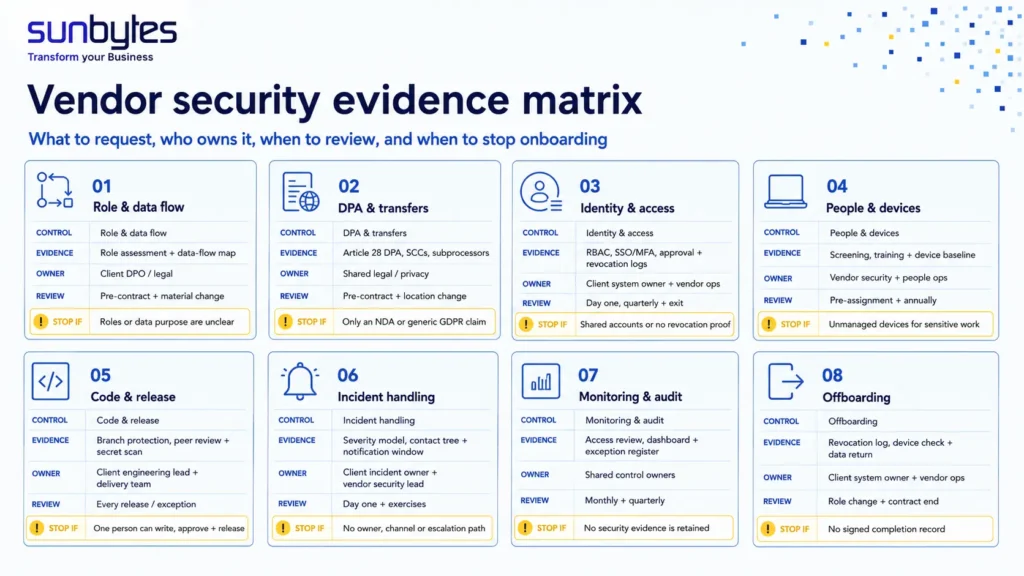
The due-diligence review should end with an evidence register, not a collection of yes/no answers. Each control needs an artefact, an owner, a review point and a condition that blocks onboarding.
Security evidence matrix
| Control area | Evidence to request | Ownership | Review point | Block or clarify if |
|---|---|---|---|---|
| Processing role and data flow | Role assessment, system and data-flow map, data categories | Client DPO or legal; vendor privacy owner | Before contract and after a material change | The parties cannot explain who processes which data or why |
| DPA and transfer safeguards | Article 28 terms, SCC module where needed, subprocessor list, transfer assessment | Shared legal and privacy ownership | Before contract; when locations or subprocessors change | The vendor offers only an NDA or a generic “GDPR compliant” statement |
| Identity and access | Role-access matrix, SSO and MFA configuration, approval and revocation records | Client system owner; vendor operations | Before day one, quarterly and at exit | Shared accounts exist or access removal cannot be evidenced |
| People and devices | Screening policy where lawful, confidentiality terms, training record, device security baseline | Vendor security and people operations | Before assignment and annually | Developers use unmanaged devices for sensitive work without approved controls |
| Code and release | Branch protection, peer-review rules, secret scanning, exception workflow | Client engineering lead; shared delivery team | Every release or approved exception | One developer can write, approve and release a high-risk change alone |
| Incident handling | Severity model, contact tree, contractual notification window, evidence-preservation process | Client incident owner; vendor security lead | Before day one and during exercises | “Notify as soon as possible” has no owner, channel or escalation path |
| Monitoring and audit | Access-review record, control dashboard, exception register, available attestations | Shared control owners | Monthly operations review; quarterly governance review | Security is discussed but no evidence is retained |
| Offboarding | Access revocation record, device and secret check, data return or deletion, handover confirmation | Client system owner; vendor operations | At role change and contract end | The engagement can end without a signed completion record |
Do not ask every vendor for the same depth of evidence. A developer limited to public test data and one repository does not need the same review as a platform engineer with privileged cloud access. Increase the evidence requirement when access, data sensitivity or production impact increases.
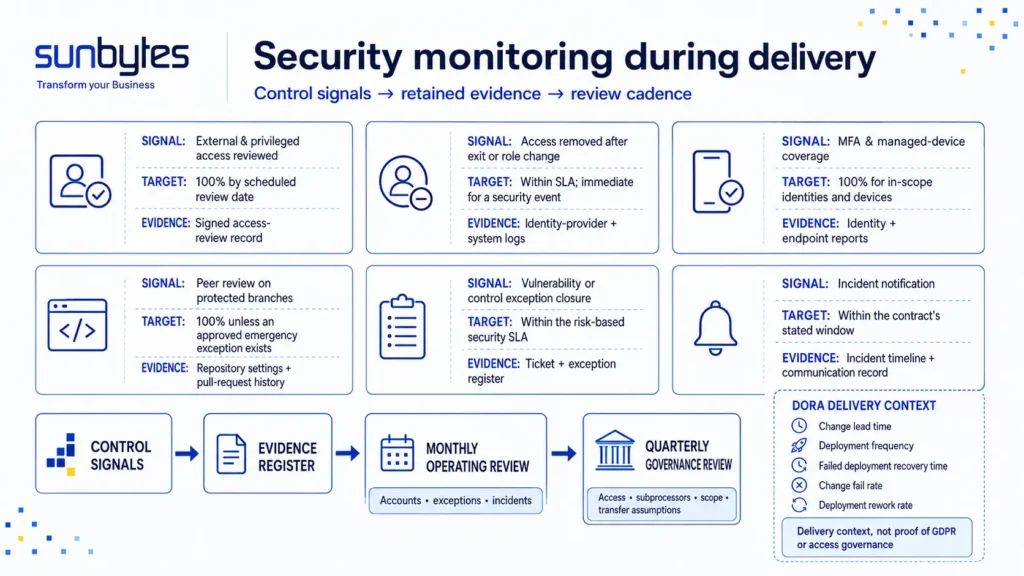
How to monitor security during delivery
Monitor security with retained evidence and agreed thresholds, not with a quarterly assurance call. The monthly operating review should cover account status, control exceptions and incidents. A quarterly governance review should confirm that access, subprocessors, delivery scope and transfer assumptions still match the engagement.
Use a small set of control signals:
| Signal | Example operating target | Evidence |
|---|---|---|
| External and privileged access reviewed | 100% by the scheduled review date | Signed access-review record |
| Access removed after exit or role change | Within the contractual SLA; immediate for a security event | Identity-provider and system logs |
| MFA and managed-device coverage | 100% for in-scope identities and devices | Identity and endpoint reports |
| Peer review on protected branches | 100% of changes unless an approved emergency exception exists | Repository settings and pull-request history |
| Vulnerability or control exception closure | Within the risk-based SLA defined by severity | Ticket and exception register |
| Incident notification | Within the contract’s stated window | Incident timeline and communication record |
These are example operating targets, not legal thresholds. Set the final values according to the system’s risk, the client’s incident process and the contract.
DORA metrics add a second view. DORA’s five software delivery performance metrics track throughput and deployment instability, including change lead time, deployment frequency, failed deployment recovery time, change fail rate and deployment rework rate. They show whether security controls are creating avoidable delivery friction or whether unstable releases are increasing. DORA metrics do not prove access governance, GDPR compliance or incident readiness, so keep the security dashboard separate.
The operating model is working when evidence arrives without a special request, expired access is zero at review time and overdue security exceptions have named owners and dates. If the same exception survives two governance reviews, the response should change the control or restrict the access, not move the due date again.
How Sunbytes supports secure IT staff augmentation
Sunbytes builds the security operating model into team setup before access is granted. Dedicated senior developers or teams can become operational in 2 to 4 weeks, with Netherlands-based accountability and a Vietnam delivery hub that provides 4 to 5 hours of working-day overlap.
Sunbytes has delivered more than 300 projects over 15+ years and has been certified to ISO/IEC 27001 since 2024. Where Sunbytes acts as a processor, the engagement can include an Article 28 DPA and the transfer safeguards required for the approved data flow. ISO-guided delivery and DORA-tracked outcomes add evidence at operating level: named access owners, documented decisions, reviewable logs and a completed offboarding record.
FAQs
Revoke identities and tokens, remove repository and cloud access, rotate exposed secrets, recover or wipe managed devices, confirm data return or deletion, and complete the knowledge handover. The client and vendor should retain a dated completion record rather than treat offboarding as an informal HR step.