

Your first leader in Vietnam will run a business that your headquarters oversees primarily through reports and site visits. Hiring the right country manager for that role starts with naming the job, building, selling or scaling, followed by four steps your headquarters owns: the mandate, a retained search, an assessment on two tracks, and a package and work permit settled before the offer.
This guide is for the CEO, COO or HR director at headquarters who makes that appointment, whether for a new Vietnamese entity or to replace the leader of an established subsidiary. It covers what the role holds under Vietnamese law, the three jobs the title can cover, the choice between a local and an expat leader, the five traits to test for, the hiring steps, the first 90 days and how to employ your leader before your entity is registered. For the wider picture of senior hiring in the country, see our guide to headhunting in Vietnam.
TL;DR
Before the offer, your headquarters settles three things: which job the leader is hired for, a written mandate with signing authority and budget limits, and an assessment that tests every finalist on two fronts, how they will run the Vietnamese business and how they will report to you. For an expat, the work permit route is confirmed before the offer, not after.
- Which job: a country manager in Vietnam is hired as a builder (set-up), a seller (revenue) or a scaler (structure); local or expat is decided within that choice.
- Profile: a strong first leader has run a P&L or a site, has reported to a headquarters abroad, holds the relationships your business needs, works in English and Vietnamese, and can build the team below them.
- Package and permit: base salary, bonus and allowances are planned as one total, and an expat needs a work permit under Decree 393/2026/ND-CP, which applies from 5 December 2026.
- No entity yet: a Vietnamese country manager can be employed through an Employer of Record until your entity exists; for a foreign national, the route is checked first.
What a country manager in Vietnam is responsible for
A country manager in Vietnam runs your Vietnamese business day to day and answers to your headquarters for its results: the profit and loss account, licences and dealings with authorities, major customers and suppliers, and the local team.
The internal corporate title can differ from the official legal designation. Internally the role may be called country manager, managing director or general manager. In the charter of a Vietnamese company, the executive role is Director or General Director (Giám đốc or Tổng giám đốc), and that is the title the authorities see.
A third role sits alongside these: the legal representative, who signs and acts for the company. Under Article 12 of the Law on Enterprises 2020, every company must have at least one legal representative residing in Vietnam, and a sole legal representative who is away for more than 30 days must authorise another person in writing. Your country manager can hold this role. Whether they do changes what they can sign alone and what they are personally liable for, so the answer belongs in the mandate.
Decide which of three jobs you are hiring for

The title country manager can cover three different jobs, and the profiles for each overlap only in part. Name the stage your Vietnamese business is in before you write the mandate, because that stage decides who belongs on the shortlist.
- The builder. Nothing exists yet. This leader sets up operations, hires the first team, deals with authorities, licences and landlords, and is comfortable with ambiguity and administrative work. Look for a strong operator; experience in a smaller company, where they ran several functions at once, is a useful signal.
- The seller. The entity exists and the job is revenue. This leader brings sector relationships, an existing customer base and credibility with Vietnamese buyers. Administration might not be their strongest suit, which is acceptable as long as a dedicated finance or operations lead handles day-to-day execution.
- The scaler. As the business matures, it requires stronger structures: processes, reporting, middle management and governance. Look for experience building these inside a larger or multinational organisation, and test whether the finalist wants to work without the infrastructure they are used to.
Local or expat is a second decision within that job. A local leader fits when the job depends on local relationships and authorities; an expat fits when your headquarters’ systems and culture have to be installed first.
| Factor | Local country manager | Expat country manager |
|---|---|---|
| Market access | Brings existing relationships with customers, industrial-zone boards and licensing authorities | Builds relationships from the start; needs local managers or advisers around them |
| Package structure | Base salary, bonus and any 13th-month payment | Base salary and bonus plus allowances such as housing, schooling and home travel |
| Work permit | Not required for a Vietnamese national | Work permit or exemption certificate required before the start date |
| Succession | Can grow a local deputy over time | Needs a named local successor if the role is to localise |
An expat’s permit route has to be confirmed before the offer, and if your entity is not registered yet, the employment route for a foreign national is checked separately under Decree 393/2026/ND-CP. Pay levels for both sides are covered in our article on manager salaries in Vietnam.
The profile that works for a foreign company’s first leader in Vietnam
A foreign company’s first leader in Vietnam has to run a business and keep a distant headquarters informed, so the profile combines general management with cross-border reporting. Whichever of the three jobs you hire for, five traits separate the finalists, each with evidence you can ask for and a warning sign.
Has run a P&L or a site, not only a function
Your first leader in Vietnam sets up and runs the business, so look for someone who has owned a profit and loss account or managed a site, not only led one function. A sales director may never have handled finance, HR or licensing.
Ask for the last budget they owned and an example of how they balanced revenue goals with cost controls. A track record described only in sales targets or team size, with no view of margin, cash or compliance, is the warning sign.
Has reported to a headquarters abroad
A country manager who has reported to a foreign headquarters understands matrix management: they are used to monthly reviews, dotted-line reporting to regional functions and approval processes that run across time zones. That experience matters because your headquarters will see the Vietnamese business mainly through their reports.
Ask to see a monthly report they wrote for a previous headquarters, with confidential details removed. If the answer is that their reporting went only to a local owner, probe how they would handle your review cycle.
Holds the relationships the business needs
The relationships that matter depend on your business: major customers, the industrial-zone management board for a plant, licensing authorities, banks and suppliers. Your country manager either holds them or knows how to build them.
Assess this through references, not claims. Ask the finalist to name three relationships they built in previous roles, then check two of them with former managers or partners. An inability to provide verifiable references is a major red flag, however impressive the claimed network appears.
Works in English, Vietnamese and ideally your HQ language
English is the minimum working language for a country manager who reports to a foreign headquarters, and Vietnamese is needed for daily work with the team, customers and authorities. A third language such as Japanese, Korean or Dutch helps with headquarters, but each extra language requirement narrows the shortlist.
Decide before the search starts whether your HQ language is required or only preferred, and test English in the case presentation rather than in small talk.
Can build the team below them
The first hires below your country manager, such as a finance lead, an operations or plant lead and an HR lead, can come from the country manager’s own network, so their ability to attract people is part of what you are hiring.
Ask who they would approach first and how they would handle a non-solicitation clause with their current employer. A plan to rebuild the whole team from one former employer carries legal and relationship risk.
Appointing your first leader in Vietnam? Our recruitment team can help you define the mandate and the profile before the search starts. See our recruitment services.
How to hire a country manager in Vietnam: 5 steps
Hiring a country manager in Vietnam takes five steps: define the mandate, run a retained search, assess for the market and for headquarters, build the package, and plan the work permit for an expat. Your headquarters owns each step, even when a search partner runs the search.
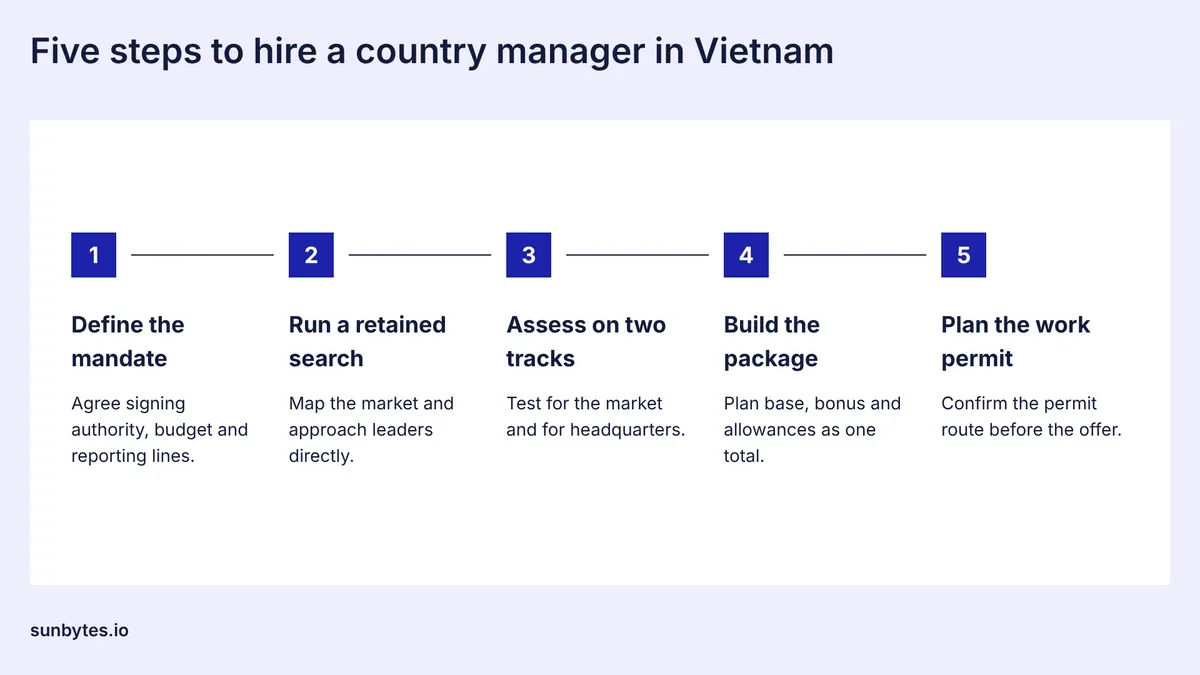
Define the mandate and reporting lines
The mandate is the written agreement, made before the search starts, on what your country manager can decide alone: signing authority, budget limits, hiring rights and reporting lines, including any dotted lines to regional functions.
Have one brief signed off by headquarters and, where one exists, the regional head or local managing director, and state whether the role holds the legal representative position. If the mandate changes after the shortlist, finalists assessed against the old version have to be assessed again.
Run a retained search
A retained search is an exclusive search for one senior role: the search partner maps the market, approaches leaders who are not actively looking and delivers a written assessment of each finalist. A leader who already runs a business in Vietnam may not respond to job advertisements, so the approach has to be direct and confidential.
Agree the target companies, the confidentiality rules and the shortlist format before the search starts. Our guide to headhunting in Vietnam explains how retained and contingency search differ.
Assess for the market and for headquarters
Assess each finalist on two tracks: how they will run the business in Vietnam, led by a regional head, local managing director or trusted adviser, and how they will work with your headquarters, led by your CEO or COO.
Add a case presentation on a real question from your business, such as the first-year plan for your Vietnamese entity, and take two references per finalist from former managers rather than peers they chose. Your headquarters then compares finalists on the same evidence instead of on interview impressions alone.
If your headquarters is in the EU, the assessment notes and references you receive are personal data under the GDPR. Share them through a controlled channel and keep them no longer than the appointment needs, in line with the storage-limitation principle in Article 5(1)(e) of the GDPR.
Build the package
The package works as a total, not as a base salary with extras added at the end: base salary, bonus, any 13th-month payment and allowances, plus housing, schooling and home travel for an expat where your policy covers them.
A 13th-month payment is not a legal requirement. Under Article 104 of the Labour Code 2019, bonuses are set by the employer; once a 13th-month payment is written into the contract, it becomes an agreed term. Current pay levels are in our article on manager salaries in Vietnam.
Plan the work permit for an expat hire
An expat country manager needs a Vietnamese work permit, or a certificate confirming an exemption, before starting work. From 5 December 2026, the rules are set by Decree 393/2026/ND-CP, which replaces Decree 219/2025/ND-CP.
The decree sets criteria per job position; for an executive director, the experience requirement drops from three years to two. The 90-day short-term exemption does not replace a permit for a leader your Vietnamese entity employs and pays. Which permit route applies is a question to settle before the offer; our article on the Vietnam work permit covers the procedure.
C-level recruitment in Vietnam: what changes above GM level
C-level recruitment in Vietnam adds more people with a say in the appointment and stricter confidentiality. For roles such as the CEO of a joint venture or a group CFO, the appointment can need approval from the Board of Directors or Members’ Council, and from both partners if a joint venture agreement reserves that decision.
Replacing an incumbent executive requires strict confidentiality, which limits the candidate pool and the outreach methods. If your joint venture agreement names reserved matters, check whether senior appointments are among them before the search starts. For the wider approach to these roles, see our article on recruiting C-level executives.
Hiring a country manager before you have an entity
A Vietnamese country manager can start before your entity is registered: an Employer of Record (EOR) employs them in Vietnam on your behalf, holding the labour contract, payroll and statutory registrations, while you direct the work.
For a foreign national, the route needs checking first. Decree 393/2026/ND-CP requires employers to use foreign workers for their own direct needs and not to lease them to another organisation, which affects whether an expat can be employed through an EOR. Our article on hiring a senior manager without an entity explains the full set-up, and our Employer of Record services page sets out what the EOR handles.
Once your entity is registered, two decisions follow: whether your country manager becomes its legal representative, and whether their employment moves from the EOR to the entity.
Executive onboarding: the first 90 days

Executive onboarding for a new country manager in Vietnam runs in three phases: meet the people the business depends on, agree targets and reporting with headquarters, then make the first hires and decisions. These phases describe your leader’s first quarter, not the hiring process.
Days 1–30: meet authorities, customers and the team
In the first 30 days, your country manager meets the people the business depends on: the local team, major customers and suppliers, and the authorities that matter for your business, such as the industrial-zone management board for a plant.
A visit to headquarters, or a visit from your CEO, in this first month shows both sides how the reporting line works in practice. The month ends with your leader’s written view of what they found.
Days 31–60: agree targets and reporting with HQ
Between days 31 and 60, your country manager and headquarters agree the targets for the year and the reporting rhythm: which numbers, how often and in which format, using the written view from the first month as input.
This phase also tests how the mandate’s decision rights work in practice: which purchases, hires and contracts still need headquarters approval. Under Article 25 of the Labour Code 2019, probation for an enterprise manager can last up to 180 days, so the probation review can test these targets.
Days 61–90: first hires and first decisions
From day 61 to day 90, your country manager makes the first hires below them, which can include a finance lead and an operations or plant lead, and the first decisions that show how they lead.
By day 90, can your headquarters name who leads each function in Vietnam, and is the agreed monthly report arriving on time?
How Sunbytes helps you appoint your country manager
Your country manager has to work for your market and for your headquarters, and Sunbytes runs the search with both in view. For critical management-level roles we use headhunting: targeted sourcing, then validation through role-based assessments, specialist interviews or reference checks where deeper evidence is useful.
Your headquarters receives a decision-ready summary for each finalist, with strengths, risks and open questions, so your HQ and local interviewers compare the same evidence. Your team interviews the finalists, selects the leader and approves the offer. Leader and client information stays within Sunbytes’ ISO 27001-certified information security management system, which matters when a search has to stay confidential.
If your entity is not registered yet and your new leader is Vietnamese, we can employ them through our Employer of Record service until your entity is ready. Sunbytes is Dutch-founded and has run its own business in Vietnam since 2011, so the questions in this guide are ones we have answered for ourselves. Our recruitment team advises on approach and cost per role: talk to our recruitment team.