SandGrain
Dedicated team for a cloud platform supporting business services
Security Systems Services I Netherlands I 7-person team I 4-year engagement (from 2023)

The Clients
- Industry:
- Security Systems Services
- Location:
- Netherlands
- Delivery model:
- Dedicated team
- Duration:
- 4 years (from 2023)
- Team size:
- 7
- Support areas:
-
Develop their cloud platform software & Hire and manage engineering teams - Platform context:
-
A secure cloud infrastructure with immutable hardware tokens—hard-coded ICs providing post-quantum-resilient authentication.

The challenge
SandGrain needed to build a robust cloud data platform from the ground up while managing multiple technical and operational challenges:
• Developing a cloud platform software from scratch
• Managing the full lifecycle: assembly, deployment, and management
• Aligning cloud architecture with business needs
• Ensuring security and maintainability throughout development
Dealing with a similar setup? Let’s discuss your requirements.
What the client needed
SandGrain needed to turn a security-focused concept into a scalable cloud platform while maintaining speed, quality, and reliability.

A secure, scalable cloud platform
Build a strong technical foundation capable of supporting high-assurance IoT environments.
A faster path from concept to product
Move quickly towards a working platform without compromising security or system reliability.
Multidisciplinary engineering capability
Bring together the development, quality, testing, and DevOps expertise needed to support delivery.

Continuous product development
Keep extending and validating the platform as requirements and functionality evolved.
What Sunbytes Delivered
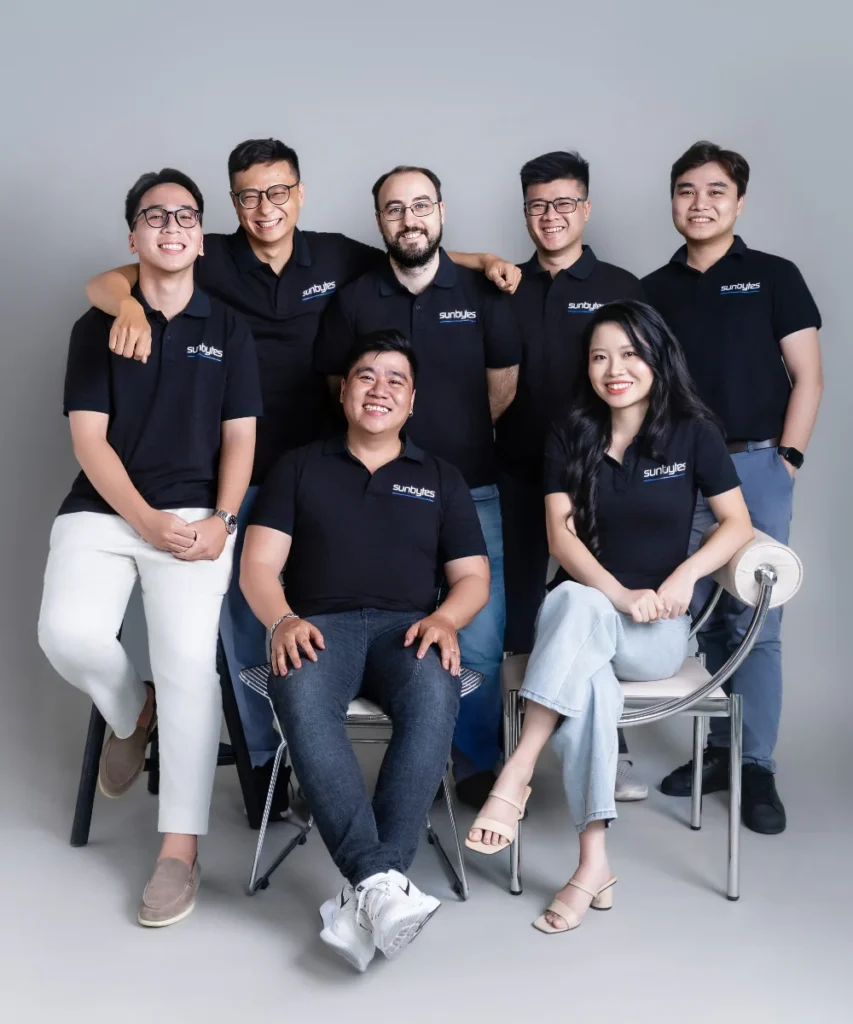
Sunbytes assembled a dedicated engineering team to build, test, and continuously improve SandGrain’s cloud platform.


Platform architecture & development
Designed and developed the core platform architecture and backend capabilities.Cloud infrastructure & DevOps
Built the infrastructure and delivery processes needed to support reliable deployment and scalability.Quality & security engineering
Combined security reviews, code quality practices, testing, and validation throughout development.Ongoing platform development
Continued extending functionality while supporting documentation, delivery coordination, and technical improvement.


Want to see if the fit is right for your team?
Why teams choose Sunbytes
A Netherlands-led delivery partner for stable dedicated teams, clear ownership, and roadmap capacity that can scale without resetting context.
Roadmap-first team design
Your team is shaped around roadmap goals, product context, skill gaps, and delivery risks—so capacity matches the work, not a generic squad template.
Product ownership stays with you
You keep backlog, priorities, acceptance, and product decisions; Sunbytes supports execution rhythm, quality, continuity, and team performance.
Stable team context
Dedicated teams retain product knowledge across releases, reducing repeated onboarding, handoff loss, and context rebuilds between roadmap phases.
Governance that fits your workflow
Sprint planning, review cadence, DORA metrics, risk tracking, and monthly service reviews are adapted to your delivery model—not forced into one process.
Continuity built into the model
Structured handover, documentation, replacement support, and performance check-ins protect delivery when team composition needs to change.
Secure cross-border delivery
ISO 27001-certified operations, GDPR-aware processes, access governance, and Vietnam delivery capacity help your team scale with stronger control.
What the team covered
The engagement combined engineering, quality, DevOps, and delivery coordination across the platform.

Sprint-based delivery & coordination
Planning, alignment, and delivery management to keep development moving against agreed priorities.Full-stack & backend development
Development of core platform functionality across application and backend components.Cloud infrastructure & DevOps engineering
Infrastructure, CI/CD, deployment, and operational support for the platform.QA, testing & code quality
Structured testing and quality practices to support reliable releases and sustainable development.Technical documentation & platform evolution
Documentation and ongoing improvements as the platform and its requirements continued to develop.


Outcomes
The collaboration resulted in:
-
Rapid prototype delivery
A functional prototype was delivered after just three sprints, giving SandGrain an early working version of the platform to validate and develop further.
This helped move the product from initial concept into an active development cycle quickly, without waiting for the full platform to be completed first.
-
Continuous product development
New functionality was continuously added, tested, and refined throughout each development sprint as the platform evolved.
This iterative approach supported ongoing product expansion and resulted in 15 releases, allowing new capabilities to be introduced progressively rather than through one large delivery.
-
Faster development velocity
A stable dedicated team across development, QA, testing, DevOps, and project management helped maintain momentum throughout the engagement.
With the team structure remaining consistent, SandGrain was able to improve development velocity while continuing to extend, validate, and strengthen the platform over time.
-
Successful platform launch
The cloud platform progressed from an early prototype to a successfully launched production solution, supported by continuous development and structured quality validation.
Across the engagement, the team delivered 15 releases, fixed 196 bugs, created 3,380 test cases, and automated 1,777 test cases, providing a stronger quality foundation for continued product development.





In their words
“Their commitment and engagement are impressive. Purely based on mutual trust Sunbytes started to assemble the team at their own risk even before we had our seed investment signed. When that happened we could make a flying start. Also the way they organize the Teams-as-a-Service is very effective, where we were especially impressed by their rigorous hiring process to select the best candidates in a very short term.”
Pieter Hooijmans
CTO, SandGrain
See also
- Dedicated Resources
IT staff augmentation from Vietnam: what European companies need to know
Vietnam is a delivery-fit decision before it is a rate decision. For European companies, IT staff augmentation from Vietnam works when internal product ownership is strong, senior external engineers can enter an existing delivery system, and the working day creates enough shared time for decisions. The location is a poor fit when the buyer expects […]
- Dedicated Resources
IT staff augmentation security: ISO 27001, GDPR and vendor due diligence
An NDA covers confidentiality. It does not decide who can enter production, whether a developer may download customer data, or how quickly access disappears when an engagement ends. Those controls must exist before the first sprint. IT staff augmentation security is the set of contractual, technical and operating controls that govern how external developers access […]
- Dedicated Resources
Building a security-first engineering culture in distributed teams
A security-first engineering culture is an operating model in which developers can see who owns a security decision, when a review is required and where the result must be recorded. It is not a slogan, a yearly course or a request for every engineer to become a security specialist. That distinction matters across locations. A […]
- Dedicated Resources
How many DevSecOps engineers does a mid-size SaaS need?
The useful DevSecOps team size question is not “How many security engineers should we hire?” It is “Which security responsibilities need continuous ownership, and how much capacity does that work require?” Two SaaS companies with 100 employees can need very different setups. One may run a single product on one cloud platform. The other may […]
- Dedicated Resources
In-house vs outsourced DevSecOps: cost, risk and speed comparison
The wrong DevSecOps operating model creates work in the place it was meant to remove. An internal hire can become a single point of dependency. An external team can generate findings without giving developers a clear remediation path. This in-house vs outsourced DevSecOps comparison focuses on the decision that matters: which model gives your company […]
- Dedicated Resources
IT Staff Augmentation Contract: What to Include and Watch Out For
An IT staff augmentation contract is not just a capacity order. It is the document that decides who controls delivery once an external developer has access to your codebase, your customer data, and your sprint board. Most disputes in staff augmentation engagements trace back to one of five gaps: vague scope, unclear IP assignment, missing […]






Download the full case study!
Get the complete story—challenge, delivery setup, scope, outcomes, and the full testimonial.