

Most growing companies reach a point where standard software no longer fits. Processes become fragmented, teams rely on workarounds, and scaling introduces more friction than speed. The problem isn’t a lack of tools. It’s that those tools weren’t designed around how your business actually operates. Left unresolved, this leads to operational blind spots, rising costs, and systems that quietly limit growth.
This article will brief CEOs and founders on what custom software development is, when it becomes necessary, and how it turns business ideas into scalable digital solutions without adding unnecessary complexity.
TL;DR
- Custom software development delivers digital solutions designed around your business model, workflows, and growth strategy, unlike off-the-shelf tools that force standardisation.
- Companies typically need custom software when existing systems no longer scale, integrations become complex, or workarounds create operational and strategic risk.
- A structured custom software development process—from discovery and architecture to development, deployment, and maintenance—reduces risk and improves long-term ROI.
- Modern custom software relies on cloud-native architecture, API-first design, automation, and strong security and compliance foundations to support scalability.
- Choosing the right custom software development partner is critical and depends on technical expertise, transparent processes, clear IP ownership, and the ability to scale with your business.
What is Custom Software Development?
Custom software development is the process of designing, building, and maintaining software specifically for your business. Instead of adapting your operations to fit a packaged tool, the software is shaped around your workflows, data flows, and strategic priorities. The goal is not feature volume, but fit, scalability, and control.
In practice, custom software development can take many forms:
- Web applications that support customer-facing platforms or internal operations
- Enterprise systems that connect departments, data, and decision-making
- Internal tools that replace manual processes and reduce operational friction
- SaaS platforms built as scalable, revenue-generating products
- Integrations and APIs that connect legacy systems, third-party tools, and data sources
At its core, custom software development is a design discipline as much as a technical one. It starts with understanding the business problem, then translating that into a system that is reliable, scalable, and aligned with long-term goals.

Why Companies Choose Custom Software Development
Companies choose custom software when standard tools start creating friction instead of progress. The main drivers are typically:
- Scalability built by design: Custom software is architected to grow with your business—supporting more users, data, and processes without constant rework or platform limitations.
- Alignment with unique workflows and business models: The system reflects how your organisation actually operates, eliminating workaround culture and reducing manual effort across teams.
- Competitive advantage and strategic control: Ownership of the codebase, roadmap, and data removes dependency on vendor decisions and protects internal intellectual property.
- Security, compliance, and data governance: Custom solutions can be designed to meet industry-specific regulatory, privacy, and security requirements without retrofitting constraints.
- Long-term cost efficiency and ROI: While upfront investment is higher, custom software avoids escalating license fees, forced upgrades, and costly customisations over time.
Compare Custom Software Development to Off-The-Shelf Software
The decision between custom software and off-the-shelf tools is less about technology and more about fit, control, and long-term impact. Both have their place—but they serve very different stages of a company’s growth.
What is Off-the-Shelf (COTS) / packaged software
Off-the-shelf (or packaged) software is built for a broad market. It’s designed to solve common problems quickly, with predefined features, pricing tiers, and vendor-controlled roadmaps. For early-stage or standardised needs, this approach can be efficient. The trade-off is limited flexibility.
Key differences
| Aspect | Off-the-Shelf Software | Custom Software Development |
| Time to launch | Fast initial setup | Longer upfront, planned rollout |
| Customization | Limited, configuration-based | Built around your exact needs |
| Scalability | Constrained by vendor limits | Designed to scale with growth |
| Integrations | Often restricted or paid add-ons | Seamless, API-driven by design |
| Control & ownership | Vendor-controlled | Full ownership of code & roadmap |
| Vendor dependency | High | Low |
| Long-term cost | Increases with users & features | More predictable over time |
As organisations expand across markets, teams, and systems, off-the-shelf tools tend to fragment operations. Integrations become brittle, licensing costs escalate, and critical workflows bend around product limitations. What once felt “simple” turns into a hidden operational tax.
Custom software addresses this by designing the system around the business, not the other way around. For leadership teams, the shift is about moving from convenience to control, ensuring technology supports strategic direction, regulatory obligations, and long-term value creation.
When does your company need custom software?
Custom software becomes relevant when growth exposes the limits of standard tools. Not as a theoretical upgrade but as a practical response to friction that keeps repeating. Leadership teams usually recognise the need when several of the following signals appear at the same time:
- Your business processes no longer fit standard software: Core workflows require constant workarounds, manual steps, or parallel tools to get work done.
- Integrations start to break or multiply: Data is scattered across systems, reporting becomes unreliable, and teams spend time reconciling information instead of acting on it.
- Scaling increases friction instead of efficiency: Adding users, customers, or markets slows the organisation down rather than accelerating delivery.
- Security, compliance, or data ownership becomes critical: Regulatory requirements, customer expectations, or internal risk standards demand tighter control than packaged tools can offer.
- Licensing and customisation costs keep rising: What started as a low-cost solution becomes expensive as usage grows, features are gated, or vendor lock-in deepens.
In most cases, companies don’t start with custom software. They arrive there when growth demands systems designed for how the business actually operates—today and tomorrow.

The Custom Software Development Process (from Idea to Live Product)
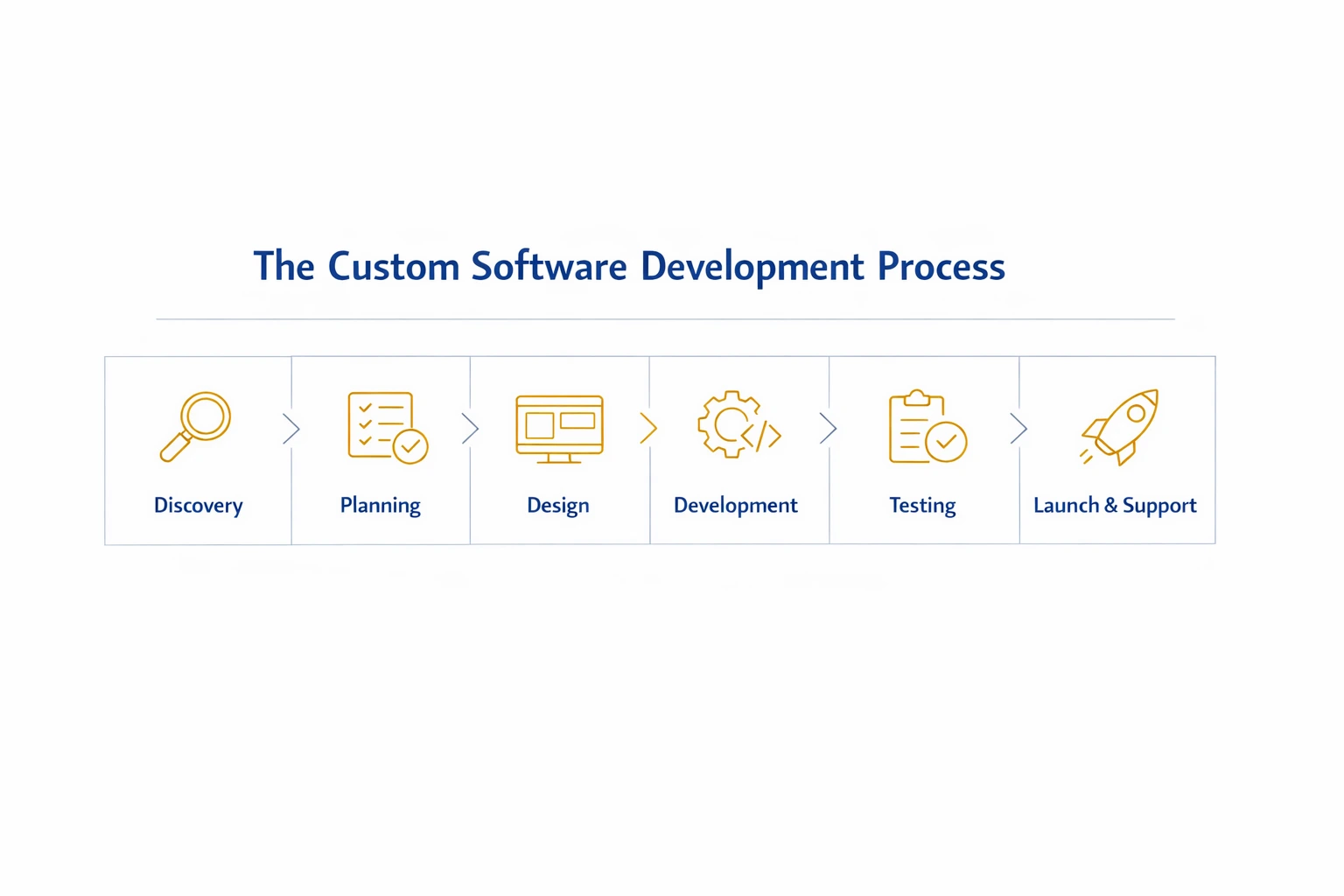
Ideation and Market Analysis
This phase clarifies what should be built and why. Business goals, user needs, constraints, and success metrics are aligned before technical decisions are made. For non-technical leaders, this is where assumptions are tested and scope is shaped into a realistic, prioritised roadmap.
Solution Design & Architecture
Based on discovery, the system architecture is designed to support scalability, security, and future change. Technology choices are made deliberately—cloud setup, integrations, data models—so the product can grow without structural debt.
Development & Testing
The software is built iteratively, with regular checkpoints and feedback loops. Testing is embedded throughout the process to ensure reliability, performance, and security, reducing surprises late in the project.
If your custom software initiative includes a mobile product, the development lifecycle involves additional considerations around UX, performance, and platform requirements. Our Mobile Application Development Step-by-Step Guide in 2025 walks through this process in more detail.
Deployment & Go-Live
Once validated, the software is deployed into production with controlled rollouts and monitoring. This phase focuses on stability, user adoption, and operational readiness—not just “shipping.”
Maintenance & Continuous Improvement
Custom software is not a one-time delivery. Ongoing maintenance, performance optimisation, and feature evolution ensure the system continues to support business growth as requirements change.
When done right, the custom software development process provides leaders with clarity, predictability, and control—turning technology into a managed asset rather than an ongoing risk.
Emerging Trends in Custom Software Development
Custom software development continues to evolve as businesses demand more scalability, resilience, and speed—without sacrificing control. For leaders, these trends aren’t about chasing innovation for its own sake, but about building systems that remain viable under pressure.
- Cloud-native and microservices architectures: Modern custom software is increasingly built as modular, cloud-native systems. This allows teams to scale individual components independently, deploy faster, and reduce the risk of system-wide failures.
- API-first and integration-driven ecosystems: Businesses now operate across multiple platforms and tools. API-first design ensures custom software can integrate cleanly with partners, legacy systems, and third-party services—without brittle connections.
- AI, automation, and data-driven functionality: From process automation to intelligent decision support, AI and data layers are becoming embedded into custom systems—not as add-ons, but as core capabilities that improve efficiency and insight.
- Low-code / no-code as augmentation, not replacement: Low-code tools are increasingly used to accelerate specific workflows or internal tools. When governed correctly, they complement custom development rather than replacing it.
- Security, compliance, and regulatory readiness by design: Rising regulatory demands and customer expectations mean security and data privacy are no longer afterthoughts. Modern custom software is built with compliance, auditability, and risk management embedded from day one.
For a broader executive-level view of what’s shaping the software landscape, see our analysis of the Top Software Development Trends to Watch in 2025.
How the Software Development Lifecycle Reduces Delivery Risk
The software development lifecycle explains how the custom software process is governed and controlled.
While the process focuses on alignment, milestones, and delivery, the SDLC defines how quality, security, and change are managed throughout development. It provides structure—so progress doesn’t come at the cost of reliability or risk exposure.
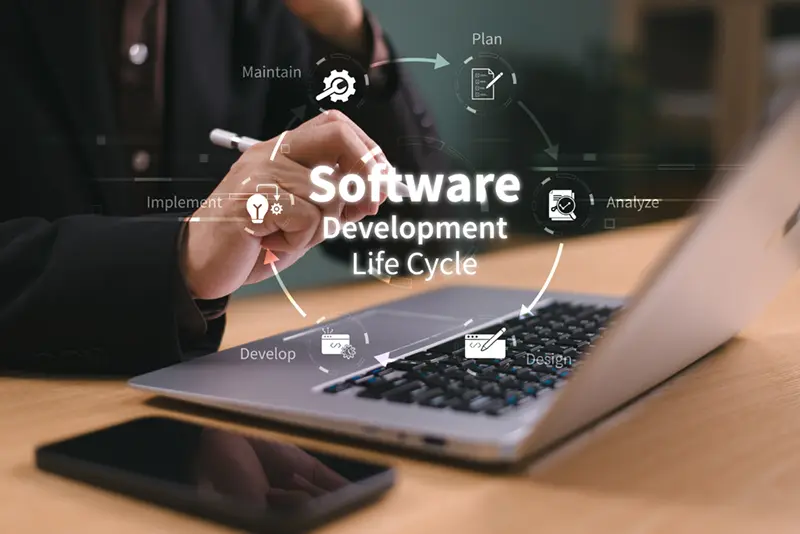
For leadership teams, the SDLC is what turns software development from ad-hoc execution into a repeatable, accountable system. A disciplined lifecycle typically includes six core stages:
- Planning & requirements: Business objectives, success criteria, scope boundaries, and constraints are defined to prevent misalignment later.
- Design: System architecture, data flows, and user experience are structured to support scalability, security, and maintainability.
- Development: Features are built incrementally, allowing progress to be measured and priorities adjusted without derailing the roadmap.
- Testing & quality assurance: Functional, performance, and security testing ensure the system behaves as expected under real-world conditions.
- Deployment: The software is released into production in a controlled manner, with monitoring and rollback plans in place.
- Maintenance & evolution: Ongoing updates, performance optimisation, and enhancements keep the system aligned with changing business needs.
In house vs Outsourcing Software Development: Which fits your business?
Once the decision to build custom software is made, leadership faces a second question: who should build it. There is no universal answer—only trade-offs that become clearer when viewed through scale, speed, and control.
In-House Software Development
Building an internal team offers direct oversight and deep product knowledge. It works well when software is core to the business and the organisation is ready to invest long-term in hiring, retention, and engineering management.
However, in-house development comes with structural constraints:
- Long hiring cycles and limited access to specialised skills
- High fixed costs across salaries, benefits, tooling, and management
- Slower ability to scale up or down as priorities change
For many companies, these constraints become visible precisely when speed and flexibility matter most.
Outsourcing Software Development
Outsourcing shifts delivery to an experienced external partner, providing faster access to talent and proven processes. This model is often chosen to accelerate delivery, reduce operational overhead, or supplement internal capabilities.
Key advantages include:
- Immediate access to multidisciplinary teams and specialised expertise
- Predictable cost structures and faster time-to-market
- Scalability without long-term hiring commitments
The trade-off is not control—but how control is exercised. Successful outsourcing relies on clear ownership, transparent communication, and mature delivery processes.
For many SMEs and scale-ups, the most effective approach is hybrid: keeping strategic ownership and product direction in-house, while partnering externally for execution and scale. The right choice depends on how critical speed, flexibility, and internal focus are to your growth strategy.

For a deeper breakdown of outsourcing models and when to use them, see Software Development Outsourcing: Everything You Need to Know.
Choosing the Right Custom Software Development Partner: A checklist for CEOs
Choosing a development partner is less about finding a team that can code—and more about finding one that can translate business intent into a system that scales. At this stage, the wrong choice doesn’t just slow delivery; it compounds risk over time.
Use the checklist below to evaluate partners from a leadership perspective:
Proven expertise beyond delivery
Look for partners who understand architecture, scalability, and trade-offs, not just implementation. They should be able to explain why a solution works—not just how it’s built.
Clear communication and transparency
You should have visibility into progress, risks, and decisions at all times. Mature partners communicate early, document consistently, and don’t hide behind technical language.
Process maturity and quality assurance
A reliable partner operates with defined processes for development, testing, deployment, and change management. This is what keeps timelines predictable and quality consistent.
Security, compliance, and IP ownership
Ensure security and data protection are designed in from the start—not added later. Ownership of source code and intellectual property must be clear and contractually defined.
Scalability of teams and engagement models
Your partner should be able to scale with your roadmap—whether through project-based delivery, dedicated teams, or hybrid models—without forcing you into a rigid structure.
Red flags to watch for:
- Vague estimates or unclear pricing models
- Little to no documentation or testing approach
- Unclear ownership of code, data, or decisions
- Overpromising speed without addressing risk
Essential questions every CEO should ask:
- How will you ensure this system scales as the business grows?
- How do you manage risk, delays, and changing requirements?
- Who owns the source code and long-term roadmap?
- How do you guarantee knowledge transfer and continuity?
The right partner provides structure, accountability, and confidence—so technology supports growth instead of introducing new uncertainty.
Build custom software development with Sunbytes
Custom software succeeds when business intent and technical execution stay aligned over time. That’s where many projects fail, and where Sunbytes is deliberately positioned to operate.
Sunbytes supports SMEs across Europe and America in turning complex business ideas into scalable digital systems. Not through one-off delivery, but through structured collaboration, from early technical consultancy to long-term team building and system evolution.
Why Sunbytes:
- End-to-end capabilities: From discovery and architecture to development, scaling, and maintenance—one partner, one accountable system.
- Proven track record: With 14+ years of experience, 300+ projects, we help European partners, especially Dutch businesses, build scalable, secure software products.
- Flexible engagement: Project-based delivery, dedicated teams, or hybrid models—adapted to your stage, speed, and level of control required.
Unlock the right software solution for your business. Contact us to get a strategic consultation tailored to your software project’s vision.
FAQs
A typical custom software project takes:
- 3–4 months for an MVP
- 6–12 months for a full-feature product
- 12+ months for complex, large-scale systems
Timelines depend on requirements clarity, integrations, team size, and the development approach. Discovery and planning phases significantly reduce delays and rework, especially for non-technical founders.
The first step is a discovery or consultation phase, where you clarify business goals, define user needs, identify technical requirements, and map out risks or constraints. This phase typically results in a system blueprint, project timeline, and cost estimate—giving the leadership team a clear direction before any development begins.
Choose off-the-shelf if you need something fast, low-cost, and standardised.
Choose custom software if your workflows are unique, scaling is a priority, integration is critical, or packaged tools force you into workarounds that slow down operations.
Many companies start with off-the-shelf but switch to custom solutions once they outgrow limitations or when long-term licensing becomes more expensive than owning the technology.
Let’s start with Sunbytes
Let us know your requirements for the team and we will contact you right away.


