

Most teams don’t fail at building MVPs—they fail earlier, when they choose the wrong way to validate. A landing page where execution risk mattered, a half-built product where demand was still uncertain, or worse, months of engineering spent proving what a simple test could have revealed in weeks. The result is familiar: slow learning, false confidence, and leadership making product decisions on incomplete signals. MVPs are meant to reduce risk, but without the right approach, they quietly introduce new ones.
This article will walk you through the proven types of MVP, explain when each one actually works, and help you choose the right MVP approach to validate faster, spend smarter, and build with confidence.
If you’re new to MVPs or want a deeper breakdown of what an MVP really is, how it’s built, and what it typically costs, this guide on MVP development provides a practical foundation.
TL;DR
- MVP types are validation strategies, not smaller products — choosing the right type determines whether you test demand, usability, or monetization at the right stage.
- Low-fidelity MVPs reduce market risk early, while high-fidelity MVPs reduce execution risk later, helping teams avoid overbuilding and false signals.
- The best MVP type depends on business risk, budget, market complexity, and team readiness.
- Teams that align MVP type with strategy learn faster, spend smarter, and build products with a higher chance of success.
How Do MVP Maturity Levels Work?
MVP maturity levels describe how teams move from testing demand to proving real product value. At early stages, the goal is to validate whether a problem is worth solving at all—before any meaningful engineering effort begins. As confidence increases, MVPs become more sophisticated, shifting focus to how users interact, stay engaged, and ultimately pay. This progression is what separates low-fidelity MVPs that test demand before building from high-fidelity MVPs that validate usability, retention, and revenue.
Low-Fidelity MVPs: Validate Demand Before You Build
Low-fidelity MVPs are designed to answer one critical question early: Does anyone actually want this? Instead of writing code, teams test demand through signals like clicks, sign-ups, replies, or pre-orders. This approach helps validate problem relevance, messaging, and market interest with minimal time and cost. When used correctly, low-fidelity MVPs prevent teams from investing in products that look good on paper but fail to generate real demand.
High-Fidelity MVPs: Validate Usability, Retention, and Revenue
High-fidelity MVPs come into play once demand is no longer the question and execution becomes the risk. These MVPs introduce real product experiences, allowing teams to observe how users interact, where they struggle, and whether they return or pay. The focus shifts from interest to behavior—usability, retention, and monetization signals that determine if the product can actually scale. Built at the right moment, high-fidelity MVPs turn early validation into confident product decisions.
What Are Low-Fidelity MVP Types for Concept-First Validation?
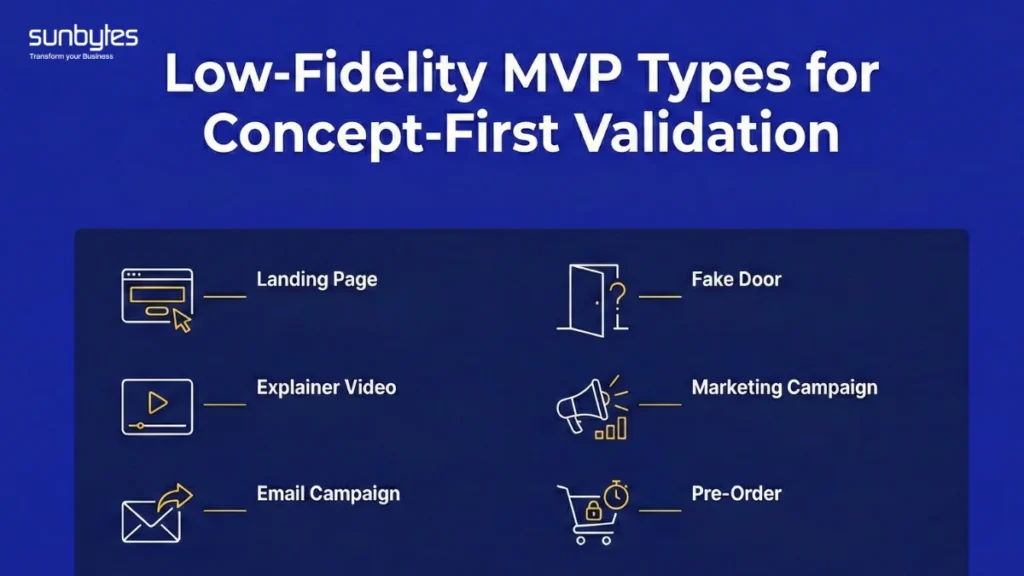
Landing Page MVP
A landing page MVP tests whether people are interested enough to take action, such as signing up for a waitlist or requesting a demo. It helps validate the value proposition, positioning, and target audience without building the product itself.
Use case
- Early-stage product ideas
- Testing positioning, messaging, or target audience
- Validating demand before design or engineering begins
Pros
- Fast and inexpensive to launch
- Clear, measurable demand signals
- Easy to iterate messaging
Cons
- Does not validate usability or product experience
- Interest does not always translate into long-term usage
Explainer Video MVP
An explainer video MVP communicates the idea and outcome of the product in a short, visual format. It is especially effective for complex or unfamiliar concepts, allowing teams to measure interest and understanding before investing in development.
Use case
- Complex or novel product concepts
- Products that require education before adoption
- Early stakeholder or investor validation
Pros
- Clarifies value quickly
- Effective for complex ideas
- Can be reused across channels
Cons
- Measures interest, not behavior
- Quality of results depends heavily on storytelling
Email Campaign MVP
An email campaign MVP tests demand by reaching a clearly defined audience and measuring engagement through opens, replies, or conversions. It is commonly used in B2B contexts to validate problem urgency and buying intent early.
Use case
- B2B products or niche markets
- Validating problem urgency and buyer interest
- Testing early offers or positioning
Pros
- Direct feedback from real prospects
- Low cost and fast execution
- Strong qualitative insights
Cons
- Limited scalability
- Results depend on list quality and segmentation
Fake Door MVP
A fake door MVP measures interest by presenting a feature or product option that does not yet exist and tracking user interaction. It helps teams prioritize what users actually want, rather than what internal stakeholders assume matters.
Use case
- Feature prioritization
- Testing demand for new capabilities
- Reducing internal assumption bias
Pros
- Reveals real user intent
- Helps prioritize roadmap decisions
- Minimal build effort
Cons
- Requires careful communication to avoid frustration
- Does not validate full user experience
Marketing Campaign MVP
A marketing campaign MVP tests messaging, channels, and positioning using ads or content before a product is built. It reveals which narratives resonate with the market and whether the problem is compelling enough to attract attention.
Use case
- Validating problem-market fit
- Testing messaging and channels
- Assessing scalability of demand
Pros
- Real-world market signals
- Scalable and data-driven
- Supports GTM strategy early
Cons
- Requires marketing expertise
- Ad performance may not equal product adoption
Pre-Order MVP
A pre-order MVP validates willingness to pay by asking users to commit financially before delivery. It provides one of the strongest demand signals and helps confirm pricing assumptions, market confidence, and early traction.
Use case
- Testing willingness to pay
- Validating pricing assumptions
- Building early traction and confidence
Pros
- Strongest demand signal
- Validates pricing early
- Attracts stakeholder and investor confidence
Cons
- Requires clear expectation management
- Pressure to deliver once payment is taken
What Are High-Fidelity MVP Types for Execution-First Validation?
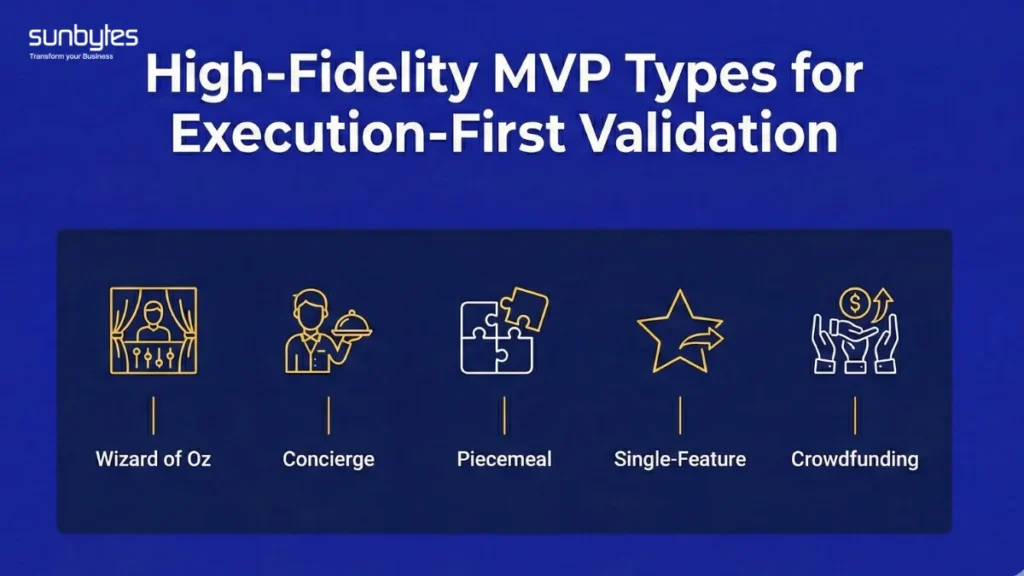
Wizard of Oz MVP
A Wizard of Oz MVP looks like a fully functional product from the user’s perspective, but key processes are handled manually behind the scenes. This allows teams to test complex workflows and user behavior before investing in full automation.
Use case
- Products involving automation, AI, or complex logic
- Validating workflows before building infrastructure
Pros
- Real user experience without full build
- Deep insight into user behavior
- Lower technical risk early on
Cons
- Not scalable
- Operationally intensive for the team
Concierge MVP
A concierge MVP delivers the service manually and in a highly personalized way, with no attempt to hide human involvement. It helps teams deeply understand user needs, expectations, and edge cases before designing a scalable product.
Use case
- B2B or service-heavy products
- Early-stage products requiring close user interaction
Pros
- Rich qualitative insights
- Strong customer relationships
- Clear understanding of value drivers
Cons
- Time-consuming
- Difficult to scale beyond a small user base
Piecemeal MVP
A piecemeal MVP combines existing tools and platforms to replicate the core product experience. Instead of building from scratch, teams assemble a functional solution to validate workflows and user adoption.
Use case
- Internal tools or process-driven products
- Fast validation with limited engineering resources
Pros
- Fast to launch
- Cost-efficient
- Reduces technical complexity
Cons
- Limited customization
- Potential integration constraints
Single-Feature MVP
A single-feature MVP focuses on delivering one core capability that represents the product’s primary value. It helps determine whether that single use case is strong enough to justify further investment.
Use case
- SaaS or platform products
- Validating the core differentiator
Pros
- Clear scope and focus
- Faster development
- Easier to measure success
Cons
- May oversimplify the full user journey
- Limited insight into secondary use cases
Crowdfunding MVP
A crowdfunding MVP validates demand by asking the market to financially support the product before it exists. It combines demand validation, pricing testing, and marketing traction in one approach.
Use case
- Consumer products or platforms
- Market-driven validation and early traction
Pros
- Strong proof of demand
- Early funding and visibility
- Built-in audience validation
Cons
- High expectation management
- Public failure risk if demand is weak
How Do You Choose the Right Type of MVP for Your Product?

The right MVP aligns validation effort with business uncertainty, ensuring teams learn what truly matters before committing more time and capital. This decision should be guided by budget, market complexity, team readiness, and the level of confidence required from stakeholders and investors.
Budget and Speed-to-Validation Constraints
Budget and time determine how much risk you can afford to take upfront. When runway is limited or decisions need to be made quickly, low-fidelity MVPs help validate demand with minimal investment. As budget and timelines expand, higher-fidelity MVPs become viable to test deeper product assumptions without rushing into full-scale development.
Market Complexity and Buying Journey
Different markets require different validation approaches. Consumer products often benefit from fast, signal-based MVPs, while B2B and enterprise solutions require validation across longer buying cycles, multiple stakeholders, and higher trust barriers. The right MVP type should reflect how decisions are made and how long it takes customers to commit.
Internal Capabilities and Team Readiness
The strength and maturity of your team directly impact which MVP types are realistic. High-fidelity MVPs require solid engineering, UX, and delivery discipline to avoid creating technical debt or misleading results. When these capabilities are limited, starting with low-fidelity MVPs reduces execution risk while building internal alignment and confidence.
This is why many teams struggle when they jump straight into building; understanding the pros and cons of MVPs helps avoid common execution traps. Read our blog: Build an MVP: Pros, Cons, and What Real MVPs Get Right.
Stakeholder and Investor Buy-In Requirements
Not all MVPs are built solely for learning—some are built to create confidence. Executives, boards, and investors often need tangible proof that a product can work, not just evidence of interest. Choosing an MVP type that balances learning with credibility helps align internal teams, secure buy-in, and support informed decision-making at critical moments.
Need Help Choosing and Building the Right MVP?
Choosing and building the right MVP is rarely just a product decision—it’s a business risk decision. Sunbytes supports teams by helping them select the MVP type that matches their goals, market uncertainty, and investment horizon, rather than defaulting to overbuilt solutions.
With dedicated software development teams, product discovery support, and execution discipline, Sunbytes helps organisations validate faster, build smarter, and avoid costly rework as they move from idea to scalable product.
Explore more about Why MVPs Built with Dedicated Software Development Teams Succeed Faster.
Why Sunbytes (Transform · Secure · Accelerate)
Sunbytes is a Dutch technology company with delivery teams in Vietnam, and for more than 14 years, we’ve helped international organisations navigate early product decisions by selecting and building MVP models that fit their goals, constraints, and level of uncertainty. The focus isn’t on following trends, but on matching the MVP approach to what actually needs to be validated.
This work is strengthened by how MVP design is supported beyond development alone:
- With Cybersecurity Solutions, security considerations are addressed early so MVPs don’t introduce hidden risks as they evolve
- Accelerate Workforce Solutions ensure teams can apply the right skills at the right stage, whether testing demand, usability, or technical feasibility, so MVP learning translates into confident next steps.
For teams evaluating different types of MVP models, Sunbytes provides the structure and experience needed to choose, build, and validate the approach that best supports scalable product outcomes. Schedule a free consultation so we can support you to choose the right type of MVP.
FAQs
Startups typically benefit most from low-fidelity MVPs early on, as they validate demand and problem relevance with minimal cost before committing to development.
Yes. Enterprises often use low-fidelity MVPs to test new ideas, features, or markets internally before securing larger budgets or cross-team alignment.
SaaS products often start with landing page, fake door, or single-feature MVPs, then progress to high-fidelity MVPs to validate usability, retention, and pricing.
Let’s start with Sunbytes
Let us know your requirements for the team and we will contact you right away.


