
An idea feels promising. The market seems ready. Investors ask when you’ll ship. So the pressure builds to just build something.
That’s where many founders lose control—either by building too little to learn anything, or too much before validating what actually matters. Time and capital get spent proving assumptions that were never tested.
MVP development is the structured way out of that uncertainty. It’s not about launching fast or cutting corners, but about validating demand, reducing risk, and making informed decisions before scaling. This guide explains what an MVP really is, how to build one, and what it truly costs, so you move forward with evidence, not guesswork.
TL;DR
- MVP (Minimum Viable Product) development is about learning, not launching, it helps founders validate assumptions, test real demand, and reduce risk before scaling.
- A well-designed MVP delivers concrete benefits early: faster validated learning, lower upfront investment, clearer stakeholder alignment, stronger investor and customer conversations, and earlier feedback based on real usage.
- Building an MVP requires ruthless focus on the core problem, key assumptions, and measurable success criteria.
- MVP development cost depends on scope, complexity, and team model, but the real risk is investing in the wrong product, not the MVP itself.
- Sunbytes helps design and build MVPs , so you can validate faster, avoid overbuilding, and move forward with confidence.
What is an MVP?
An MVP (Minimum Viable Product) is the simplest version of a solution that allows you to test a critical business assumption with real users.
MVP development is about learning as fast as possible with the least amount of risk. Instead of asking “What can we build?”, it asks “What do we need to learn first?”—about demand, value, behaviour, or willingness to pay.
At its core, an MVP gives founders/product owners evidence to answer one question early: Should this product be built, iterated, pivoted, or stopped?

MVP vs. Prototype vs. PoC: What’s the Difference?
While the terms are often used interchangeably, an MVP, a prototype, and a Proof of Concept (PoC) are designed to answer very different questions. Understanding the difference helps founders choose the right approach at the right stage—before time and budget are committed.
| Aspect | Prototype | Proof of Concept (PoC) | Minimum Viable Product (MVP) |
| Purpose | Visualise ideas and test usability | Validate technical feasibility | Validate business value and demand |
| Completeness | Partial and non-functional | Functional but limited in scope | Functional product with minimal features |
| Focus | Design, user flow, and experience | Technology and system viability | Core user problem and value proposition |
| User Interaction | Internal users or test sessions | None or internal testing only | Real users in real scenarios |
| Development Effort | Low | Medium | Medium to high (but controlled) |
| Risk Mitigation | Reduces design and usability risk | Reduces technical risk | Reduces market and business risk |
| Iteration | Fast and informal | Limited, technical iterations | Continuous, data-driven iterations |
| Example Scenario | Mocking up an app to test navigation | Testing whether AI can process data at scale | Launching a basic product to test user adoption |
Choosing the wrong approach—such as building an MVP when a PoC is needed, or overusing prototypes when validation is required—often wastes time, money, and momentum.
What are the characteristics of an MVP?
A Minimum Viable Product is defined by intent and discipline—not by how “small” it looks. A strong MVP shares the following characteristics:
- Focused on one core problem: An MVP targets a single, clearly defined user problem. Every included feature exists to validate a specific assumption about value or behavior.
- Designed for learning, not perfection: The primary goal is insight. An MVP prioritises evidence and feedback over completeness or polish.
- Functional and usable: Unlike prototypes, an MVP works in real conditions. Users can interact with it meaningfully, allowing teams to observe actual behavior.
- Deliberately incomplete: Non-essential features are intentionally excluded. This keeps scope tight, reduces cost, and shortens feedback loops.
- Built for iteration: An MVP is structured to evolve. Insights gathered inform whether to iterate, pivot, or scale without reworking the entire product.
- Aligned with a clear decision point: Every MVP should answer a defined business question, helping founders move forward with clarity rather than assumptions.
What are the 3 elements of MVP in Software Development?
An MVP only works when all three elements: Minimum, Viable, Product—are taken seriously. Most MVP failures happen when one of them is misunderstood or ignored.
Minimum
“Minimum” does not mean rushed or low quality. It means intentional restraint. A minimum MVP includes:
- Only the features required to test one key assumption
- One primary user journey, not multiple edge cases
- Clear boundaries on what is explicitly out of scope
For founders or product owners, this is a leadership decision. Every additional feature delays learning and increases cost without improving signal. If removing a feature doesn’t weaken what you’re trying to validate, it shouldn’t be there.
Viable
“Viable” is about credible learning—not polish. An MVP is viable when:
- Users can realistically complete the core action
- The experience is trustworthy enough to observe real behaviour
- The product works reliably where it matters most
If users drop off because of obvious friction, bugs, or broken flows, you won’t learn whether the idea is bad—or just poorly executed. Viability ensures that feedback reflects the idea itself, not avoidable flaws.
Product
“Product” means something people can actually use, not a demo or concept. A true MVP:
- Is used by real users in a real context
- Generates measurable behaviour, not opinions
- Supports a clear decision after launch: iterate, pivot, or scale
This is what separates an MVP from a prototype or PoC. A product creates consequences. It forces real trade-offs, reveals real constraints, and produces data that leadership can act on. When Minimum, Viable, and Product are aligned, an MVP becomes more than an early build—it becomes a decision-making instrument that protects time, capital, and momentum.
Benefits of MVP development
- Faster time to validated learning: An MVP helps you test assumptions early, so decisions are driven by evidence—not opinions or guesswork.
- Lower upfront investment: By focusing only on what needs to be validated, you avoid committing full budgets before demand is proven.
- Clearer stakeholder alignment: Teams, founders, and investors align around real data and shared learning goals instead of competing priorities.
- Better investor and customer conversations: An MVP replaces slides and assumptions with real usage, making discussions more concrete and credible.
- Earlier feedback loops based on real usage: You learn how users actually behave—not how you expect them to—allowing faster iteration or confident pivots.
What Are the Most Common MVP Development Challenges and How to Avoid Them
MVPs fail less because of technology—and more because of unclear intent and weak discipline. These are the challenges founders run into most often, and how to prevent them.
Lack of Clear Focus
- Too many assumptions are tested at once
- No single success metric defines “learning”
- The MVP becomes vague and hard to evaluate
How to avoid it: define one core problem, one key assumption, and one clear success signal before development starts.
Feature Creep
- Internal opinions outweigh user evidence
- “Just one more feature” turns the MVP into version 1.0
- Delivery slows, learning stalls
How to avoid it: treat scope as a boundary, not a wishlist. If a feature doesn’t support validation, it doesn’t belong.
Perfectionism
- Over-polishing before market exposure
- Fear of negative feedback delays launch
- Learning is postponed—and so are decisions
How to avoid it: optimise for insight, not aesthetics. Quality matters only where it affects learning and trust.
Ignoring User Feedback
- Feedback is collected but not acted on
- Internal assumptions override real usage data
How to avoid it: decide in advance how feedback will influence next steps—iterate, pivot, or stop.
How to Build an MVP
Building an MVP is not a linear delivery exercise, it’s a learning-driven process designed to reduce uncertainty at each step. The goal is not speed alone, but clarity before commitment.
Step 1: Discovery and MVP Planning
Start by defining what you need to learn first:
- Who is the target user?
- What core problem are you solving?
- Which assumption, if wrong, would invalidate the idea?
Define what success looks like for this MVP before anything is built.
Step 2: Proof of Concept or Rapid Prototyping
Use this step only when:
- Technical risk is high, or
- The concept needs quick validation visually or functionally
Keep it time-boxed. Its purpose is risk reduction—not momentum loss.
Step 3: MVP Development Project Planning
Scope ruthlessly. Decide upfront:
- MVP boundaries
- Timeline and budget guardrails
- Decision checkpoints
This prevents the MVP from quietly becoming a full product.
Step 4: MVP Development
Build only what supports validation. Prioritise:
- Quality where it impacts trust and learning
- Speed over perfection
- Flexibility for iteration
Step 5: MVP Launch and Iteration
Launch to learn, not to impress:
- Measure real user behaviour
- Review outcomes against success criteria
- Decide whether to iterate, pivot, or scale
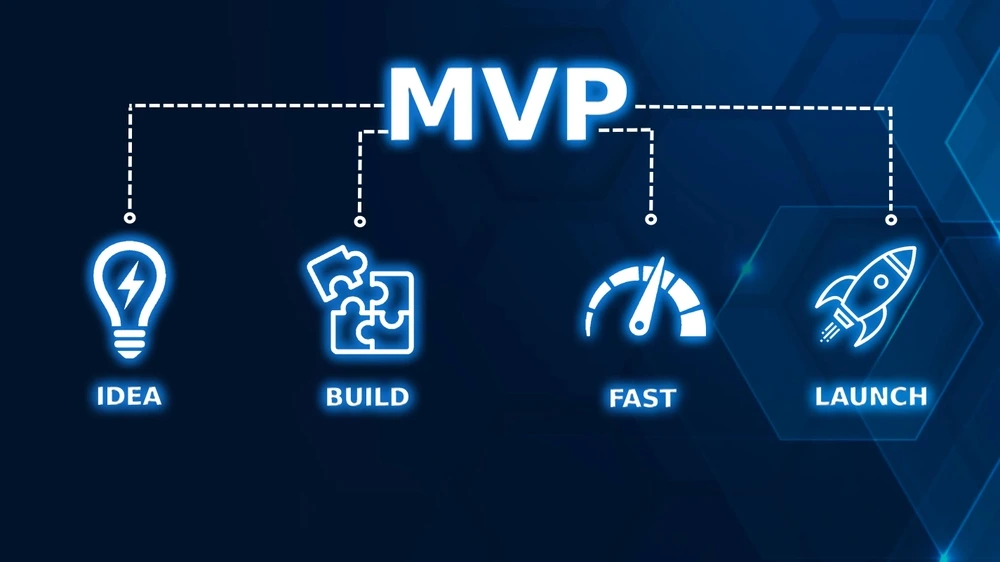
At Sunbytes, we help to define, scope, and build MVPs with discipline, so the product you invest in is intentionally designed to support validation. Let’s make a quick call to pressure-test your MVP scope or technical approach before committing to development.
Key Sourcing Models for MVP Development
Choosing how to resource your MVP has a direct impact on speed, cost control, and learning quality. There is no universal best option—only what fits your stage, constraints, and risk profile.
In-House Team
Best when you already have a strong product and engineering foundation.
- High level of control and context
- Slower to start due to hiring and setup
- Higher fixed costs, even before validation
Outsourcing Team
Suitable when speed and focus matter more than long-term hiring.
- Faster setup with ready-to-go expertise
- Predictable costs and clear delivery scope
- Requires strong alignment and clear ownership
Hybrid Model
Combines internal product leadership with external execution.
- Strategic control remains in-house
- Flexible capacity for specialised skills
- Balanced risk between speed and governance
The right model supports fast learning without locking you into long-term cost or structure—which is exactly what an MVP is meant to enable
How Much Does MVP Development Cost?
In the US and global market, most MVPs fall within a predictable cost range when scope and intent are clear.
- Simple MVP: $7,000+ => Best for validating a single core workflow or value proposition.
Examples: internal tools, single-feature SaaS, basic marketplaces without complex integrations. - Mid-complexity MVP: $30,000+ => Common for B2B SaaS and platform ideas.
Includes multiple user roles, basic integrations (payments, CRM, analytics), and a scalable foundation. - Complex MVP: $100,000+ => Used when validation requires real-time data, custom logic, third-party APIs, or compliance constraints.
Typical in fintech, healthtech, or data-heavy platforms.
These ranges assume 3+ weeks of development with a focused, senior team, not a bloated delivery setup.
What Actually Drives MVP Cost
- Scope discipline: Every additional assumption you try to test increases cost. High-performing teams define one learning goal per MVP.
- Technology complexity: Custom algorithms, data pipelines, or legacy integrations drive cost far more than UI polish.
- Team composition: Senior engineers cost more per hour—but often reduce total spend by building the right thing faster.
- Sourcing model: While in-house teams carry higher fixed costs and slower ramp-up, dedicated external teams offer predictable budgets and faster execution. The Hybrid models balance control and speed.
How Long Should It Take to Develop an MVP?
In practice, most well-scoped MVPs take 3 – 12+ weeks from discovery to first validated insights.
Here’s how that timeline usually breaks down:
- Stage 1: Discovery & MVP planning
Clarifying the target user, core problem, key assumptions, success metrics, and MVP boundaries. Teams that skip or rush this phase often lose more time later. - Stage 2: Design, prototyping, or PoC
Used only when usability or technical feasibility is uncertain. This phase should reduce risk—not extend momentum. - Stage 3: MVP development & testing
Building the minimum set of features required to validate assumptions, with enough quality to ensure trustworthy user behaviour and data. - Stage 4: Launch & early learning
Releasing to a controlled user group, observing real usage, and collecting actionable signals.
Several factors strongly influence whether an MVP stays within this window:
- Scope discipline: the tighter the scope, the faster the build.
- Decision speed: slow approvals and unclear ownership quickly add weeks.
- User access: fast feedback loops shorten iteration cycles.
- Team model: dedicated or hybrid teams often move faster than newly formed in-house teams.
As a rule of thumb: If your MVP takes longer than three months without producing clear learning, it’s likely no longer an MVP—it’s an early-stage product build.

What are some examples of MVP development?
Amazon
Amazon began by asking whether people would buy physical goods online without seeing them first. Instead of launching as a broad e-commerce platform, it started as an online bookstore, an intentionally narrow category where selection, inventory management, and fulfilment could be tested with relatively low complexity. That early MVP validated consumer trust, demand, and operational flow before Amazon expanded into new categories and ultimately became a global marketplace.
Uber
Uber’s first question wasn’t about disrupting transportation globally, it was whether people would pay more for a reliable, on-demand ride experience. The early UberCab MVP launched in San Francisco with a small fleet of black cars and a simple app flow: request, dispatch, ride. By focusing on a premium use case and a high-signal user group, Uber validated willingness to pay and marketplace dynamics before expanding pricing models, supply types, and geographies.
Strong engineering education and close timezone alignment. Higher costs than offshore, but convenient for teams needing frequent real-time collaboration.
Spotify
Spotify faced a different kind of uncertainty: could streaming feel fast and seamless enough to compete with piracy? Its MVP launched as a desktop-first product with controlled access, allowing the team to test performance, licensing constraints, and user behaviour without scaling too quickly. The learning wasn’t about feature breadth, it was about whether the experience itself was compelling enough to change habits.
Key Takeaways
- Successful MVPs test one high-risk assumption at a time, not the entire business model.
- A narrow initial scope or market is a strength. It increases signal and speeds up learning.
- MVPs are designed around real user behaviour, not opinions or vanity metrics.
- Scale comes after validation; these companies expanded only once evidence justified it.
These examples show that MVP development is less about starting small, and more about starting with intent.
Final Thoughts: Turning MVP Ideas into Informed Decisions
MVP development is not a delivery shortcut, it’s a leadership discipline. Its real value lies in replacing assumptions with evidence before capital, time, and credibility are fully committed.
The companies that win don’t build faster by chance. They make deliberate decisions about what to test first, how much to invest, and when to move on. A well-designed MVP creates that clarity, giving you a defensible basis to iterate, pivot, or scale with confidence.
Why Sunbytes
Sunbytes is a Dutch technology company with over 14 years of experience helping startups and growing businesses build and scale MVPs that are ready for real-world use. Working with clients globally, Sunbytes supports MVP development through flexible delivery models, adapting team structure, scope, and engagement approach to match each product’s stage and goals.
Beyond product development, Sunbytes strengthens MVP success with built-in cybersecurity solutions to reduce risk early, and workforce acceleration solutions to help companies scale capabilities as traction grows. This combination enables founders to move faster from idea to market while laying a solid foundation for long-term growth.
If you’re exploring MVP development and want to sanity-check your scope, assumptions, or approach, contact us to gain clarity for your business.
FAQs
- A business owner (CEO or founder) to define goals, assumptions, and success criteriarn
- A product lead to translate business intent into scope and prioritiesrn
- A technical lead to ensure feasibility and avoid unnecessary complexityrn
- The problem and solution are already proven, and the goal is execution at scalern
- Regulatory or compliance requirements demand a near-complete product from day one
- Failure is not an acceptable option (e.g. safety-critical systems)
- User activation or completion of a core actionrn
- Retention or repeat usage over a short time windowrn
- Conversion signals (sign-ups, requests, payments, or commitments)