

An Employer of Record and a staffing agency solve different parts of the hiring process. An EOR becomes the formal employer for a candidate your company has selected. A staffing agency usually finds or supplies workers and may employ them during a temporary assignment.
The distinction affects more than recruitment. It determines who signs the employment contract, runs payroll, makes statutory contributions and manages formal termination steps.
This guide compares Employer of Record vs staffing agency models by employment ownership, compliance duties, cost and duration. It also explains when you may need both.
TL;DR
- Use an EOR when you have selected the candidate but need a legal employer in a country where your company has no entity.
- Use a staffing agency when your main need is candidate sourcing, temporary capacity or short-term project support.
- Use recruitment and EOR together when you need one planned route from candidate search to contract, payroll and statutory registration.
- Use duration as a first filter: staffing may suit a genuine assignment under three months, while a flat EOR fee is often easier to control for an ongoing role expected to last 12 months or more.
How each model works in practice
For teams new to outsourced HR models, it helps to start with the HRO meaning before drilling into EOR specifically; EOR is a specialized form of HR outsourcing, not a separate category.
An EOR employs a candidate you have selected
An Employer of Record signs the local employment contract and becomes the formal employer. Your company directs the employee’s daily work, priorities and performance. The EOR handles payroll, payroll-tax withholding, statutory social contributions, employment records, leave administration and formal employment procedures.
This structure lets your company hire in a country where it has no employing entity. It can also support an existing entity that lacks local payroll or HR capacity, depending on local law and the provider’s operating model. Sunbytes’ Employer of Record service supports international companies employing people in Vietnam.
A staffing agency finds, places or supplies workers
A staffing agency sources candidates, screens them and presents a shortlist. The employment relationship after selection depends on the arrangement.
For a permanent placement, your company may hire the candidate directly. For temporary agency work, the staffing agency may employ the worker and assign that person to your organisation. EU temporary agency rules describe this as an employment relationship with the agency while the worker performs duties under the supervision and direction of a user company.
“Staffing agency” therefore does not always mean recruitment only. Before signing, confirm whether the provider is making a permanent placement, supplying a temporary worker or arranging a later conversion.
Where the legal line sits: who is the employer?
The legal employer is responsible for more than sending salary payments. Formal duties can include the employment contract, payroll-tax withholding, social-security registration, statutory benefits, employment records, leave administration, sick-pay obligations and termination procedures.
An EOR normally owns these duties from the employee’s first day because the EOR signs the employment contract. A staffing agency’s responsibility depends on the model. It may employ a worker during a temporary assignment, but its role may end when a permanent candidate joins your company. That transition point needs a named owner before the offer is accepted.
Your company may still retain workplace duties in either model. These can include health and safety, management conduct, system access, data handling and the instructions given to the worker.
Before signing, get written answers to five questions:
- Who signs the employment contract?
- Who pays the worker and issues payslips?
- Who submits payroll taxes and social contributions?
- Who manages sickness, leave and formal termination?
- What changes if a temporary assignment becomes permanent?
The proposal and service agreement should answer each question. If responsibility is split across providers, the handoff steps and deadlines should also be documented.
Dutch enforcement examines the real working relationship
Dutch companies need to distinguish genuine self-employment from an employment relationship. Since 1 January 2025, the Dutch Tax Administration has fully enforced the rules against schijnzelfstandigheid, or false self-employment. The Dutch government confirmed in March 2026 that enforcement remains in place.
If a contractor is later classified as an employee, the opdrachtgever may have to pay outstanding payroll taxes. Employment-law and pension obligations may also follow. The Dutch government explains the current position in its March 2026 update on self-employment and enforcement.
Wet DBA enforcement does not regulate EOR services directly. It does affect how an ongoing role should be structured. If a person works under your company’s direction, follows your working arrangements and performs duties similar to those of an employee, a contractor agreement may not match the real relationship.
An EOR can employ that person under a local employment contract from day one. The formal employer duties then sit with a named party rather than inside an employee-like contractor arrangement. Your company’s daily management must still remain consistent with the employment contract.
The EU Platform Work Directive has a specific scope
The EU Platform Work Directive addresses employment-status decisions and personal-data protections in paid work organised through digital labour platforms. It includes situations where automated systems monitor workers or influence decisions about their work.
EU member states must transpose the directive by 2 December 2026. The directive is not the main legal framework for a standard EOR, recruitment or staffing arrangement. It should be cited only when digital platform work falls within the operating model.
Temporary agency work breaches can lead to penalties
The consequences of an incorrect staffing arrangement depend on the country and the offence. In Germany, the Federal Ministry of Labour and Social Affairs states that certain failures to identify or disclose temporary agency work correctly may lead to fines of up to €30,000.
Depending on the case, an employer may also owe social-security contributions and late-payment charges. The €30,000 figure applies to a specific breach of German temporary agency work rules. It is not a standard fine for every worker-classification error.
Employer of record vs staffing agency: side-by-side comparison

| Decision point | Employer of Record | Staffing agency |
|---|---|---|
| Main purpose | Legally employ a selected candidate | Find, place or supply workers |
| Who sources the candidate? | Usually your company or recruiter | Usually the staffing agency |
| Who selects the candidate? | Your company | Your company selects from a shortlist |
| Who signs the employment contract? | The EOR | The agency or your company, depending on the model |
| Who runs payroll? | The EOR | The agency or your company |
| Compliance ownership | The EOR owns formal employer administration; your company retains workplace and management duties | Responsibility varies by permanent placement, temporary assignment and conversion terms |
| Common cost model | Monthly employee fee or percentage of gross salary | One-time placement fee or ongoing worker-rate markup |
| Best duration | Ongoing or long-term employment | Temporary, seasonal or project-based work |
| International hiring | Strong fit where your company lacks an entity | Depends on agency country coverage and employment model |
| Main risk | Dependence on provider payroll, contract and offboarding quality | Unclear responsibility when the assignment changes or converts |
| Best fit | Known candidate who needs local employment | Your company needs candidates or temporary capacity |
The employment-contract row is the first one to check. If the EOR signs the contract, the EOR is the formal employer. If a staffing agency employs a temporary worker, responsibility may be divided between the agency and your company.
When to use an EOR
An EOR is usually the stronger fit when:
- You have already selected the candidate.
- The role is expected to continue beyond a short project.
- Your company has no employing entity in the hiring country.
- Local payroll and statutory registration are required.
- Your HR team needs one owner for formal employment administration.
- You want to test a market before committing to entity setup.
- The role involves employee data or compliance controls that need a documented owner.
In Vietnam, that means the EOR can prepare the local employment contract, register eligible employees for social, health and unemployment insurance, withhold Personal Income Tax and maintain statutory employment records. For foreign employees, the process may also include work-permit coordination.
The operating standard matters as much as the legal structure. For Sunbytes EOR engagements, payroll is processed on time and offboarding actions start within 24 hours. Your service agreement should also name the deadline for employment contracts, payroll changes and termination instructions.
An EOR is not the cheapest option for every situation. One short assignment may require less setup through a staffing agency. A large, stable local workforce may justify an entity that gives your company direct control over payroll, benefits and employment policy. Review the pros and cons of using an EOR before making that longer-term decision.
You already know who you want to hire. The remaining question is who can employ that person correctly in the hiring country.
Sunbytes prepares local employment contracts, runs payroll and manages statutory employment administration for international companies hiring in Vietnam.
When to use a staffing agency
A staffing agency is usually the stronger fit when:
- You need candidates rather than an employment structure.
- The role is temporary, seasonal or project-based.
- Your company needs cover for an absence.
- Hiring demand has increased for a limited period.
- You need access to a specialist candidate network.
- Your local entity can employ permanent placements directly.
A staffing agency can reduce sourcing and screening work. It can also give your team access to people who are available for a defined assignment. The arrangement becomes less suitable when a short assignment turns into an ongoing role but the contract and responsibility split remain unchanged.
Review the model when the assignment has no clear end date, the worker serves only your company, your managers control the person’s hours and working method, or the role has become part of normal operations. Confirm any temp-to-permanent conversion fee before the placement starts.
This article does not compare staffing with hiring through your own payroll. That decision belongs in the guide to direct hiring vs staffing agency.
Can you use both? The single-vendor advantage
Yes. Many international hiring plans contain two separate needs. Your company must find the candidate, then establish a legal structure to employ that person.
A recruitment or staffing provider can solve the first need. An EOR can solve the second. The main risk is the handoff.
Imagine that your candidate accepts an offer on Monday. The recruitment provider does not offer EOR services. Your HR team now has to find another provider, send the role details again, rebuild the employee file and confirm a new process for contracts, payroll and statutory registration.
The offer has been accepted, but the local contract is not ready. Payroll setup has not started. The planned start date now depends on two providers.
A single-vendor recruitment and EOR process removes that handoff:
- Approve the role and hiring budget.
- Confirm whether your company can employ the worker locally.
- Start candidate sourcing.
- Select the candidate.
- Confirm the EOR terms before the offer is signed.
- Prepare one consistent offer and employment contract.
- Start payroll and statutory registration.
- Give the employee a confirmed start date.
Sunbytes’ recruitment services use a 14-day time-to-hire target for qualified roles when the brief and interview process are ready. Connecting recruitment to EOR before the offer reduces the risk of losing time between candidate acceptance and local employment.
Companies hiring at a larger scale may need a wider recruitment operating model. The guide to RPO vs staffing agency vs EOR by growth stage covers that separate decision.
Protect candidate data during the handoff
Recruitment files can contain identification data, salary information, interview notes and background-check records. Article 5 of the General Data Protection Regulation requires personal data to be adequate, relevant and limited to what is needed. Article 28 requires a binding contract when a processor handles personal data for a controller.
Before transferring a candidate file, confirm which party is the controller or processor, what data will move, why each item is needed, who can access it, how long it will be kept, whether a Data Processing Agreement is signed and whether transfer safeguards are needed outside the EEA.
What each model costs: a practical comparison
Cost comparisons often fail because the models charge for different work. An EOR fee covers ongoing employment administration. A permanent recruitment fee pays for candidate search and placement. A temporary staffing markup can cover both the worker and agency administration.
Typical EOR cost structure
For 2026 planning, Sunbytes’ review of anonymised market quotations found two common EOR fee models:
- A flat fee of about €300–€600 per employee per month
- A percentage fee of about 15–25% of gross salary
These ranges are planning estimates, not statutory rates or fixed Sunbytes prices. They reflect anonymised provider quotations reviewed for 2026 scoping discussions. Final pricing depends on the hiring country, payroll complexity, benefits, immigration support, expense processing, currency handling, contract changes and termination support.
The management fee is separate from salary, statutory employer contributions and employee benefits. The Employer of Record cost guide explains those layers in more detail.
Typical staffing cost structure
Permanent recruitment often uses a one-time placement fee based on annual salary. Temporary staffing usually uses an ongoing markup within an hourly or monthly bill rate.
The contract may also include advertising fees, background checks, assessments, minimum assignment periods, conversion fees or early-termination fees. Ask what each percentage applies to. A fee based on annual salary is different from a markup charged on every hour worked.
Illustrative comparison for a €60,000 role
| Cost model | Illustrative provider charge | What the charge covers |
|---|---|---|
| EOR at €450 per month | €5,400 over 12 months | Ongoing employment administration |
| EOR at 20% of gross salary | €12,000 over 12 months | Ongoing employment administration |
| Permanent recruitment at 20% | €12,000 once | Candidate search and placement |
| Temporary staffing at 20% markup | Charged throughout the assignment | Worker supply and agency administration, depending on the contract |
The models are not direct substitutes. A permanent recruitment fee does not include your future payroll and employer administration. An EOR fee may not include candidate sourcing. A temporary staffing rate may cover both employment and worker supply.
Duration gives you a useful first filter. Staffing may cost less for a genuine assignment lasting under three months. A flat EOR fee may be easier to control for a role expected to last 12 months or more. These are planning signals rather than universal break-even points.
How to choose between an EOR and a staffing agency
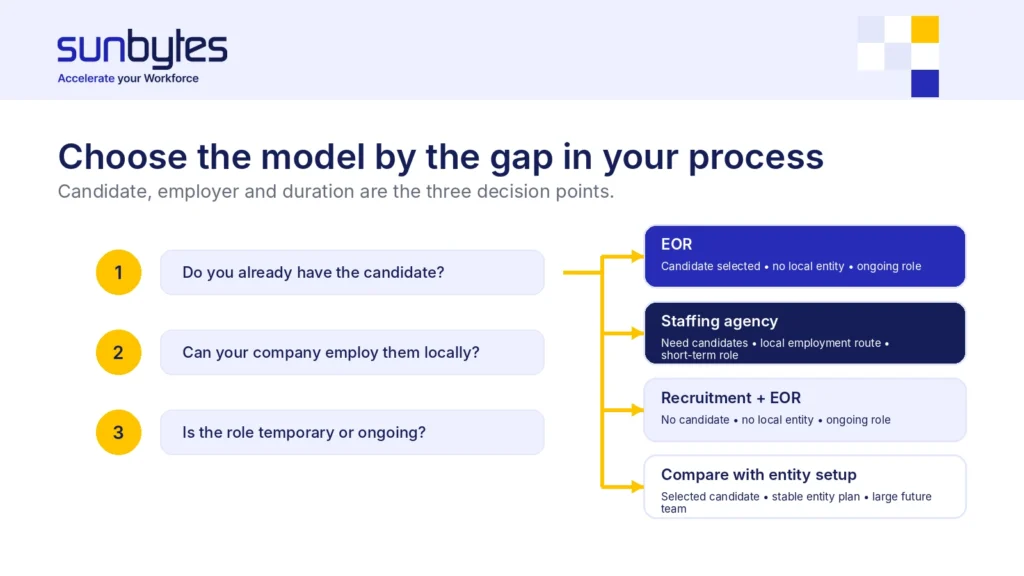
Start with three questions: do you already have the candidate, can your company legally employ that person in the country, and is the role temporary or intended to continue?
| Your answers | Likely fit |
|---|---|
| Candidate selected, no local entity, ongoing role | Employer of Record |
| No candidate, local employment route exists, short-term role | Staffing agency |
| No candidate, no local entity, ongoing role | Recruitment plus EOR |
| Candidate selected, stable local entity and a large future team | Compare EOR with entity-based employment |
For the last scenario, review EOR vs entity setup in Vietnam.
How Sunbytes connects recruitment and legal employment
The gap between candidate selection and legal employment is where delays often begin.
The offer is accepted, but the contract is not ready. Payroll ownership is unclear. Candidate documents move between providers without a named handoff process.
Sunbytes connects these steps through Accelerate Workforce Solutions.
Recruitment services handle the search and screening. The Employer of Record service then prepares the local contract, sets up payroll and manages statutory employment administration.
Your HR team keeps one process from approved role to first payroll.
Digital Transformation Solutions supports this model by defining the work the new hire will enter. For technical roles, that includes role scope, seniority, delivery duties and onboarding expectations.
A clear delivery structure reduces the risk of hiring the right person into a role that is still poorly defined.
Cybersecurity Solutions provides the control layer around employee data and access.
Candidate files follow documented data-processing practices. Access can be limited by role. Onboarding and offboarding follow controlled procedures supported by Sunbytes’ ISO 27001-certified information-security management system.
The result is one connected hiring route:
- Employment contracts within 48 hours after complete information is received
- A 14-day time-to-hire target for qualified roles when the brief and interview process are ready
- Payroll processed on time
- Offboarding actions started within 24 hours
The decision is not only whether to choose an EOR or staffing agency. It is whether recruitment, employment, payroll and employee-data handling have named owners before the candidate starts.
FAQs
No. An EOR becomes the formal employer of a person your company has selected. A staffing agency finds, places or supplies workers and may act as the employer during a temporary assignment.
Yes. The staffing or recruitment provider can source the candidate, while the EOR prepares the local employment contract, payroll and statutory registration. Agree on the handoff and data-processing roles before making the offer.
An EOR places the worker under a local employment contract from day one and assigns formal employer duties to a named entity. It does not remove every risk: your company must still manage the person in a way that matches the employment relationship and local law.
An EOR is the legal employer and can usually employ someone in a country where your company has no entity. A PEO normally enters a co-employment arrangement and often requires your company to have a local employing entity.
Timing depends on the country, document readiness, background checks, benefits and immigration requirements. For Sunbytes engagements, employment contracts are prepared within 48 hours after complete information is received; immigration or work-permit steps can extend the full onboarding timeline.
A staffing agency can be less expensive for a genuine short-term assignment under three months. A flat EOR fee can be easier to control for an ongoing role expected to last 12 months or more, but the comparison must separate recruitment, worker supply and employment-administration costs.