Legacy applications often create a growing legacy burden, increasing cost, risk, and complexity as the business scales. As markets demand faster delivery and greater resilience, leaders are forced to confront a hard truth: maintaining the status quo is often more expensive than change.
App modernisation has become a strategic necessity, not a technical upgrade. This article will talk about what app modernisation is, why organisations pursue it, the most common modernisation patterns, the technologies that enable it, how to measure success, and how to modernise applications safely and effectively.
TL;DR
- App modernisation is the process of improving legacy applications to increase scalability, security, performance, and maintainability—without unnecessary disruption to the business.
- Organisations modernise applications to reduce technical debt, improve time-to-market, lower operational costs, and address growing security risks caused by outdated systems.
- Common app modernisation patterns follow the “R” model (rehost, refactor, rearchitect, rebuild, replace, retire, retain), allowing teams to choose the right level of change per application.
- An effective app modernisation strategy starts with assessment and prioritisation, focuses on incremental delivery, and aligns technology choices with long-term business goals.
- Cloud platforms, containers, microservices, APIs, and DevOps practices are key technologies enabling scalable, resilient, and secure modern applications.
What is app modernisation and how does it work?
App modernisation is the process of upgrading existing applications to improve architecture, performance, security, and maintainability while preserving the business value they already deliver. Instead of treating legacy systems as liabilities, modernisation turns them into platforms that can support growth, scale, and faster change.
At its core, app modernisation focuses on:
- Modern architectures, such as cloud-native, modular, and API-driven designs
- Reduced operational complexity through automation, standardisation, and better tooling
- Improved resilience and scalability without rebuilding everything from scratch
Legacy applications typically differ from modern, cloud-ready systems in fundamental ways:
- Monolithic architectures tightly couple components, making changes slow and risky, while modular systems enable independent updates and scaling
- Manual deployments increase error rates and downtime, whereas automated pipelines support frequent, reliable releases
Importantly, app modernisation goes beyond rewriting code. It also involves changes to processes, tooling, security practices, and operating models, ensuring applications can evolve safely as business needs change.

Why do organisations choose to modernise their applications?
As organisations scale, legacy applications often become constraints rather than enablers. What once worked reliably now slows delivery, increases risk, and limits the ability to respond to change.
- Technical debt limits speed and innovation: Outdated codebases and fragile integrations make even small changes costly. Release cycles slow down, backlogs grow, and teams spend more time maintaining systems than improving them
- Rigid architectures reduce scalability and flexibility: Monolithic systems struggle to handle demand spikes or support new business models. Scaling becomes expensive and slow, forcing organisations to overprovision infrastructure or accept performance trade-offs
- Outdated systems increase security exposure: Unsupported frameworks, missing patches, and limited visibility create vulnerabilities that are harder to detect and remediate. Over time, security risk compounds faster than functionality improves
- Legacy applications drive up operational and maintenance costs: Older systems often rely on specialised skills, custom infrastructure, and manual processes. The result is higher run costs with diminishing returns
- Poor user experience impacts customers and internal teams: Slow, unreliable applications frustrate users, reduce adoption, and affect productivity—ultimately translating into lost revenue and weakened competitive position.
What are the most common app modernisation patterns?
Not every application needs the same level of change. Effective app modernisation starts by choosing the right pattern based on business value, technical health, and risk tolerance.
The “R” model explains different levels of modernisation
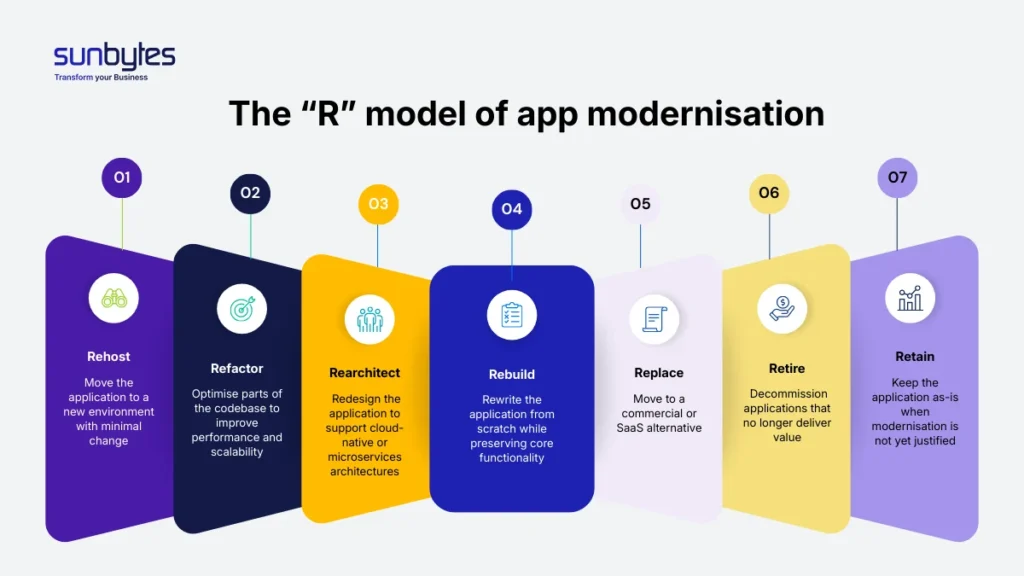
The R model provides a practical framework for deciding how far to modernise an application:
- Rehost: Move the application to a new environment with minimal change
- Refactor: Optimise parts of the codebase to improve performance and scalability
- Rearchitect: Redesign the application to support cloud-native or microservices architectures
- Rebuild: Rewrite the application from scratch while preserving core functionality
- Replace: Move to a commercial or SaaS alternative
- Retire: Decommission applications that no longer deliver value
- Retain: Keep the application as-is when modernisation is not yet justified
Each option balances speed, cost, and long-term impact differently.
Rehosting offers quick wins with minimal change
Rehosting—often called lift and shift—moves applications to cloud or modern infrastructure without altering core functionality.
- When it works: Stable applications with low complexity or short-term migration goals
- Pros: Fast execution, low upfront risk
- Cons: Limited performance gains and little reduction in technical debt
Refactoring improves performance and scalability
Refactoring focuses on improving code quality and efficiency while keeping the overall architecture intact.
- Optimising existing components to reduce bottlenecks
- Preparing applications for cloud environments without full redesign
Rearchitecting enables cloud-native and microservices adoption
Rearchitecting involves breaking monoliths into smaller, independently deployable services.
- Enables scalability and resilience through distributed design
- Supports faster releases with isolated deployments and fault tolerance
Rebuilding or replacing fits when legacy systems block progress
When technical debt outweighs the cost of change, rebuilding or replacing becomes the most viable path.
- Rebuild when custom functionality remains a competitive advantage
- Replace when mature, off-the-shelf solutions meet business needs
How do you build an effective app modernisation strategy?
Successful app modernisation is driven by strategy, not tools. Organisations that see real results align technical decisions with clear business outcomes and manage change incrementally.
A comprehensive application assessment identifies risks and opportunities
Modernisation starts with visibility.
- Create an application inventory covering ownership, dependencies, and usage
- Assess business criticality and technical health to understand risk and value
This prevents over-investing in low-impact systems and exposes quick wins.
Clear business and technical objectives guide prioritisation
Without clear goals, modernisation becomes fragmented.
- Define objectives such as cost reduction, scalability, faster time-to-market, or risk reduction
- Prioritise applications that deliver the highest business impact
- Avoid modernising everything at once—focus drives momentum
Incremental modernisation reduces disruption and risk
Large, one-off transformations increase failure rates.
- Apply the strangler pattern to replace legacy components gradually
- Use phased rollouts to limit downtime and operational impact
Incremental modernisation requires disciplined delivery practices. Our Application Development Step-by-Step Guide explains how teams structure development and rollout phases to reduce risk while maintaining momentum.
Technology choices must align with long-term architecture goals
Relying on ad-hoc approaches or ‘vibe coding’ may speed up early experimentation, but it rarely scales in regulated, enterprise environments.
- Select technologies that support modularity, automation, and future scalability
- Ensure platforms and frameworks fit the organisation’s target architecture
Skills, teams, and operating models enable sustainable change
Technology alone does not modernise applications.
- Assess DevOps readiness and automation maturity
- Establish clear team ownership models for services and platforms
Security and compliance should be embedded from day one
Modernisation increases exposure if security is an afterthought.
- Apply secure-by-design principles throughout the lifecycle
- Make compliance-aware architecture decisions early to avoid rework
Which technologies are essential for modernising applications today?
App modernisation succeeds when technology choices directly support the target architecture, operating model, and business goals. The following technologies are not trends to adopt blindly—they should be applied deliberately, based on where an organisation is today and where it needs to go.
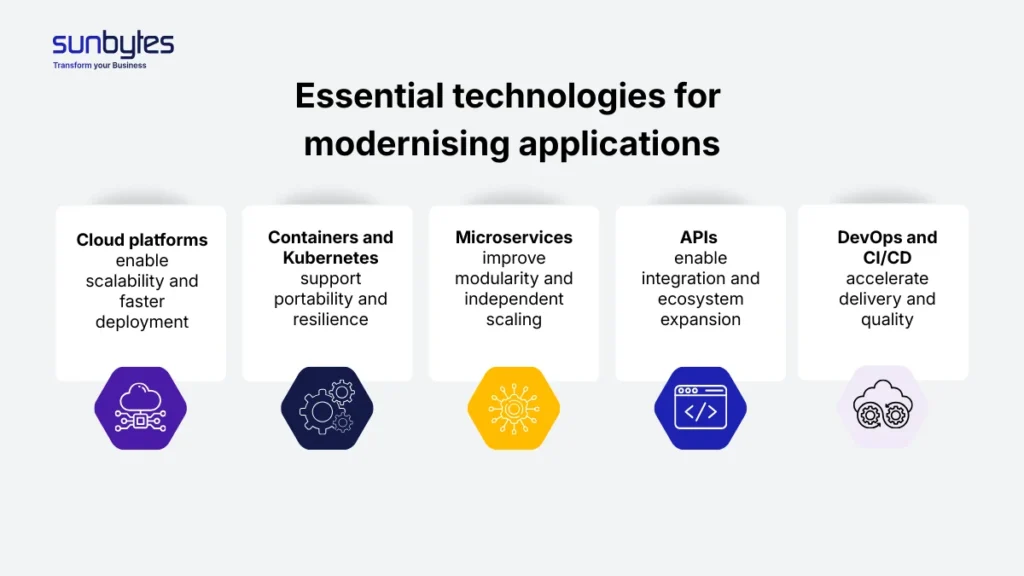
Cloud platforms enable scalability and faster deployment
Cloud platforms provide the foundation for most modernisation initiatives, offering elasticity, managed services, and global reach.
- When to apply: Use public cloud for customer-facing or variable workloads, private cloud for regulated or latency-sensitive systems, and hybrid models when legacy constraints prevent full migration.
- How they help: On-demand scaling, reduced infrastructure overhead, and faster environment provisioning enable teams to release features without capacity bottlenecks.
Read our guide “Application Scalability: Key Strategies and Best Practices”
Containers and Kubernetes support portability and resilience
Containers standardise how applications are packaged and deployed, while Kubernetes orchestrates them across environments.
- When to apply: Ideal when applications are being refactored or rearchitected and need consistent deployment across development, test, and production.
- How they help: Containers reduce environment-related issues, while Kubernetes improves resilience through automated scaling, self-healing, and controlled rollouts.
Microservices improve modularity and independent scaling
Microservices break applications into smaller, independently deployable components.
- When to apply: Best suited for complex systems where different components scale at different rates or change frequently.
- How they help: Teams can release updates faster, isolate failures, and evolve parts of the system without affecting the whole.
APIs enable integration and ecosystem expansion
APIs act as the connective tissue between legacy systems, modern services, and external partners.
- When to apply: Use APIs to expose legacy functionality, enable gradual modernisation, or support platform and partner strategies.
- How they help: APIs decouple systems, simplify integration, and allow new capabilities to be added without disrupting existing operations.
DevOps and CI/CD accelerate delivery and quality
DevOps practices and CI/CD pipelines automate the path from code to production.
- When to apply: Essential once teams aim to increase deployment frequency and reduce manual errors.
- How they help: Automated testing, monitoring, and deployment improve reliability, shorten feedback loops, and make frequent releases sustainable.
Together, these technologies form a modern delivery ecosystem that supports scalability, resilience, and security—but only when applied in alignment with a clear modernisation strategy.
How does hybrid cloud support app modernisation initiatives?
Hybrid cloud plays a critical role in app modernisation by allowing legacy constraints and modern delivery models to coexist without forcing high-risk, all-or-nothing decisions.
Hybrid cloud is most effective when legacy systems have hard dependencies on on-prem infrastructure, specialised hardware, or regulatory requirements. Core systems of record can remain on-prem, while modernised services, such as customer-facing APIs, analytics, or new digital products, run in the cloud. This separation allows innovation to move faster without destabilising critical operations.
From a risk perspective, hybrid architectures reduce migration pressure. Instead of rewriting or relocating entire systems upfront, organisations can modernise incrementally. Components are extracted, wrapped with APIs, or replatformed over time, lowering the risk of downtime and business disruption. This approach is particularly valuable for revenue-critical applications with limited tolerance for failure.
Hybrid cloud also supports gradual operating model change. Teams can adopt cloud-native practices, CI/CD, infrastructure as code, automated scaling—on modern workloads first, while legacy environments continue to operate under existing processes. Over time, skills, tooling, and governance models converge, making broader modernisation achievable.
When designed deliberately, hybrid cloud becomes a transition architecture. It provides the flexibility to modernise at a pace aligned with enterprise realities, while still unlocking the scalability, resilience, and speed that modern applications demand.
What challenges do organisations face during app modernisation?
Most app modernisation initiatives fail not because of poor technology choices, but because hidden complexity is addressed too late. Successful organisations anticipate these challenges early and design solutions into their strategy.
- Legacy dependencies complicate modernisation efforts. Tightly coupled systems, shared databases, and undocumented integrations make change risky and slow.
How to address it: start with a dependency-led application assessment and use patterns like API encapsulation and the strangler pattern to decouple functionality incrementally, rather than attempting large-scale rewrites.
- Skills gaps slow delivery and increase risk. Modern architectures require experience with cloud platforms, distributed systems, security, and automation—skills many legacy teams lack.
How to address it: combine upskilling with experienced delivery teams, introduce modern practices gradually, and standardise tooling to reduce cognitive load across teams.
- Data migration introduces complexity and compliance concerns: Data is often deeply embedded in legacy logic and constrained by regulatory requirements.
How to address it: treat data modernisation as a standalone workstream, apply phased migration, and design architectures that support data coexistence until full migration is safe and compliant.
- Business disruption fears delay decision-making:For mission-critical applications, the perceived risk of downtime often outweighs the cost of inefficiency.
How to address it: adopt incremental delivery models, parallel-run critical components, and use automated testing and monitoring to detect issues before they impact users.
- Underestimating scope leads to budget and timeline overruns. Modernisation affects architecture, security, operations, and governance—not just code.
How to address it: define clear success metrics upfront, align stakeholders early, and plan modernisation as a multi-phase transformation, not a one-off project.
How do you measure success in app modernisation?
App modernisation only delivers value when progress is measurable. The most effective organisations track success across technical performance, operational stability, security posture, and business impact.

Technical metrics track reliability, performance, and maintainability
These metrics show whether modernisation is improving how software is built and operated.
- Deployment frequency reflects how often teams can release changes without increasing risk
- Lead time measures how quickly code moves from commit to production, highlighting delivery efficiency
- Mean time to recovery (MTTR) shows how fast teams can restore service when failures occur
- Change failure rate reveals the stability of releases and the quality of engineering practices
- Test coverage indicates whether automated testing is preventing defects from reaching production
- Technical debt reduction tracks whether complexity is being actively reduced rather than carried forward
Improvements here signal healthier systems and more predictable delivery.
Performance metrics measure speed, uptime, and responsiveness
erformance metrics confirm whether modernisation delivers real operational benefits.
- Application response times measure end-user experience under normal and peak load
- Scalability improvements show whether systems can handle increased demand without linear cost growth
- Infrastructure costs highlight whether cloud or hosting spend is being optimised over time
- Resource utilisation indicates how efficiently compute, memory, and storage are being used
These metrics ensure modernisation improves performance without inflating operational costs.
Security metrics assess risk reduction and compliance readiness
Modernisation should measurably reduce security exposure.
- Vulnerability count tracks whether known weaknesses are decreasing over time
- Time to patch measures how quickly security updates can be applied across environments
- Security incidents indicate whether breaches or critical events are becoming less frequent
- Compliance status shows whether regulatory requirements can be met with less effort and risk
Stronger results here demonstrate that security is improving as systems evolve.
Business metrics connect modernisation to ROI and growth
Ultimately, modernisation must support business growth and efficiency.
- Development velocity shows whether teams are delivering features faster
- Feature adoption confirms whether new capabilities deliver real user value
- Customer satisfaction reflects improvements in reliability, usability, and performance
- Revenue impact indicates whether modernisation enables new products, services, or markets
- Maintenance costs reveal whether resources are shifting from upkeep to innovation
When these business indicators improve alongside technical metrics, app modernisation becomes a strategic investment—not a cost-saving exercise.
How can Sunbytes support your app modernisation journey?
App modernisation demands architectural judgment, delivery discipline, and risk-aware decision-making. By analysing existing systems, dependencies, and risks upfront, Sunbytes help organisations modernise incrementally—focusing on the areas that deliver the greatest impact while keeping critical operations stable.
Our senior engineering teams combine deep experience in legacy and cloud-native systems with a secure-by-design mindset, ensuring modernisation reduces risk rather than introducing it. With flexible delivery models, Sunbytes supports both targeted modernisation initiatives and long-term transformation—at a pace aligned with enterprise realities.
Why Sunbytes?
Sunbytes is a Dutch technology company, headquartered in the Netherlands, with a delivery hub in Vietnam. For over 14 years, we’ve helped organisations modernise and scale their applications—turning strategy into reliable delivery, with security built in from day one.
- Digital Transformation Solutions: Modernise and build applications with senior engineering teams, from custom development and QA to long-term support.
- CyberSecurity Solutions: Reduce risk during modernisation with practical cybersecurity and compliance readiness.
- Accelerate Workforce Solutions: Scale teams and capabilities flexibly when transformation and growth demand it.
Ready to modernise with confidence? Contact Sunbytes to discuss your app modernisation roadmap.
FAQs
Timelines vary by scope and approach. Small refactoring or rehosting efforts can take weeks, while incremental rearchitecting of core systems may span several months. Most organisations succeed by delivering value in phases rather than attempting a single, large transformation.
In many cases, yes. Modernising selectively—using patterns like refactor or rearchitect—preserves existing business logic and reduces risk. Rebuilding makes sense only when technical debt is so high that change becomes slower and more expensive than replacement.
Common application modernization techniques are often grouped into the “6Rs” framework. These approaches help organizations modernize legacy systems based on cost, complexity, and business goals:
-
Rehosting (Lift and Shift): Moving applications to a new infrastructure, such as the cloud, with minimal or no code changes.
-
Refactoring: Optimizing existing code to improve performance, scalability, and maintainability without changing core functionality.
-
Re-architecting: Redesigning the application architecture—often toward microservices or cloud-native models—to support long-term growth and flexibility.
-
Replatforming: Making limited changes to leverage modern platforms or managed services while keeping the core application structure intact.
-
Replacing: Retiring legacy applications and adopting SaaS or off-the-shelf solutions.
-
Retiring: Decommissioning applications that no longer deliver business value.
In practice, most modernization initiatives combine multiple approaches, starting with applications that deliver quick wins while gradually addressing more complex systems
Let’s start with Sunbytes!
Let us know your requirements for the team and we will contact you right away.