

Software projects don’t fail because teams can’t code. They fail because there is no clear structure to manage requirements, risks, timelines, and security from day one. As systems grow more complex and compliance pressures increase, an unstructured development process quickly leads to cost overruns, delays, and technical debt.
The Software Development Life Cycle (SDLC) provides a disciplined framework to plan, build, test, and maintain software with control and predictability. This article will talk about what the SDLC is, its seven core phases, the most common models, how security and DevSecOps integrate into the process, and how leaders can apply it to deliver scalable, secure software.
TL;DR
- The Software Development Life Cycle (SDLC) is a structured framework used to plan, design, build, test, deploy, and maintain software with clear governance and accountability.
- The SDLC consists of seven core phases: planning, requirements gathering, design, development, testing, deployment, and maintenance — each reducing risk and improving delivery predictability.
- Different SDLC models (Waterfall, Agile, Spiral, V-Model, Lean, RAD, and others) provide varying levels of flexibility, risk control, and speed depending on project complexity and business goals.
- Security must be embedded across the entire lifecycle, not added at the end — through secure design, threat modeling, code reviews, and continuous testing (Secure SDLC).
- DevSecOps modernizes the SDLC by integrating automated security and continuous delivery practices, enabling faster releases without compromising compliance or system integrity.
What Is the Software Development Life Cycle (SDLC)
The Software Development Life Cycle (SDLC) is a structured framework that defines how software is planned, designed, built, tested, deployed, and maintained. Rather than treating development as a series of disconnected tasks, SDLC provides a disciplined process that aligns technical execution with business goals.
At its core, SDLC answers three fundamental questions:
- What problem are we solving?
- How will we build the right solution?
- How do we ensure it remains secure, scalable, and sustainable over time?
SDLC is not just a technical workflow. It is a governance model. It reduces uncertainty, controls risk, clarifies accountability, and ensures that investment in software translates into measurable business outcomes. Without a defined SDLC, projects often suffer from scope creep, misaligned requirements, budget overruns, and late-stage security gaps. With it, organizations gain visibility, predictability, and structured decision-making across the entire development journey.
If you’re exploring how structured development translates into real-world execution, our guide on Custom Software Development Services: Turning Business Ideas into Scalable Digital Solutions explains how a disciplined development process transforms strategic vision into scalable, production-ready systems.

Why the Software Development Life Cycle Matters for Modern Software Projects
The Software Development Life Cycle (SDLC) matters because modern software environments are more complex, regulated, and risk-sensitive than ever. A structured lifecycle provides control across several critical dimensions:
- Rising software complexity: Modern systems integrate cloud services, APIs, data platforms, and third-party tools. SDLC creates a structure to manage this growing technical complexity.
- Regulatory requirements: Industries face increasing compliance demands (data protection, financial regulation, industry standards). A defined lifecycle ensures traceability and documentation.
- Cybersecurity threats: Security cannot be reactive. SDLC embeds risk assessment, secure design, and testing throughout development.
- Budget and timeline control: Clear phases and validation checkpoints reduce rework, prevent overruns, and improve delivery predictability.
- Alignment between stakeholders and developers: Structured requirement gathering and documentation minimize miscommunication and costly misalignment.
- Preventing technical debt: Disciplined architecture, testing, and maintenance planning reduce long-term system fragility.
What Are the 7 Phases of the Software Development Life Cycle (SDLC)?
The Software Development Life Cycle (SDLC) is structured around seven core phases. Each phase serves a distinct purpose , reducing uncertainty, validating assumptions, and ensuring controlled execution from concept to long-term operation. Together, these stages create a disciplined path from business idea to scalable, maintainable software.
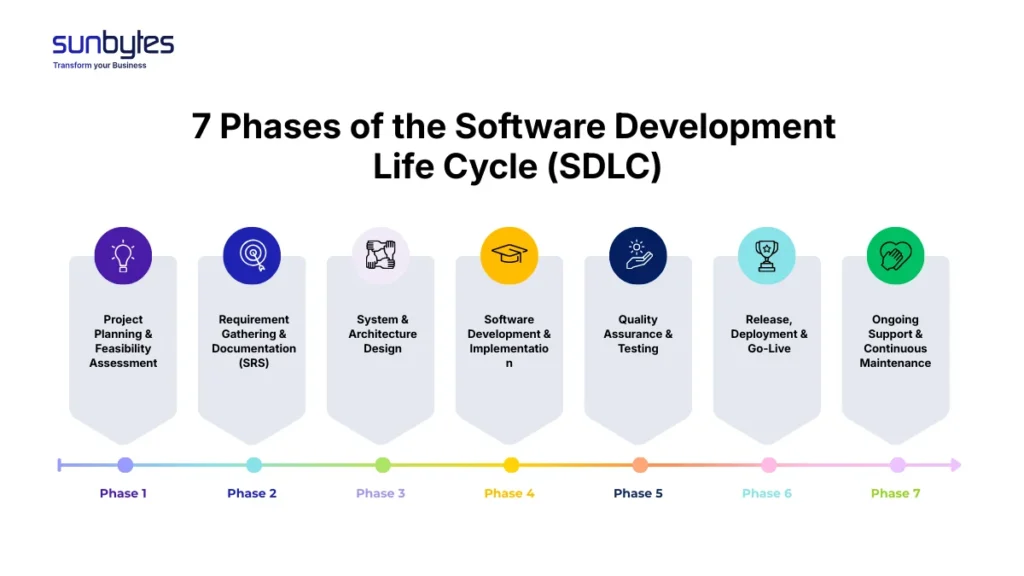
Phase 1: Project Planning & Feasibility Assessment
Every successful software initiative begins with clarity — not code. This phase defines direction, constraints, and viability before significant resources are committed.
Key focus areas:
- Define business objectives and measurable success criteria
- Estimate budget, timeline, and ROI expectations
- Identify technical, operational, and compliance risks
- Conduct feasibility analysis (technical + financial)
- Outline team structure and resource allocation
Without disciplined planning, execution becomes reactive. This phase establishes governance and prevents strategic drift.
Phase 2: Requirement Gathering & Documentation (SRS)
Many software failures originate here — unclear or shifting requirements. This stage translates business needs into structured documentation that engineering teams can execute against with precision.
Core components:
- Functional requirements (what the system must do)
- Non-functional requirements (performance, security, scalability)
- User stories and real-world use cases
- Stakeholder interviews and validation workshops
- Formal Software Requirements Specification (SRS) documentation
Clear documentation aligns executives, product leaders, and developers. For organizations evaluating structured development approaches, this is where professional custom software development services demonstrate their value — transforming high-level ideas into scalable, technically validated roadmaps.
Phase 3: System & Architecture Design
Design is where long-term scalability is determined. Poor architectural decisions rarely fail immediately — they fail under growth pressure. This phase converts requirements into technical blueprints.
Design priorities include:
- High-Level Design (HLD) defining system structure
- Low-Level Design (LLD) detailing modules and logic
- Database architecture and data flow modeling
- Technology stack and infrastructure selection
- Security architecture planning
For leaders exploring scalable system foundations, selecting the right architecture is critical, as discussed in how to choose the right software architecture to scale your business.
Phase 4: Software Development & Implementation
Execution begins — but within disciplined guardrails. Development should follow structured standards, not improvisation.
Execution controls include:
- Coding standards and clean code principles
- Version control for traceability and accountability
- Structured code reviews, both manual and automated. Code review discipline, in particular, plays a strategic role in maintaining quality and preventing security flaws. Explore our in depth comparison between manual vs. automated code review approaches for executive decision-making.
- CI/CD pipeline integration
- Sprint-based execution (in Agile environments)
At this stage, leadership visibility into development velocity and quality metrics becomes essential.
Phase 5: Quality Assurance & Testing
Testing is not a final step. It is a validation layer across the lifecycle. This phase ensures the system performs as intended, under real-world conditions.
Testing layers typically include:
- Unit testing (component validation)
- Integration testing (system interaction validation)
- System testing (end-to-end performance)
- User Acceptance Testing (UAT)
- Security testing (SAST and DAST)
Phase 6: Release, Deployment & Go-Live
Deployment is where planning meets reality. A poorly managed release can undermine months of structured development.
Deployment governance includes:
- Production environment configuration
- Deployment strategy selection (blue-green, rolling updates)
- Monitoring and observability setup
- Structured go-live checklist and rollback planning
Controlled deployment reduces downtime and protects customer experience.
Phase 7: Ongoing Support & Continuous Maintenance
Software is never “finished.” It evolves. Post-launch governance ensures longevity, security, and performance stability.
Ongoing lifecycle management involves:
- Bug resolution and incident response
- Performance monitoring and optimization
- Security patch management
- Feature enhancements aligned with business growth
- Technical debt management
This final phase transforms software from a one-time project into a sustainable digital asset.
What Are the Most Common Software Development Life Cycle Models?
While the seven phases of the Software Development Life Cycle (SDLC) remain consistent, the way those phases are structured and executed varies. That variation is defined by the SDLC model you choose.
Each model balances flexibility, risk control, documentation, speed, and stakeholder involvement differently. For leadership teams, selecting the wrong model can increase cost, slow delivery, or expose the organization to unnecessary risk.
| Model | Definition | Structure | Flexibility Level | Risk Management Approach | Best For | Key Strength | Main Limitation |
|---|---|---|---|---|---|---|---|
| Waterfall | A linear development approach where each phase must be completed before the next begins. | Sequential and phase-driven | Low | Risks assessed early; limited adjustment later | Projects with stable, well-defined requirements | Strong documentation and predictability | Hard to accommodate change mid-project |
| Agile | An iterative, incremental approach that delivers software in short development cycles (sprints). | Sprint-based, iterative | High | Continuous feedback reduces evolving risks | Startups, SaaS, evolving digital products | High adaptability and rapid iteration | Requires disciplined scope management |
| Iterative | A model that builds software through repeated cycles, refining the system with each iteration. | Repeated refinement cycles | Medium to High | Risk reduced through progressive validation | Large systems developed in stages | Early partial releases for feedback | Can increase cost if iterations are poorly controlled |
| Spiral | A risk-driven model combining iterative development with structured risk analysis at every cycle. | Iterative loops with risk evaluation | Medium | Formal risk assessment at each phase | High-risk, complex, or mission-critical systems | Strong focus on identifying and mitigating risks | Complex and costly to manage |
| V-Model | A structured extension of Waterfall where each development stage has a corresponding testing phase. | Sequential with parallel validation | Low to Medium | Early validation through mirrored testing phases | Regulated industries requiring strict verification | Strong quality assurance alignment | Limited flexibility to adapt to change |
| Lean Development | A methodology focused on eliminating waste and maximizing value delivery efficiency. | Iterative with optimization focus | High | Continuous improvement reduces inefficiencies | Organizations prioritizing speed and efficiency | Resource optimization and process efficiency | Requires mature teams and culture |
| Rapid Application Development (RAD) | A prototype-driven model emphasizing rapid development and frequent user feedback. | Prototype-based and user-centric | High | Risks reduced through early user validation | MVPs, UI-driven applications | Accelerated validation and quick releases | May sacrifice architectural robustness |
| Big Bang | A minimally structured approach where development begins with little formal planning. | Unstructured and developer-driven | Very High (but uncontrolled) | Minimal formal risk management | Small experimental or internal initiatives | Minimal process overhead | Extremely high risk and unpredictability |
If you’re evaluating the trade-offs between flexibility and predictability, our in-depth comparison of The Agile vs Waterfall: Which Methodology Wins? breaks down when each approach makes strategic sense for different business environments.
How Is Security Integrated into the Software Development Life Cycle?.
Security can no longer be treated as a final checkpoint before release. In modern software environments, threats evolve faster than development cycles. Integrating security directly into the Software Development Life Cycle (SDLC) is not optional, it is a strategic requirement. A Secure SDLC embeds protection mechanisms into every phase, reducing vulnerabilities before they reach production.
1. Secure Planning from the Start
Security begins during the planning phase.
- Identify regulatory and compliance requirements (GDPR, ISO 27001, SOC 2, HIPAA, etc.)
- Conduct initial risk assessments
- Define security objectives alongside business goals
- Allocate budget and resources for security controls
Early alignment ensures security is funded and prioritized, not retrofitted later.
2. Threat Modeling During Requirements & Design
Before development begins, potential risks must be identified and mitigated at the architectural level.
- Perform structured threat modeling
- Identify attack surfaces and trust boundaries
- Define authentication and authorization models
- Plan encryption and data protection strategies
Architectural security decisions determine long-term system resilience.
3. Secure Coding Practices in Development
Security must be embedded in daily development activities.
- Follow secure coding standards
- Enforce access controls and input validation
- Conduct manual and automated code reviews
- Implement dependency and vulnerability scanning
Disciplined code review processes significantly reduce exploit risk, especially when combining automation with human oversight.
4. Integrated Security Testing
Testing is not only functional — it must be defensive.
- Static Application Security Testing (SAST)
- Dynamic Application Security Testing (DAST)
- Penetration testing
- API security validation
Security testing should run continuously within CI/CD pipelines — not just before go-live.
5. Continuous Monitoring After Deployment
Security does not end at launch.
- Real-time monitoring and logging
- Incident response protocols
- Patch and vulnerability management
- Regular security audits
Ongoing oversight protects systems against emerging threats.
Strategic Perspective
Embedding security into the SDLC provides:
- Reduced breach probability
- Lower remediation costs
- Stronger compliance posture
- Greater customer trust
- Long-term system resilience
Organizations pursuing structured compliance frameworks often formalize this approach through standards such as ISO 27001 — which reinforces governance, documentation, and risk management practices across the development lifecycle.
Security in SDLC is not about slowing development. It is about building software that can withstand scrutiny, scale responsibly, and operate confidently in a high-risk digital environment.
What Is DevSecOps and How Does It Transform the SDLC?
DevSecOps is the evolution of DevOps, integrating security directly into the Software Development Life Cycle (SDLC) instead of treating it as a final checkpoint before release. Where traditional models often placed security at the end of development, DevSecOps embeds it from planning through maintenance, transforming security from a bottleneck into a continuous control mechanism.
| DevOps | DevSecOps |
|---|---|
| Prioritizes speed and automation | Prioritizes speed and security |
| Security often reviewed late | Security embedded from planning onward |
| CI/CD automates builds and deployments | CI/CD also automates security scanning |
| Security handled by separate teams | Security becomes shared responsibility |
In a DevSecOps-enabled SDLC, security shifts “left.” Risk assessment begins during planning. Threat modeling happens during design. Secure coding standards are enforced during development. Automated security scans run inside CI/CD pipelines. Instead of waiting for late-stage audits, vulnerabilities are detected and resolved in real time when they are faster and cheaper to fix.
Automation plays a central role. Static and dynamic security testing (SAST and DAST), dependency scanning, container security checks, and infrastructure validation become part of every build cycle. Security policies are enforced automatically before deployment, reducing human error and ensuring compliance consistency.
DevSecOps also introduces continuous monitoring in production. Logging, anomaly detection, patch management, and incident response workflows operate as an extension of the lifecycle. The SDLC becomes circular and continuously validated rather than linear and reactive.
Most importantly, DevSecOps transforms culture. Security is no longer owned by a single department. Developers, operations teams, and security specialists share responsibility, aligned through automation and governance. For leadership, this means faster releases without sacrificing control, improved compliance readiness, reduced breach exposure, and stronger customer trust.
DevSecOps does not replace the SDLC. It modernizes it — turning a structured development framework into a secure, continuously optimized delivery system.
Read our detailed guide on DevSecOps Pipeline: Definition, Tools and Best Practices breaks down the architecture, tools, and governance frameworks behind a secure CI/CD environment.
What Are the Common Risks and Challenges of the Software Development Life Cycle?

The Software Development Life Cycle (SDLC) brings structure and control — but it is not immune to failure. When poorly executed, misunderstood, or rigidly applied, even a well-defined lifecycle can introduce operational and strategic risks.
For leadership teams, understanding these challenges is as important as understanding the framework itself.
Scope Creep Disrupt the SDLC Process
Uncontrolled requirement changes can destabilize even structured projects.
- Continuous feature additions without impact analysis
- Shifting priorities mid-development
- Lack of formal change management
When scope expands without governance, budgets stretch, timelines slip, and quality suffers. A disciplined SDLC requires structured change approval and stakeholder alignment to prevent strategic drift.
Requirements Are Poorly Defined
Ambiguous or incomplete requirements create downstream instability.
- Misalignment between business and technical teams
- Rework caused by misunderstood objectives
- Increased testing failures and redesign costs
Most project overruns trace back to weak requirement definition. Clear documentation and early validation are non-negotiable.
Testing Is not Enough in SDLC
Testing that occurs too late or too superficially increases production risk.
- Inadequate test coverage
- Limited security validation
- Overreliance on manual testing
- Lack of automated regression testing
Without integrated quality assurance, defects reach customers — damaging trust and increasing remediation costs.
Security Risks Exist During Maintenance & Updates
Post-deployment complacency is dangerous, resulting in:
- Delayed security patching
- Outdated dependencies
- Legacy system vulnerabilities
- Weak monitoring practices
The maintenance phase is often underestimated, yet it is where long-term exposure accumulates. Continuous monitoring and structured update processes are essential.
Rigid SDLC Models Limit Innovation
Excessively strict processes can slow responsiveness.
- Difficulty adapting to market shifts
- Resistance to iteration
- Slow feedback loops
In fast-moving industries, overly rigid lifecycle execution can hinder competitiveness. The model must match organizational agility and product maturity.
The SDLC itself is not the risk — poor implementation is. When governance is weak, documentation incomplete, or security sidelined, structure becomes superficial. However, when applied with discipline and adaptability, the SDLC mitigates far more risk than it creates.
For executives, the priority is balance: maintain structured control while preserving flexibility, innovation, and continuous improvement.
How Can Sunbytes Accelerate Your Software Development Life Cycle?
A well-structured SDLC requires experienced execution, embedded security, and the ability to scale as complexity grows. Many organizations struggle not with defining phases, but with aligning strategy, engineering capacity, governance, and security across the entire lifecycle.
Sunbytes supports organizations end-to-end: from requirements validation and architecture design to secure development, rigorous testing, deployment, and long-term maintenance. By combining structured delivery frameworks with embedded cybersecurity practices, we help businesses reduce operational risk, accelerate time-to-market, and maintain control over quality and compliance throughout the lifecycle.
Why Sunbytes?
Sunbytes is a Netherlands-based technology partner with a delivery hub in Vietnam, bringing over a decade of experience helping international organizations translate strategy into secure, scalable software delivery. Our approach aligns directly with the core principles of a mature SDLC: structured execution, integrated security, and scalable capacity.
We support the full lifecycle through three complementary service pillars:
- Digital Transformation Solutions: Design, build, modernize, and maintain digital products through senior engineering teams — covering custom software development, QA/testing, and long-term support to ensure every SDLC phase is executed with discipline and continuity.
- Cybersecurity Solutions: Embed security into every stage of development — from secure architecture and code reviews to penetration testing and compliance readiness — minimizing risk without slowing delivery.
- Accelerate Workforce Solutions: Strengthen your SDLC execution capacity through flexible recruitment and workforce support models, enabling you to scale teams, close skill gaps, and maintain delivery momentum when growth demands it.
Ready to strengthen your Software Development Life Cycle with structured delivery and built-in security? Contact Sunbytes today to discuss your project and receive a tailored consultation on optimizing your SDLC from strategy to secure deployment.
FAQs
- Waterfall is suitable when requirements are fixed and clearly defined.
- Agile works best for projects that require flexibility and frequent updates.
- DevSecOps-driven approaches are ideal when continuous delivery and built-in security are top priorities.
- Planningrnrn
- Requirements Analysisrnrn
- Designrnrn
- Development (Coding)
- Testingrnrn
- Deploymentrnrn
- Maintenance (sometimes listed as a separate final phase)