
Choosing the right Employer of Record (EOR) switch strategy is just as critical as selecting the provider itself, as the transition phase is where most switches fail. A documented transition process reduces payroll disruption, protects employment continuity, and gives each provider clear responsibility before the first live cycle.
TL;DR
- Employers of record(EOR) switch strategies fail at two points: data transfer and employment contract continuity. Employee records, year-to-date statutory figures, and work permit status must transfer with formal verification. The gap between the old provider deregistering an employee and the new provider registering them is the highest-risk window in the entire transition. A statutory contribution due date falling in that gap produces a late-payment penalty for a payment that was never late in practice.
- The 7 strategies in this guide are ordered by execution sequence, not importance. Strategy 1 happens before you give notice. Strategy 2 is in the new provider contract. Strategies 3 through 6 happen during the transition. Strategy 7 is post-handover. Running them out of order creates the gaps they are designed to prevent.
- Belgian logistics company result: 28 employees, 6 weeks, zero payment gaps, zero statutory lapses. The deciding factor was the provider’s transition documentation, not its brand recognition or its marketing materials.
Why employer of record switch strategies matter more than provider selection
“An employer of record switch is the process of moving employees from one legal employer provider to another while keeping payroll, contracts, statutory registrations, tax records, and work permit sponsorship continuous.”
Understanding how to switch employers of record providers starts with the transition process, not the provider selection. The evaluation covers pricing, compliance credentials, entity ownership, and service scope. The transition planning covers almost nothing, because the assumption is that the provider will handle it.

The full compliance context for EOR arrangements in Vietnam , including what the EOR is responsible for and what stays with the client , is covered in the Employer of Record in Vietnam for FDI guide.
The two failure points in every EOR provider switch
Failure point one is data transfer integrity. Your incumbent EOR holds employee master records, year-to-date gross income and withholding figures, contribution history, work permit status, and the historical payroll records your new provider needs to continue statutory calculations correctly. If any of these transfer incompletely or incorrectly, the new provider’s first payroll cycle produces errors. The errors are retroactive, because statutory calculations accumulate across the year.
Failure point two is employment contract continuity. When an employee moves from one EOR to another, their employment contract must transfer , or a new contract must be issued by the new EOR , without a gap in employment status. In Vietnam, the gap between the old provider deregistering an employee with Vietnam Social Security and the new provider completing registration is typically 5 to 10 business days. If a SHUI contribution due date falls in that window, the contribution is late. The penalty accrues from day one of the delay.
What triggers most EOR switches and why timing matters
Changing EOR provider is triggered by four common situations: the incumbent cannot handle specific statutory requirements such as work permit processing or multi-currency payroll, service quality has declined below a usable standard, the provider does not cover the new markets your company is entering, or pricing has changed materially without corresponding service improvement.
Timing matters because mid-year switches carry Year-to-Date (YTD) data complexity. A switch that begins on 1 January avoids the cumulative year-to-date transfer problem entirely; the new provider starts with clean opening balances and no YTD history to verify. A switch in month nine requires verification of nine months of accumulated income, withholding, and contribution data. When the source data is clean and the process is structured, the additional complexity is manageable. When the source data has gaps, mid-year switches take longer than planned.
7 employer of record switch strategies for a successful transition
The seven strategies below represent EOR transition best practices ordered by execution sequence.
Before evaluating the transition process, review the pros and cons of the employer of record and how to choose the right EOR service guides to confirm your selection criteria are aligned with the transition requirements.
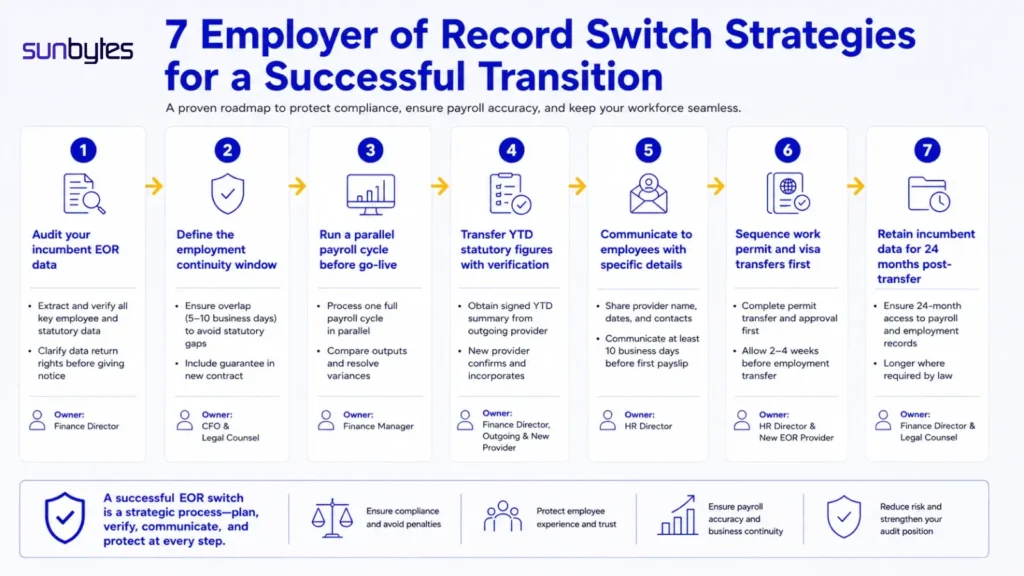
Strategy 1: Audit your incumbent EOR provider’s data holdings before giving notice
Before informing your incumbent provider that you are switching, extract and verify all data they hold: employee master records, contribution history by employee, year-to-date statutory figures, work permit and visa records, and the contractual terms governing data return upon termination.
The reason to do this before giving notice is not adversarial. It is practical. Some providers deprioritise data requests from departing clients. Information that would take two business days to receive before notice can take two weeks after. If your contractual right to the data is unclear, clarify it before you trigger the departure conversation. Once notice is given, your leverage to negotiate data access timelines decreases.
Owner: Finance Director.
Consequence if skipped: Data extraction delays extend the transition timeline. If the incumbent holds work permit documents and is slow to return them, the new provider cannot begin permit transfer until they arrive.
Strategy 2: Define the employment continuity window and protect it contractually
The employment continuity window is the period during which both the old and new EOR provider hold active registrations for the same employees. This parallel registration prevents the gap that produces statutory late-payment penalties.
Negotiate a specific employment continuity guarantee into your new provider contract before signing: the new provider begins statutory registration for all transferring employees before the old provider deregisters them. The parallel window is typically 5 to 10 business days. The cost is usually one partial month of additional service fees from one or both providers. The cost of the alternative , a statutory gap , is daily penalty interest under Decree 12/2022/ND-CP in Vietnam and equivalent frameworks in other markets.
Owner: CFO and legal counsel.
Consequence if skipped: Statutory contributions due in the gap window will be late. The employer incurs penalty interest from the first day of delay regardless of which provider was supposed to file.
Strategy 3: Run a parallel payroll cycle before go-live
Parallel payroll means processing one complete payroll cycle through the new provider in parallel with the incumbent, without making actual payments from the new provider. The outputs are compared line by line. Any variance requires investigation and configuration correction before go-live.
The Belgian logistics company ran one parallel cycle before go-live. That cycle surfaced two configuration differences that would have affected 11 employees’ social insurance calculations on day one , not because the new provider made an error, but because the configuration of the outgoing provider had been handling two categories of allowance differently from what the new provider had been told. Without the parallel run, those differences would have appeared in the first live payslip.
Owner: Finance Manager.
Consequence if skipped: Configuration errors surface in the first live cycle. Employees are affected. No comparison data exists to distinguish between configuration errors and data transfer errors.
Strategy 4: Transfer YTD statutory figures with formal verification
Year-to-date statutory figure transfer is the highest-risk data movement in an EOR switch. The figures , cumulative gross income, taxes withheld, and contributions paid , must transfer from the incumbent to the new provider with written confirmation from both parties before the incumbent deregisters.
Formal verification means: the outgoing provider produces a signed YTD summary for each employee, the new provider confirms receipt and incorporation into the new system, and the Finance Director signs off that the figures match the client’s own payroll records. A receiving provider that starts YTD figures from zero in month seven will under-withhold for the remainder of the year. The shortfall surfaces at annual tax finalisation, by which point it has been accumulating for five months.
Owner: Finance Director, outgoing provider, new provider.
Consequence if skipped: YTD calculation errors that produce withholding shortfalls, requiring amended tax filings and potential late-payment interest for the affected employees.
Strategy 5: Communicate to employees with specific dates and named contacts
How to change EOR without disrupting employees comes down to one principle: communicate before the payslip arrives. Employee communication must include: the name of the new EOR provider, the exact date of the first payment from the new provider, the name of the contact at the new provider for payroll queries, and individual confirmation for employees whose deductions or benefit structures are changing.
Communication should go out a minimum ten business days before the first new-provider payslip. Employees who receive a payslip from an unfamiliar entity without prior explanation generate immediate queries to your HR team. At 28 employees, even a moderate query rate at payslip time creates an HR workload spike that coincides with the most operationally demanding week of the transition.
Owner: HR Director.
Consequence if skipped: High query volume at first payslip. Employees questioning whether their bank details are secure or whether the payment came from the right entity create reputational risk alongside the operational disruption.
Strategy 6: Sequence work permit and visa transfers before employment contract transfers
For employees on work permits or visas sponsored by the incumbent EOR, the permit transfer to the new EOR must be completed before employment transfers. In Vietnam, cancellation of an employment-linked work permit triggers a visa consequence. The new EOR must be approved as the sponsoring entity before the old EOR cancels the existing permit.
This sequencing adds two to four weeks to the transition timeline for any employee with employer-sponsored immigration status. It is not negotiable , the consequence of getting the sequence wrong is a work permit cancellation that requires a full re-application, which can take 4 to 8 weeks and leaves the employee unable to work during the processing period.
Owner: HR Director and new EOR provider.
Consequence if skipped: Work permit cancellation before new permit is issued. Employee unable to work legally during the re-application period.
Strategy 7: Retain the incumbent provider’s data for 24 months post-transfer
After the transition is complete, your company must retain , or have contractual access to , payroll and employment records from the incumbent provider for at least 24 months, and longer in jurisdictions with extended audit exposure.
Most EOR contracts address what happens to data at termination. Review this clause before signing the termination agreement. If the contract specifies destruction of data at termination, negotiate a minimum 24-month accessibility window. In Vietnam, SHUI audit exposure can reach back three years. In most EU markets, employment records must be retained for the statutory limitation period, typically five to seven years.
Owner: Finance Director and legal counsel.
Consequence if skipped: Historical payroll data is unavailable for a subsequent audit or inspection covering the period managed by the incumbent provider.
Common mistakes in EOR provider switches (and how to avoid them)
The three mistakes below account for the majority of EOR switches that produce employee payment failures, compliance lapses, or unexpected costs. They are predictable because they follow the same pattern: speed is prioritised over sequence.
Mistake 1: Giving notice to the incumbent before extracting your data
This is the most common sequencing error. The natural impulse when you have decided to switch is to inform the incumbent immediately. The operational consequence is that the provider’s motivation to respond quickly to data requests drops the moment they know they are losing the client. Data that would take two days to receive before notice takes two weeks after.
Extract all data, verify it against your own records, and resolve any gaps before giving formal notice of termination. The delay between your decision to switch and the notice date is typically two to four weeks anyway while you finalise the new provider contract. Use that window productively.
Mistake 2: Choosing a go-live date that falls on a statutory deadline
If your go-live date falls on or near a statutory contribution due date , the last day of the month in Vietnam, the 15th in some European markets , both providers may assume the other is handling that cycle’s filing. Neither files. The employer incurs a late-payment penalty for a contribution that was budgeted and available, but not submitted because the handover date created ambiguity about responsibility.
Go-live on the first of a month, at least five business days before the earliest statutory deadline in that month. Assign filing responsibility in writing for every statutory obligation due within the 30 days following go-live.
Mistake 3: Skipping the parallel payroll cycle to save time
The parallel cycle adds two to four weeks to the transition timeline. Under time pressure , a new provider contract is signed with a fast-start expectation, a board requirement to have the switch complete by a specific date , the parallel cycle is the step that gets cut. The consequence is that configuration errors in the new provider surface in the first live cycle, when employees are paid and the old system is already closed.
Time saved by skipping the parallel cycle: two to four weeks. Time spent investigating and correcting first-cycle errors without a comparison dataset: four to eight weeks. The time saving is negative in every scenario where a configuration error exists, which is most scenarios involving a provider switch from a different system architecture.
EOR switch transition timeline: from decision to full handover
The six-week timeline below reflects the Belgian logistics company’s transition.
| Week | Key actions | Owner | Risk if delayed |
| Week 1 to 2 | Data audit from incumbent. New provider contract negotiation including continuity window. | Finance Director + CFO | Data gaps extend Week 3. Contract without continuity clause creates statutory gap risk. |
| Week 3 | Formal notice to incumbent. New provider begins statutory registration. Work permit transfer initiated for foreign employees. | HR Director + new provider | Permit transfer sequencing failure if not started here. |
| Week 4 | YTD data transfer with dual sign-off. Employee communication sent. | Finance Director + both providers | YTD errors not caught before parallel run. |
| Week 5 | Parallel payroll cycle. Outputs compared line by line. Configuration corrections made. | Finance Manager | No pre-go-live validation if skipped. |
| Week 6 | Finance sign-off. Go-live on a new provider. Incumbent deregistration after new registration confirmed. | CFO + Finance Director | Employment gap if deregistration precedes new registration. |
Post-switch verification: how to confirm the transition succeeded
The transition is technically complete when the first live payroll cycle runs successfully under the new provider. The transition is operationally confirmed when the 90-day post-switch audit produces a clean result. Most EOR switch guides end at go-live. The problems that appear between go-live and the 90-day mark are the ones most likely to produce material liabilities.

The 90-day post-switch audit: what to check and why
Three checks at 90 days cover the highest-risk residual issues from the transition.
- YTD figure consistency
Verify that the year-to-date figures in the new system match the YTD transfer records signed off at handover. A discrepancy at 90 days indicates a transfer error that is still correctable before end-of-year statutory calculations are finalised.
- Authority registration confirmation
Confirm that all employees’ contribution histories are correctly recorded under the new provider’s registration with the relevant statutory authority. In Vietnam, request a VSS contribution history extract for each employee and compare it to the new provider’s records.
- Regulatory currency
Confirm that any regulatory changes that occurred during the transition window have been incorporated into the new provider’s configuration. A provider change that straddles a regulatory update date creates the possibility that neither provider incorporated the change.
When to escalate: signs the transition has a structural problem
Four observable signals indicate a structural problem rather than a minor teething issue that self-resolves.
- First-cycle payroll variance above 2% vs parallel-run output, without a documented explanation. A variance at this level is a configuration difference the parallel run did not surface.
- Any statutory authority notice received after go-live referencing the transition period. Signals that a handover step (filing, registration, data submission) was not completed.
- Employee payslip errors that persist past cycle 2. First-cycle errors are often transition data artefacts; cycle-2 persistence indicates a configuration error requiring correction.
- New provider unable to produce YTD statutory figures within 3 business days. Data is not correctly loaded in the new system.
What to verify before signing with the new EOR provider
An EOR migration checklist starts at the contract negotiation stage, not at go-live. The contractual terms that protect you during the transition must be in the contract before you sign, not negotiated after notice is given to the incumbent.
Statutory capability: what the new provider can actually handle
- Entity ownership: Does the new provider own its legal entity in your target market, or operate through a local partner? If employment sits with a sub-contracted entity, you have not vetted the actual employer.
- License status: In Vietnam, temporary staffing requires a labor leasing license under Decree 145/2020/ND-CP. EOR for permanent employment requires a compliant Vietnamese entity. Ask for the license number and verify it.
- Work permit capability: Can the new provider sponsor work permits and visas for foreign employees in your target market? For the Belgian logistics company, this was the reason for the switch. Verify it explicitly before signing.
- Geographic coverage: If you have employees in multiple locations within the market , HCMC, Binh Duong, Hanoi , confirm that the provider covers all of them under the same contract and compliance framework.
The Vietnam Data Protection Regulation imposes obligations on how employee data is handled during and after the EOR relationship. Your new provider should demonstrate compliance before you transfer any data. Details on these requirements are covered in the Vietnam data protection law guide.
Data handling: how your employee data will be protected during transfer
- Data Processing Agreement: Must be signed before any employee data is transferred. This is required under GDPR Article 28 for any EU parent company. In Vietnam, Decree 13/2023/ND-CP imposes equivalent requirements. A provider that makes you request the DPA is not set up for EU client standards.
- ISO 27001 certification: The international standard for information security management. Ask for the current certificate, not a statement of intent.
- Data transfer encryption: All employee records must be transmitted via encrypted channels. Request the provider’s data transfer protocol in writing before the first data exchange.
- Post-termination data access: The contract must specify your right to access historical payroll data for the statutory retention period after the engagement ends. Minimum 24 months. Ideally 5 to 7 years for markets with extended audit exposure.
Switching EOR providers is safest when payroll data, YTD figures, and statutory registrations are verified before go-live. Sunbytes manages EOR transitions with parallel registration windows, YTD data sign-off, and work permit sequencing built into the handover plan.
Explore Employer of Record Service
How Sunbytes handles EOR transitions
The Belgian logistics company did not choose Sunbytes because of its marketing. It chose Sunbytes because Sunbytes had a documented transition process, owned its Vietnamese entity, held the required licenses, and could handle the work permit transfer that the incumbent provider had failed to process. The transition structure produced the result: 28 employees, 6 weeks, zero payment gaps.
Sunbytes is a Dutch-founded technology and workforce company founded in 2011, with 300+ client projects across 20+ countries.
- EOR with a documented transition process.
Through Employer of Record service and Accelerate Workforce Solutions, Sunbytes provides EOR transitions with parallel employment windows, YTD data verification with dual sign-off, work permit transfer management, and a 90-day post-switch audit included in the transition scope. Time-to-hire under EOR: 14 business days. Contracts within 48 hours. Offboarding within 24 hours. ISO 27001 certified. Signed DPA on all engagements.
- System integration for EOR data environments.
For companies connecting EOR employment data to a European HR or payroll platform, Digital Transformation Solutions handles the integration architecture for the new provider relationship. Data flows are mapped before the first live cycle.
- Data protection across the full transition lifecycle.
Employee data transferred during an EOR switch moves between three entities: the outgoing provider, your company, and the new provider. CyberSecurity Solutions embeds GDPR Article 32 and Decree 13/2023/ND-CP requirements into the transfer process from the first data exchange.
FAQs
Four to eight weeks for a structured transition with a parallel employment window. Switches attempted in under four weeks typically skip the parallel payroll cycle, which means the first live cycle is also the first validation cycle. The Belgian logistics company’s six-week transition included a parallel cycle in week five and produced no first-cycle errors.
Yes, with the parallel employment window and employee communication in place. Employees should experience no payment gap, no change in their statutory contribution history, and no change in their employment status. The transition is an administrative change, not an employment event, when it is structured correctly.
Employee master records (national ID, VSS number or equivalent, bank account, employment contract dates), year-to-date gross income and taxes withheld, contribution history by employee for the current statutory year, work permit and visa records for foreign employees, and all contractual terms from the employment contracts issued by the incumbent.
January 1 is structurally simplest , it eliminates YTD data transfer complexity entirely because the new provider starts with clean opening balances. Mid-year switches are manageable with a documented transfer process but add one to two weeks of verification work. Avoid switching in the final three months of the tax year if possible, because YTD figures are accumulating to their most complex state and any transfer error affects the annual withholding calculation.
Employment contracts must be reissued by the new EOR provider. In most markets, including Vietnam, this requires a formal termination of the employment relationship with the outgoing provider and a new contract with the incoming provider. Employees should not experience a gap in employment status. The transition is sequenced so that the new contract takes effect before or simultaneously with the old contract termination.
Five provisions: data return obligations specifying the format and timeline for returning all employee records, post-termination data accessibility period of at least 24 months, employment continuity provisions covering the transition to the next provider, SLA for YTD data transfer accuracy, and a liability clause for errors in the data provided that affect the new provider’s statutory filings.
Let’s start with Sunbytes
Let us know your requirements for the team and we will contact you right away.