

Your candidate has accepted the offer, but the employment contract still has no confirmed local legal employer. The probation period comes from a European template, while HR and payroll hold different salary figures.
An employment contract Vietnam hiring teams can use safely must identify the employer, include the statutory content under Article 21 of the Vietnam Labour Code 2019 and use the correct contract type. It must also connect compensation, statutory insurance, employee data and signature records to the same start date.
This article provides operational guidance, not legal advice. Qualified Vietnam employment counsel should review the final contract and any sample wording before signing.
TL;DR
- Vietnam recognises fixed-term employment contracts of up to 36 months and indefinite-term employment contracts.
- Article 21 requires ten content groups covering the parties, role, workplace, term, compensation, working conditions, insurance and training.
- Probation is limited by role to 180, 60, 30 working days. Probation pay must equal at least 85% of the agreed position salary.
- Electronic employment contracts are valid when identity, signature, integrity and retrieval requirements are met. From 1 July 2026, the workflow must account for the national platform and electronic contract ID.
What is an employment contract in Vietnam, and who can sign it?
Under Article 13 of the Vietnam Labour Code 2019, an employment contract is an agreement under which an employee performs paid work under an employer’s management and supervision. The definition applies regardless of the document title.
The document title does not determine worker status
Calling an agreement a consultancy, service or cooperation contract does not determine the legal relationship. If the individual performs paid work and the organisation manages or supervises that work, the agreement may still qualify as an employment contract.
A contractor agreement cannot replace a lawful local employment model when the relationship meets the Article 13 conditions.
Valid contract forms
Article 14 recognises:
- Written employment contracts.
- Electronic employment contracts that meet Vietnam’s electronic transaction requirements.
- Oral employment contracts lasting less than one month, subject to statutory exceptions.
The Labour Code does not create a universal requirement for every employment contract to be bilingual. A Vietnamese-English contract may still reduce interpretation problems for an EU employer and Vietnam-based employee.
Employer signatory and foreign-company threshold
The employer’s signatory must have authority under Article 18. Depending on the employer type, this may be its legal representative, an authorised person, the head of an organisation or an individual employer.
A foreign parent company should not release the contract until it identifies the Vietnam legal employer and authorised signatory. For a foreign employee, the named employer, role, workplace and contract duration should also align with the applicable Vietnam work permit requirements.
If no authorised Vietnam employer can sign, resolve the employment model before confirming the start date.
Which clauses are mandatory under Article 21?
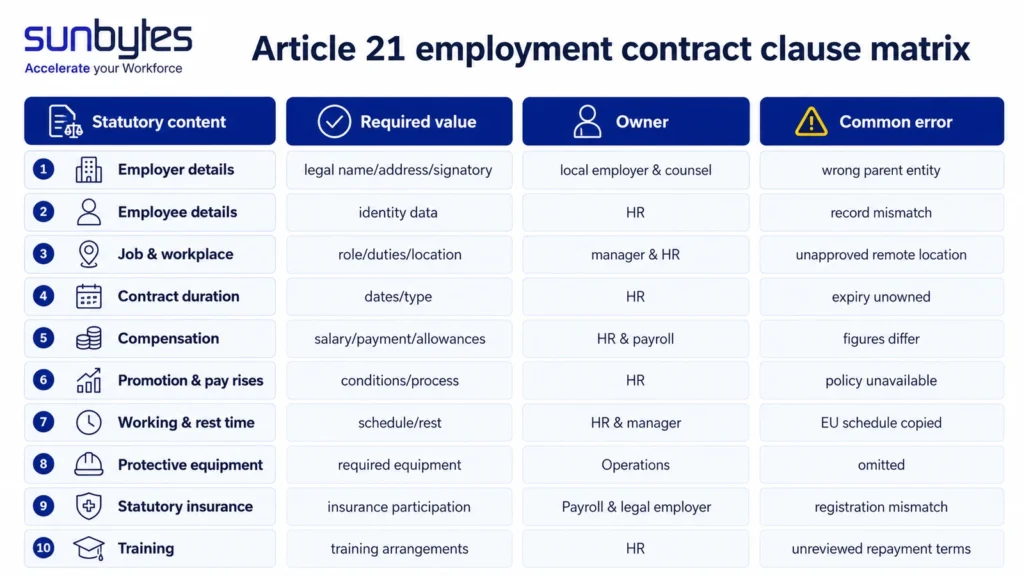
Article 21 requires ten statutory content groups. Each group should contain a specific value or an accessible policy reference.
The matrix below maps each Article 21 requirement to its operational owner and the error that HR should check before releasing the contract.
| Article 21 content | Required contract value | Owner | Common error |
|---|---|---|---|
| Employer details | Legal name, address, signatory name and position | Local employer and counsel | European parent named instead of Vietnam employer |
| Employee details | Name, date of birth, gender, residence and ID or passport number | HR | Details conflict with identity or permit records |
| Job and workplace | Role, duties and approved work location | Hiring manager and HR | Remote work included without permitted locations |
| Contract duration | Start date, end date or indefinite status | HR | No owner assigned to the expiry date |
| Compensation | Salary, payment method and date, allowances and additional payments | HR and payroll | Offer, contract and payroll contain different figures |
| Promotion and pay rises | Conditions or applicable process | HR | Policy referenced but not provided |
| Working and rest time | Normal schedule and rest arrangements | HR and manager | European schedule copied without local review |
| Protective equipment | Required equipment where applicable | Operations | Omitted for an eligible role |
| Statutory insurance | Applicable insurance participation | Payroll and legal employer | Contract wording does not match registration |
| Training | Training and occupational skill arrangements where applicable | HR | Training repayment terms added without review |
Article 21(2) permits a separate written agreement for employees whose work relates directly to business secrets or technological know-how. It does not make every confidentiality, intellectual property or employee-data provision a mandatory Article 21 clause.
What belongs outside the employment contract?
Not every employment record belongs in the employment contract. The following document map keeps statutory terms in the contract while routing changing or specialist information to the correct record.
| Employment information | Document of record |
|---|---|
| Statutory employment terms | Employment contract |
| Detailed compensation components | Contract annex or compensation schedule |
| Confidentiality and business secrets | Contract or separate written agreement |
| Acceptable-use and security requirements | Employee-acknowledged internal policy |
| Employee-data information | Privacy notice, contract clause or applicable DPA |
| Monthly SHUI and PIT calculations | Payroll records |
| EOR scope, fees and liability | Client-EOR service agreement |
The employee’s employment contract is separate from the commercial agreement between a client and an Employer of Record. If an EOR will employ the candidate, review the EOR contract clauses in Vietnam separately.
Fixed-term or indefinite: which contract type fits?
Vietnam recognises two statutory contract types: fixed-term and indefinite-term employment contracts. A fixed-term employment contract may last no more than 36 months.
The comparison below connects each contract type to its duration, use case and main HR control.
| Attribute | Fixed-term employment contract | Indefinite-term employment contract |
|---|---|---|
| End date | Defined | No predetermined end date |
| Maximum duration | 36 months | Not applicable |
| Suitable use | Role with a genuine time boundary | Continuing employment |
| Renewal control | Renewal and conversion rules apply | No expiry renewal |
| Main HR risk | Missing the renewal deadline | Assuming termination at will |
If the employee continues working after a fixed-term contract expires, the parties have 30 days to conclude a new contract. Existing rights and obligations continue during this period. Without a new contract, the employment relationship generally converts to an indefinite-term contract.
The parties may generally enter into one further fixed-term contract. Continued employment after that usually requires an indefinite-term contract, subject to statutory exceptions.
Foreign employees may be subject to contract-duration rules linked to their work permits. Route that decision to current work-permit guidance and legal counsel.
Set HR reminders 60 and 30 days before expiry. These are operational controls, not statutory deadlines.

How should probation be written into the contract?
Probation may be included in the employment contract or documented separately. It is permitted once for the same job, and probation pay must equal at least 85% of the agreed position salary.
The maximum period depends on the statutory role category:
| Role category | Maximum probation |
|---|---|
| Qualifying enterprise executive | 180 days |
| Role requiring junior-college qualifications or higher | 60 days |
| Technical or vocational role | 30 days |
| Other eligible work | 6 working days |
Probation is not permitted for an employment contract lasting less than one month. Under Article 27, either party may end probation without advance notice or compensation.
The probation clause should state:
- Statutory role category.
- Start and end dates.
- Probation salary.
- Evaluation criteria.
- Decision owner.
Illustrative drafting prompt:
The employee will complete a probation period from [date] to [date] based on the role category confirmed under Article 25. The probation salary will be [amount], equal to at least 85% of the agreed position salary. [Role or name] will assess the documented job outcomes before the probation end date.
This wording requires local legal review. Background checks and reference calls belong in candidate vetting in Vietnam, not in the probation clause.

Which additional clauses protect an EU employer?
Additional clauses should address the risks created by the employee’s actual role. Confidentiality, intellectual property, remote work, equipment, information security and employee data each require a defined control and owner.
| Clause | Required control | Owner |
|---|---|---|
| Confidentiality | Protected information, permitted use and return | Legal and information owner |
| Intellectual property | Work created and intended rights holder | Legal and hiring manager |
| Remote work | Permitted locations, schedule and expenses | HR and manager |
| Equipment | Ownership, acceptable use and return | IT and HR |
| Information security | Accounts, access controls and incident reporting | IT or security |
| Employee data | Purpose, access, retention, transfer and deletion | HR, privacy and legal |
| Policy incorporation | Applicable policies and acknowledgement date | HR |
The contract pack should translate these controls into role-specific language:
- Confidentiality: Define protected information and permitted use instead of treating all company information as confidential.
- Intellectual property: Identify the intended rights holder and align the employee clause with applicable client and provider agreements.
- Remote work: State permitted work locations, equipment ownership and expense responsibility.
- Information security: Name the applicable security policy, reporting route and employee acknowledgement.
- Employee data: Connect the processing purpose to the employee privacy notice.
Vietnam’s Law No. 91/2025/QH15 on Personal Data Protection and Decree No. 356/2025/ND-CP took effect on 1 January 2026.
When a Vietnam employee’s payroll or performance data enters an EU-based HRIS, assign the processing purpose, access rights, retention period, cross-border transfer process and exit deletion rules. The EU entity should also determine its GDPR role rather than treating every employment-data relationship as identical.
How should salary, SHUI, PIT and benefits connect to the contract?
The employment contract should state the salary, payment method, payment date, allowances, additional payments and statutory insurance terms. Payroll records should hold changing contribution rates, deductions, calculations and remittance evidence.
Before signature, HR and Finance should compare:
- Accepted offer.
- Compensation schedule.
- Employment contract.
- Payroll input file.
A difference in salary, currency, allowance or payment date should block the payroll handoff until one approved value is recorded across all four documents. Use the Vietnam Social Insurance obligations guide to confirm current contribution rules. For tax residency, withholding and payroll treatment, refer to Vietnam PIT for employers.
Already have the candidate but no clear employment owner?
Sunbytes Recruitment connects candidate selection to the appropriate Vietnam employment setup, so contract, work-permit and payroll responsibilities are assigned before the start date. Discuss your Vietnam hiring setup.
How do electronic employment contracts work from July 2026?
Electronic employment contracts have the same legal value as paper contracts when they meet the applicable identity, agreement, signature, integrity, storage and retrieval requirements.
Decree 337/2025/NĐ-CP regulates electronic employment contracts, eContract providers and the national electronic employment contract platform. Circular 08/2026/TT-BNV provides implementation guidance effective from 1 July 2026.
The electronic workflow should complete five controls:
- Verify identity: Confirm the employee and authorised employer signatory.
- Approve content: Lock the reviewed contract version.
- Sign electronically: Apply a legally qualifying signature method.
- Obtain the contract ID: Complete the applicable national-platform process.
- Retain evidence: Store the contract, signatures and audit trail in a secure, retrievable form.
A PDF containing pasted signature images is not automatically a controlled electronic employment contract. HR should be able to prove who signed, which version was signed, when signature occurred and whether the record remains intact.
The July 2026 framework does not require every employer to abandon paper contracts. It defines additional controls for employers using the regulated electronic workflow.

What expiry and notice rules should the contract process reflect?
Fixed-term expiry, employee resignation, employer-initiated termination and probation termination follow different legal conditions.
The table maps each event to the process HR must activate.
| Employment event | Required process control |
|---|---|
| Fixed-term expiry | Review expiry and manage the 30-day window if work continues |
| Employee resignation | Apply the relevant statutory notice period and exceptions |
| Employer termination | Confirm lawful grounds, evidence and procedure |
| Probation termination | Apply Article 27 |
| Mutual termination | Document the agreement and effective date |
Under Article 35, common employee notice periods include:
- 45 days for an indefinite-term employment contract.
- 30 days for a fixed-term employment contract lasting 12 to 36 months.
- Three working days for a fixed-term employment contract lasting less than 12 months.
Exceptions apply to certain circumstances and occupations. Do not add “termination at will” to a Vietnam contract. Contract wording cannot replace the lawful grounds, evidence and procedure required for employer-initiated termination.
Employment contract review checklist before the employee starts
Do not release the contract until each start-date control has an owner. Any unresolved blocker should stop signature or start-date confirmation.
| Pre-start control | Accountable owner | Block contract release? |
|---|---|---|
| Vietnam legal employer confirmed | EU HR and local employer | Yes |
| Signatory authority verified | Legal counsel | Yes |
| Employee identity matched | HR | Yes |
| Job and workplace approved | Hiring manager | Yes |
| Contract type and dates confirmed | HR and counsel | Yes |
| Article 21 content completed | HR and counsel | Yes |
| Probation category and pay confirmed | HR and hiring manager | Yes |
| Compensation matches payroll | HR, Finance and payroll | Yes |
| SHUI and PIT handoff assigned | Payroll and legal employer | Yes |
| Work-permit dependency checked | Legal employer and counsel | Where applicable |
| Data, IP and policies issued | HR, IT and legal | Role-dependent |
| Signature and record method ready | HR Operations | Yes |
Once every blocker is cleared, the employment file should contain the signed contract, applicable annexes and policies, payroll input sheet, employee privacy notice and work-authorisation evidence.

When recruitment needs an EOR handoff
An Employer of Record handoff is relevant when a candidate has been selected but the company has no Vietnam entity or authorised local legal employer ready to sign the employment contract and administer payroll.
An EOR may fit when:
- You are making your first Vietnam hire without an entity.
- Entity setup will not be ready before the intended start date.
- The employee needs a local contract and payroll before your internal structure is ready.
It is a poor fit when your Vietnam entity can already employ the person and you only need candidate sourcing.
Recruitment finds and assesses the candidate. The local legal employer signs and administers the employment contract. If your company lacks that employer, review the Employer of Record in Vietnam before issuing the offer pack.
How Sunbytes connects the contract to the employee’s working setup
An employment contract is ready only when its terms match how the employee will be hired, managed and given access to company systems. Separate decisions can leave the contract naming one workplace while the team follows another, assign intellectual property to the wrong entity or leave payroll and access controls without owners.
Sunbytes starts with the recruitment-to-employment handoff through Accelerate Workforce Solutions. The role, compensation, probation category, legal employer and start date are confirmed before the contract moves to payroll. For qualified roles with an approved brief and aligned salary range, Sunbytes targets a first shortlist within three days and a 14-day time-to-hire when interview decisions stay on schedule. Without a Vietnam entity, the selected candidate can move to an EOR employment setup.
For an employee joining a software or product team, Digital Transformation Solutions connects the employment terms to the delivery model. The job description, reporting line, workplace, working overlap and expected outputs should reflect the employee’s actual role. This prevents a generic contract from being used for an engineer whose responsibilities include source-code ownership, sprint delivery or production access.
That delivery model determines the necessary contract protections. Cybersecurity Solutions connects confidentiality, intellectual property, equipment and employee-data clauses to access controls. The written obligations should match the security policies, systems and offboarding process applied to the employee.
The result is one employment handoff: the candidate is hired through the correct local model, the contract reflects the actual role, and system access supports the obligations recorded in the contract pack.
Talk to Sunbytes about your Vietnam hiring and employment handoff.