
IT staff augmentation rates are useful only when they show what the buyer is actually getting. A €6,000/month backend developer and a €9,500/month senior DevOps engineer do not solve the same problem, even if both appear on the same vendor rate card.
IT staff augmentation rates are the monthly fees a company pays to add external technical specialists to an existing team. In a Dutch or European context, those rates should be read by role, seniority, region, responsibility level, communication overlap, onboarding support, replacement terms, and security requirements.
The rate is the starting point. The decision is whether that role can improve delivery without creating more management, rework, or security overhead for your internal team.
TL;DR
IT staff augmentation rates usually differ by role, seniority, region, and ownership level. Use monthly EUR ranges as a planning tool, not as a vendor selection shortcut. A lower rate is useful only when onboarding, timezone overlap, security requirements, replacement terms, and delivery metrics are clear before the first sprint.
- Developer staff augmentation rates are usually lower for frontend and backend roles than for DevOps, solution architecture, or specialist data roles because responsibility and scarcity differ.
- QA augmentation rates depend on whether the role covers manual testing, automation, test strategy, or release quality ownership.
- DevOps augmentation rates should be judged against uptime, deployment discipline, access control, and incident response expectations, not only against monthly cost.
- Vietnam delivery can be commercially strong when the operating model includes 4 to 5 hours of Netherlands-Vietnam overlap, clear ownership, and documented security controls.
- Watch out for rate cards that exclude onboarding, replacement policy, communication cadence, access control, or delivery metrics.
How to read IT staff augmentation rates
IT staff augmentation rates should be read as a capability signal, not only as a price. A useful rate card tells you which role you are buying, how senior that person is, which responsibilities are included, and how quickly the person can become productive.
A simple monthly number hides four decisions:
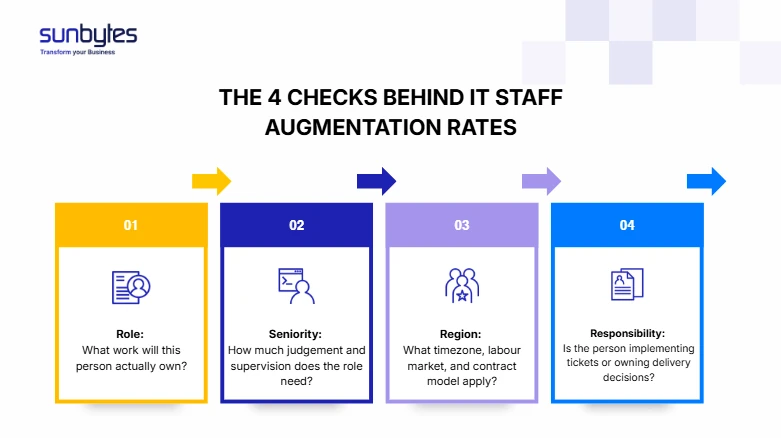
First, define the role. A frontend developer building a campaign interface is not comparable to a frontend developer owning a design system across five product squads. A QA engineer running manual regression tests is not comparable to a QA automation engineer designing CI test coverage.
Second, define seniority. Junior, mid-level, senior, and lead roles should not be priced as interchangeable capacity. Seniority changes decision quality, supervision load, and rework risk.
Third, define the region. Netherlands-based hiring, nearshore Europe, and Vietnam delivery have different labour markets, timezones, contract structures, and collaboration patterns. The cheapest monthly rate can become expensive when overlap is too low or the role needs constant architecture clarification.
Fourth, define responsibility. The same backend role can be priced differently when the engineer only implements tickets, owns API design, reviews pull requests, or supports production releases.
A comparable rate card should state the monthly fee, role, seniority, region, minimum commitment, onboarding support, replacement policy, communication overlap, security requirements, and delivery reporting. Without those details, the rate is not comparable.
Monthly rates only show one layer of the budget. A fuller IT staff augmentation cost view should include onboarding time, vendor management, replacement terms, internal supervision, and the cost of delayed delivery.
Rate benchmarks by role and seniority
IT staff augmentation rates are easiest to compare when each role is separated by seniority and region. The table below uses monthly EUR planning ranges based on Sunbytes scoping experience and public salary context.
The Stack Overflow Developer Survey 2025 is useful for salary context by developer type and experience level, not as direct bill-rate proof. The Eurostat Digital Decade ICT specialist data gives the European talent context. Eurostat reports 10.3 million ICT specialists in the EU in 2024, still more than 9.7 million below the EU’s 2030 Digital Decade target.
| Role | Seniority | Netherlands or local hiring equivalent | Nearshore Europe augmentation | Vietnam delivery augmentation |
|---|---|---|---|---|
| Frontend developer | Medior | €7,500–€10,500 /month | €5,500–€8,000/ month | €3,800–€6,200/ month |
| Frontend developer | Senior | €10,500–€14,00 0/month | €7,500–€10,500 /month | €5,500–€8,000/ month |
| Backend developer | Medior | €8,000–€11,500 /month | €6,000–€8,800/ month | €4,200–€6,800/ month |
| Backend developer | Senior | €11,000–€15,50 0/month | €8,000–€11,500 /month | €6,000–€9,000/ month |
| Full-stack developer | Medior | €8,500–€12,000 /month | €6,500–€9,500/ month | €4,800–€7,200/ month |
| Full-stack developer | Senior | €12,000–€16,50 0/month | €9,000–€12,500 /month | €6,800–€9,800/ month |
| QA engineer | Medior | €6,500–€9,000/ month | €4,800–€7,000/ month | €3,500–€5,500/ month |
| QA automation engineer | Senior | €9,000–€13,000 /month | €6,500–€9,500/ month | €5,000–€7,800/ month |
| DevOps engineer | Senior | €12,000–€17,50 0/month | €9,000–€13,500 /month | €7,000–€10,500 /month |
| Data engineer | Senior | €12,000–€18,00 0/month | €9,500–€14,000 /month | €7,000–€11,000 /month |
| Project manager | Medior to senior | €9,000–€14,000 /month | €7,000–€10,500 /month | €5,500–€8,500/ month |
| Solution architect | Senior or lead | €14,000–€22,00 0/month | €11,000–€17,00 0/month | €8,500–€13,500 /month |
These ranges are full-time monthly planning estimates for 2026 scoping discussions. They assume standard working-week availability and exclude VAT, unusual tooling costs, 24/7 support, rare niche premiums, and scope changes outside the agreed role. Final vendor rates should be compared only after role seniority, overlap, access level, onboarding support, and replacement terms are defined.
The safest way to use this table is to compare roles by responsibility. A senior DevOps engineer may cost more than a mid-level backend developer, but the DevOps role protects delivery flow, deployment reliability, and recovery discipline. DORA software delivery performance metrics such as deployment frequency, change lead time, failed deployment recovery time, change failure rate, and deployment rework rate are better measures for that role than ticket output alone.
Teams that are still deciding whether this model fits should first clarify how IT staff augmentation principles apply to ownership, management, and internal team control.
Hourly vs monthly IT staff augmentation rates
In practice, European staff augmentation engagements are often contracted as monthly dedicated-capacity arrangements, especially when the engineer joins an existing product team for multiple sprints.
| Role | Typical hourly rate | Typical monthly rate |
|---|---|---|
| Frontend developer (mid-level) | €24–€39/hour | €3,800–€6,200/month |
| Frontend developer (senior) | €34–€50/hour | €5,500–€8,000/month |
| Backend developer (mid-level) | €26–€43/hour | €4,200–€6,800/month |
| Backend developer (senior) | €38–€56/hour | €6,000–€9,000/month |
| Full-stack developer (mid-level) | €30–€45/hour | €4,800–€7,200/month |
| Full-stack developer (senior) | €43–€61/hour | €6,800–€9,800/month |
| QA engineer | €22–€34/hour | €3,500–€5,500/month |
| QA automation engineer | €31–€49/hour | €5,000–€7,800/month |
| DevOps engineer | €44–€66/hour | €7,000–€10,500/month |
| Data engineer | €44–€69/hour | €7,000–€10,500/month |
| Project manager / Delivery manager | €34–€53/hour | €5,500–€8,500/month |
| Solution architect | €53–€84/hour | €8,500–€13,500/month |
Hourly equivalents are derived from the monthly planning ranges used in this article, assuming approximately 160 billable hours per month. Actual vendor pricing varies by scope, contract length, availability, onboarding requirements, and delivery responsibility.
Hourly comparisons should be treated carefully. Two engineers with the same hourly rate may contribute very different values depending on seniority, onboarding speed, communication quality, architecture ownership, and production experience.
For long-term augmentation engagements, monthly rates are usually the better planning metric because they reflect dedicated capacity rather than individual billable hours. Hourly rates are most useful when comparing short-term specialist support, architecture reviews, consulting engagements, or part-time expertise.
Whether a role is priced hourly or monthly, the biggest drivers of cost are still region, scarcity, and responsibility level. The same engineer can command very different rates depending on delivery ownership, production risk, and communication requirements.
What changes the rate: region, scarcity, and responsibility
Rates change when a role is hard to hire, close to production risk, or expected to make senior delivery decisions. Region affects the monthly number, but responsibility level usually explains the bigger difference between two rate cards.
Netherlands-based hiring is usually the highest-cost path because the employer carries salary, recruitment, benefits, payroll costs, equipment, management time, and retention risk. The upside is local overlap, direct control, and easier access to company context.
Nearshore Europe can reduce cost while keeping strong working-day overlap. The limit is availability. Senior DevOps, data engineering, cybersecurity-aware development, and solution architecture roles are still scarce across many European markets.
Vietnam delivery can create strong commercial value when the operating model is designed properly. The useful comparison is not “Vietnam is cheaper.” The useful comparison is whether the team can work inside your sprint cadence with 4 to 5 hours of Netherlands-Vietnam overlap, clear acceptance criteria, and documented security controls.
Responsibility changes price because implementation, ownership, and production risk are different jobs. A backend developer who builds tickets is not the same profile as a backend developer who reviews API design, challenges unclear requirements, and supports release stability.
Security requirements also affect the rate. If augmented staff need access to repositories, cloud dashboards, production systems, or personal data, the vendor must support access control, least privilege, device policy, offboarding, and DPA terms. ISO/IEC 27001:2022 is relevant because it defines requirements for an information security management system. GDPR Regulation (EU) 2016/679 applies when augmented staff process or access personal data for a Dutch or European company.
Why seniority matters more than the average rate
The cheapest role on the rate card is not always the lowest-cost role in delivery. When the work contains unclear architecture, weak backlog definition, or production risk, a senior engineer can reduce the internal correction load before it turns into rework.
Mid-level developers are usually best when the work is already shaped. They can ship defined frontend, backend, QA, or data tasks when architecture, acceptance criteria, and code review are controlled by your team.
Senior developers are needed when the task includes judgement. They should notice unclear requirements, ask the right questions before implementation, review technical decisions, and reduce rework before sprint review. This is where rate and delivery value split apart.
Lead engineers, solution architects, and senior DevOps roles should be used selectively. They are more expensive, but they are often cheaper than letting a team build the wrong thing for a month. A solution architect at €13,500/month may be easier to justify than four developers waiting for integration decisions.
The practical rule is simple: use senior roles where ambiguity is high and medior roles where the work is already structured. If the roadmap is unclear, start with a senior engineer, solution architect, or delivery manager for the first 2 to 4 weeks before scaling the team.
Sunbytes uses this logic when designing dedicated senior teams. The goal is not to fill every seat with the most expensive profile. The goal is to create the smallest role mix that can move from backlog to shipped work with controlled rework, documented decisions, and DORA-tracked outcomes.
Comparing rates before defining roles usually creates false savings. Sunbytes can help define the right mix of developers, QA, DevOps, project management, delivery management, and architecture ownership before a rate card becomes a commitment.
How rates compare to local hiring cost
A IT staff augmentation rate only looks high or low after it is compared with the full cost of hiring. For Dutch companies, that comparison should include recruitment time, employer costs, onboarding, equipment, management capacity, retention risk, and the cost of leaving the role unfilled.
| Cost factor | Netherlands local hiring | IT staff augmentation |
|---|---|---|
| Salary or monthly fee | Gross salary plus employer costs | Monthly vendor fee |
| Recruitment | Internal recruiter, agency fee, interview time | Usually included in vendor model |
| Onboarding | Internal team time and documentation | Shared responsibility, should be defined before start |
| Equipment and tooling | Employer usually provides equipment and licences | Depends on vendor terms and security policy |
| Replacement risk | Employer restarts hiring if the person leaves | Vendor should define replacement policy |
| Management load | Full internal responsibility | Internal responsibility unless delivery management is included |
| Security controls | Internal IT and HR process | Must be defined in DPA, access control, device policy, and offboarding process |
| Ramp-up speed | Often measured in months | Dedicated senior teams can be operational in 2 to 4 weeks |
A local hire may be the best option when the role is strategic, permanent, and close to company knowledge. A staff augmentation role is usually better when the company needs specialist capacity faster than hiring can provide, or when the roadmap needs flexible capacity for 6 to 18 months.
The comparison changes again when output is measured. A lower monthly rate does not help if deployment frequency drops, change failure rate rises, or internal managers lose time correcting work. DORA software delivery performance metrics give engineering leaders a way to compare delivery health instead of debating rate cards in isolation. Deployment frequency shows release cadence. Changing lead time shows how quickly code reaches production. Failed deployment recovery time shows how quickly the team restores service after a failed deployment.
When the finance team needs to move beyond monthly cost, the next question is whether the role mix creates enough delivery value to justify the spend. A stricter IT staff augmentation ROI view should include close rate, margin, rework avoided, ramp-up speed, and the cost of keeping key roles unfilled.
How to ask vendors for comparable rate cards
Procurement can only compare vendor rates when every provider prices the same role, responsibility level, and operating conditions. Without that structure, three monthly prices may look comparable while describing three different services.
Ask each vendor for the same structure:
| Question to ask | Why it matters |
|---|---|
| Which role and seniority is included in the monthly rate? | Prevents comparing a senior implementer with a senior owner |
| What onboarding support is included in the first month? | Shows whether the vendor helps the role become productive or leaves ramp-up fully to your internal team |
| What replacement policy applies if the person is not a fit? | Protects continuity and reduces restart cost |
| What timezone overlap is guaranteed? | Controls meeting cadence, review speed, and blocker resolution |
| What security requirements are included? | Clarifies DPA, access control, device policy, repository access, and offboarding |
| Who manages day-to-day delivery? | Separates staff augmentation from managed delivery or dedicated team models |
| Which delivery metrics are reported? | Moves the discussion from rate to output |
| What happens when scope changes? | Prevents hidden cost when the roadmap shifts |
The best vendor conversations start with the work, not the rate. Share the roadmap, current team structure, delivery bottleneck, required timezone overlap, and access level. Then ask the vendor to recommend a role mix.
For example, a team struggling with release stability may not need three more developers. It may need one senior DevOps engineer, one QA automation engineer, and a delivery manager for two sprints to stabilize release flow. A team with slow feature throughput but strong architecture may need two medior developers instead.
The recommendation should end with a condition. Choose the lower-rate vendor only if the role, seniority, overlap, replacement terms, and security controls match the higher-rate proposal. If those terms are missing, the cheaper proposal is not comparable yet.
How Sunbytes helps turn rates into delivery capacity
A rate card is only useful when it shows whether each role can become productive, secure, and measurable inside your delivery model. Through Digital Transformation Solutions, Sunbytes designs dedicated resources and senior teams around role clarity, 4 to 5 hours of Netherlands-Vietnam overlap, ISO-guided delivery, and DORA-tracked outcomes from sprint one.
A typical team design starts with the role mix: developers, QA, DevOps, project manager, delivery manager, and architecture support where needed. The next step is delivery control: sprint rhythm, code review ownership, access model, security requirements, communication cadence, and replacement policy.
Security and workforce operations also affect the real value of a rate card. When augmented staff need repository, cloud, production, or personal data access, Cybersecurity Solutions can support secure-by-design controls, DPA evidence, access governance, and offboarding discipline. When the challenge is scaling people across roles and locations, Accelerate Workforce Solutions can support recruitment, onboarding, and workforce operations around the delivery model.
Sunbytes has delivered 300+ projects and can make dedicated senior teams operational in 2 to 4 weeks, depending on role availability, onboarding scope, and access requirements. The point is not to sell the lowest monthly rate. The point is to build capacity that your internal team can trust, manage, and measure.
FAQs
DevOps augmentation rates are often higher because the role touches infrastructure, CI/CD, access control, deployment reliability, and incident response. A senior DevOps engineer should be measured against delivery stability, change failure rate, and recovery time, not only ticket output.
Vietnam delivery can reduce monthly cost, but the useful question is whether the operating model protects quality and control. Vietnam works best when the engagement has clear ownership, 4 to 5 hours of Netherlands-Vietnam overlap, documented security controls, and a replacement policy.
Choose the lowest-rate vendor only if the role, seniority, responsibility level, communication overlap, onboarding support, replacement terms, and security controls match the higher-rate proposals. If those details differ, the cheaper rate is not a like-for-like comparison.
QA augmentation rates should be evaluated by responsibility level. Manual QA, QA automation, test strategy, CI test integration, and release quality ownership are different services. QA that prevents rework earlier in the sprint can be more valuable than cheaper testing added at the end.
A useful rate card should include monthly fee, role, seniority, region, minimum commitment, onboarding process, replacement policy, timezone overlap, security requirements, management responsibility, and delivery reporting. Without those fields, procurement cannot compare providers fairly.
Local hiring is usually better for permanent roles that need deep company knowledge, long-term ownership, or leadership authority inside the organisation. Staff augmentation is usually better when the company needs specialist capacity faster, wants flexibility, or needs to scale a team for a defined roadmap.
Let’s start with Sunbytes
Let us know your requirements for the team and we will contact you right away.