

IT staff augmentation cost is the total cost of turning external capacity into shipped work. The hourly or monthly rate is only the visible part. The real budget depends on role mix, ramp-up time, management load, compliance work, and the amount of rework the delivery model creates.
IT staff augmentation cost means the full cost of adding external technical professionals to your existing team for a defined period. For European companies, that cost should include vendor rate, onboarding time, internal review effort, access control, GDPR-related checks, and the cost of delayed or repeated work.
TL;DR
IT staff augmentation cost should be estimated as monthly rate × role mix × ramp-up time × management load × rework risk. For European companies, the model works best when internal product ownership is strong and the missing piece is technical capacity, not delivery control.
- Local EU hiring gives maximum internal control, but it turns capacity into a fixed cost and may delay delivery while recruitment runs.
- Nearshore and Vietnam augmentation can reduce monthly delivery cost, but only when ownership, sprint rituals, documentation, and security responsibilities are clear from week one.
- Dedicated teams cost more than individual augmentation, but they can reduce coordination risk when the roadmap needs several roles working together for 6 months or longer.
- IT staff augmentation works best when the roadmap is active, internal product ownership is strong, and the missing piece is technical capacity.
- A low monthly rate becomes risky when the internal team must spend too much time correcting work, rewriting tickets, or reviewing the same decisions twice.
What IT staff augmentation actually costs
A realistic IT staff augmentation budget starts with one question: how much internal effort is needed to make the external team productive? A €5,500 monthly developer can become expensive if your tech lead spends 10 hours per week rewriting tickets, correcting architecture decisions, or reviewing the same work twice.
Use this formula for a first budget:
IT staff augmentation cost = monthly rate × role mix × ramp-up time × management load × rework risk
That formula gives finance and delivery teams a better starting point than a rate card. A €7,500 senior engineer can be cheaper if that person joins sprint planning quickly, documents decisions, and reduces review load after the first two sprints.
For Dutch and European teams, the cost model should also include data and contract handling. If the augmented team touches production systems, customer data, analytics, logs, or support tooling, the budget needs room for GDPR processor terms, access control, security onboarding, and audit evidence.
The useful budget is not “developer cost per hour.” The useful budget is “cost per shipped change under control.”
The five cost drivers most teams miss
The five cost drivers most teams miss are seniority, role mix, onboarding depth, management load, and rework risk. These drivers explain why two teams with the same hourly rate can produce very different monthly delivery costs.
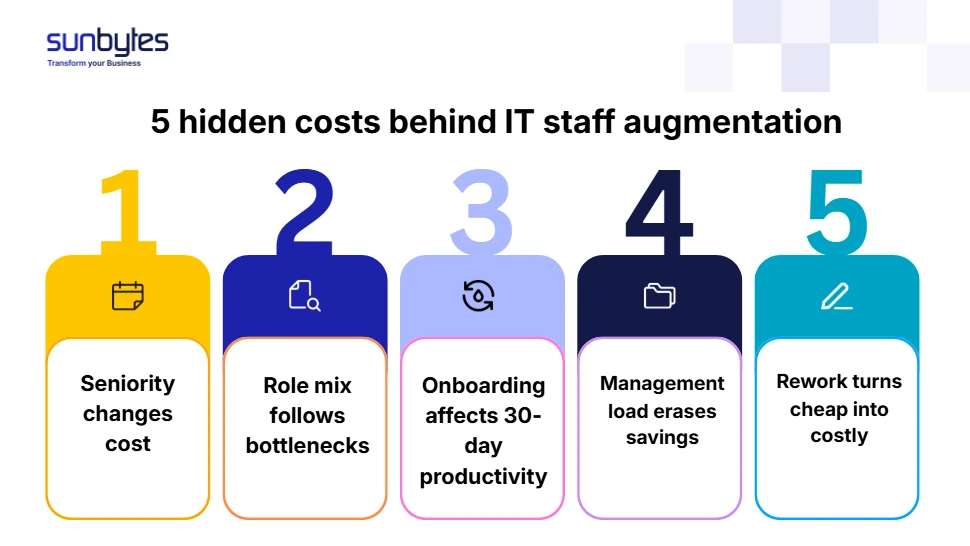
Seniority changes the cost curve
The more ambiguity a role carries, the more seniority matters. Junior and mid-level developers can work well when the backlog is clear, code review is active, and the architecture is stable.
For a European product team with limited internal engineering leadership, a cheaper junior-heavy setup often increases the real cost. The internal tech lead becomes the missing senior layer. That cost rarely appears in the vendor proposal, but it appears in sprint delay, review queues, and unfinished tickets.
A good cost estimate separates roles by delivery function:
| Role | Why the role affects cost | Budget implication |
|---|---|---|
| Senior developer | Handles ambiguity, architecture decisions, and technical trade-offs | Higher monthly rate, lower correction load |
| Mid-level developer | Ships defined backlog items with normal review | Good fit when internal product and technical ownership are strong |
| QA engineer | Reduces release risk and regression load | Often cheaper than using senior developers for repeated manual checks |
| DevOps or cloud engineer | Handles deployment, infrastructure, CI/CD, and reliability work | Expensive to add late when release problems already exist |
| Delivery lead or technical lead | Keeps sprint decisions, blockers, and ownership visible | Needed when several augmented engineers work together |
Role mix matters more than headcount
The cheapest team shape depends on where delivery slows down. A team of three developers is not automatically cheaper than a balanced team of two developers and one QA engineer.
Role mix should follow the bottleneck. If your internal team already has strong architecture ownership, add delivery capacity. If releases fail or deployment takes too long, add DevOps or QA support before adding more feature developers.
Onboarding is a cost, not an admin task
The first 30 days decide whether extra capacity becomes delivery output or management overhead. The first sprint should not be measured only by story points. It should be measured by whether the augmented developers can run the project locally, understand the release process, access the correct documentation, and make a small production-safe change.
For a controlled start, budget the first 2 weeks for environment setup, architecture walkthroughs, backlog calibration, security access, and definition of done. Dedicated senior teams can be operational in 2 to 4 weeks when role design, access, and sprint ownership are prepared before start.
Management load can erase rate savings
Every unclear ticket, delayed decision, and repeated review transfers cost back to the internal team. If your product manager rewrites tickets every day, your tech lead reviews
every decision twice, and your delivery manager resolves every timezone blocker, the internal team is paying for the external rate with its own time.
This is where DORA metrics help. Deployment frequency, lead time for changes, change failure rate, and mean time to restore service show whether extra capacity is improving delivery or adding instability.
Rework risk is the final multiplier
The same task becomes more expensive when it has to pass through correction loops before it can ship. Rework appears when acceptance criteria are vague, architecture decisions are not documented, code review is slow, or the external team lacks context about the product.
As a Sunbytes planning assumption, unresolved ownership and repeated correction loops can add 30 to 40% to the original delivery estimate before launch. Treat that range as a planning risk, not a universal benchmark. The point is simple: a low rate stops being low when the same work is done twice.
Local hiring vs augmentation cost: what changes
Local hiring changes cost from a variable delivery expense into a fixed employment commitment. IT staff augmentation changes cost into a monthly capacity model, but it requires stronger delivery governance from your internal team.
Local hiring is the right model when the capability should stay inside the company for several years. Core platform architecture, long-term product leadership, and permanent domain knowledge often belong in-house. The cost is slower flexibility. Recruitment, onboarding, payroll, benefits, equipment, training, and management all sit inside the company.
IT staff augmentation is the better model when the roadmap needs capacity now and the internal team can still own product direction. The external developers add execution power, while your product owner, tech lead, and delivery manager keep control of priorities, architecture, and acceptance.
For a finance owner, the difference is not only salary versus invoice. The difference is timing and reversibility.
| Cost area | Local EU hire | IT staff augmentation |
|---|---|---|
| Payment model | Salary, employer costs, equipment, benefits, payroll | Monthly or hourly vendor invoice |
| Time to capacity | Recruitment and notice periods can delay start | Senior capacity can start in weeks if scope is clear |
| Flexibility | Harder to scale down without HR process | Easier to adjust after contract period |
| Internal control | Highest control after onboarding | Strong control if internal product and technical ownership remain active |
| Hidden cost | Hiring time, management, retention, backfill | Onboarding, vendor coordination, review load, rework risk |
| Best fit | Permanent capability | Roadmap acceleration, temporary skill gap, delivery support |
For a Dutch founder or CTO, the practical recommendation is clear. Hire locally for permanent product ownership. Use augmentation for delivery capacity when the roadmap cannot wait for recruitment. The broader delivery model is explained in the IT staff augmentation guide.
Vietnam, Eastern Europe, and local EU rates: how to compare
Vietnam, Eastern Europe, and local EU rates should be compared through total delivery cost, not by converting hourly rates into a simple ranking. The right choice depends on required overlap, seniority, compliance needs, role mix, and how much delivery ownership stays with your team.
The ranges below combine public salary and rate benchmarks with Sunbytes planning ranges. Netherlands salary context was checked against Robert Half’s 2026 Netherlands Salary Guide and public salary platforms such as Glassdoor. Offshore and Vietnam rate context was checked against public outsourcing rate guides and Vietnam software salary reports. Sunbytes adjusts the planning range for vendor fee, seniority, overlap requirements, onboarding, and governance load. Use these ranges for budget planning, not as fixed vendor pricing
| Model | Planning range | What the range includes | Best fit | Budget warning |
|---|---|---|---|---|
| Local EU hire | €75,000 to €125,000+ annual employer cost for senior software roles | Salary, employer costs, equipment, HR, management | Permanent product or platform capability | Slow hiring can delay roadmap value |
| Nearshore augmentation | €4,500 to €8,500 per developer per month | Developer capacity, vendor fee, EU-friendly overlap | Product teams that need timezone proximity | Strong rates can approach local contractor cost for senior roles |
| Vietnam augmentation | €3,500 to €7,500 per developer per month | Developer capacity, vendor fee, offshore delivery structure | Cost-controlled scaling with defined overlap and clear sprint process | Savings depend on documentation, overlap, and review discipline |
| Dedicated team | €18,000 to €45,000+ per month depending on role mix | Developers, QA, DevOps, delivery lead, governance rhythm | Multi-role roadmap delivery over 6+ months | Too much structure for a small one-off task |
| Scenario | Role mix | Monthly planning range | Budget note |
|---|---|---|---|
| Single capacity gap | 1 senior developer | €3,500-€8,500/month depending on region and seniority | Works when your product owner and tech lead already own backlog, architecture, and reviews. |
| Delivery bottleneck | 2 developers + QA | €10,000-€24,000/mo nth depending on region and QA scope | Often cheaper than adding a third developer when release quality is the bottleneck. |
| Multi-role roadmap | Backend, frontend, QA, DevOps, delivery lead | €18,000-€45,000+/m onth | Use when the roadmap needs a coordinated team for 6+ months, not isolated capacity |
Local EU hiring is usually strongest when domain knowledge, stakeholder access, and long-term ownership matter more than start speed. Nearshore is often the safest middle option when same-day collaboration is the main constraint. Vietnam augmentation is strongest when the company needs senior engineering capacity at a lower monthly cost and can run a disciplined sprint process across a 4 to 5 hour Netherlands-Vietnam overlap.
A dedicated team is the better model when a roadmap needs several roles working together. If the work needs backend, frontend, QA, DevOps, and delivery coordination, buying individual capacity one role at a time can create gaps between people. A dedicated team costs more than one or two augmented developers, but the model can reduce coordination risk because the team is designed as a delivery unit.
The recommendation: compare models by the cost of a stable shipped increment every 2 weeks, not by the lowest individual rate. For a deeper rate comparison, use IT staff augmentation rates as the next step.
When a cheaper team becomes more expensive
A cheaper team becomes more expensive when the internal team spends more time correcting work than using it. The warning signs usually appear within the first 2 to 3 sprints, before the budget overrun is visible in finance reporting.
The first warning sign is unclear ownership. If the augmented developer is waiting for decisions every day, the problem is not developer quality. The problem is that product ownership, technical ownership, or delivery ownership has not been assigned.
The second warning sign is weak acceptance criteria. A ticket that says “improve dashboard performance” is not ready for an external developer. A ticket that defines target load time, affected user role, API constraints, test path, and rollback condition is ready for delivery.
The third warning sign is architecture drift. When each developer solves local problems differently, the codebase starts accumulating patterns the internal team does not want to maintain. Architecture decisions need to be documented early, especially around API boundaries, authentication, data handling, logging, and deployment process.
The fourth warning sign is security work added after coding. For European companies, GDPR and access control cannot wait until launch. If augmented developers need repository
access, analytics access, production logs, or customer data, the project needs processor terms, least-privilege access, and secure offboarding from the start.
The fifth warning sign is DORA instability. If deployment frequency does not improve, lead time increases, change failure rate rises, or MTTR becomes worse, the added capacity is not improving delivery. The team has added output without enough control.
A cheaper team works when the delivery system can absorb the capacity. A cheaper team fails when the delivery system needs to be rebuilt while the work is already in motion.
Need to check whether extra capacity will lower cost or add correction work?
Sunbytes can review your roadmap, role mix, seniority needs, and first 90-day delivery risks before you commit to a larger team.
How to budget for the first 90 days
The first 90 days should be budgeted in three stages: setup, measured delivery, and scaling decision. This prevents the team from committing to a large monthly run rate before the delivery model has proved itself.
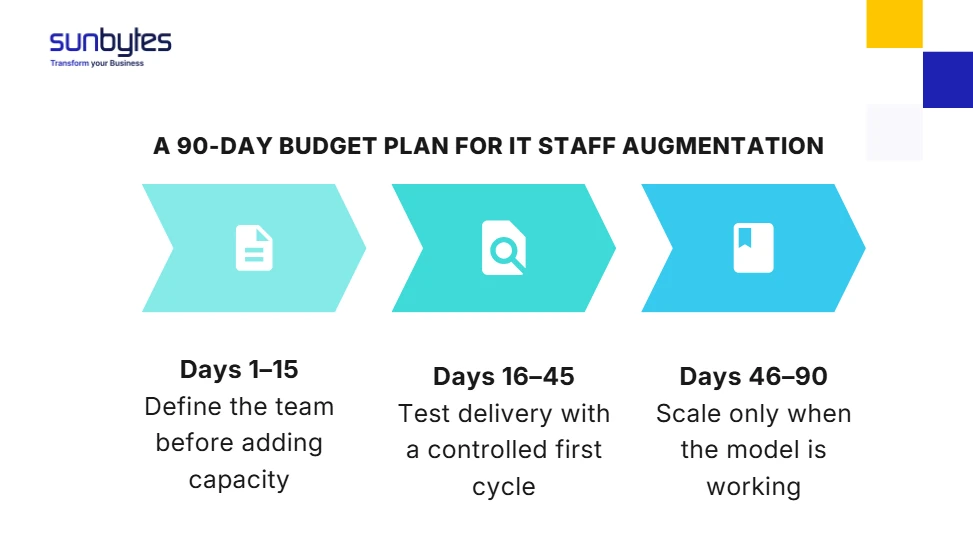
Days 1 to 15: design the team before adding people
The first 2 weeks should define what capacity is missing. Do not start by asking for “two developers.” Start by mapping the next 90 days of roadmap work against role gaps.
Use these questions:
- Which backlog items are blocked by missing capacity?
- Which decisions must stay with the internal team?
- Which systems will augmented developers access?
- Which role reduces the bottleneck fastest: backend, frontend, QA, DevOps, or tech lead?
- Which DORA metric should improve after 30 days?
The output should be a role mix, not a CV list.
Days 16 to 45: run a controlled first delivery cycle
The next 30 days should prove that the augmented capacity can ship under your process. The goal is not maximum velocity. The goal is a predictable working rhythm.
For European teams, the first delivery cycle should include sprint planning, code review rules, access control, documentation standards, test expectations, and release responsibility. If Vietnam delivery is part of the model, plan live overlap for the work that needs discussion: architecture decisions, backlog clarification, QA triage, and sprint demo.
Days 46 to 90: scale only after the system works
The final 45 days should decide whether to add capacity, change role mix, or stop. If the first developer works well, the next hire may not be another developer. The better next role may be QA, DevOps, or a part-time delivery lead.
After 90 days, the budget should move from estimate to operating model. Once the first 90 days are measurable, the next budget question is not only cost. It is return. Use IT staff augmentation ROI to compare delivery cost against commercial value, margin, and time saved.
How Sunbytes helps European teams budget augmentation
If cost is the question, the answer should include delivery control. Through Digital Transformation Solutions, Sunbytes helps European companies design the right role mix, ramp-up path, sprint ownership, and delivery metrics before extra capacity is added
Sunbytes combines Dutch HQ ownership with a Vietnam delivery hub, with senior teams operational in 2 to 4 weeks, ISO-guided delivery, DORA-tracked outcomes, and 4 to 5 hours of Netherlands-Vietnam overlap for architecture decisions, backlog clarification, QA triage, and sprint demos.
When augmented developers touch repositories, production logs, customer data, or internal tools, Cybersecurity Solutions supports the security layer around access control and GDPR evidence. When scaling also involves hiring, onboarding, or people operations, Accelerate Workforce Solutions supports the operational layer.
Sunbytes has delivered 300+ projects across industries and regions. Start with hire dedicated development teams from Sunbytes and leave with a role mix, ramp-up path, and delivery metrics your CTO can defend.