
Hiring fails when companies screen for tool familiarity instead of production ownership. To hire a DevSecOps engineer, define the ownership gap first, write a role brief before opening the search, screen for evidence from real delivery systems, run a 60 to 90 minute practical task, and agree the first 30 days before signing the offer.
A DevSecOps engineer is an engineering role that builds security into the software delivery workflow. The role connects CI/CD controls, SAST, DAST, SCA, secrets scanning, IaC scanning, container scanning, SBOMs, vulnerability triage, release gates, exception logs, and audit trails.
This guide is for CTOs, Heads of Product, Engineering Managers, and Founders at Dutch and EU SaaS companies that already know they need DevSecOps capacity. For a broader comparison of in-house, freelance, and dedicated models, use the DevSecOps team hiring guide.
TL;DR
Hire a DevSecOps engineer by testing ownership, not tool recall. The process should produce five outputs before the offer is signed: an ownership gap, a role brief, a production evidence screen, a practical task score, and a 30-day handover plan.
- Start with the security work nobody owns today, such as release gates, vulnerability queues, ISO 27001 evidence, or NIS2 Article 21 buyer questions.
- Use a 60 to 90 minute task that tests triage, CI/CD judgement, and communication without exposing company secrets.
- Score candidates from 1 to 5 on ownership, evidence quality, developer workflow, risk judgement, and delivery communication.
Best fit: this process works when the role will sit inside engineering, platform, DevOps, or product delivery.
Watch out for candidates who can name tools but cannot explain remediation ownership, exception rules, or where evidence should live.

Start hiring a DevSecOps engineer by defining the ownership gap
Start with the security decision your team cannot make reliably today. A DevSecOps engineer should own a production gap, not a generic list of tools. The gap usually appears in one of four places.
A release has security findings, but nobody knows which ones block production. A scanner creates 300 issues, but no one owns triage. A customer asks for ISO 27001, GDPR Article 32, or NIS2 Article 21 evidence, but engineering cannot produce the audit trail quickly. A vulnerability is accepted as an exception, but the expiry date, owner, and business reason are not recorded.
That is the hiring problem.
Before writing the job description, complete this sentence:
“We need a DevSecOps engineer to own [security decision or workflow] across [systems or teams] and produce [evidence or delivery output] within [timeframe].”
Examples:
- “We need a DevSecOps engineer to own vulnerability triage across 18 repositories and produce a weekly remediation report within the first 30 days.”
- “We need a DevSecOps engineer to own release gate rules for SAST, SCA, secrets scanning, and container findings across the core SaaS platform.”
- “We need a DevSecOps engineer to map CI/CD controls to NIS2 Article 21 buyer questions and ISO 27001 secure development evidence.”
For teams still defining where security controls should sit in CI/CD, read our DevSecOps pipeline guide. The pipeline is where ownership becomes visible: pull request checks, build rules, severity thresholds, exception approvals, and release decisions.
The outcome of this section should be one ownership statement. If the statement still says “manage DevSecOps tools,” the role is not defined tightly enough.
Write a DevSecOps role brief before opening the search
Write the role brief before opening LinkedIn, briefing recruiters, or contacting vendors. A DevSecOps role brief should define the mission, owned systems, evidence outputs, decision rights, and first-30-day goal.
A generic DevSecOps engineer job description attracts generic answers. The stronger brief tells candidates what they will own and how success will be measured.
Use this copy-ready template.
| Role brief field | What to write | Example |
|---|---|---|
| Mission | The delivery problem the role must solve | Reduce late security surprises by moving SAST, SCA, secrets scanning, and container risk into CI/CD decisions |
| Owned systems | The repos, services, cloud environments, or product areas in scope | 18 production repositories, GitHub Actions, AWS workloads, Kubernetes clusters, customer-facing SaaS app |
| Primary workflows | The recurring work the engineer owns | Vulnerability triage, release gate rules, exception approvals, dependency risk, evidence storage |
| Tool categories | Categories, not only vendor names | SAST, DAST, SCA, secrets scanning, IaC scanning, container scanning, SBOM, ticketing, evidence repository |
| Evidence outputs | Proof the business needs | Weekly vulnerability report, exception log, release gate record, control owner map, audit trail |
| Reporting line | Where the role sits | Platform Engineering Manager, Head of Engineering, or CTO |
| Working rhythm | Where the role joins delivery | Sprint planning, PR review, weekly vulnerability review, release readiness |
| First-30-day goal | The first measurable output | Triage top 20 production findings, define severity thresholds, create exception process, produce first evidence pack |
| Decision rights | What the engineer can block or escalate | Critical exploitability in production dependency blocks release unless CTO-approved exception is logged |
| Collaboration points | Who needs to be involved | DevOps, backend leads, QA, product owner, security lead, compliance owner |
A clear role brief also prevents overhiring. Some companies need one embedded DevSecOps engineer. Others need a platform engineer with security depth, or a short-term pipeline review. The title is less useful than the ownership boundary.
Cost planning belongs outside this article. If budget is the next blocker, link the role brief to the DevSecOps engineer salary in Europe article rather than adding a full salary table here.
Screen for production evidence, not tool recall
Screen for evidence from real systems: tickets, policies, pull request examples, release rules, exception logs, control maps, and remediation outcomes. Tool names are weak signals unless the candidate can explain what changed in production.
A CV that lists Snyk, SonarQube, GitLab, GitHub Advanced Security, Terraform, Kubernetes, Docker, Trivy, and OWASP is not enough. The question is what the candidate owned after those tools produced findings.
Use this screening matrix before the first interview.
| CV signal | Evidence to ask for | Weak signal | Interview follow-up |
|---|---|---|---|
| “Implemented SAST in CI/CD” | Pipeline stage, block rules, false-positive handling, developer workflow | Only names the tool | “Which findings blocked a release, and who approved exceptions?” |
| “Managed vulnerabilities” | Triage criteria, asset criticality, exploitability, SLA, backlog flow | Uses CVSS score alone | “How did you decide what waited until the next sprint?” |
| “Worked on ISO 27001 evidence” | Control owner map, audit trail, review cadence, evidence storage | Talks about policies only | “What evidence did engineering produce without manual chasing?” |
| “Secured cloud infrastructure” | IAM review, secrets handling, IaC scanning, logging, environment separation | Treats cloud security as setup work | “How did you detect drift after the first fix?” |
| “Improved dependency security” | SCA setup, Dependabot or equivalent PR flow, exception process, SBOM | Says dependencies were scanned | “How did you stop update noise from being ignored?” |
| “Supported compliance” | Evidence output tied to GDPR Article 32, NIS2 Article 21, ISO 27001 controls | Uses compliance terms with no artefacts | “What did you give auditors, buyers, or management?” |
Strong evidence does not require a candidate to expose confidential material. They can anonymise screenshots, describe a workflow, show a redacted ticket structure, explain a decision log, or walk through a sanitized architecture pattern.
Red flags to watch for:
- Tool-name recall without production evidence.
- Scanner administration without remediation ownership.
- Compliance language without evidence output.
- Security blocking without delivery judgement.
- Findings handed to developers without guidance, priority, or sprint context.
- No exception expiry dates, owner records, or audit trail.
- No answer for what happens when security and release timing conflict.
A candidate does not need to have used your exact stack. They need to show they can turn security output into delivery decisions.
Use a practical screening task when hiring a DevSecOps Engineer
Use one 60 to 90 minute task that tests CI/CD judgement, dependency risk, and communication. Do not ask candidates to secure your real repository as unpaid work.
The task should be close enough to the job to reveal ownership, but abstract enough to protect company secrets. Give the same task to every candidate so the score is comparable.
Screening task: vulnerability triage and release gate decision
Scenario: Your SaaS team has 18 repositories. A new SCA rollout produced 300 dependency findings across backend services, frontend apps, and internal tools. One backend service handles customer data. A release is planned in two days.
Ask the candidate to produce:
- A triage plan for the first 30 findings.
- Release gate criteria for critical, high, medium, and low findings.
- An exception approval flow with owner, reason, expiry date, and audit trail.
- A developer communication note for the next sprint planning meeting.
- A short evidence plan for GDPR Article 32, NIS2 Article 21, or ISO 27001 secure development controls.
Scoring criteria:
| Score area | What to look for |
|---|---|
| Risk judgement | Uses exploitability, asset criticality, exposure, data sensitivity, and business timing, not CVSS alone |
| Delivery fit | Keeps product delivery moving while defining clear block rules for real risk |
| Evidence output | Produces exception log, decision record, owner map, and follow-up cadence |
| Developer workflow | Converts findings into tickets, PR guidance, sprint actions, and recurring review |
| Communication | Explains trade-offs clearly to CTO, developers, product, and compliance owner |
What not to ask:
- Do not ask for unpaid fixes to your production code.
- Do not ask for access to live systems.
- Do not ask for a generic “DevSecOps strategy presentation.”
- Do not reward candidates for naming the most tools.
- Do not make the task longer than 90 minutes unless it is paid.
A strong submission should leave you with a decision record you could adapt for your own team. A weak submission will list tools without saying who owns the finding, who approves the exception, or what blocks the release.
Ask interview questions that reveal ownership
Ask interview questions that force the candidate to explain mechanism, evidence, and trade-off. The goal is not to catch wrong definitions. The goal is to see whether the candidate can own security inside delivery.
Use a 1 to 5 score for each category.
| Score | Meaning | Hiring signal |
|---|---|---|
| 1 | Tool recall only | Candidate names tools but cannot explain ownership or production flow |
| 2 | Basic setup knowledge | Candidate can configure checks but needs heavy guidance on risk and delivery impact |
| 3 | Working contributor | Candidate can run triage, support developers, and produce basic evidence |
| 4 | Delivery owner | Candidate can define gates, handle exceptions, align teams, and improve workflow |
| 5 | Strategic operator | Candidate can design the operating model, coach engineering, and connect controls to business evidence |
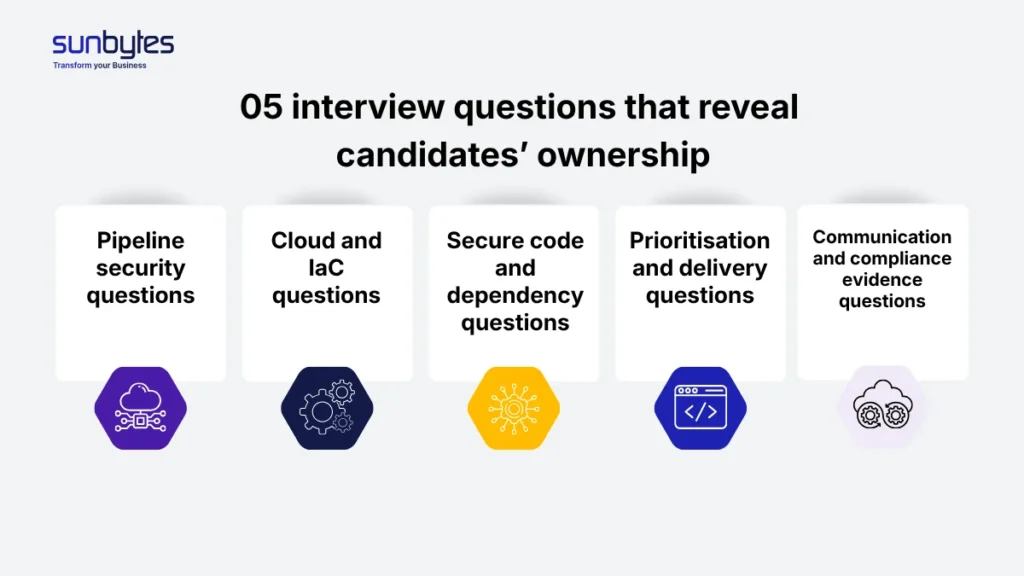
Pipeline security questions
- Where would you place SAST, SCA, secrets scanning, container scanning, and IaC scanning in a CI/CD pipeline? Strong answer proves the candidate understands where each control belongs and which checks should happen at pull request, build, and release stages.
- Which findings should block a release? Strong answer proves the candidate can define severity thresholds, business context, exception rules, and ownership.
- A scanner creates 300 findings in week one. What do you do first? Strong answer proves triage discipline: reduce noise, protect high-risk assets, and create a review cadence.
- How would you design an exception log? Strong answer proves the candidate understands owner, expiry date, business reason, compensating control, and audit trail.
Cloud and IaC questions
- What would you check first in a Terraform or IaC security review?
Strong answer proves the candidate can find risky defaults, exposed services, weak IAM, secret handling issues, and environment drift. - How do you separate development, testing, staging, and production security concerns?
Strong answer proves the candidate understands access boundaries, data handling, secrets management, and release control. - How would you detect cloud configuration drift after the first remediation?
Strong answer proves the candidate does not treat cloud security as a one-time fix. - What evidence would you collect to prove production access is controlled?
Strong answer proves the candidate can connect IAM, logs, approvals, and review cadence to buyer or audit evidence.
Secure code and dependency questions
- How do you handle a critical dependency vulnerability two days before release?
Strong answer proves the candidate can balance exploitability, exposure, service criticality, customer impact, and release timing. - How would you reduce noise from dependency update bots or SCA tools?
Strong answer proves the candidate can tune rules without hiding real risk. - What does a useful SBOM process look like for a SaaS team?
Strong answer proves the candidate can explain ownership, updates, consumption, and supplier security use, not only file generation. - How do you work with developers when the same secure coding issue appears repeatedly?
Strong answer proves the candidate can move from one-off fixes to templates, pull request guidance, and secure defaults.
Prioritisation and delivery questions
- Product wants to ship. Security wants to block. How do you make the decision?
Strong answer proves the candidate can define escalation rules, document exceptions, and make risk visible. - How do you prioritise vulnerabilities when every team says its sprint is full?
Strong answer proves the candidate can use risk, business impact, asset exposure, and planning discipline. - What should be fixed immediately, and what can become backlog work?
Strong answer proves the candidate can separate urgent risk from hygiene work. - How do you measure whether DevSecOps is improving delivery?
Strong answer proves the candidate can use practical signals such as critical finding age, exception expiry, release delay caused by security, repeated finding rate, and remediation cycle time.
Communication and compliance evidence questions
- A customer asks for proof that your team manages vulnerabilities. What do you provide?
Strong answer proves the candidate can produce evidence without turning engineering into manual documentation. - How would you explain NIS2 Article 21 expectations to an engineering team?
Strong answer proves the candidate can translate risk-management measures into pipeline controls, vulnerability handling, incident readiness, and supplier security evidence. - How does GDPR Article 32 affect engineering work?
Strong answer proves the candidate can connect security of processing to access control, encryption, resilience, recovery, testing, and evidence. - What would you include in a first-month DevSecOps status report to the CTO?
Strong answer proves the candidate can report ownership, risk, blockers, progress, and next decisions without drowning management in tool output.
A good interview should make the candidate show how decisions move through the team. If the answer stops at “I would add a scanner,” keep probing until the ownership path is visible.
Need DevSecOps ownership before the local hiring cycle finishes? Sunbytes can help you define the role scope, screening criteria, and first 30 days, then add dedicated DevSecOps capacity around your existing engineering workflow. Explore how to hire dedicated DevSecOps engineers without turning security into a separate delivery layer.
Compare hiring models only after the role is clear
Compare in-house, freelance, and dedicated DevSecOps models only after the role brief is clear. Without role clarity, every model looks plausible and the decision becomes a cost comparison too early.
| Model | Use when | Risk to manage | First 30-day output |
|---|---|---|---|
| In-house DevSecOps engineer | DevSecOps is a permanent capability and company context matters most. | Long local hiring cycle and slow ramp-up. | Ownership map, first triage process, release gate rules. |
| Freelance DevSecOps support | The scope is narrow and time-boxed, such as CI/CD review or SAST rollout. | Knowledge leaves after the project unless handover is documented. | Specific fix, implementation note, and handover record. |
| Dedicated DevSecOps engineer | Work is continuous and releases cannot wait for local recruitment. | Needs clear integration into sprint rhythm and decision rights. | Embedded triage, exception log, evidence output, and sprint workflow. |
Use in-house hiring when DevSecOps is a permanent capability, the role needs deep company context, and the business can wait through a local hiring cycle.
Use freelance support when the scope is narrow and time-boxed, such as a CI/CD review, SAST rollout, IaC misconfiguration fix, or short audit preparation.
Use dedicated DevSecOps engineer support when the work is continuous, releases cannot pause, and the company needs embedded capacity faster than local recruitment can deliver.
If you are comparing external providers, check this DevSecOps outsourcing checklist once it is live. If you are still deciding whether managed capacity fits your team, take this DevSecOps as a Service as a reference.
The hiring model should answer one question: which setup can own the defined workflow within the first 30 days?

Plan the first 30 days before signing the offer
Plan the first 30 days before the offer is signed. A DevSecOps engineer cannot succeed if access, ownership, and evidence expectations are still unclear on day one.
The first month should create a working ownership system, not a long assessment document.
| Timeline | Focus | Expected output |
|---|---|---|
| Week 1 | Access and context | Repo map, CI/CD map, tool inventory, cloud access boundary, current vulnerability queue |
| Weeks 2 to 3 | Paired ownership | First triage review, release gate draft, exception log, developer workflow, top risk backlog |
| Week 4 | First control improvement | Implement one control improvement and produce first evidence output for CTO, buyer, or audit need |
Week 1 should answer four questions:
- Which systems are in scope?
- Which findings can block a release?
- Who approves exceptions?
- Where does evidence live?
Weeks 2 to 3 should move the engineer into paired ownership. They should join sprint planning, review current scanner output, align with DevOps or platform leads, and define what developers see in tickets and pull requests.
Week 4 should produce one concrete improvement. That could be a release gate rule, secrets scanning workflow, exception approval log, dependency update process, or evidence pack for a buyer questionnaire.
The first month is successful when the team can point to a control, an owner, an exception path, and a report. If the engineer is still only “reviewing tools” after 30 days, the role brief or onboarding plan was too vague.
How Sunbytes helps you hire a dedicated DevSecOps engineer
Sunbytes helps when the role is clear but the hiring cycle is too slow for the security pressure already inside delivery.
As a Dutch technology company with a delivery hub in Vietnam, Sunbytes supports European teams that need dedicated engineering capacity without losing delivery control. For DevSecOps hiring, that means starting with the ownership gap, defining the first role scope, and matching dedicated DevSecOps capacity to the workflow your team already uses.
Sunbytes can support dedicated DevSecOps engineers around CI/CD ownership, vulnerability triage, release gates, security evidence, and developer workflow. Dedicated senior teams are typically onboarded within 2 to 4 weeks, with Netherlands account management and a Vietnam delivery hub that gives Dutch teams a 4 to 5 hour Amsterdam-Vietnam overlap.
Security proof should stay precise. Sunbytes’ ISO 27001 certification is company and ISMS evidence. It should not be presented as certification for every client application. In a DevSecOps engagement, the relevant output is the evidence created inside the client workflow: owner records, remediation tickets, exception logs, access review trails, release gate history, and control documentation.
If your team already knows the DevSecOps role it needs, talk to Sunbytes about how to hire dedicated DevSecOps engineers and define the first 30 days before the engineer starts.