
Your delivery lead needs two backend engineers before the next release window. HR posts the job description. The first CVs arrive, but the salary range is unclear, the technical screen is still being discussed, and nobody has decided whether the final hire will be employed through a local entity, staffing model or Employer of Record. That is where IT recruitment in Vietnam often slows down.
Vietnam has a deep technology talent base, especially across software engineering, QA, DevOps, cloud, data and product roles. The search still needs structure. For EU companies, speed depends less on posting the role and more on what is agreed before sourcing starts: seniority, salary signal, English level, technical assessment, feedback cadence and employment setup.
If you are planning to hire developers, engineers or IT specialists, professional recruitment services in Vietnam can help structure the process from the start.
This guide explains how to turn a Vietnam IT hiring need into a controlled recruitment workflow, from role scorecard to shortlist, offer and onboarding.
TL;DR
IT recruitment Vietnam works for EU teams when the search is treated as a hiring workflow, not only a sourcing task. Define the role scorecard, salary band, technical assessment, feedback timeline and employment route before sourcing begins. That gives recruiters the information they need to screen accurately and gives hiring managers fewer weak-fit interviews.
- Vietnam offers strong availability for software engineers, QA specialists, DevOps professionals, mobile developers and business analysts.
- Senior cloud, AI, data, cybersecurity and niche ERP roles need tighter calibration because the candidate pool is narrower.
- Recruitment finds and screens candidates, but EU companies still need to decide how the hire will be employed, paid, onboarded and managed in Vietnam.
- Best fit: IT recruitment Vietnam works well when your team has an approved role, realistic salary expectations and a hiring manager ready to give feedback within 24 to 48 hours.
- Watch out for: increasing sourcing volume will not fix the search if compensation is below market expectations or the technical requirement is unclear.
What IT recruitment in Vietnam means for EU companies
IT recruitment Vietnam is the process of sourcing, screening and hiring technology professionals in Vietnam for roles such as software engineer, QA engineer, DevOps engineer, cloud engineer, data engineer, business analyst, product owner and IT support specialist.
Recruitment answers one question: who is the right candidate?
It does not automatically answer the employment question. Once the candidate is found, your company still needs to decide who legally employs the person, who runs payroll, what contract applies, how candidate data is stored, and whether work permit checks are needed for foreign employees in Vietnam.
That boundary matters because several hiring models sound similar during early conversations.
| Model | What it solves | What it does not solve by itself |
|---|---|---|
| Technical recruitment | Finds and screens candidates for your role | Payroll, contract ownership and ongoing HR administration |
| IT staffing | Supplies people for a defined period or capacity need | Permanent hiring ownership, unless agreed separately |
| Outsourcing | Delivers a scope, project or managed team outcome | Direct hiring control over each individual contributor |
| Employer of Record | Employs and pays the hire locally on your behalf | Candidate search, unless paired with recruitment |
| RPO | Takes ownership of part or all of your recruitment process | Legal employment setup after the hire, unless paired with another model |
For a Dutch or EU company hiring its first Vietnam-based engineer, the common mistake is mixing the search problem with the employment problem too late. If your issue is finding the right candidate, start with recruitment. If your issue is employing that person correctly in Vietnam, solve the employment model before offer stage.
Learn more about using an Employer of Record in Vietnam when hiring without a local entity.
Why IT hiring in Vietnam stalls before sourcing starts
A Vietnam IT search usually stalls before the first message goes out. The symptoms appear later: weak shortlist, low response rate, salary mismatch, slow interviews or candidates dropping out before offer.
Here is the pattern.
Your CTO asks for a senior backend engineer. HR converts that request into a job description. The recruiter starts outreach. Two weeks later, the shortlist looks too junior. The hiring manager says the candidates do not understand distributed systems, but the original brief only listed “Node.js, AWS, English, senior level.” Nobody defined what senior means in your environment.
The issue is not always the talent market. Often, the brief is too thin.
Four gaps usually create the delay:
| Gap before sourcing | What happens later |
|---|---|
| Seniority is not defined | The shortlist mixes strong mid-level candidates with senior candidates who expect a different scope |
| Salary signal is weak | Good candidates respond once, then disappear when compensation becomes clear |
| Technical screen is vague | The recruiter cannot filter beyond keywords |
| Feedback owner is unclear | Candidates wait too long and accept another process |
The fix is not a longer job description. The fix is a role scorecard.
A job description tells candidates what the company wants to say. A role scorecard tells the recruiter what the company must actually hire for.
Which IT roles are realistic to hire in Vietnam
Vietnam is a practical market for many software and IT roles, but the market is not equally deep across every stack, seniority level and domain.
According to VietnamPlus, Vietnam’s ICT workforce exceeded 1 million people after more than 20 years of sector growth, and the country is forecast to need 2.5 million personnel for digital transformation by 2030. That shows the scale of the talent base. It also shows the pressure inside the market. Demand keeps growing, especially for experienced technical profiles.
For EU companies, the most realistic roles are usually:
| Role category | Hiring reality in Vietnam | What to define before sourcing |
|---|---|---|
| Web and mobile engineering | Strong availability across frontend, backend and mobile roles | Framework, seniority, product type, English level |
| Backend engineering | Practical for Java, Node.js, PHP, Python and .NET roles | System complexity, API design, database depth, cloud exposure |
| QA and automation | Good fit for manual QA, automation QA and test engineering | Tooling, automation framework, release cadence |
| DevOps and cloud | Available, but senior profiles need stronger calibration | AWS/Azure/GCP depth, Kubernetes, CI/CD, incident ownership |
| Data engineering and analytics | Searchable, but quality varies by business domain | Data stack, modelling, governance, stakeholder English |
| Product and business analysis | Stronger when the company can explain product context clearly | User type, backlog ownership, documentation style |
| AI, security and niche ERP | Harder searches with narrower candidate pools | Must-have depth, salary flexibility, assessment design |
The ITviec Vietnam IT Salary & Recruitment Market Report provides useful benchmarks for salaries, hiring demand and technology trends across the Vietnamese IT sector.
Use salary reports as a signal, not as a final budget. ITviec’s report gives role and compensation context for Vietnam’s IT market, but your offer still depends on stack, English level, seniority, remote setup and whether the person is joining a foreign employer, local entity, EOR or staffing arrangement.
You can also review current average salary in Vietnam data to benchmark compensation expectations before opening a search.
The safer hiring assumption is simple: common stacks can move fast when the salary band is credible. Senior and niche profiles need more precision before outreach starts.
What IT hiring rates look like in Vietnam in 2026
Hiring in Vietnam is still cost-effective compared with Western Europe, but the useful question is not “Is Vietnam cheaper?” It is: which roles can you hire reliably, at what seniority, and how much budget should you plan before the shortlist starts?
Salary benchmarks are only one layer of the hiring rate. They do not include employer contributions, recruitment fees, onboarding time, retention risk, equipment, management overhead, or any EOR/staffing markup if you use an external employment model. Use them as a planning baseline, not as the final employment cost.
Approximate USD conversions based on an exchange rate of 25,000 VND = 1 USD.
| Role | Median monthly salary benchmark | Senior benchmark signal | What this means for hiring |
|---|---|---|---|
| Back-end Developer | $1,512 | $2,196 at high seniority | Realistic to hire, but senior back-end talent needs a tight technical brief and fast interview process. |
| Front-end Developer | $1,392 | $1,852 at high seniority | Strong fit for product teams that need UI delivery, web app work, and ongoing feature development. |
| Full-stack Developer | $1,490 | $1,792 at high seniority | Useful for smaller product teams, but scope must be clear so “full-stack” does not become an unclear catch-all role. |
| Mobile Developer | $1,474 | $1,828 at high seniority | Practical for Android, iOS, or cross-platform delivery when the role is tied to a defined product roadmap. |
| QA/QC | $1,248 | $1,540 at high seniority | Often easier to hire than senior engineering roles, but test automation experience should be screened separately. |
| Tester | $1,152 | $1,460 at high seniority | Good fit when you need manual testing capacity, release support, or structured regression coverage. |
| Data Analyst / Data Scientist / BI Analyst | $1,626 | $1,700 at 5–8 years | Demand is stronger where the role combines analytics, stakeholder communication, and business context. |
| Data Engineer | $1,652 | $2,276 at 3–4 years | Harder to hire than general software roles because strong candidates need pipeline, cloud, and data architecture exposure. |
| Product Owner / Product Manager | $2,004 | $3,000 at 8+ years | Available, but English communication, stakeholder ownership, and domain experience change the hiring difficulty quickly. |
| Tech Lead | $2,072 | $2,738 at high seniority | Realistic, but not a volume hire. Expect a narrower shortlist and more time spent validating leadership depth. |
Source: ITviec Vietnam IT Salary & Recruitment Market Report 2025–2026. Figures are median monthly salary benchmarks converted from VND to USD using an approximate exchange rate of 25,000 VND = 1 USD.
For EU companies, the practical planning rule is simple: junior and mid-level engineering roles are usually the fastest to shortlist; senior back-end, data, product, and tech lead roles need sharper scoping before sourcing starts. If the role requires strong English, client-facing communication, niche cloud experience, or regulated-sector background, the benchmark salary is only the starting point.
This is where recruitment speed matters. A realistic hiring budget can still fail if the process moves too slowly. Time-to-shortlist should be measured in days, not weeks. Time-to-hire should stay close to 14 days once the brief is approved and the interview panel is ready.
Build the role scorecard before the search opens
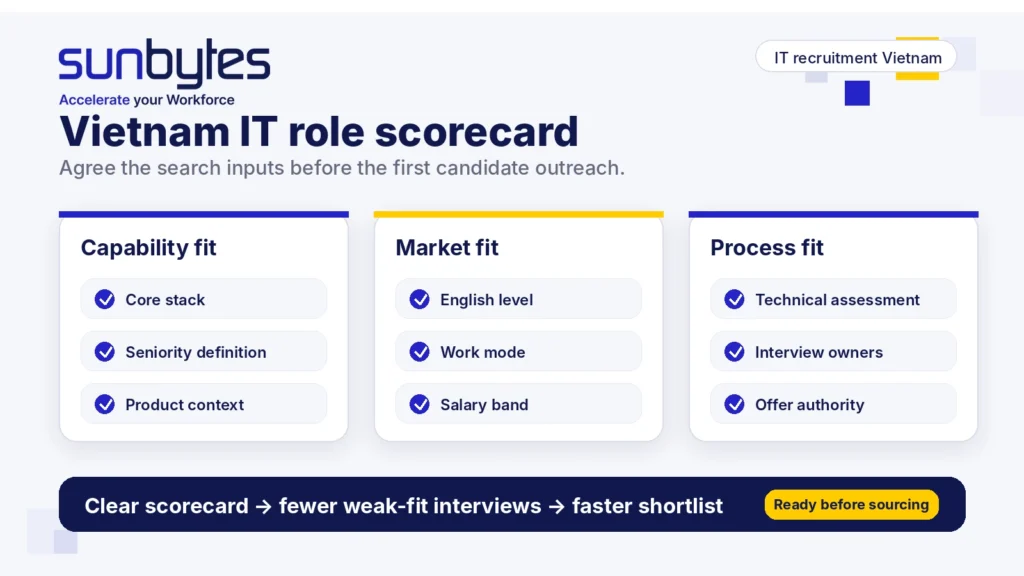
A role scorecard turns “we need a senior developer” into a search that can be screened, compared and closed. Without it, your recruiter is forced to guess what good means.
For EU teams hiring in Vietnam, the scorecard should be agreed by the hiring manager, recruiter and offer owner before sourcing starts. This is where time is saved.
| Requirement | Why it matters | Example for backend engineer | What breaks if missing |
|---|---|---|---|
| Core stack | Keeps sourcing focused | Java 17, Spring Boot, PostgreSQL, AWS | Recruiter sends candidates with adjacent but weak stack fit |
| Seniority definition | Prevents title mismatch | Owns API design, reviews PRs, mentors two engineers | “Senior” becomes a salary label, not a capability level |
| Product context | Helps candidates self-select | B2B SaaS, multi-tenant, EU clients | Candidates cannot judge whether the role fits their experience |
| English level | Protects team communication | Can join sprint planning and explain trade-offs in English | Interview passes technically, then collaboration slows |
| Work mode | Affects response rate | Remote from Vietnam with 4 to 5 hour NL-VN overlap | Candidate expects hybrid or different hours |
| Salary band | Filters early | Approved range before outreach begins | Strong candidates exit after first call |
| Technical assessment | Makes screening fair | 60-minute technical interview plus architecture discussion | Hiring manager rejects candidates using criteria the recruiter never saw |
| Interview owners | Keeps momentum | CTO technical screen, product lead culture fit, COO final offer | Feedback waits in Slack while candidates move elsewhere |
| Offer authority | Avoids late approval delay | Salary, start date and employment model approved upfront | Offer takes a week and loses urgency |
Your scorecard does not need to be long. It needs to be clear enough that the recruiter can say no early. That early “no” protects your hiring manager’s time. A shortlist within 3 days from brief sign-off is only realistic when the scorecard, salary and assessment route are already agreed. Time-to-hire of 14 days depends on the same discipline.
Need to validate whether Vietnam has the engineering roles you need? Sunbytes can review your role scorecard, salary signal, stack requirements, remote setup and interview process before sourcing starts.
From there, the brief becomes a recruitment workflow with structured screening and technical assessment handoff.
Choose the right hiring route before offer stage
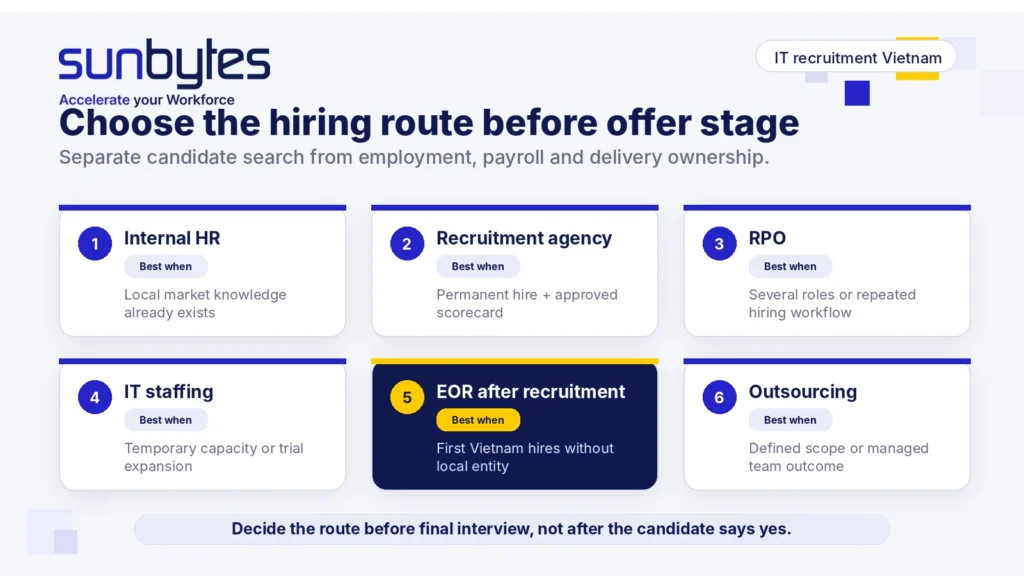
The right hiring route depends on what your company wants to own. Recruitment is the best fit when you want to hire the person directly or through a planned employment model. Staffing or outsourcing may fit better when the work is temporary, capacity-led or still undefined.
| Hiring route | Ownership | Speed | Control | Compliance layer | Best fit | Poor fit |
|---|---|---|---|---|---|---|
| Internal HR | Your team owns the whole process | Slower if Vietnam market knowledge is limited | High | Your team must handle candidate data and employment setup | You already have local market knowledge and recruiter capacity | First Vietnam hire with no salary benchmark or sourcing channel |
| Recruitment agency | External recruiter owns sourcing and screening | Faster when the role scorecard is ready | Medium to high | Employment setup still needs a separate decision | Permanent hires where you want candidate ownership | Undefined roles or unapproved salary bands |
| RPO | External team owns part or all of recruitment process | Good for multiple roles or hiring backlog | Medium | Depends on scope | Scaling several roles with repeated workflow needs | One urgent niche hire only |
| IT staffing | Provider supplies people for capacity | Fast when the need is role-based and temporary | Medium | Provider usually handles worker administration | Temporary capacity, project coverage, trial team expansion | Permanent leadership role |
| EOR after recruitment | Recruitment finds candidate, EOR employs locally | Fast when employment route is agreed before offer | High day-to-day work control | EOR handles local employment and payroll layer | First hires in Vietnam without a local entity | Short project with uncertain scope |
| Outsourcing | Provider delivers scope or team outcome | Fast if scope is clear | Lower individual hiring control | Provider owns delivery employment setup | Project delivery, managed team, defined backlog | You want to directly manage and retain each hire |
If you are still comparing recruitment models, this guide to the top recruitment service companies in Vietnam can help you understand common provider types and selection criteria.
This is where many EU teams lose time. The candidate says yes. Then the company starts deciding whether to use an entity, EOR, staffing contract or contractor setup. That delay can turn a warm offer into a cold one.
Decide the employment route before final interview. It does not mean every contract must be prepared before the candidate is selected. It means your team knows which route will be used if the candidate accepts.
If the role is better handled as ongoing capacity rather than permanent recruitment, Sunbytes staffing services may be a better fit.
The IT recruitment workflow for EU companies
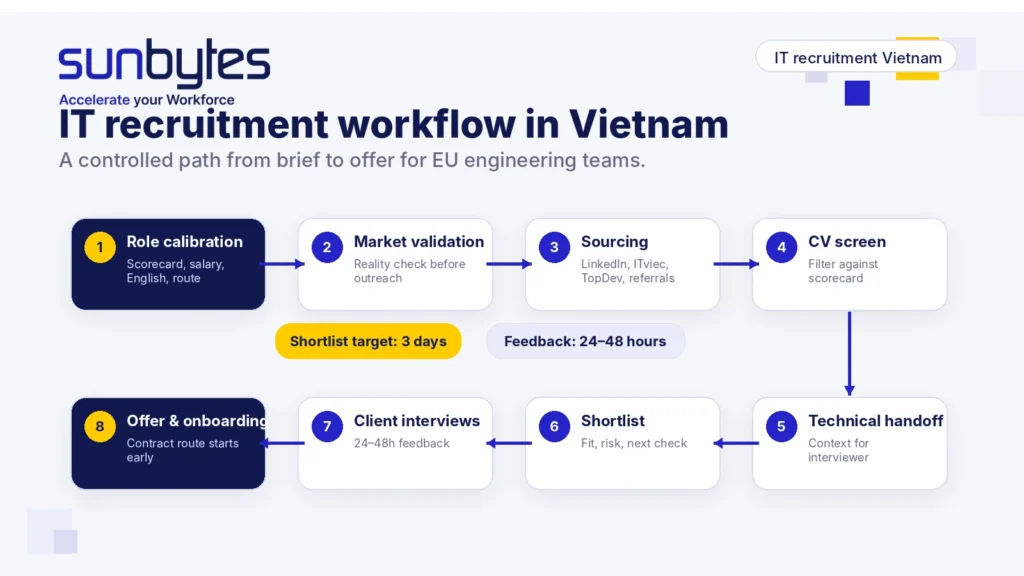
A controlled IT recruitment workflow in Vietnam moves from role calibration to sourcing, screening, technical assessment, shortlist, interview, offer and onboarding. Each step has an owner.
A practical sequence looks like this:
- Role calibration
The hiring manager, recruiter and offer owner agree the role scorecard, salary band, seniority level, English level, work mode and employment route. - Market validation
The recruiter checks whether the role is realistic for Vietnam, which cities or channels are likely to work, and where salary expectations may create friction. - Sourcing
The search uses the right mix of channels. LinkedIn can work well for senior and international profiles. ITviec and TopDev are useful for Vietnam IT roles. VietnamWorks may support broader professional searches. Referrals and direct outreach still matter for experienced engineers who are not actively applying. - CV screen
The recruiter filters against the scorecard, not only against keywords. The screen checks stack depth, product context, communication fit and compensation signal. - Technical screen handoff
The recruiter does not replace the technical interviewer. The recruiter prepares the candidate context so your technical owner can assess the right things. - Shortlist
For aligned roles, the target is a shortlist within 3 days from brief sign-off. The shortlist should show why each candidate fits, where the risk is, and what the hiring manager must check next. - Client interviews
Your hiring manager gives feedback within 24 to 48 hours. A finalist available on Monday may be in another process by Thursday, especially for senior engineering roles. - Offer and onboarding
The offer is made with the employment route already chosen. If the hire needs EOR, staffing or payroll support, that setup starts before the start date becomes urgent.
For a deeper operational view, compare this workflow with the recruitment process in 8 steps.
The workflow is simple on paper. The hard part is ownership. Someone must own the salary signal, someone must own technical feedback. Someone must own employment setup. If those owners are missing, the search slows down even when the candidate market is strong.
Compliance and candidate data checks
IT recruitment in Vietnam involves candidate data from the first outreach message. For EU companies, that makes GDPR/AVG relevant before the employment contract exists.
Candidate data may include CVs, diplomas, work history, interview notes, test results, salary expectations, reference feedback and assessment reports. The European Data Protection Supervisor explains that selection and recruitment procedures involve the collection and processing of personal data, including CVs, professional experience, evaluation tests and reports.
For Dutch companies, the Autoriteit Persoonsgegevens guidance on job applications is also relevant because employers cannot ask applicants for every type of personal data simply because they are applying for a role.
For EU-to-Vietnam data handling, check whether candidate data is transferred outside the EEA, who controls the data, who processes it, how long it is kept, and which transfer mechanism applies. The European Commission explains that adequacy decisions are the mechanism used to determine whether a non-EU country provides an adequate level of data protection. In the absence of an adequacy decision, appropriate safeguards may be needed for international transfers.
Vietnam data protection also needs legal review before publication and before a recruitment workflow goes live. For a 2026 recruitment workflow, verify candidate-data handling against Vietnam’s Personal Data Protection Law and Decree 356/2025/ND-CP before collecting or transferring CVs, interview notes, test results or reference feedback. Decree 356 took effect on 1 January 2026 and replaced Decree 13/2023/ND-CP, so older PDPD references should be updated before the workflow goes live.
Employment classification also matters. ILO NATLEX summarises Vietnam’s 2019 Labour Code as broadening the definition of employee to a person who works under an agreement, is paid, and is managed and supervised by the employer. This matters when a candidate is treated like an employee but contracted under another label.
Work permits are usually not relevant when you hire Vietnamese nationals in Vietnam. They become relevant when the person working in Vietnam is a foreign national. The official Vietnamese Government legal database lists Decree 219/2025/ND-CP as the regulation on foreign workers working in Vietnam, effective from 7 August 2025.
If your search includes a foreign employee working in Vietnam, review the Vietnam work permit requirements before offer stage.
Common mistakes in IT recruitment Vietnam
Many hiring teams assume recruitment slows down because there are not enough candidates. In practice, the bigger issue is often a lack of alignment before sourcing begins. A vague job description forces recruiters to screen for keywords instead of real capability. An unclear salary range attracts interest but loses strong candidates once compensation becomes visible. Technical expectations are sometimes defined only after interviews start, creating mismatches between recruiter screening and hiring-manager evaluation.
The same pattern appears later in the process. Feedback takes too long, allowing top candidates to accept other offers. Employment decisions are postponed until offer stage, leaving teams debating between an entity, EOR or staffing model after the candidate is already ready to sign. Candidate data is collected across CVs, interview notes and assessments without clear ownership, retention rules or deletion procedures.
The common thread is that recruitment is being asked to solve decisions that should have been made earlier. The strongest hiring processes define the role scorecard, salary band, technical assessment, feedback timeline, employment route and candidate-data handling approach before outreach begins. When those elements are aligned upfront, recruiters can screen more accurately, hiring managers spend less time on weak-fit interviews, and candidates move through the process with fewer delays.
If your hiring problem is part of a wider capacity gap, review these talent shortage solutions before adding more roles to the pipeline.
How Sunbytes helps with IT recruitment in Vietnam
The search does not fail only because candidates are scarce. It fails when role ownership, salary, technical screening and employment setup are decided too late.
Sunbytes starts with the hiring problem inside your process: what role you need, what the engineer must own, what salary signal the market will accept, and how fast your team can make decisions. From there, the brief becomes a recruitment workflow: market calibration, sourcing, structured screening, technical assessment handoff, offer support and employment setup guidance in Vietnam.
This is where Sunbytes works across three pillars without turning the section into a service menu.
Through Accelerate Workforce Solutions, Sunbytes helps EU teams move from hiring intent to hiring execution. For IT recruitment, that means defining the role scorecard, validating salary expectations, sourcing candidates, screening against technical and communication requirements, and keeping the process moving toward a shortlist within 3 days from brief sign-off when the role, salary and decision path are ready.
Through Digital Transformation Solutions, Sunbytes brings delivery context into the hiring process. The point is not only to find someone with the right keywords on a CV. The role must match how your engineering team actually ships: stack depth, code ownership, QA handoff, sprint rhythm, documentation habits and long-term product support. That technical layer helps your team brief recruiters more clearly and assess candidates with fewer false starts.
Through CyberSecurity Solutions, Sunbytes supports safer handling of candidate data, assessment materials and access requirements. For EU teams working under GDPR/AVG expectations, recruitment should not leave CVs, interview notes, salary data and test results scattered across inboxes without clear access and retention rules.
If the candidate needs to be employed locally, Accelerate Workforce Solutions can connect the recruitment process with EOR, payroll or staffing support before the offer goes out. That means contract setup, payroll route and employment ownership are not left until the candidate has already accepted.
For EU teams, the useful point is ownership. Sunbytes can review the role scorecard, salary signal, stack requirements, remote setup and interview process before sourcing starts. From there, the recruitment workflow targets a shortlist within 3 days from brief sign-off, structured screening, technical assessment handoff and a 14-day time-to-hire when the role, salary and decision process are aligned.