
Rate savings are the weakest business case for additional engineering capacity. A CTO, CFO, or founder should judge IT staff augmentation ROI by a harder question: does extra capacity bring delivery forward, reduce vacancy delay, and prevent expensive rework?
IT staff augmentation ROI is the return a company gets from adding external engineers to its existing team, measured against the cost of that capacity. A useful ROI model compares augmentation cost with earlier delivery value, avoided vacancy cost, reduced rework, and delivery metrics after the team starts.
For Dutch and European companies, the business case is strongest when the team can start within 2 to 4 weeks, work inside the client’s delivery system, and be measured against sprint outcomes rather than hourly activity.
TL;DR
IT staff augmentation ROI should be calculated from delivery value, not rate savings alone. The model works when a company can put extra engineers onto a defined roadmap, reduce waiting time by several weeks, and track output through delivery metrics such as lead time for changes, deployment frequency, change failure rate, and failed deployment recovery time.
- Use this formula: ROI = (value of earlier delivery + avoided vacancy cost + avoided rework – augmentation cost) / augmentation cost.
- Treat vacancy delay as the baseline. A cheap option that starts 12 weeks late can lose more value than a higher-rate team that starts in 2 to 4 weeks.
- Measure ROI again after 30, 60, and 90 days using delivery outcomes, not only utilisation.
How to calculate IT staff augmentation ROI
IT staff augmentation ROI is calculated by comparing the financial value of faster delivery and avoided delivery risk against the full cost of augmented capacity. The formula should include cost, time, and quality because a rate-only calculation misses the two biggest ROI drivers: waiting time and rework.
Use this formula:
ROI = (value of earlier delivery + avoided vacancy cost + avoided rework – augmentation cost) / augmentation cost
Before ROI modelling starts, confirm the operating model: staff augmentation keeps the roadmap, backlog, architecture, and release ownership inside your company while external engineers add capacity inside that system. Use the IT staff augmentation complete guide to validate that model before comparing costs.
A simple example:
| ROI input | Example value | Assumption |
|---|---|---|
| Value of earlier delivery | €60,000 | The release moves forward by 8 weeks and is expected to generate €30,000 per month in gross margin. |
| Avoided vacancy / coverage cost | €11,400 | A tech lead and product manager avoid 12 hours per week of stopgap work for 10 weeks, at a €95 loaded hourly cost. |
| Avoided rework | €7,600 | 80 hours of rework are avoided through clearer onboarding, architecture review, and senior delivery support, at a €95 blended engineering cost. |
| Augmentation cost | €65,280 | 2 senior developers × 32 billable hours per week × 12 weeks × €85 per hour. |
| ROI | 21% | (€60,000 + €11,400 + €7,600 – €65,280) / €65,280. |
Positive ROI only proves the model works under defined conditions: clear ownership, a ready backlog, access rights, onboarding materials, and a measurement baseline.
The four inputs your ROI model needs
A CTO-ready ROI model needs four inputs: capacity cost, ramp-up time, output value, and rework risk. A CFO can approve a business case faster when each input has an owner, a calculation method, and a verification point.
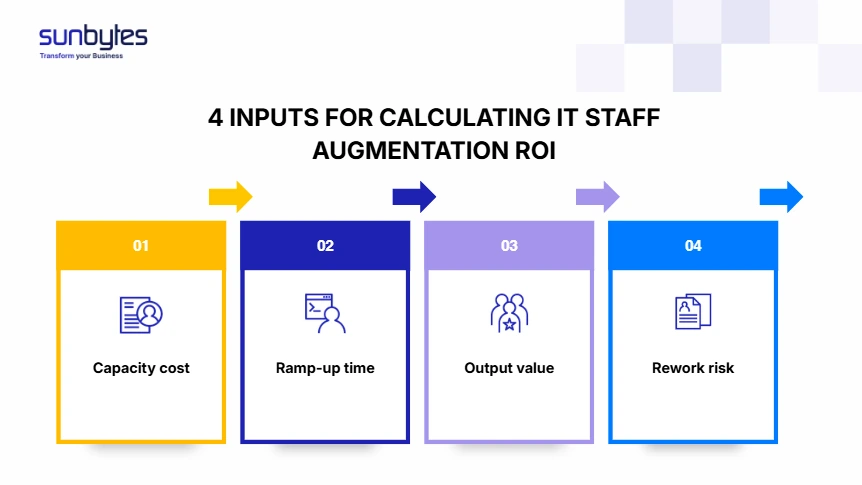
Start with the full cost of augmentation. That includes the provider rate, contract duration, onboarding time, internal management time, tools, licences, and any compliance review. The IT staff augmentation cost breakdown is useful here because a lower monthly rate is not automatically better if the provider needs more correction time or cannot support the operating model.
Ramp-up time changes the ROI model quickly. The business case should show when the first engineer starts, when the full team is operational, and when the team is expected to contribute to sprint goals. A senior team operational in 2 to 4 weeks can change the comparison if the local hiring baseline is 8 to 16 weeks longer.
Output value should be tied to a business event: a product release, regulatory deadline, platform migration, client commitment, or roadmap item that unlocks revenue or reduces operating cost. The model becomes weak when output is described only as “more developer hours.”
Rework belongs in the model because unclear delivery systems turn added capacity into correction work. Rework often appears when architecture decisions are undocumented, acceptance criteria are unclear, or external engineers work outside the client’s engineering standards. A stronger augmentation case includes ISO-guided delivery, documented technical decisions, code review rules, and DORA-tracked outcomes from the first sprint.
A practical model uses one owner per input:
| Input | Owner | What to measure | Verification point |
|---|---|---|---|
| Capacity cost | CFO / Finance | Monthly cost, onboarding time, internal management time | Contract and finance model |
| Ramp-up time | CTO / Engineering lead | Days to first contribution, weeks to full team operation | Sprint 1 and sprint 2 review |
| Output value | Founder / Product lead | Release date, revenue trigger, customer deadline, cost reduction | Roadmap and forecast |
| Rework risk | CTO / Delivery lead | Change failure rate, rejected work, escaped defects, unplanned fixes | 30, 60 and 90-day delivery review |
For approval, frame the request around the business event, not the role list: “move the customer portal release forward by 10 weeks while keeping the change failure rate under 15%.”
Cost of waiting: the hidden baseline
The hidden baseline in IT staff augmentation ROI is the cost of doing nothing while a role stays unfilled. A vacancy that blocks a roadmap for 10 to 12 weeks can cost more than the visible monthly cost of augmentation.
Dutch and European companies should make waiting cost explicit because the ICT labour market is not a neutral backdrop. Eurostat’s ICT specialists vacancy data reported that 57.5% of EU enterprises that recruited or tried to recruit ICT specialists had difficulties filling ICT vacancies in 2023. The Netherlands 2025 Digital Decade country report also notes that existing ICT specialist shortages could challenge the Dutch digital labour market.
Waiting cost has three parts:
| Waiting cost component | Question to answer | Example |
|---|---|---|
| Vacancy delay | How many weeks will the roadmap wait for local hiring? | 12 weeks of delay |
| Internal drag | Which senior people are covering missing capacity? | Tech lead spends 8 hours per week on stopgap work |
| Opportunity cost | Which release, client, or migration is delayed? | Portal release misses a quarterly revenue target |
A business case should compare augmentation against the real alternative. The real alternative is rarely “hire instantly at local salary.” The real alternative is often “wait 10 to 16 weeks, split critical work across overloaded engineers, and accept slower delivery until the role is filled.”
Use staff augmentation when waiting time is more expensive than controlled external capacity, not when the hourly rate simply looks lower.
ROI table: local hiring vs augmentation
A useful ROI comparison should compare time-to-capacity, total delivery cost, control, and risk. Local hiring can be the better choice for long-term core roles, while staff augmentation is usually stronger when delivery cannot wait for a full hiring cycle.
The following example shows how the business case changes when speed is part of the model.
| Criteria | Local hiring | IT staff augmentation |
|---|---|---|
| Time to useful capacity | 12 to 16 weeks | 2 to 4 weeks |
| Contract commitment | Long-term employment cost | Defined engagement window |
| Delivery ownership | Internal team | Internal team retains roadmap and technical ownership |
| Best fit | Permanent core capability | Delivery gap, specialist skill, roadmap acceleration |
| Main ROI driver | Long-term retention | Earlier delivery and avoided vacancy delay |
| Main risk | Slow hiring and onboarding | Weak onboarding or unclear ownership |
| Example 90-day capacity cost | €75,000 | €90,000 |
| Example value of earlier delivery | Lower if role starts late | Higher if team starts in 2 to 4 weeks |
| Decision | Choose when the role is strategic for 12+ months | Choose when delay blocks delivery within the next quarter |
Choose local hiring for strategic capabilities that span multiple product cycles. Choose IT staff augmentation when the next 90 days matter and your team still owns product direction, architecture, and review. If provider speed and delivery maturity affect the ROI case, compare vendors against the criteria used for top IT staff augmentation providers in the Netherlands.
Need to test the ROI model against your next 90 days? Sunbytes can help define team size, ramp-up path, DORA baseline, and governance before you add capacity.Hire remote developers when the business case points to a delivery gap, not a permanent role.
How to measure ROI after the team starts
IT staff augmentation ROI should be measured again after the team starts because the initial business case is only a forecast. The 30, 60, and 90-day review should compare expected delivery value against actual delivery signals.
DORA’s software delivery performance metrics are useful because they connect engineering work to delivery performance. The measurement set should include lead time for changes, deployment frequency, change failure rate, and failed deployment recovery time. Teams can also track deployment rework rate when unplanned deployments are caused by production incidents.
A simple measurement plan:
| Timeframe | CTO signal | CFO signal | Founder signal |
|---|---|---|---|
| Day 30 | Team is onboarded, access is working, first backlog items shipped | Burn rate matches forecast | Roadmap risk is lower |
| Day 60 | Lead time for changes is stable or improving | Forecast cost still matches scope | Customer or release date is still credible |
| Day 90 | Deployment frequency, change failure rate and recovery time show controlled delivery | ROI model can be updated with actuals | Business event has moved closer or shipped |
A DORA-based review avoids measuring only utilisation or story points. Pair delivery metrics with business milestones: forecast control for the CFO, stable change failure rate for the CTO, and committed release dates for the founder.
The practical threshold: if an augmented team is still not shipping reviewed work by the end of sprint two, the issue is not only capacity. The issue may be onboarding, access, backlog quality, ownership, or architecture decision-making. The guide to managing augmented IT teams covers the onboarding, documentation, KPI, and compliance controls that protect the ROI case after day one.
What to check before signing a staff augmentation contract
A staff augmentation contract should protect delivery control, access security, replacement rights, and measurable outcomes. The contract should not only state the number of engineers and the monthly rate.
For Dutch and EU companies, security and data handling should be part of the business case because engineering capacity often touches source code, production-like data, customer systems, or regulated workflows.GDPR Article 32 requires appropriate technical and organisational security measures.NIS2 Article 21 requires covered essential and important entities to take proportionate technical, operational, and organisational cybersecurity risk-management measures.
ISO/IEC 27001:2022 is also relevant when the engagement needs controlled access, documented security responsibilities, and evidence that information security risks are managed through a formal system.
Before signing, check these points:
| Contract area | What to verify | ROI impact |
|---|---|---|
| Scope of control | Client owns backlog, architecture direction and release decisions | Prevents drift from business priorities |
| Ramp-up commitment | Named start window, onboarding plan and replacement process | Protects the waiting-time assumption |
| Security | Access control, confidentiality, DPA, code access and audit trail | Reduces compliance and incident risk |
| Delivery governance | Sprint rhythm, review cadence, escalation path | Reduces rework and stalled delivery |
| Measurement | DORA baseline, release milestones, quality gates | Turns ROI from forecast into evidence |
| Exit terms | Handover, documentation, access removal, knowledge transfer | Protects continuity after the engagement |
Do not sign a staff augmentation contract that treats engineers as interchangeable seats. Before approval, use the IT staff augmentation checklist to review provider fit, delivery control, contracting, and security readiness.
What the CFO/CEO approval pack should include:
A staff augmentation ROI business case should not ask for approval on “two developers for three months.” It should ask for approval on a measurable delivery outcome.
Include five items:
- Business event: the release, migration, client deadline, or risk reduction the team protects.
- Baseline alternative: local hiring delay, unfilled role cost, or internal drag if no capacity is added.
- 90-day cost: provider cost, onboarding time, internal management time, tooling, and compliance checks.
- Delivery assumptions: start window, sprint contribution date, ownership model, and DORA baseline.
- Review trigger: what must be true at day 30, day 60, and day 90 for the business case to remain valid.
When IT staff augmentation ROI is negative
IT staff augmentation ROI is negative when extra capacity adds coordination cost without increasing useful delivery. Negative ROI usually appears within the first 30 to 60 days if ownership, onboarding, and backlog quality are weak.
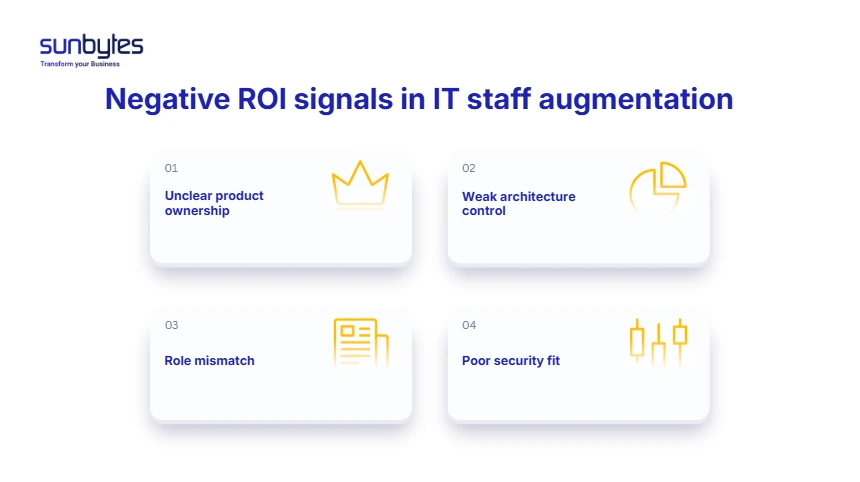
The first negative ROI condition is unclear product ownership. External engineers cannot create ROI when the internal team cannot decide what should ship. The result is more people waiting for answers, not more software delivered.
The second negative ROI condition is weak architecture control. A fast team with poor architecture discipline can create rework within two or three sprints. The warning signal is not a single defect. The warning signal is repeated correction work, rising change failure rate, and undocumented technical decisions.
The third negative ROI condition is a role mismatch. Staff augmentation works best when the company needs added capacity inside an existing delivery system. Project outsourcing is often the better model when the company wants a vendor to own scope, delivery management, and acceptance. The IT outsourcing models guide helps clarify when a staffing model should become a managed delivery model.
The fourth negative ROI condition is poor security fit. If the engagement requires access to regulated data, production systems, or critical infrastructure, the business case needs security checks before work starts.
Use staff augmentation when the internal team can own the roadmap and measure output. Use outsourcing when an external partner should own delivery. Delay both if the problem, backlog, or decision owner is unclear.
How Sunbytes supports IT staff augmentation ROI
The ROI case for staff augmentation is strongest when added capacity becomes measurable delivery. Sunbytes helps CTOs, CFOs, and founders turn ROI assumptions into a delivery design through Digital Transformation Solutions: team shape, ramp-up plan, backlog ownership, sprint governance, and 90-day measurement.
With 15+ years of experience, 300+ projects delivered, a Netherlands HQ, and a Vietnam delivery hub, Sunbytes can support a senior team ramp-up in 2 to 4 weeks. ISO 27001 and ISO-guided delivery help keep security, documentation, and delivery control visible, while DORA-tracked delivery connects added capacity to measurable outcomes.
For delivery involving customer data, code access, or regulated workflows, Cybersecurity Solutions can support secure access and governance. If team formation also depends on hiring, onboarding, payroll, or workforce support,Accelerate Workforce Solutions helps keep operations from slowing delivery.
Want to test whether the next 90 days justify augmentation? Sunbytes can model ramp-up cost, role mix, DORA baseline, and delivery-risk assumptions before you sign. Request a staff augmentation ROI review →
FAQs
A good ROI for IT staff augmentation is positive after augmentation cost, onboarding time, internal management time, and rework risk are included. A 90-day model should show whether earlier delivery and avoided vacancy delay outweigh the cost of added capacity.
IT staff augmentation is not always cheaper than local hiring on a monthly cost basis. The ROI becomes stronger when local hiring delay blocks a release, migration, or client commitment that has business value within the next quarter.
A CFO should include augmentation cost, onboarding cost, internal management time, avoided vacancy cost, earlier delivery value, and avoided rework. Each assumption should have an owner and a verification point before approval.
A company should see early delivery signals within 30 days and stronger evidence within 60 to 90 days. If an augmented team is not shipping reviewed work by the end of sprint two, check onboarding, access, backlog quality, and ownership before adding more people.
Yes. Knowledge transfer affects ROI because poor handover can create hidden rework after the engagement ends. Include documentation quality, architecture decision records, code review history, and access offboarding in the final ROI review.
Let’s start with Sunbytes
Let us know your requirements for the team and we will contact you right away.