Most teams compare IT staff augmentation vs outsourcing as a cost decision. That is too late in the decision process. The model should be chosen by ownership first: who controls architecture, backlog priority, quality standards, and delivery risk once the work starts.
Staff augmentation is the better model when you want senior capacity inside your own delivery system. Your team keeps product direction, technical decisions, sprint rhythm, and code ownership. Outsourcing is the better model when the workstream is defined well enough for a provider to own the outcome, manage delivery, and hand back tested work against agreed acceptance criteria.
For Dutch and European technology leaders, this choice is also shaped by talent availability, compliance, and timezone execution. The European Commission 2026 State of the Digital Decade package reports that ICT specialists represented only 5% of EU employment in 2025, compared with the EU’s 10% target for 2030. External delivery capacity can close part of that gap, but only when the operating model makes decision ownership explicit.
TL;DR
Staff augmentation adds external specialists to your existing engineering system, while outsourcing delegates a defined project or workstream to a provider.
- Staff augmentation suits teams that need senior capacity in 2 to 4 weeks while keeping architecture, backlog, and quality decisions internal.
- Choose outsourcing when the scope is stable enough to specify outcomes, milestones, acceptance criteria, security responsibilities, and handover requirements before work starts.
- The main risk is unclear ownership: augmented teams need internal management capacity, while outsourced workstreams need precise scope and governance.
Staff augmentation vs outsourcing: the direct answer
Staff augmentation services adds external engineers, QA specialists, DevOps engineers, or product roles to your existing team while your company keeps day-to-day delivery control. Outsourcing assigns a defined project, function, or workstream to a provider that manages delivery against agreed outcomes.
IT staff augmentation vs outsourcing is the comparison between buying capacity inside your system and buying responsibility for a defined result. The useful distinction is not where the people sit. The useful distinction is who decides the architecture, prioritises the backlog, accepts risk, and answers when delivery slips.
Staff augmentation works when you already have a product owner, technical lead, delivery cadence, and engineering standards. The operating baseline is the same one used in an IT staff augmentation guide: role definition, onboarding, code review, sprint ownership, and performance measurement have to exist before external capacity improves delivery.
Outsourcing makes sense when the work can be specified as an outcome. A website rebuild, QA automation package, migration stream, integration project, or maintenance function can be outsourced if the provider can plan, staff, manage, test, and hand over the work without needing your team to make daily delivery decisions.
The ownership difference most teams miss
The ownership question decides the model before cost does. Staff augmentation keeps architecture, backlog, and quality ownership with your team; outsourcing moves delivery responsibility for a defined scope to the provider.
Architecture ownership shapes every later technical trade-off. If your team owns the product architecture, staff augmentation lets external specialists contribute inside that architecture without changing who makes design decisions. If a provider owns a workstream, the contract needs named architecture checkpoints so the provider does not optimize locally and create integration debt elsewhere.
Backlog control becomes critical when product priorities keep moving. A roadmap that changes every sprint usually favours staff augmentation because external specialists can respond inside your sprint rhythm. As an operating rule, treat outsourcing as easier to govern when a workstream has stable priorities for at least 6 to 12 weeks. That window gives the provider enough room to plan milestones, manage dependencies, and test against agreed acceptance criteria without constant scope reset.
Delivery risk needs to surface before it turns into rework. DORA’s software delivery performance metrics include change lead time, deployment frequency, failed deployment recovery time, change failure rate, and deployment rework rate as measures of software delivery throughput and instability. Those metrics help show whether external capacity is improving the system or creating rework.
In delivery governance, we use this as a signal: if change failure rate rises across two consecutive sprints after external capacity is added, the issue is unlikely to be individual performance only. The integration model, review rules, or architectural decision flow needs adjustment.
Decision table: which model fits which situation
Staff augmentation fits work where control and internal learning matter more than delegating management. Outsourcing fits work that can be described, tested, and accepted without daily steering from your internal team.
| Decision criterion | Staff augmentation points to… | Outsourcing points to… |
|---|---|---|
| Ownership | Your CTO, architect, or product lead keeps control of architecture, backlog, and quality. | The provider owns a defined deliverable or workstream. |
| Scope | Scope is changing, discovery is active, or priorities move every sprint. | Scope is stable enough for milestones, acceptance criteria, and handover rules. |
| Control level | You need direct access to people, code, sprint rituals, and technical decisions. | You need provider-led planning, delivery management, testing, and reporting. |
| Cost model | Monthly or hourly capacity cost per role, plus internal management time. | Fixed price, milestone-based, or managed-service pricing tied to deliverables or SLA. |
| Best duration | 2 to 12 months for capacity gaps, product acceleration, or specialist roles. | 6 weeks to 12 months for bounded projects, migrations, QA streams, or maintenance. |
| Main risk | Internal leads become bottlenecks if they cannot onboard and manage external specialists. | Scope ambiguity creates change orders, rework, or unclear acceptance. |
| Metrics to watch | Lead time for changes, deployment frequency, change fail rate, code review cycle time, MTTR. | Milestone completion, defect escape rate, acceptance rate, SLA compliance, handover readiness. |
A lower day rate does not always mean lower delivery cost. Procurement should compare staff augmentation and outsourcing by the cost of control: how much internal time is needed to direct work, review output, fix defects, and keep delivery moving.
Use a 100-point scorecard before choosing a vendor or model:
| Procurement criterion | Weight | What to check |
|---|---|---|
| Ownership clarity | 25 | Who owns architecture decisions, backlog priority, release approval, and defect correction? |
| Internal management load | 20 | How many hours per week will internal leads spend on onboarding, review, clarification, and escalation? |
| Delivery evidence | 20 | Does the vendor report lead time, change failure rate, defect escape rate, SLA performance, or handover readiness? |
| Security and access control | 20 | Are DPA terms, access rules, audit trails, repository permissions, and offboarding steps defined before work starts? |
| Commercial flexibility | 15 | Can the model adapt if scope changes, team size changes, or the workstream moves from build to maintenance? |
As a cost-control rule, do not approve the cheaper option if ownership clarity scores below 15 out of 25. Low ownership clarity usually turns into correction meetings, change requests, delayed acceptance, or undocumented handover work. A higher rate with clear ownership can cost less over 2 to 3 sprints than a lower rate that needs constant internal rescue.
Need senior capacity without handing over architecture? Sunbytes helps Dutch teams add augmented engineers in 2–4 weeks while keeping the roadmap and releasing ownership in-house. See how to hire dedicated development teams →
When staff augmentation is the better choice
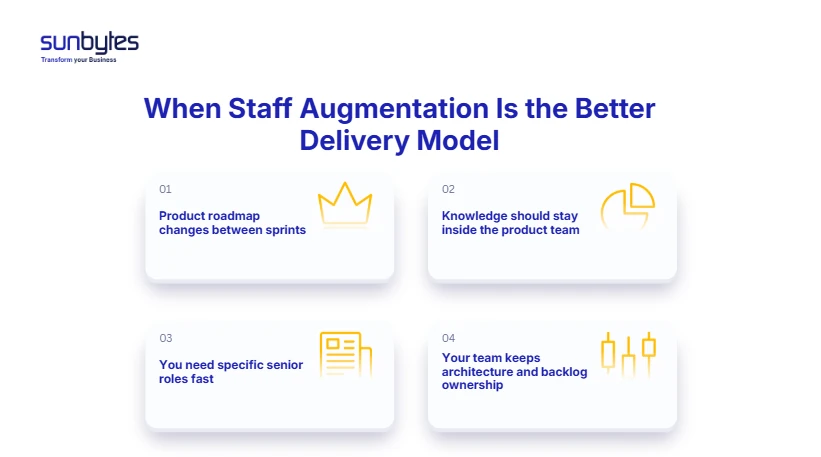
Staff augmentation performs best when external specialists can contribute inside a delivery system your team already controls. The model depends on internal direction, code review, sprint priorities, and architecture decisions from day one.
A changing product roadmap usually calls for staff augmentation. Customer feedback, investor deadlines, regulatory updates, and technical discovery can all shift priorities between sprints. External specialists who work inside the same sprint system can adapt without forcing a contract renegotiation every time the roadmap changes.
Knowledge retention is another reason to keep the model close to your internal team. If the product is core to the business, every design decision, incident, trade-off, and release should build internal capability. Outsourcing can still work, but knowledge transfer has to be designed into the agreement. Staff augmentation keeps more of that learning inside the client team by default.
The model also works well for precise skill gaps. A senior backend engineer, QA automation specialist, DevOps engineer, or technical product manager can remove a bottleneck without transferring ownership of the whole product. The trigger conditions behind when to use IT staff augmentation are usually specific: missing senior capacity, delayed roadmap items, specialist skill gaps, or hiring timelines that cannot match delivery pressure.
For example, a Dutch SaaS company with a delayed payments module may not need a full outsourced team. It may need one senior backend engineer and one QA automation specialist inside the existing sprint team for 8 to 10 weeks. If lead time for changes drops from 12 days to 6 days without change failure rate rising, staff augmentation is doing its job: adding throughput without moving product ownership outside the company.
The weak point is management capacity. Staff augmentation breaks down when nobody inside the client team can prioritise work, explain architecture, review pull requests, or remove blockers. As a Sunbytes delivery guideline, each senior augmented role usually needs visible internal governance in the first month: onboarding context, backlog clarification, pull request review, and architecture feedback. If internal leads cannot reserve roughly 3 to 5 hours per week for that role during ramp-up, outsourcing or a more stable team model may be safer.
When the same roles are needed for 6 months or longer, the decision often moves toward IT staff augmentation vs dedicated team. At that point, the question is no longer only which specialist you need. The more useful question is which stable team structure should own that delivery lane.
When outsourcing is the better choice
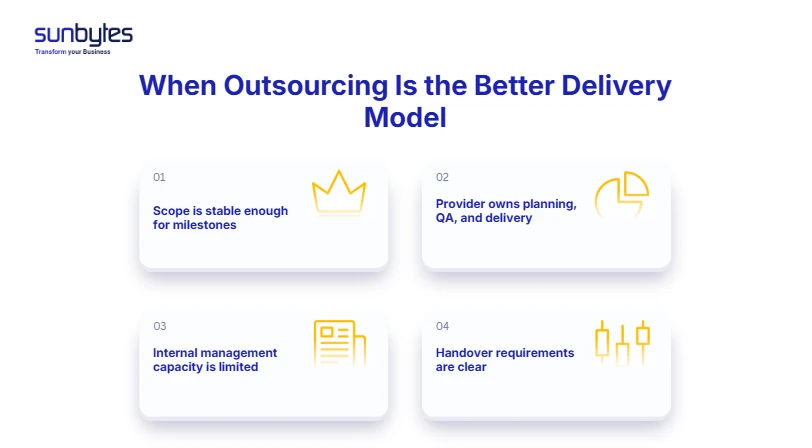
Outsourcing works best when the provider can own planning, staffing, delivery, and acceptance for a defined outcome. The model needs scope, dependencies, and quality gates documented before the first sprint starts.
Bounded workstreams are the clearest candidates. QA automation, legacy module replacement, API integration, cloud migration, and application support can all be outsourced when the inputs, outputs, acceptance criteria, and handover requirements are stable.
For example, a CTO may outsource a legacy reporting module replacement when the inputs, outputs, data sources, and acceptance tests are already documented. The provider can own the workstream if success is measurable: the new module matches existing report logic, passes agreed test cases, and is handed over with deployment notes before the next release window. If the internal team has to reinterpret requirements every sprint, the workstream is not ready for outsourcing.
A management bottleneck inside the client team can also make outsourcing the safer route. A CTO without engineering managers, product owners, or QA leads should not add five external developers and expect velocity to improve automatically. A provider-led workstream can reduce the management load because delivery management, reporting cadence, and escalation paths sit with the provider.
Outsourcing is also useful when a non-core workstream needs external accountability. The contract should make the provider responsible for delivery quality, defect correction, documentation, security duties, and handover. Without those terms, outsourcing becomes a lower-visibility staffing arrangement.
High ambiguity is the warning sign. A backlog that changes every week, a product still searching for fit, or architecture that depends heavily on internal domain knowledge can turn outsourcing into rework. Staff augmentation keeps those decisions closer to the people who understand the product context.
Security and contract checks before choosing a model
Security and contract design should follow the ownership model. Staff augmentation needs access controls and role-level onboarding; outsourcing needs processor terms, supplier oversight, delivery evidence, and clear handover obligations.
For EU teams, Regulation (EU) 2016/679 becomes relevant as soon as external specialists or providers touch personal data. GDPR Article 28 requires controllers to use processors that provide sufficient guarantees for appropriate technical and organisational measures, and it requires processing to be governed by a contract or legal act. GDPR Article 32 requires security measures appropriate to risk, including confidentiality, integrity, availability, resilience, restoration, and regular testing.
NIS2 affects the delivery model when the buyer is in scope or works inside a regulated supply chain. Directive (EU) 2022/2555 Article 21 names cybersecurity risk-management measures such as incident handling, business continuity, supply chain security, secure acquisition and development, vulnerability handling, access control, and encryption where appropriate. Those responsibilities should be visible in the staffing model, contract, and delivery governance.
ISO/IEC 27001:2022 gives teams a useful reference point for information security management because it frames confidentiality, integrity, and availability through a risk management process. For staff augmentation, ISO-guided delivery helps structure access, asset handling, and security responsibilities. For outsourcing, the same discipline helps define supplier controls, audit evidence, and risk ownership.
| Check | Staff augmentation | Outsourcing |
|---|---|---|
| Access and identity | Named users, least-privilege access, MFA, repository access review within the first week. | Provider access model, audit trail, named delivery roles, and offboarding rules. |
| Data processing | DPA if external specialists access personal data under your instructions. | DPA, subprocessors, transfer basis, retention, deletion, and audit support. |
| IP and code ownership | Code remains in your repositories unless agreed otherwise. | Contract states source code ownership, transfer timing, and third-party component rules. |
| Security evidence | Onboarding checklist, secure coding rules, review policy, incident reporting path. | Security plan, vulnerability handling, acceptance evidence, and handover package. |
| Delivery metrics | Lead time, change fail rate, review cycle time, MTTR. | Milestone acceptance, defect escape rate, SLA, documentation completeness. |
How to switch or combine models without rework
A hybrid model can work when the boundary between internal control and provider accountability is explicit. The safest pattern keeps product architecture and backlog ownership internal while assigning bounded workstreams to providers with clear interfaces.
In the first 30 days, build an ownership map. Name who owns architecture, backlog, security, QA standards, release approval, and incident response. If two parties own the same final decision, rewrite the model. Shared input is useful. Shared final ownership is where rework starts.
In Sunbytes’ Netherlands–Vietnam delivery setup, the typical 4 to 5 hour working overlap is treated as decision time. Architecture reviews, sprint planning, blocker escalation, and release readiness checks should happen inside that window when they need live discussion.
The cadence should stay simple: async updates before the Dutch workday starts, shared technical checkpoints during overlap, and one escalation path for scope, security, or release-quality decisions. Track the model with DORA metrics. If lead time improves while change failure rate and recovery time stay stable, the setup is adding capacity without hiding delivery risk.
From days 31 to 60, use delivery metrics to test whether the model is stable. In staff augmentation, lead time for changes should improve without change failure rate rising. In outsourcing, acceptance criteria should pass without repeated clarification loops. If the provider still needs daily internal correction after two sprints, the workstream is not defined tightly enough to be outsourced.
By days 61 to 90, decide whether to scale, hold, or convert the setup. Staff augmentation can become a dedicated team when the same roles are needed for 6 months or longer. An outsourced workstream can move back toward staff augmentation when discovery reveals too much product ambiguity.
For Dutch teams, delivery model and geography usually need to be decided together because timezone overlap, communication cadence, and escalation speed affect the same ownership structure. That is where IT staff augmentation vs nearshoring becomes part of the operating model.
The Netherlands-Vietnam setup can work well when the team protects a 4 to 5 hour overlap window for architecture reviews, sprint planning, and blocker resolution. Timezone overlap is not a substitute for ownership, but it reduces latency when decisions need the client’s product context.
How Sunbytes helps choose and run the right delivery model
Choosing between staff augmentation and outsourcing does not remove the need for ownership. It makes ownership more important, because every added engineer or provider-led workstream changes how decisions, quality checks, and delivery risk move through the sprint system.
Through Digital Transformation Solutions, Sunbytes helps Dutch and European teams add senior engineering capacity in 2 to 4 weeks, with ISO-guided delivery, DORA-tracked outcomes, and a Netherlands–Vietnam delivery model that uses the 4 to 5 hour working overlap for planning, escalation, and release-critical decisions where relevant.
Cybersecurity Solutions can support the control layer when delivery depends on security evidence, access control, or vendor due diligence, while Accelerate Workforce Solutions supports the workforce layer when scaling also involves hiring, onboarding, contracts, or people operations.
Ready to close the capacity gap before it becomes a roadmap gap? Explore Digital Transformation Solutions from Sunbytes →
FAQs
An onboarding pack should include repository access rules, architecture notes, coding standards, branch strategy, sprint rituals, definition of done, security expectations, and the first 2 weeks of prioritised work. The goal is to help external specialists contribute without turning senior internal engineers into full-time translators.
An outsourcing handover package should include source code, deployment instructions, test coverage, architecture decisions, known limitations, access removal confirmation, support contacts, and unresolved backlog items. The handover should be accepted as a deliverable, not treated as an informal final meeting.
Staff augmentation adds internal costs through onboarding, code review, technical direction, and delivery coordination. Outsourcing adds hidden cost when scope changes, acceptance criteria are unclear, or handover is incomplete. The cheaper model on paper can become more expensive if ownership is not defined before work starts.
The first warning sign is repeated correction after sprint work has already started. In staff augmentation, that usually means onboarding, architecture context, or review flow is weak. In outsourcing, it usually means the scope is too ambiguous for provider-owned delivery.
Procurement should compare vendors by ownership model, seniority mix, delivery governance, security evidence, timezone overlap, handover quality, and measurable delivery practices. A lower day rate is not useful if internal leaders spend the savings on correction meetings, rework, or unclear accountability.
Yes. A hybrid model can work when the boundary is clear. Keep internal architecture, backlog priority, release approval, and product decisions with your own team, then outsource bounded workstreams that have defined scope, acceptance criteria, security responsibilities, and handover requirements. Staff augmentation should extend your core delivery system; outsourcing should handle provider-owned work that can be delivered and accepted without daily internal steering.