

The decision to use IT staff augmentation comes down to one question: is the capability gap temporary or strategic? Getting this wrong in either direction is expensive, whether it’s overhiring full-time staff for a six-month project or under-resourcing a core product function with short-term contractors.
So when to use IT staff augmentation and how can you ensure it drives real business value? In this post, we’ll explore the key use cases where augmentation makes sense, along with a practical action plan to help you integrate external talent seamlessly, maintain quality control, and achieve measurable outcomes.
TL;DR
- Use IT staff augmentation when you need to add specific skills fast, keep delivery moving, or scale without long-term hiring risk. It works best for short-to-mid term gaps, specialized expertise, and projects with changing scope
- In contrast, it may not be the right fit for long-term strategic roles, culture-dependent positions or projects that require full vendor ownership and deep institutional knowledge retention.
- To maximize success in using staff augmentation, the implementation process should follow a structured approach that includes identifying needs, selecting the right partner, onboarding and team integration, initial performance evaluation and continuous optimization to ensure long-term delivery value.
Why Companies Should Use IT Staff Augmentation
IT staff augmentation is a model where companies extend their in-house teams by integrating external tech professionals on a temporary or project basis. Rather than relying solely on traditional recruitment, this approach unlocks several advantages, including:
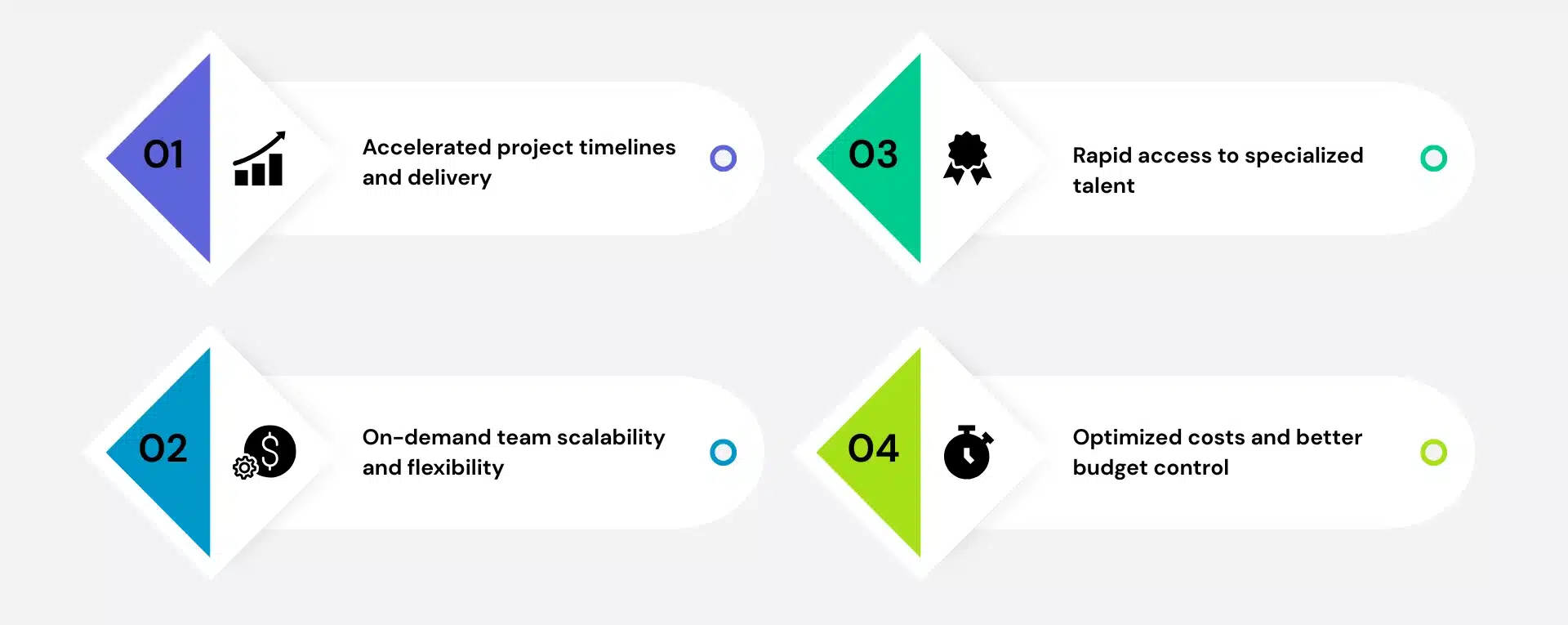
- Improved project speed and delivery: Augmented teams help accelerate timelines by filling skill gaps instantly, enabling projects to move forward without delays caused by lengthy hiring processes.
- Flexible team scaling on demand: Businesses can adjust team size up or down based on project needs, facilitating optimal resource allocation
- Faster access to skilled talent: Staff augmentation provides immediate access to experienced professionals with niche or in-demand technical skills that may be difficult to source locally.
- Cost efficiency and budget control: Companies can reduce overhead costs related to full-time hiring, training, and benefits, while maintaining control over project budgets.
When to Use IT Staff Augmentation
Companies should consider IT staff augmentation in situations where flexibility, speed, and specialized expertise are critical:
Rapid scaling requirements or time-sensitive product delivery
One key scenario for when to use IT staff augmentation is during unexpected project spikes or tight delivery deadlines. In such cases, teams may need to scale capacity quickly, sometimes by around 30% – 50% within 2-4 weeks, to meet critical milestones.
Achieving this through traditional hiring alone is nearly impossible, given average recruitment cycles of 4-6 weeks or longer. Staff augmentation bridges the gap by enabling immediate access to pre‑vetted professionals, often within 1-2 weeks, helping teams stay on track and meet deadlines.
Seasonal demand or project-driven workloads
Another clear case for when to use IT staff augmentation is in businesses with cyclical or project-based workloads. Demand may fluctuate throughout the year depending on business cycles or client engagements. Augmentation provides the flexibility to scale teams up during peak periods and reduce headcount when demand stabilizes, supporting efficient resource utilization.
Skill gaps in specialized areas
Many internal teams excel in core competencies but may lack expertise in niche or rapidly evolving technologies such as cloud architecture, DevOps, cybersecurity, data engineering, or specific programming frameworks. In these cases, augmented specialists can be brought in quickly to fill critical skill gaps and ensure the project continues without technical bottlenecks.
Need for flexible headcount and budget control
IT staff augmentation also supports more agile financial and workforce planning. Instead of committing to permanent headcount, organizations can adjust team size based on project needs and budget availability. This model provides greater cost transparency and allows leaders to align spending more closely with actual delivery requirements.
When Not To Use IT Staff Augmentation
While IT staff augmentation is highly effective for scaling quickly and accessing specialized talent, it is not always the right solution. In some cases, it can introduce misalignment, inefficiencies, or unnecessary overhead if used in the wrong context.
Long-term strategic needs
A key part of deciding when to use IT staff augmentation is evaluating whether the capability is temporary or strategically core to the business. If your organization is building a permanent cybersecurity division, a product R&D function, or another mission-critical team, relying too heavily on temporary external staff can weaken internal knowledge retention and slow long-term capability building. In these cases, investing in full-time employees provides stronger continuity, ownership, and institutional growth.
End-to-end project ownership
IT staff augmentation works best when you manage the project internally. If your business needs a vendor to take full responsibility for planning, execution, and delivery, then a dedicated software development team is a better fit. Augmented staff integrate into your team but do not assume ownership of the entire project lifecycle, which can lead to gaps in accountability if misapplied.
Culture-dependent roles
Roles that require deep integration into company culture, leadership responsibilities, or direct customer-facing interactions are better filled by permanent employees. Augmented staff may not fully align with organizational values or long-term relationship building, which can impact team cohesion and customer trust. Cultural fit is critical in these positions, making augmentation less suitable.
| Decision factor | Use IT staff augmentation | Avoid IT staff augmentation |
|---|---|---|
| Speed to hire | You need skilled engineers deployed quickly to meet urgent deadlines | You can afford a longer hiring timeline and want permanent ownership |
| Project duration | The need is temporary, project-based, or linked to a specific delivery milestone | The role is long-term, strategic, and central to product continuity |
| Skill requirements | You need niche expertise your internal team lacks | The capability is core to your business and should be developed in-house |
| Budget model | You need flexible cost control and scalable headcount | You have budget certainty and prefer investing in permanent team growth |
| Leadership capacity | You have internal tech leads or delivery managers who can guide external talent | You lack strong internal ownership, governance, or engineering leadership |
| Knowledge retention | The work is execution-focused and does not require deep institutional knowledge | The work requires long-term product context and retained business knowledge |
| Team integration | External engineers can plug into existing workflows with clear processes | Success depends heavily on deep cultural alignment and long-term collaboration |
Need help choosing the right engagement model? Talk to our experts for tailored recommendations.
How to Successfully Implement IT Staff Augmentation
Once you understand when to use IT staff augmentation, the next step is execution. To maximize the value of this model, companies should follow a clear, structured approach that aligns talent decisions with delivery goals, budget constraints, and long-term business priorities.
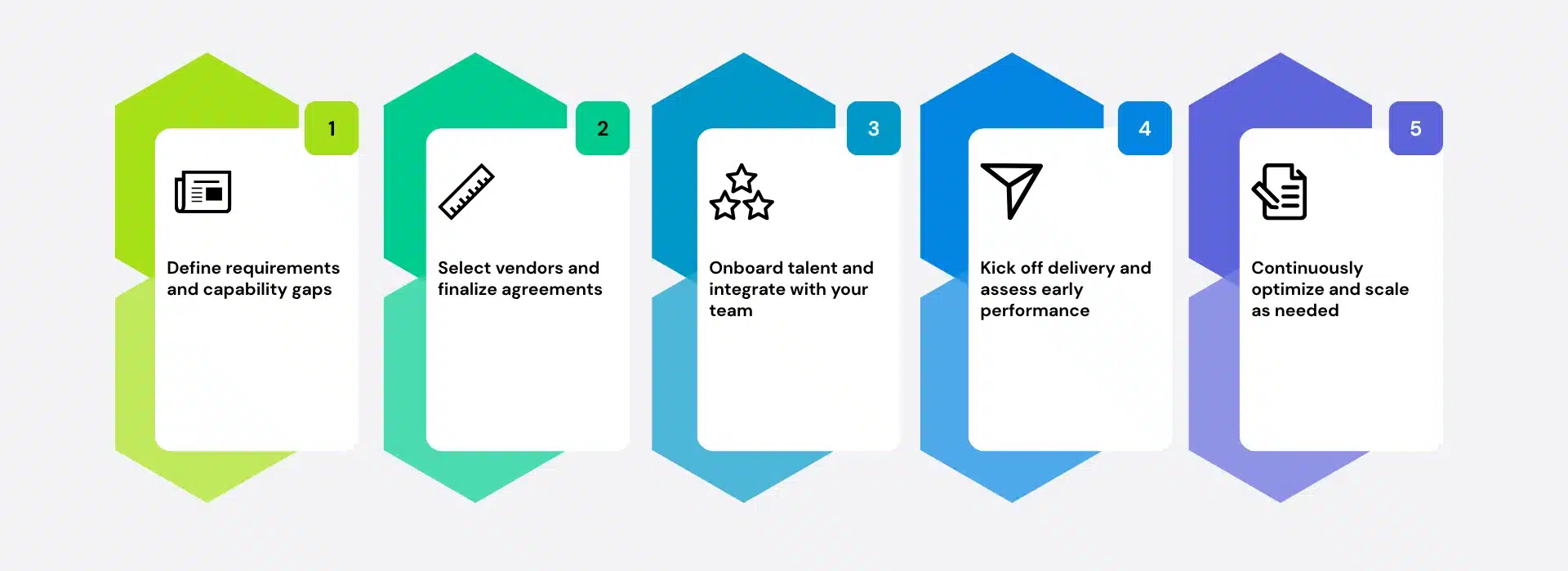
Phase 1: Identify needs
Start by defining exactly what your team is missing. This includes not only technical skills but also project scope, timelines, and expected outcomes. The clearer your requirements, the easier it is to source the right talent and avoid delays caused by mismatched expectations or capabilities.
*Tips: Bring HR and Finance into the process early. HR can validate whether the required skills are realistic in the market, while Finance ensures the budget can support flexibility—preventing bottlenecks later during contracting.
Phase 2: Partner selection and contracting
Once you’ve defined your requirements, the next step is to evaluate potential vendors. The right staff augmentation partner should provide pre‑vetted professionals who closely match your criteria, ensuring a faster and more reliable selection process. In highly regulated industries, it’s equally important to choose a vendor with a strong understanding of data compliance standards such as GDPR, HIPAA, PCI DSS, ISO 27001 to maintain regulatory confidence.
Once the right talent is selected, move forward with contracting. A well-structured contract should clearly outline roles, responsibilities, KPIs, and compliance requirements to achieve alignment from the start.
*Tips: Use a structured partner scorecard with weighted criteria such as technical expertise, cultural fit, and responsiveness to guide your decision. This helps keep evaluations objective and prevents subjective impressions from influencing choices rather than measurable performance.
Phase 3: Onboard & team integration
Effective onboarding is critical to accelerating productivity, as it sets the foundation for how well augmented staff integrate into your team. Start by providing access to essential tools, documentation, and workflows, ensuring they understand your internal processes and standards. From there, run kickoff meetings followed by structured knowledge transfer sessions to align expectations and clarify responsibilities. As they become familiar with the environment, integrate them into daily meetings and collaboration channels to strengthen communication, build cohesion, and enable them to operate as a cohesive extension of your team.
Phase 4: Initial delivery & evaluation
Begin with smaller deliverables or short sprints to assess performance, communication, and output quality. This phase allows you to validate the fit, identify gaps early, and fine-tune collaboration before scaling the engagement further.
Phase 5: Ongoing improvement
Sustaining success requires continuous optimization as business needs evolve over time. Regularly recalibrate your resource mix, ideally on a quarterly basis, to stay aligned with shifting priorities. Meanwhile, encourage cross-training between internal teams and augmented staff to strengthen knowledge transfer and reduce long-term dependency. To keep everything on track, conduct quarterly vendor evaluations to assess performance and ensure ongoing alignment with your long-term strategic goals.
Sunbytes IT Staff Augmentation: On-Demand Expertise, On-Time Delivery
Knowing when to use IT staff augmentation can make the difference between delivery momentum and costly delays. When speed, flexibility, and access to specialized expertise are critical, IT staff augmentation gives organizations a practical way to scale engineering capacity without the long lead times of traditional hiring. It is especially effective for rapid scaling, time-sensitive product delivery, skill-gap coverage, and project-based workloads where resource needs can change quickly.
If your team is facing growth pressure or hard-to-fill technical skill gaps, contact Sunbytes today to assess the optimal resourcing model and access senior engineering talent.
About Sunbytes
Sunbytes is a Netherlands-based technology partner with a delivery hub in Vietnam, delivering Digital Transformation Solutions for international organizations for more than 15 years. We help businesses design, build, and modernize digital products through senior engineering teams that combine technical excellence with delivery discipline and a strong focus on long-term business impact
Our Digital Transformation is strengthened by two key pillars that reinforce its success:
- Cybersecurity Solutions: With our Secure by Design approach, risk is reduced without slowing delivery. Security is embedded from the start, aligned with real architectures and delivery constraints, so modernized systems remain resilient.
- Accelerate Workforce Solutions: Scaling transformation requires the right skills and capacity at the right time. We help you efficiently expand both, ensuring your roadmap stays on track and your delivery model remains stable as demand grows.