Remote DevSecOps onboarding usually fails before the first ticket is assigned. The failure point is rarely skill. It is unclear access, missing pipeline context, undefined evidence ownership and a handoff rhythm that depends on goodwill instead of operating rules.
Onboarding a remote DevSecOps team works when access, context, ownership and cadence are defined before the first sprint. In the first 90 days, the goal is not to “do security work remotely.” The goal is to make the remote team safe enough to contribute, close enough to delivery to improve sprint flow, and clear enough on ownership to produce evidence your Dutch or EU team can trust.
This playbook is written for CTOs, Heads of Product, Engineering Managers and founders at EU SMEs that have already decided to add remote DevSecOps capacity and now need the first 90 days to work.
If your team is still deciding which role or model to choose before onboarding starts, use the DevSecOps team hiring guide first. This article starts after the team or provider has been selected.
TL;DR
Remote DevSecOps onboarding is the controlled process of bringing an external DevSecOps engineer or team into your repositories, CI/CD pipeline, access model and sprint cadence without creating uncontrolled security risk. By Day 90, onboarding should produce four outputs: reviewed access, owned findings, documented evidence and a repeatable handoff rhythm.
A remote DevSecOps team should be onboarded through a controlled 90-day plan: prepare access and context before Day 1, use the first 30 days for baseline and limited access, embed the team into sprint rhythm by Day 60, and prove value by Day 90 with delivery metrics, reduced backlog and a clear evidence trail.
- Best fit: EU SMEs that need DevSecOps capacity without waiting for a full internal hiring cycle.
- First control: least-privilege access with a named approver, review cadence and offboarding plan.
- Day-90 proof: measurable delivery improvement, closed security findings, documented controls and a working handoff rhythm.
- Watch out for: giving production access before the team understands incident flow, release ownership and evidence requirements.
Before Day 1: what to prepare
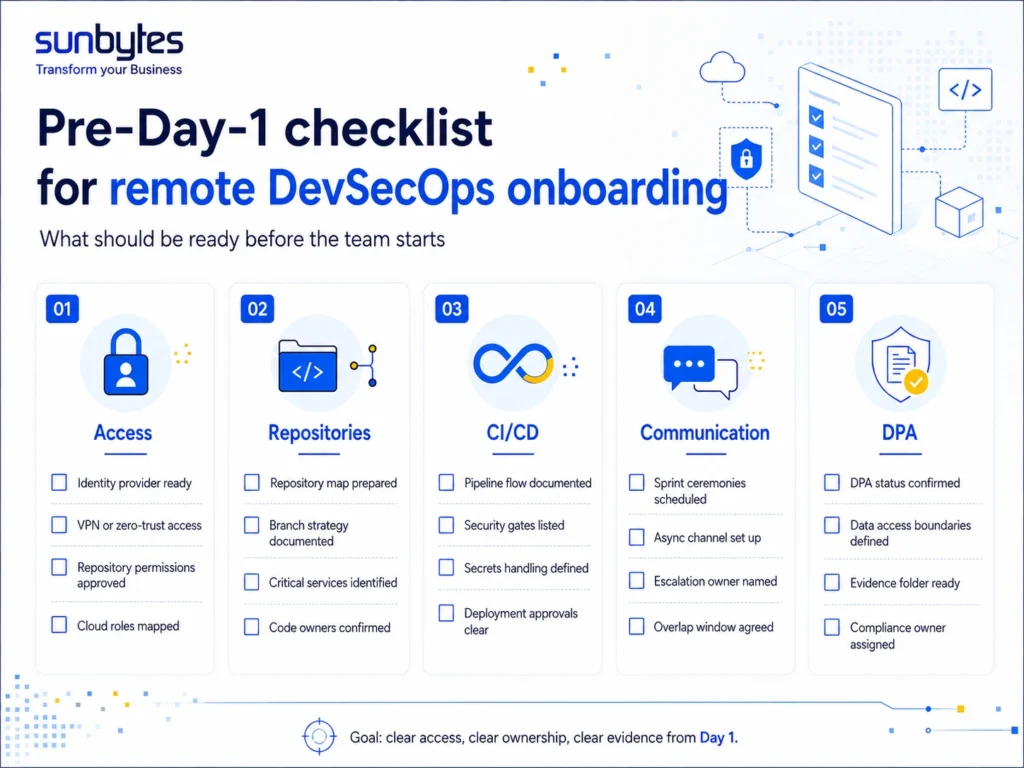
Before Day 1, prepare the access map, delivery context and ownership model. A remote DevSecOps team can only move safely if it knows which systems exist, who approves changes and where security evidence should be stored.
The useful question is not “Can the team start Monday?” It is “Can the team start Monday without creating hidden risk?” For most EU SMEs, that means preparing six things before the first onboarding call.
| Area | What should be ready | Owner before Day 1 | Why it matters |
|---|---|---|---|
| Access | Identity provider, VPN or zero-trust access, repository permissions, cloud roles | Client security or engineering owner | Prevents over-permissioned access during onboarding |
| Code and pipeline context | Repository map, CI/CD flow, branch strategy, release process | Engineering lead | Helps the remote team understand where controls belong |
| Cloud and infrastructure | Cloud accounts, environments, secrets process, deployment permissions | Platform or DevOps owner | Keeps production access controlled |
| Security workflow | Vulnerability backlog, severity model, incident process, escalation owner | Security lead or CTO | Prevents findings from becoming unowned tickets |
| Communication cadence | Sprint ceremonies, async channel, escalation window, decision owner | Engineering manager | Keeps remote work tied to delivery rhythm |
| Legal and compliance basics | DPA status, security approvals, data access boundaries | Legal, procurement or CTO | Reduces cross-border access ambiguity |
The Data Processing Agreement matters when the remote DevSecOps team may access systems, logs, tickets or environments that contain personal data. GDPR Article 32 requires controllers and processors to apply technical and organisational measures appropriate to the risk, including security controls such as encryption, resilience, restore capability and regular testing where appropriate.
A practical pre-Day-1 checklist should include:
- A named client-side approver for access.
- A list of repositories, systems and environments in scope.
- A “no production access by default” rule.
- A severity model for vulnerabilities and security tickets.
- A shared evidence folder for control decisions, screenshots, reports and remediation notes.
- A first-sprint objective that is small enough to complete without production ownership.
If the provider model is still unclear, compare this setup with DevSecOps as a Service before finalising onboarding. A managed service, a dedicated engineer and a dedicated team need different handoff rules.
First-sprint success criteria
The first sprint should prove safe integration, not maximum output. By the end of the first sprint, the remote team should have access to the right repositories, understand the CI/CD path, complete a first pipeline or backlog review, and raise at least one concrete improvement with an owner attached.
Do not measure the first sprint by number of tickets closed alone. Measure whether the team can make a change without confusion over access, approval, severity or documentation.
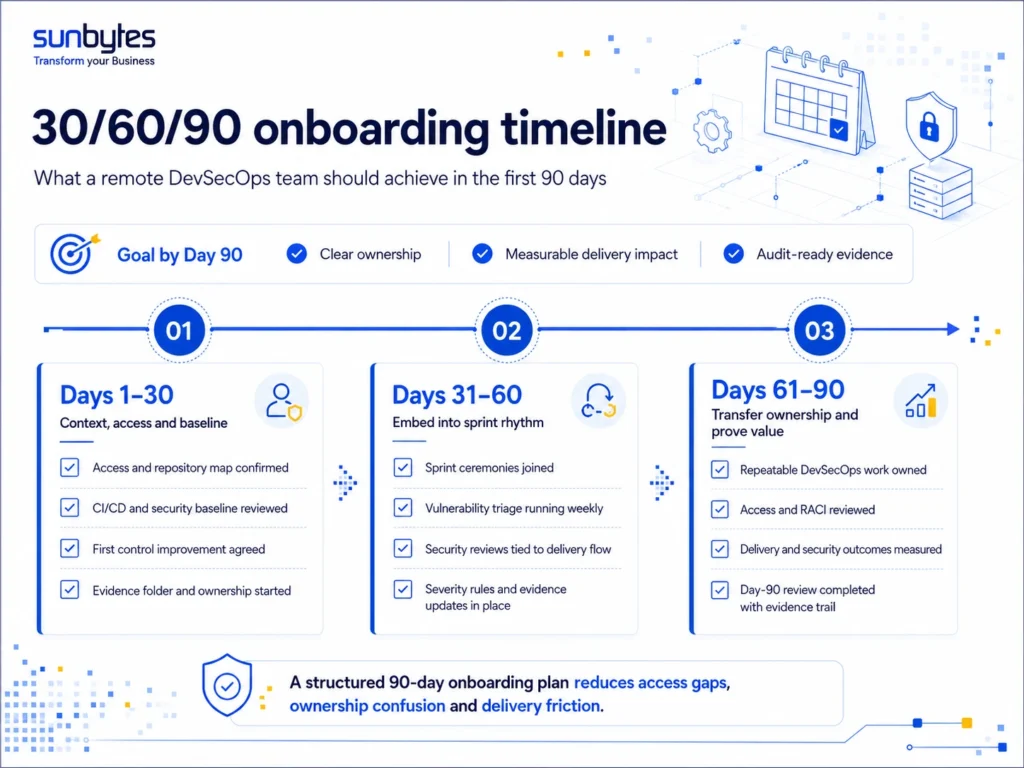
Days 1-30: context, access and first security baseline
Days 1-30 should focus on controlled context transfer, limited access and one first security baseline. The remote DevSecOps team should understand the product, pipeline and release model before it owns production-facing changes.
A strong first month has four weekly outcomes.
| Week | Focus | Expected output |
|---|---|---|
| Week 1 | Context and access | Repository map, access list, communication channel, onboarding notes |
| Week 2 | Pipeline and security baseline | CI/CD review, current security gate map, vulnerability backlog review |
| Week 3 | First control improvement | One agreed improvement such as SAST tuning, dependency triage or secret scanning review |
| Week 4 | Ownership check | RACI confirmed, first evidence folder updated, access review completed |
Start with read access where possible. Write access should be granted only after the team understands branch rules, review rules and release flow. Production access should require a named approver and a clear reason. If production access is needed, define scope, duration and logging before granting it.
NIST SSDF gives a useful reference point here because it frames secure software development as repeatable practices to reduce software vulnerabilities. For onboarding, the practical value is not copying the whole framework into the article. It is using the framework to structure early questions: who owns secure development practices, how vulnerabilities are reviewed, and where evidence is kept.
The first security baseline should be narrow. For an EU SME, a useful baseline may include:
- Which security tools already run in CI/CD.
- Which checks are blocking, warning-only or manual.
- Which repositories contain business-critical code.
- Which secrets, dependencies or infrastructure findings are already known.
- Which findings are accepted risk, deferred work or active remediation.
For a full control rollout sequence, read DevSecOps 90-day implementation plan.
Production access rule for the first 30 days
Production access should be treated as an exception in the first 30 days. The default should be least privilege, temporary elevation, named approval and review after use.
The access record should answer five questions:
| Question | Required answer |
|---|---|
| Who requested access? | Named person and role |
| Who approved it? | Named client-side approver |
| What is the scope? | System, environment and permission level |
| How long is it needed? | Start date and review date |
| How is it removed? | Offboarding or access reduction step |
This prevents a common remote onboarding failure: access grows gradually, but no one reviews whether the original reason still exists.
Days 31-60: embed into sprint rhythm
Days 31-60 should move the remote DevSecOps team from observer to operating participant. By this stage, the team should join sprint planning, PR review, vulnerability triage and release discussions with defined responsibilities.
The second month is where remote onboarding either becomes part of delivery or stays stuck as a side channel. If security work sits outside the sprint rhythm, findings arrive late, developers treat them as interruptions and remediation becomes negotiation. The fix is to attach DevSecOps work to existing delivery rituals.
A workable cadence for Days 31-60 should include:
| Cadence | Frequency | Owner | Output |
|---|---|---|---|
| Vulnerability triage | Weekly | Security or engineering lead | Prioritised finding list with severity and owner |
| Pull request security review | Per agreed repository or risk level | Remote DevSecOps engineer | Comments, approvals or escalation |
| Pipeline gate review | Every sprint | DevOps or platform owner | Gate changes, false-positive notes, accepted risks |
| Evidence update | Every sprint | Assigned evidence owner | Control evidence added to folder or audit trail |
| Retrospective input | Every sprint | Engineering manager | Remote handoff friction and decision delays |
OWASP SAMM is useful in this phase because it gives teams a way to assess and improve software security practices across governance, design, implementation, verification and operations. For onboarding, use it as a maturity lens: decide which practice the remote team will improve first, and which practice stays with the client team.
Severity thresholds should be agreed by Day 45. Without them, the remote team may treat every issue as a blocker, or the internal team may treat every issue as optional. A simple starting point is:
| Finding type | Action rule |
|---|---|
| Critical exploitable issue in production path | Escalate same day, assign owner, document decision |
| High issue in active release scope | Triage within one sprint, decide block or defer |
| Medium issue in non-critical path | Add to backlog with owner and target sprint |
| Low or informational issue | Batch review, tune scanner noise if needed |
| False positive | Document rationale and tuning action |
The decision should be visible in the ticketing system, not hidden in chat. Chat is for speed. Tickets are for ownership. Evidence folders are for audit trail.
Need help turning remote DevSecOps onboarding into a working delivery plan? Sunbytes can help define ownership, map controls to the pipeline and add DevSecOps capacity without restarting your hiring cycle.
For teams that need DevSecOps support inside an existing delivery cadence, connect the onboarding plan to Dedicated Remote Developers so the first 90 days start with clear access, sprint ownership and evidence expectations.
Days 61-90: transfer ownership and prove value
Days 61-90 should prove that the remote DevSecOps team can own repeatable work, not just complete isolated tasks. By Day 90, the client should see measurable delivery, security and evidence outcomes. The third month is not the time to add more meetings. It is the time to remove ambiguity.
A useful Day-90 review should cover four areas:
| Area | Day-90 proof |
|---|---|
| Delivery | PR review flow works, security tickets move through sprint planning, release blockers are visible earlier |
| Security | Finding backlog is reduced or reclassified, first gate improvement is active, false positives are tuned |
| Evidence | Control decisions, access reviews, remediation notes and retest results are stored in the agreed location |
| Ownership | RACI is updated, escalation paths are used, offboarding and access review rules are clear |
DORA metrics help keep this review grounded in delivery reality. DORA defines metrics such as deployment frequency, change lead time and failed deployment recovery time to measure software delivery performance. For onboarding, do not use DORA as a vanity dashboard. Use it to check whether security work is slowing delivery, improving flow or exposing a bottleneck that was already there.
A remote DevSecOps team is working by Day 90 if the internal team spends less time clarifying ownership and more time acting on prioritised work. The clearest signals are concrete:
- Security findings have named owners.
- Critical and high findings have decision records.
- Access has been reviewed at least once.
- Evidence is stored where compliance, audit or procurement teams can find it.
- Sprint planning includes security work before release pressure starts.
- The remote team can explain the pipeline and escalation model without asking the same questions again.
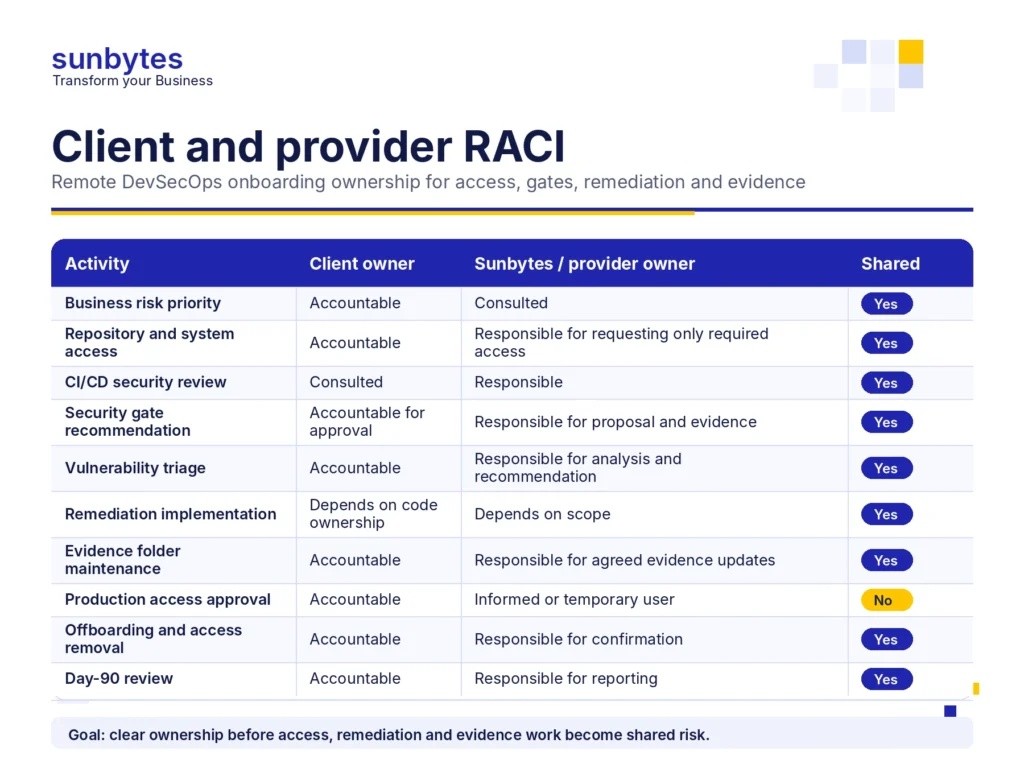
Client and provider RACI for remote DevSecOps onboarding
| Activity | Client owner | Sunbytes or provider owner | Shared |
|---|---|---|---|
| Business risk priority | Accountable | Consulted | Yes |
| Repository and system access | Accountable | Responsible for requesting only required access | Yes |
| CI/CD security review | Consulted | Responsible | Yes |
| Security gate recommendation | Accountable for approval | Responsible for proposal and evidence | Yes |
| Vulnerability triage | Accountable | Responsible for analysis and recommendation | Yes |
| Remediation implementation | Depends on code ownership | Depends on scope | Yes |
| Evidence folder maintenance | Accountable | Responsible for agreed evidence updates | Yes |
| Production access approval | Accountable | Informed or temporary user | No |
| Offboarding and access removal | Accountable | Responsible for confirmation | Yes |
| Day-90 review | Accountable | Responsible for reporting | Yes |
Remote operating model for Dutch and Vietnam teams
A Dutch and Vietnam remote DevSecOps model works when the overlap window is used for decisions, not status updates. With a 4-5 hour Amsterdam-Vietnam overlap, the operating model should separate synchronous decisions from async documentation.
Use the overlap window for:
- Access approvals and escalation.
- Security findings that may block a release.
- Sprint planning decisions.
- Retest and remediation priority.
- Architecture or pipeline changes that affect multiple teams.
Use async documentation for:
- Pipeline review notes.
- Vulnerability analysis.
- Evidence updates.
- PR comments.
- Retest results.
- Daily handoff notes.
The rule is simple: decisions need a meeting only when the decision is blocked by missing context or competing priorities. Everything else should be documented where the delivery team already works.
For Dutch teams, direct communication matters. A remote DevSecOps engineer should be expected to raise access blockers, unclear severity rules or missing evidence early. Waiting until the retrospective creates the wrong signal: the team protects the sprint on paper while the risk grows underneath.
A practical NL-VN cadence can look like this:
| Timeframe | Cadence |
|---|---|
| Daily | Async handoff note before overlap starts |
| 2-3 times per week | Short overlap check for blockers and decisions |
| Weekly | Vulnerability triage and access review check |
| Every sprint | Security gate review and evidence update |
| Every 30 days | Ownership, access and metric review |
The model works best when the Netherlands account management function keeps commercial context, escalation and stakeholder communication close to the client, while the Vietnam delivery hub provides the engineering capacity inside the agreed cadence.
If your team is deciding whether to use a broader dedicated team rather than one DevSecOps engineer, explore the Dedicated Software Development Team. The onboarding rules are similar, but team-level delivery needs stronger sprint ownership and more explicit role boundaries.
How Sunbytes supports remote DevSecOps onboarding
Sunbytes supports remote DevSecOps onboarding by combining dedicated engineering capacity with ISO-aware delivery habits, NL-VN operating cadence and security coordination when evidence matters.
For EU SMEs, the practical problem is whether that work becomes part of sprint planning, release decisions and audit-ready evidence. Sunbytes structures onboarding around access, context, ownership and measurable outcomes from the first month.
Dedicated senior teams are typically operational within 2-4 weeks, depending on role scope, access readiness and interview flow. In DevSecOps onboarding, that timeline only works when the client prepares repository access, CI/CD context, DPA status and decision owners before Day 1.
Why Sunbytes?
Sunbytes is a Dutch technology company with headquarters in the Netherlands and a delivery hub in Vietnam. The 4-5 hour Amsterdam-Vietnam overlap gives teams a practical window for sprint decisions, security escalation and handoff review. Netherlands account management keeps stakeholder communication close to the client, while the Vietnam delivery hub supports day-to-day engineering execution.
The Transform layer gives the delivery structure: repository context, sprint ownership, DORA-tracked review points and a first-90-days operating model. The Secure layer keeps the evidence trail usable: DPA discipline, least-privilege access, access review cadence and ISO 27001-certified delivery practices. The Accelerate layer makes the people model practical, with dedicated capacity that can be operational in 2–4 weeks when access, scope and interview flow are ready.
If the decision in this article points to missing ownership, evidence or delivery capacity, Sunbytes can help design the next step through Dedicated Remote Developers: dedicated DevSecOps support, ISO-aware delivery practices and a first-90-days operating model matched to your team.
FAQs
A remote DevSecOps team usually needs 30 days to understand context and access, 60 days to work inside sprint rhythm and 90 days to prove repeatable value. Sunbytes dedicated senior teams are typically operational within 2-4 weeks, but DevSecOps onboarding still depends on client readiness: access, repositories, CI/CD context, DPA status and named decision owners.
Before Day 1, prepare the repository map, CI/CD flow, cloud access model, vulnerability backlog, incident process, communication channels and DPA or security approval status. The most important item is ownership: every access request, security finding, gate change and evidence update needs a named client-side approver.
Production access should follow least privilege, named approval, temporary elevation where possible and scheduled review. In the first 30 days, production access should be the exception, not the default. Every approval should record who requested access, who approved it, what system it covers, how long it lasts and how it will be removed.
The first 30 days should create a controlled baseline. The remote DevSecOps team should receive limited access, understand the product and pipeline, review current security gates, inspect the vulnerability backlog and complete one first control improvement. The first month should prove safe integration before broader ownership is transferred.
A Dutch and Vietnam team should use the 4-5 hour overlap for decisions, blockers and escalation. Async documentation should handle pipeline notes, PR comments, vulnerability analysis and evidence updates. The model works when meetings are reserved for decisions and the handoff record is clear enough for both sides to continue work without waiting.
By Day 90, the remote DevSecOps team should have named owners for findings, a reviewed access model, a working triage cadence, updated evidence folders and at least one measurable improvement in the pipeline or vulnerability backlog. DORA metrics can help show whether security work is improving flow or creating delay.
Yes, when the team may access systems, logs, tickets or environments that involve personal data. GDPR Article 32 is relevant because it focuses on security of processing and appropriate technical and organisational measures. In onboarding, this translates into access control, encryption where relevant, restore processes, testing cadence and evidence that controls are reviewed.
A DevSecOps implementation roadmap explains which technical controls to roll out and when. Remote DevSecOps onboarding explains how an external team enters your delivery model safely: access, context, handoff cadence, RACI, evidence ownership and Day-90 review. The two should link to each other, but they should not answer the same search intent.
Let’s start with Sunbytes
Let us know your requirements for the team and we will contact you right away.