DevOps is enough when your main delivery risk is speed, reliability or handover between development and operations. DevSecOps becomes necessary when security findings, evidence requests and release exceptions start affecting delivery decisions.
That is the practical difference in the DevOps vs DevSecOps conversation.
DevOps improves how software moves from code to production. DevSecOps keeps that delivery rhythm, then adds security ownership, automated checks, release controls and evidence into the same workflow. For Dutch and EU software companies with 50 to 500 employees, the adoption question is usually not “Do we need more security tools?” It is “Who owns security decisions before production?”
If your team still needs the foundation before comparing the models, start with this guide to DevSecOps explained. This article assumes the basic concept is clear and focuses on the adoption decision.
TL;DR
DevOps focuses on delivery speed, reliability and collaboration between development and operations. DevSecOps keeps those goals, then adds security controls, evidence and vulnerability ownership inside the delivery workflow. A team should move from DevOps to DevSecOps when security evidence becomes part of customer due diligence, audit readiness, enterprise sales or release approval.
- Keep DevOps if your product has low regulatory exposure, limited personal data processing, few external security questions and a low-risk release profile.
- Adopt DevSecOps when findings arrive late, evidence is collected manually, customer questionnaires slow deals, or release exceptions have no clear owner.
- Measure the change with delivery and reliability signals such as deployment frequency, lead time for changes, change failure rate and time to restore, the four software delivery metrics used by DORA.
What is the difference between DevOps and DevSecOps?
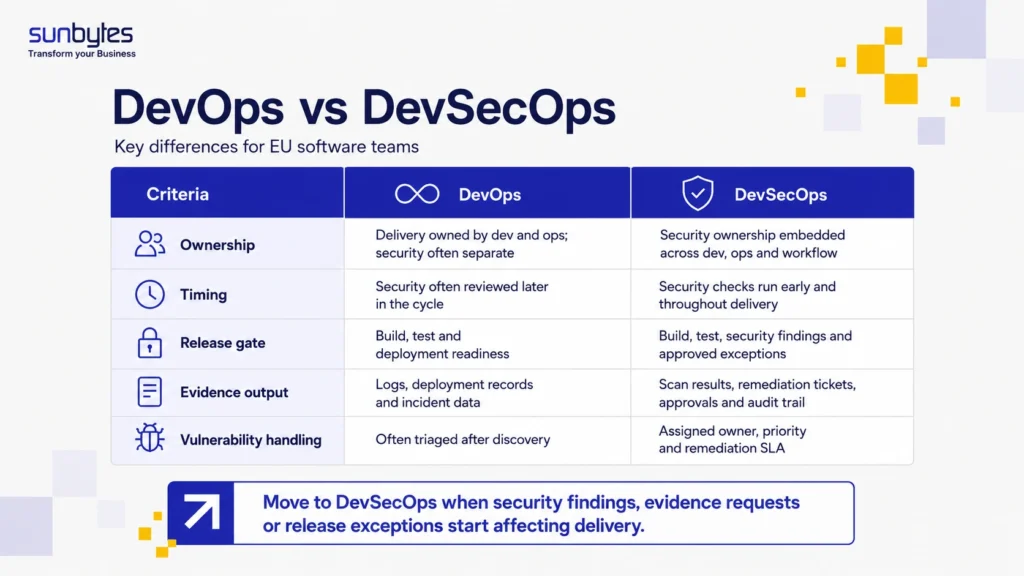
DevOps improves delivery flow. DevSecOps adds security control and evidence to that flow.
The difference is not that DevOps ignores security. Mature DevOps teams already care about quality, reliability and operational risk. The real difference is where security decisions sit. In DevOps, security often appears as a review, ticket or separate check. In DevSecOps, security becomes part of how code is built, reviewed, released and evidenced.
| Criteria | DevOps | DevSecOps |
|---|---|---|
| Primary goal | Faster and more reliable software delivery | Faster and safer delivery with security evidence |
| Security timing | Often reviewed before release or after testing | Checked throughout planning, coding, CI/CD and release |
| Main owner | Development and operations teams | Development, operations and security ownership shared by process |
| Release gate | Performance, test results, deployment readiness | Security findings, risk exceptions and evidence also affect release |
| Evidence output | Deployment logs, incident records, monitoring data | Security scan output, remediation tickets, exception approvals, access reviews |
| Vulnerability handling | Often handled after discovery by security or engineering | Assigned to a clear owner with priority, SLA and release impact |
| Compliance trail | Usually prepared manually when requested | Evidence is generated as part of the delivery workflow |
| Team responsibility | Ship and operate software reliably | Ship, operate and prove controls are working |
A simple way to separate the two: DevOps asks whether the team can ship reliably. DevSecOps asks whether the team can ship reliably and prove the right controls were applied.
That proof matters once buyers, auditors, boards or enterprise customers ask for evidence. A release that passed tests but has no record of dependency review, access approval or vulnerability ownership may still create business risk.
When is DevOps enough?
DevOps is enough when delivery risk is low and security evidence is not yet a repeated business requirement.
For many software teams, starting with strong DevOps is the right move. If the product is early-stage, handles limited sensitive data, sells mostly to small customers and has no recurring security due diligence, a heavy DevSecOps operating model may create process before the team needs it.
DevOps is usually enough when these conditions are true:
| Condition | What it means in practice |
|---|---|
| Low regulatory pressure | The product is not yet in a high-compliance sales cycle or regulated delivery environment. |
| Limited personal data exposure | The system does not process sensitive or high-volume personal data. |
| Few customer evidence requests | Sales and procurement do not regularly ask for security questionnaires, audit reports or control evidence. |
| Low release risk | Failed releases are recoverable without major customer, legal or operational impact. |
| Clear operational ownership | Incidents, rollbacks and monitoring already have named owners. |
This does not mean security can wait. It means the team can focus first on a disciplined DevOps baseline: version control, automated tests, deployment consistency, rollback visibility, incident response and DORA-style delivery tracking.
DORA metrics are useful here because they prevent security discussions from becoming abstract. If deployment frequency drops, lead time increases or change failure rate rises after adding checks, the team can see whether the process is improving risk control or creating avoidable friction.
DevOps stops being enough when security work becomes repetitive, late or disconnected from release decisions.
When should a team move from DevOps to DevSecOps?
A team should move from DevOps to DevSecOps when security becomes a release, customer or evidence requirement instead of a separate technical task.
The trigger is not company size alone. A 70-person SaaS company selling into enterprise healthcare may need DevSecOps earlier than a 250-person company building low-risk internal tooling. The better signal is friction: how often security questions slow delivery, sales or release approval.
These are the common adoption triggers:
| Trigger | What it usually means |
|---|---|
| Enterprise deals create security questionnaires | Sales needs repeatable answers about access, vulnerability handling, dependencies and secure development. |
| Findings arrive late in the release cycle | Security review happens after the team has already committed to a release date. |
| Scanner output creates noise | SAST, SCA or container findings exist, but no one owns triage, prioritisation or remediation. |
| Evidence is collected manually | Someone has to chase tickets, screenshots, logs and approvals for every audit or customer request. |
| Release exceptions are informal | The team ships with known risks, but approval, expiry and mitigation are not documented. |
| Board or management asks for risk visibility | Engineering needs to explain risk status in business language, not only tool output. |
For Dutch companies preparing for NIS2-related readiness, the trigger often becomes evidence. Sunbytes’ guide to DevSecOps and NIS2 for Dutch teams explains how software delivery controls can support Article 21 evidence. In this article, the point is narrower: when that evidence affects releases, the team needs DevSecOps ownership.
The 5-question ownership scorecard
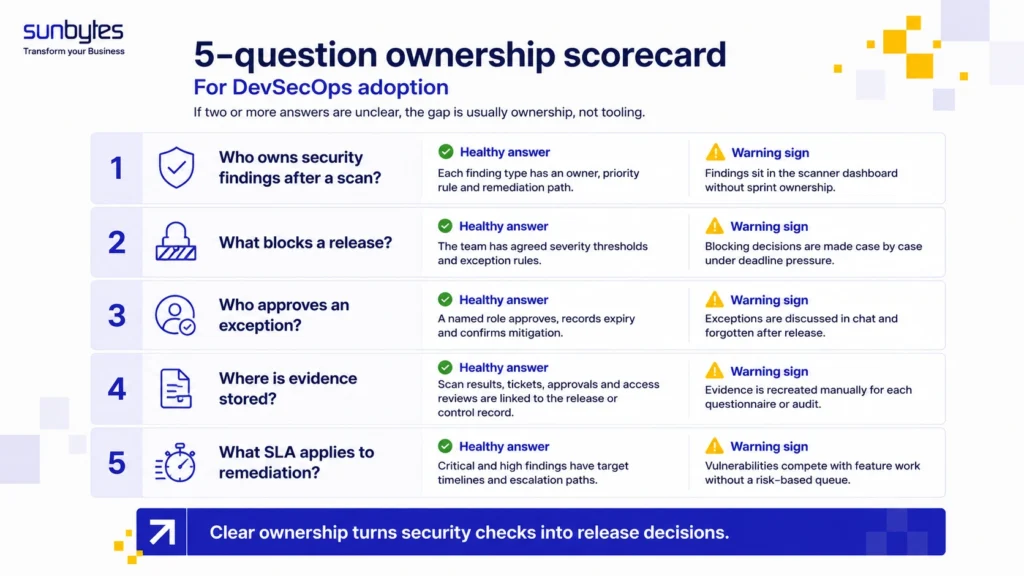
Use this scorecard before buying another tool. If two or more answers are unclear, the gap is usually ownership, not tooling.
| Question | Healthy DevSecOps answer | Warning sign |
|---|---|---|
| Who owns security findings after a scan? | Each finding type has an owner, priority rule and remediation path. | Findings sit in the scanner dashboard without sprint ownership. |
| What blocks a release? | The team has agreed severity thresholds and exception rules. | Blocking decisions are made case by case under deadline pressure. |
| Who approves an exception? | A named role approves, records expiry and confirms mitigation. | Exceptions are discussed in chat and forgotten after release. |
| Where is evidence stored? | Scan results, tickets, approvals and access reviews are linked to the release or control record. | Evidence is recreated manually for each questionnaire or audit. |
| What SLA applies to remediation? | Critical and high findings have target timelines and escalation paths. | Vulnerabilities compete with feature work without a risk-based queue. |
If DevOps is already working but this scorecard exposes gaps, the next step is not a larger tool stack. It is a clearer operating model.
Sunbytes can help define which controls belong in your pipeline, which belong with a dedicated DevSecOps engineer, and what evidence your next release should produce.
For teams that need extra delivery capacity, hire dedicated DevSecOps engineers through a model that can plug into your current engineering workflow.
How DevSecOps changes release ownership
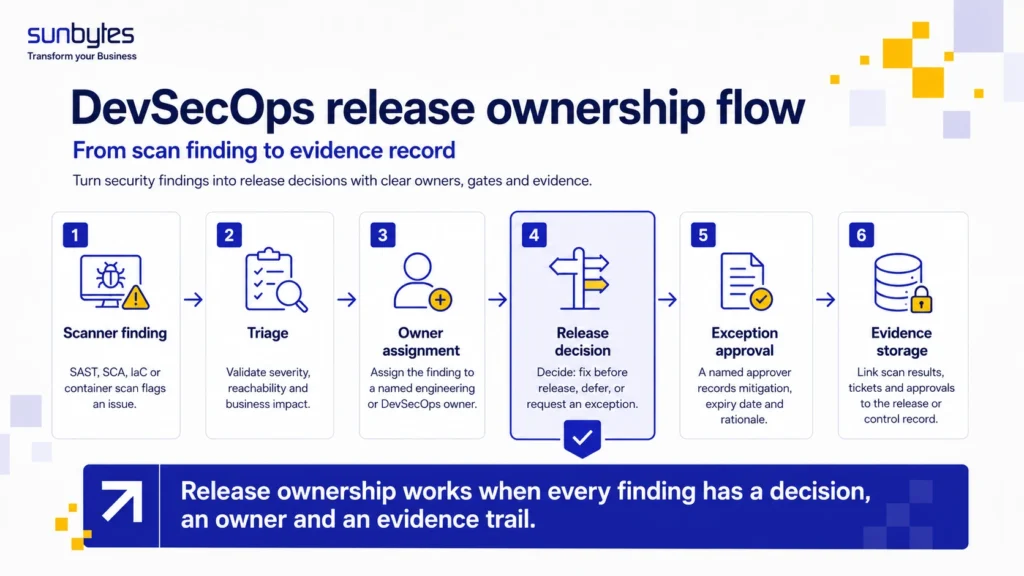
DevSecOps changes release ownership by making security decisions part of the release process, not a separate approval step at the end.
In DevOps, a release owner usually asks: did the build pass, did tests pass, is the deployment ready, and can we roll back? In DevSecOps, that owner also needs answers to four security questions:
- What security checks ran for this release?
- Which findings were accepted, fixed or deferred?
- Who approved any exception?
- Where is the evidence stored?
The release does not need to become slow. It needs to become traceable.
For example, a medium-severity dependency finding may not block a release if the vulnerable package is not reachable in production. But that decision should not live only in a Slack thread. It should be recorded in the ticket, linked to the release, assigned an expiry date and reviewed in the next sprint.
This is where DevSecOps becomes an operating model. Security gates are not only tool results. They are decisions with owners.
A practical release ownership model should define:
| Release control | Owner | Evidence |
|---|---|---|
| Dependency review | Engineering lead or DevSecOps engineer | SCA scan, affected package, remediation ticket |
| Code security finding | Developer owner plus reviewer | SAST finding, triage decision, pull request link |
| Infrastructure change | DevOps or platform owner | IaC scan, approval record, deployment log |
| Exception approval | Product, engineering or security owner depending on severity | Risk acceptance note, expiry date, mitigation plan |
| Post-release monitoring | Operations or platform team | Incident log, alert record, MTTR trend |
The DevSecOps pipeline guide goes deeper into where SAST, DAST, SCA, IaC scanning and evidence flow sit in CI/CD. This comparison article stays at the ownership level because that is where most adoption decisions succeed or fail.
If no one owns a finding, the tool has only created visibility. DevSecOps starts when visibility turns into a release decision.
DevOps vs DevSecOps cost and team impact
DevSecOps usually adds cost in three areas: tooling, engineering time and ownership. The return comes from reducing late rework, manual evidence collection and release risk.
The most common mistake is treating DevSecOps as a tool purchase. Tools matter, but they do not assign risk, approve exceptions or negotiate release trade-offs. People and process decide whether findings become action.
Here is the team impact to expect:
| Cost or impact area | DevOps baseline | DevSecOps change |
|---|---|---|
| Tooling | CI/CD, test automation, monitoring, incident tools | Adds SAST, SCA, container scanning, IaC scanning, secret detection or evidence storage |
| Developer workflow | Developers fix build and test issues | Developers also triage security findings linked to their code |
| Review cadence | Code review and release review | Adds risk-based security review and exception tracking |
| Training | Deployment, observability, incident response | Adds secure coding, vulnerability prioritisation and evidence discipline |
| Management visibility | Delivery speed and reliability | Adds risk status, remediation trend and evidence readiness |
| Hiring or support | DevOps/platform capacity | May require dedicated DevSecOps capacity or shared security engineering support |
A good DevSecOps adoption plan should protect delivery performance. That means tracking security improvements alongside DORA metrics. If the team adds security gates but lead time doubles, the gates may be too late, too manual or too broad. If change failure rate drops and critical findings are handled earlier, the model is working.
For teams planning the move, this DevSecOps implementation roadmap gives a 90-day sequence for adding controls without trying to rebuild the whole delivery process at once.
The hiring question usually appears next. If your engineering managers can define the controls but no one has time to own them, the issue becomes capacity. This guide to hiring DevSecOps engineers for EU companies explains how to evaluate the role, cost and team model.
The cost question should not be “Is DevSecOps cheaper than DevOps?” It should be “Which risks are now expensive enough to need ownership?”
How Sunbytes helps teams adopt DevSecOps without slowing delivery
DevSecOps adoption fails when security findings have visibility but no owner. Sunbytes helps Dutch and EU teams turn that visibility into release decisions by combining Transform delivery discipline with Secure-by-design controls: CI/CD security checks, exception rules, remediation queues and evidence records. Dedicated DevSecOps engineers can join your current workflow in 2–4 weeks, with ISO 27001 certified delivery and 4–5 hours of Amsterdam-Vietnam overlap.
If DevOps is already working but security evidence is still manual, the next step is not a new tool list. It is ownership. Sunbytes helps Dutch and EU teams add dedicated DevSecOps capability through Dedicated Remote Developers so security work becomes part of delivery, not a separate queue after release.
FAQs
The main difference is ownership. DevOps focuses on improving how software is built, released and operated. DevSecOps adds security checks, vulnerability ownership, exception approval and evidence into the same delivery workflow.
No. Security tools are only one part of DevSecOps. DevSecOps also needs owners, gates, remediation rules, exception handling and evidence storage. Without those, scanner output becomes another backlog instead of a release control.
DevOps is usually enough when the product has low release risk, limited personal data exposure and few customer security evidence requests. If your team can ship reliably, recover quickly and answer basic security questions without manual effort, a full DevSecOps operating model may not be urgent yet.
A team should adopt DevSecOps when security findings, evidence requests or release exceptions start affecting delivery. Common triggers include enterprise sales questionnaires, late security reviews, rising scanner noise, manual audit preparation and unclear vulnerability ownership.
DevSecOps can slow releases if controls are added late, manually or without prioritisation. A good implementation should move checks earlier and make decisions clearer. Track deployment frequency, lead time, change failure rate and time to restore to see whether controls are improving delivery or creating avoidable delay.
You may need a dedicated DevSecOps engineer when security work has become regular enough to need ownership. If developers are receiving findings but no one owns triage, remediation rules, exception approval or evidence, a dedicated role can reduce delivery friction.
NIS2 Article 21 requires in-scope essential and important entities to take appropriate and proportionate cybersecurity risk-management measures. DevSecOps can support this by turning secure development, vulnerability handling and evidence collection into repeatable engineering controls.
Let’s start with Sunbytes
Let us know your requirements for the team and we will contact you right away.