
DevSecOps means building security into the software delivery process from the first planning decision to production monitoring.
For EU tech leaders, the question is no longer only “what is DevSecOps?” It is whether your software delivery process can prove how security is handled before a release, during a release, and after a vulnerability is found.
That matters more in 2026 because NIS2, GDPR, vendor due diligence, and enterprise procurement are all pushing engineering teams toward documented security evidence. A CTO or IT Director does not need a bigger security slogan. They need to know where controls sit in the pipeline, who owns them, and what evidence the team can produce when a client or regulator asks.
TL;DR
DevSecOps is a software delivery approach that embeds security checks into every stage of development, instead of reviewing security once before release. It replaces late manual review with automated controls, shared engineering ownership, and evidence produced inside the CI/CD pipeline. For EU software companies, DevSecOps also supports NIS2 and GDPR readiness by creating a traceable record of access, vulnerabilities, remediation, and release decisions.
- DevOps focuses on fast and reliable delivery. DevSecOps adds security ownership and evidence to that delivery model.
- Security controls usually appear at code, build, test, deploy, operate, and monitor stages.
- Dutch companies preparing for the Cyberbeveiligingswet should treat July 2026 as a planning milestone, subject to the final parliamentary process.
- DevSecOps is a good fit when your team ships software, handles EU user data, serves enterprise clients, or falls under NIS2 scope.
- The first step is not buying a full tool stack. It is mapping your current pipeline and deciding which controls must be embedded first.
If you are still deciding whether to build, hire, or outsource this capability, Sunbytes’ guide to hiring DevSecOps engineers for EU companies explains the role, team model, and capability path in more detail.
DevSecOps definition: security embedded from day one
DevSecOps is the practice of integrating security into DevOps workflows so that security checks happen continuously across planning, coding, building, testing, release, deployment, operations, and monitoring. The practical shift is simple: security moves from a release gate to an engineering habit.
In a legacy model, a development team builds the feature, QA tests it, and a security review happens close to release. That model creates a common failure mode: the team discovers a vulnerable dependency, weak access rule, exposed secret, or misconfigured infrastructure when the release is already under time pressure.
DevSecOps changes the timing. At the code stage, static application security testing can flag insecure patterns before the merge. At the build stage, dependency scanning can detect known vulnerable packages. At the deploy stage, infrastructure-as-code scanning and dynamic testing can catch configuration or runtime issues before they reach production.
A simple example shows the difference. A developer commits code that uses a package with a known vulnerability. In a DevSecOps setup, the CI/CD pipeline detects the dependency risk and blocks the merge or creates a remediation ticket. In a late-review model, the same issue may ship to production, then appear later in a penetration test, vendor questionnaire, or incident review.
The point is to make security part of the delivery system, so the team does not depend on a single final review to catch what the pipeline could have detected earlier.
How DevSecOps works: the pipeline in practice
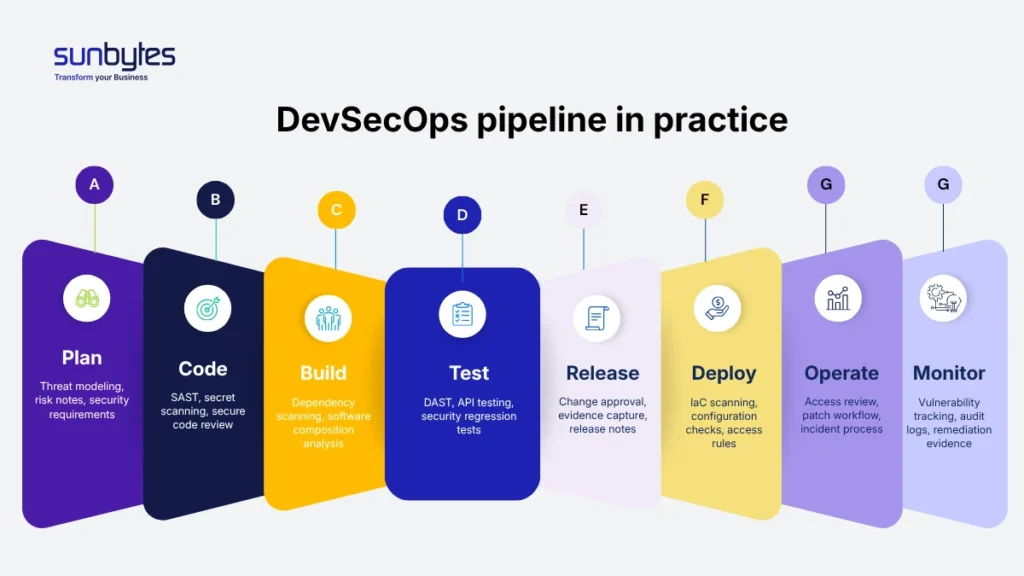
DevSecOps works by placing security controls inside the same pipeline that already moves software from idea to production. A useful way to see it is through the delivery flow: Plan, Code, Build, Test, Release, Deploy, Operate, and Monitor. Each stage has a different security job.
| Pipeline stage | What happens | DevSecOps control |
|---|---|---|
| Plan | Scope, architecture, acceptance criteria | Threat modeling, risk notes, security requirements |
| Code | Developers write and review code | SAST, secret scanning, secure code review |
| Build | Application and dependencies are packaged | Dependency scanning, software composition analysis |
| Test | Application is tested before release | DAST, API testing, security regression tests |
| Release | Release candidate is approved | Change approval, evidence capture, release notes |
| Deploy | Infrastructure and app are pushed live | IaC scanning, configuration checks, access rules |
| Operate | System is maintained in production | Access review, patch workflow, incident process |
| Monitor | Logs and alerts are reviewed | Vulnerability tracking, audit logs, remediation evidence |
The exact tools vary by stack. The categories matter more than the brand names: SAST tools, dependency scanners, DAST tools, secret scanning, infrastructure-as-code scanners, access management, logging, and vulnerability tracking.
For most teams, the first useful layer is not a complex security platform. It is a small set of controls that sit where engineers already work: pull requests, CI/CD builds, deployment checks, and operational reviews.
For a more detailed breakdown of how each stage works, the DevSecOps pipeline guide walks through the pipeline, tool categories, and control points in more depth.
DevSecOps vs DevOps: the key difference
DevOps improves delivery speed and reliability by connecting development and operations. DevSecOps keeps that delivery model, then adds security ownership and security evidence inside the same workflow.
The difference is not only culture. It is where the control sits.
| Dimension | DevOps | DevSecOps |
|---|---|---|
| Security ownership | Separate security team reviews before release | Engineers, security, and operations share ownership across the pipeline |
| Security timing | End of the pipeline, usually before release | Embedded at code, build, test, deploy, operate, and monitor stages |
| Compliance output | Manual audit trail assembled when needed | Evidence trail created as the pipeline runs |
| Vulnerability detection | Often after merge, release, or production | Earlier in pull requests, builds, and deployment checks |
This is why “DevSecOps” should not be reduced to “DevOps plus security tools.” A tool can scan code. It cannot decide who owns remediation, what blocks a release, how evidence is stored, or when access rights are reviewed.
If your team is comparing the two models before changing your delivery process, the full guide to DevOps vs DevSecOps: key differences and when to adopt should sit next in the reading path.
Why EU companies are adopting DevSecOps in 2026
EU companies are adopting DevSecOps because software delivery now has to produce evidence, not only working releases. Four forces are driving the shift.
- First, NIS2 Article 21 requires essential and important entities to take technical, operational, and organisational measures to manage cybersecurity risk. For software teams, the relevant question is how security is handled in development, maintenance, vulnerability handling, access control, incident response, and supplier risk. DevSecOps is one operating model for producing that evidence. It can show which vulnerabilities were found, when they were triaged, who remediated them, which access rights were reviewed, and what release decisions were made.
- Second, the Dutch Cyberbeveiligingswet is the national transposition of NIS2. For Dutch companies, enforcement is expected around July 2026, subject to the final parliamentary process. That date should be treated as a planning milestone, not a reason to wait. Software delivery controls take time to map, implement, test, and document.
- Third, GDPR Article 32 requires technical and organisational measures appropriate to the risk when personal data is processed. For software teams, that connects to access control, encryption, logging, vulnerability handling, incident response, and secure development. DevSecOps does not guarantee GDPR compliance by itself, but it helps produce the technical evidence a company may need to demonstrate how security is handled in delivery.
- The fourth driver is commercial. Enterprise buyers in the Netherlands, Germany, France, and other EU markets increasingly ask suppliers to prove how they handle secure development. Vendor due diligence questionnaires often ask for vulnerability management, access reviews, secure SDLC controls, incident response, and audit evidence. That is where DevSecOps becomes a business requirement. A team that can show its pipeline evidence can answer procurement faster. A team that has to rebuild the evidence trail manually will lose time every time a buyer, auditor, or board asks for proof.
If your company falls under NIS2 scope, the next article to read is DevSecOps and NIS2: what Dutch companies must do before July 2026.
Your pipeline, your compliance evidence, built in from sprint one. Sunbytes embeds security controls into software delivery and maps them to NIS2 Article 21 and ISO 27001, so your audit trail exists before the questionnaire arrives. Dedicated DevSecOps engineers can be operational in 2 to 4 weeks. Get a DevSecOps assessment.
Who needs DevSecOps, and who does not
DevSecOps applies when your company builds, changes, or operates software that carries business, client, or compliance risk. Use two questions to self-qualify.
- First: does your team build or ship software? This includes customer-facing SaaS products, mobile apps, APIs, internal tools, integrations, data platforms, and portals. If your business depends on software delivery, DevSecOps is relevant.
- Second: does that software handle EU personal data, serve enterprise clients, connect to regulated workflows, or fall under NIS2 scope? If yes, security evidence becomes part of the delivery requirement.
Most CTOs assume DevSecOps requires a full in-house security team. That is not always true. A five-engineer product team can start with SAST, dependency scanning, secret scanning, and access review discipline before hiring a dedicated security engineer. The operating model matters more than team size.
DevSecOps may not be a priority for a non-technical company with no software delivery pipeline, no custom integrations, and no meaningful role in handling digital services or personal data. In that case, general IT security controls may matter more than engineering pipeline controls.
The boundary is delivery. If you ship software, you need security inside delivery. If you only consume standard software with no development pipeline, DevSecOps is probably not the first model to implement.
How to get started with DevSecOps
The first DevSecOps step is a baseline assessment, not a tool purchase.
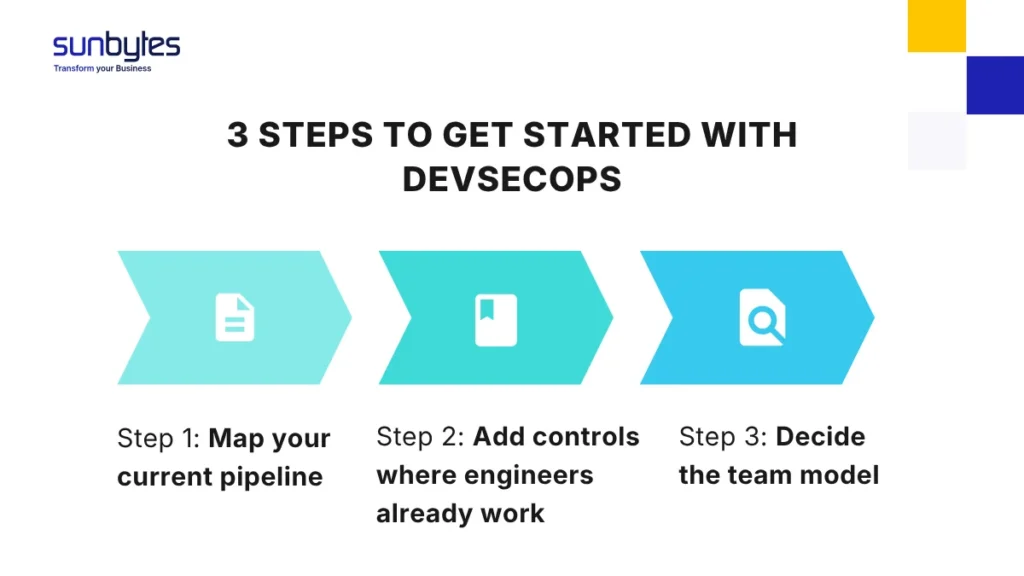
Step 1: Map your current pipeline
Start with the actual path from requirement to production. Identify where work is planned, where code is reviewed, how builds run, how releases are approved, how infrastructure changes are made, and how incidents are tracked.
Then mark the security gaps. Common gaps include no dependency scanning, no secret scanning, no access review, no vulnerability ownership, and no clear release-blocking rules.
The OWASP DevSecOps Maturity Model can be useful here because it helps teams assess and prioritise security activities across the development cycle.
Step 2: Add controls where engineers already work
Do not start by adding every security tool available. Start with controls that fit the current CI/CD workflow. For many teams, the first layer is:
- SAST in code review
- dependency scanning during build
- secret scanning before merge
- DAST in testing
- infrastructure-as-code checks before deployment
- quarterly access reviews in operations
The rule is simple: add the control at the point where the team can still fix the issue without reopening a finished release.
Step 3: Decide the team model
Once the first controls are visible, decide who owns them. There are three common paths. You can build DevSecOps capability in-house, hire dedicated DevSecOps engineers, or outsource part of the function through a dedicated team model.
The right choice depends on two conditions: how much security ownership already exists internally, and how fast the company must produce evidence for clients, auditors, or board review.
If you already have strong DevOps and security leadership, in-house build may work. You have product engineers but no security ownership, a dedicated DevSecOps engineer can add capability faster. If you need implementation and evidence support across several workstreams, an outsourced or hybrid model may reduce ramp-up risk.
Teams comparing hiring, outsourcing, and hybrid ownership can use in-house vs outsourced DevSecOps as the next decision guide. If the hiring path is already clear, the follow-up guide on how to hire a DevSecOps engineer: roles, skills, interview questions goes deeper into job scope and evaluation.
How Sunbytes helps EU teams build DevSecOps capability
DevSecOps only works when delivery ownership, security control, and people access are handled as one system. A scanner can flag a vulnerable dependency. It cannot decide who remediates it, whether the release is blocked, or how the evidence is stored for the next audit.
Sunbytes helps EU teams build that system through Digital Transformation Solutions, supported by Secure and Accelerate. Transform layer embeds controls into real delivery workflows: code review, CI/CD, release management, monitoring, and documentation. The Secure layer maps those controls to ISO 27001, NIS2 Article 21, GDPR Article 32, and vendor due diligence evidence. The Accelerate layer helps add DevSecOps capability when internal teams need experienced engineers without rebuilding the whole function.
Sunbytes is headquartered in the Netherlands with a delivery hub in Vietnam. Delivery is ISO-guided, DORA-tracked from sprint one, and supported by ISO 27001 certification and signed DPA expectations where applicable. Talk to our DevSecOps delivery team.