
Most teams comparing IT staff augmentation and nearshoring options are really asking two separate questions at once: who manages the work, and where is the team located. Treating that as a single decision is what causes the wrong vendor to get picked.
Staff augmentation is an ownership model. It defines who directs daily work, who owns code quality, and who is accountable when a sprint slips. Nearshoring is a location strategy. It defines time zone overlap and travel distance, nothing else. A Dutch CTO can run a fully nearshored team with weak ownership and still miss deadlines. A Dutch CTO can also run an offshore augmented team with disciplined ownership and a structured 4-5 hour overlap window and hit every sprint commitment.
This article separates the two decisions, gives a 2×2 model for comparing them, and ends with a recommendation by use case rather than a regional preference.
TL;DR
IT staff augmentation nearshoring is not one decision. Staff augmentation determines who owns and directs the work; nearshoring only determines how close that team sits to your time zone. The two can be combined (nearshore augmentation) or split (offshore augmentation with a structured overlap window), and the right combination depends on how much real-time collaboration your team needs, not on geography alone.
- Staff augmentation = ownership model. Nearshoring = location strategy. They answer different questions and should be decided separately.
- A nearshore team with unclear ownership fails the same way an offshore team does: through ambiguous decision rights, not distance.
- A 4-5 hour overlap window, structured around async handoffs and ISO-guided delivery, can replace full-day nearshore overlap for most product and engineering work.
| Situation | Better default | Why |
|---|---|---|
| You need full-day live collaboration across product, QA, and release coordination. | Nearshore augmentation | The overlap premium pays for real synchronous dependency. |
| You need senior build capacity for defined engineering work. | Offshore augmentation with structured overlap | A 4-5 hour overlap window is enough when decisions, specs, and review ownership are documented. |
| You want the vendor to own scope, planning, and delivery acceptance. | Outsourcing or managed dedicated team | Staff augmentation keeps ownership inside your team. |
| You need to reduce cost without losing delivery control. | Vietnam staff augmentation | The savings comes from labor economics, not from lowering delivery standards. |
Staff augmentation vs nearshoring: the direct answer
Staff augmentation and nearshoring solve different problems, and the article that compares them as if they were competing options is asking the wrong question.
IT staff augmentation means a vendor supplies engineers who work inside your existing team, under your processes, reporting into your engineering management. The vendor handles sourcing, employment, and often payroll. You retain architectural decisions, sprint planning, and code review. Nearshoring means the team, whatever its ownership model, sits in a time zone close enough to overlap with your working hours for most of the day. The two terms describe independent variables: one is about who runs the work, the other is about when the work happens relative to your calendar.
The confusion happens because some providers sell “nearshore staff augmentation” as a single bundled product, in markets like Poland or Romania for Dutch buyers. That bundling makes sense commercially, but it hides the fact that you are making two decisions, not one. A team in Krakow can be staff-augmented (you direct daily work) or outsourced (the vendor directs daily work and delivers outcomes). A team in Vietnam can be the same. Location does not determine ownership model, and ownership model does not determine location.
Model decision: who owns the work
The model decision comes down to one question: who is accountable when a deliverable is late or wrong. In staff augmentation, you are. In outsourcing or a managed dedicated team, the vendor is within the scope they agreed to deliver.
This matters more than location because ownership ambiguity is the single most common cause of failed engagements, regardless of where the engineers sit. A team that is nominally “augmented” but actually waits for vendor-side leads to make technical calls is not augmented in practice. It is an outsourced team wearing an augmentation label, and the client ends up paying for control they never actually have.
| Question | Staff augmentation answers this | Nearshoring answers this |
|---|---|---|
| Who assigns daily tasks? | Yes, client engineering lead | No, location has no bearing on this |
| Who owns architecture and code review? | Yes, client owns the final call | No |
| What time zone overlap will the team have? | No, augmentation can be nearshore or offshore | Yes, defines overlap hours with client working day |
| Who is accountable for a missed deadline? | Yes, client absorbs schedule risk | No |
| What does it determine instead? | Decision rights and daily control | Travel distance and live collaboration window |
A practical check before signing: ask who runs the daily stand-up. If the answer is “the vendor,” the engagement is functioning as outsourcing regardless of what the contract calls it. If the answer is “us, with the vendor’s engineers in the room,” it is staff augmentation. Get this right before the location conversation starts, because fixing an ownership mismatch after the team is staffed costs more than getting it right at the start: rework on a misaligned engagement typically adds 30-40% to the original delivery estimate, since the client has to retroactively rebuild the decision trail the vendor should have been following from day one.
For a deeper breakdown of the augmentation-vs-outsourcing decision itself, including a full CTO decision framework, see our guide on choosing between IT staff augmentation and outsourcing.
Need help deciding who should own daily delivery before you pick a region? Talk to us about your team design and we’ll walk through ownership, overlap, and cost together.
Location decision: how much overlap matters
Once the model is fixed, the location decision reduces to a single practical question: how many real-time overlap hours does your team actually need, and for what.
Full nearshore overlap (6-8 working hours) matters most for roles with constant cross-team dependency: a product manager running daily refinement sessions, a QA lead coordinating release windows with client-side ops, or any role where Slack-and-wait async communication would create a same-day bottleneck. For most backend, frontend, and DevOps engineering work, a 4-5 hour overlap window is enough, provided the team structures async handoffs around it: end-of-day documentation, recorded decisions, and a clear single point of contact on each side.
A Dutch team working with a Vietnam-based delivery partner typically gets a 4-5 hour overlap window depending on the time of year (CET is UTC+1/+2, Vietnam is UTC+7), concentrated in the Dutch morning and Vietnam afternoon. That is enough time for a daily stand-up, a blocking-issue sync, and a same-day escalation path. What it is not enough for is a model where every architectural decision requires a live conversation before work continues; if your delivery process depends on that, the overlap gap will surface as missed days, not missed hours.
If the region choice itself, rather than the overlap-hours question, is still open, our comparison of IT staffing in Southeast Asia versus Eastern Europe breaks down Vietnam, Poland, and Romania specifically on cost, quality, and timezone fit.
Cost and quality trade-offs
Cost differences between nearshoring and offshore augmentation are real, but they are driven by labor market economics, not by a quality gap tied to distance.
The Netherlands had roughly 7% of its workforce employed as ICT specialists in 2024, ahead of the EU average of 5%, according to the European Commission’s Digital Decade 2025 report. The EU as a whole still sits far below its own 2030 target of 20 million ICT specialists, with around 10.3 million in post as of 2024. That gap between demand and supply keeps Dutch developer compensation high relative to the rest of the EU.
Backend and full-stack developer salaries in the Netherlands typically range from roughly €59,000 for an entry-level engineer to around €96,000 for a senior engineer with 8+ years of experience, according to 2026 salary benchmark data from ERI SalaryExpert, before employer costs and benefits are added.
Eastern European nearshore rates (Poland, Romania) usually land 30-50% below Dutch in-house cost for an equivalent senior role. Vietnam-based offshore rates typically land a further 20-30% below Eastern European nearshore rates for comparable seniority, reflecting both regional cost of living and currency differences, not a difference in delivery standard.
The quality variable that actually matters is not geography. It is whether the delivery process includes ISO-guided documentation, code review discipline, and measurable delivery tracking, regardless of where the engineers sit. DORA’s four key metrics, deployment frequency, lead time for changes, change failure rate, and time to restore service, give a team-agnostic way to verify delivery quality on any engagement, nearshore or offshore. A nearshore team without DORA tracking is not inherently safer than an offshore team with it.
| Cost driver | Netherlands in-house | Eastern Europe nearshore | Vietnam offshore |
|---|---|---|---|
| Senior developer relative cost | Baseline | 30-50% below NL | 50-65% below NL |
| Typical overlap with NL working hours | Full day | Full day | 4-5 hours |
| Hiring lead time | Often 8-12+ weeks given current shortage | 4-8 weeks via partner | 2-4 weeks via dedicated team partner |
| Delivery risk driver | Internal hiring capacity | Vendor process maturity | Vendor process maturity + overlap discipline |
The hidden cost most comparisons miss is rework from unclear ownership, covered in the model-decision section above, not the headline day rate. A cheaper hourly rate paired with heavy correction overhead is not actually cheaper once the rework percentage is factored in.
Note: These ranges are 2026 planning estimates for Dutch tech teams comparing in-house, nearshore, and Vietnam-based augmentation options. They assume senior full-time engineering capacity, standard working-week availability, and a defined delivery scope. They exclude VAT, unusual tooling costs, 24/7 support, rare niche premiums, and scope changes outside the agreed role. Final vendor rates should be compared only after role seniority, overlap needs, access level, onboarding support, and replacement terms are defined.
When nearshore augmentation works best
Nearshore augmentation fits best when your engagement genuinely depends on synchronous collaboration for most of the working day, and when the cost premium over offshore is acceptable given that dependency.
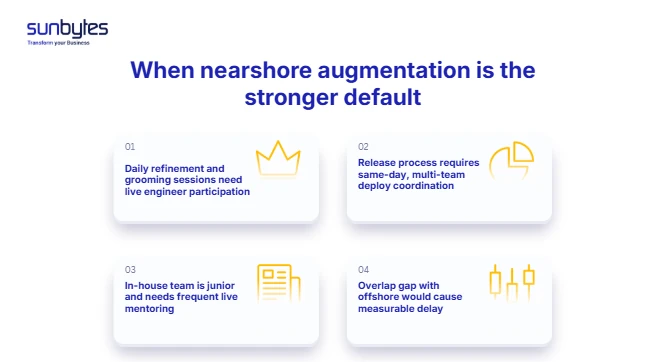
Specific conditions where nearshore is the stronger default: your product team runs daily refinement and grooming sessions that need live participation from engineers, not just the engineering lead. Your release process requires same-day, multi-team coordination during deploy windows. Your in-house team is junior or newly formed and needs frequent live mentoring from senior augmented engineers rather than async code review. In each of these cases, the overlap gap with an offshore team would create a measurable delay, not just an inconvenience, and the nearshore premium is paying for a real operational need.
Nearshore augmentation is a weaker fit when the actual workflow is closer to defined-ticket, async-friendly engineering: well-scoped feature work, API development against an agreed spec, or QA automation against existing test plans. Paying the nearshore premium for work that does not require full-day live collaboration is the most common cost inefficiency teams report once they audit a nearshore engagement after 6-12 months.
When can offshore augmentation work better
Offshore augmentation, including Vietnam-based delivery, works well when the team has structured its process around a defined overlap window rather than trying to replicate full-day nearshore collaboration with a shorter clock.
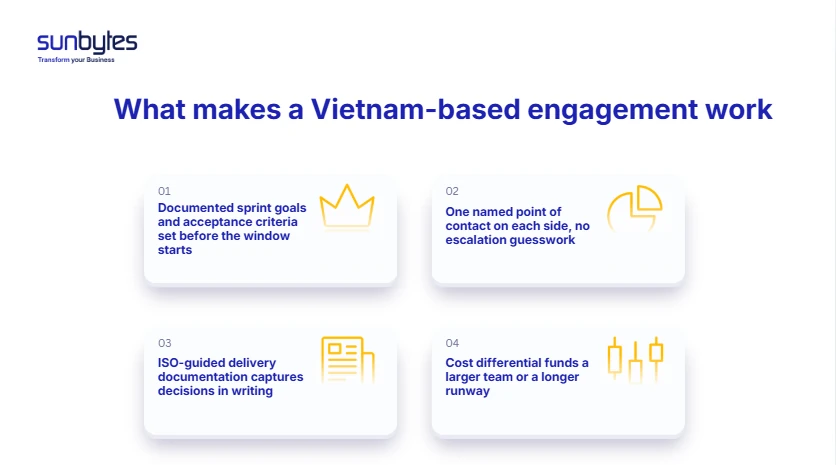
The conditions that make this work: documented sprint goals and acceptance criteria before the overlap window starts, so the live hours are used for blockers and decisions rather than status updates. A single named point of contact on each side, so escalation does not depend on whoever happens to be online. ISO-guided delivery documentation that captures architectural decisions in writing, so context is not lost between one overlap window and the next.
Under those conditions, a 4-5 hour Dutch-Vietnam overlap window is sufficient for most backend, frontend, mobile, and DevOps engineering work, and the cost differential funds either a larger team or a longer runway for the same budget.
Offshore augmentation is a weaker fit when the client team has no spare capacity to run that async discipline themselves, when the work involves heavy, ambiguous discovery rather than defined build tasks, or when data residency or specific compliance review requirements make remote document handling itself a blocker rather than a process detail.
Our guide to IT staff augmentation from Vietnam covers the delivery-specific detail Dutch teams ask about most. That last condition deserves its own evaluation, covered next, because it applies regardless of which region the team sits in.
This is not a case for one region over another. The recommendation is conditional: pick nearshore when synchronous collaboration is structurally required, and pick offshore augmentation when the workflow is async-compatible and the cost or capacity benefit outweighs the shorter overlap window. Most product engineering work fits the second category more often than teams initially assume, simply because they have not yet tested how much of their “we need to be online together” assumption is habit rather than requirement.
How Sunbytes structures dedicated teams
Nearshore is a location choice. Staff augmentation is an ownership choice. Treating them as one decision is what leads Dutch teams to pick a region before they have actually decided who should run the work.
At Sunbytes, we design the ownership model first: who directs daily work, who owns architectural sign-off, who is accountable for the sprint. Only after that is settled do we discuss region and overlap.
For teams that land on augmentation as the right model, Sunbytes gives Dutch companies access to dedicated senior engineering capacity from our Vietnam delivery hub, with a structured 4-5 hour NL-VN overlap window, ISO-guided delivery documentation, and DORA-tracked outcomes from sprint one. Teams are typically operational within 2-4 weeks of a signed scope, across Digital Transformation Solutions engagements built on the same delivery discipline.
Where the engagement also requires secure handling of employee or customer data across the Dutch-Vietnam boundary, our Cybersecurity Solutions team maps the GDPR Article 28 and Article 46 requirements into the contract before the team starts, and where ramp-up requires bringing additional senior talent into an existing structure quickly, our Accelerate Workforce Solutions team handles the sourcing and onboarding logistics behind the scenes.
If you are weighing this model decision for your own team, you can hire dedicated software development teams from Sunbytes and walk through the ownership and region questions together before you commit to either.
FAQs
Usually, yes, but only if ownership is clear from the start. The headline hourly rate is lower offshore, and that gap holds up in practice as long as task assignment, architecture sign-off, and acceptance criteria are documented rather than assumed. Where teams lose the savings is rework from unclear ownership, which typically adds 30-40% to the original estimate and applies equally to nearshore and offshore engagements with the same gap.
Yes. Staff augmentation can be nearshore, offshore, or local because augmentation describes the ownership model, not the location. Nearshore staff augmentation means the vendor supplies engineers in a nearby time zone while your team still directs daily work, architecture decisions, and sprint priorities.
Most Dutch-Vietnam engagements run a 4-5 hour overlap window, covering the Dutch morning and the Vietnam afternoon. That is sufficient for daily stand-ups, blocker resolution, and same-day escalation on backend, frontend, and DevOps work. Roles requiring constant live coordination, such as a product manager running multiple daily sessions, need a larger overlap window or a nearshore location instead.
It creates an extra step, not necessarily extra risk. Article 28 GDPR requires a Data Processing Agreement with any processor handling personal data, regardless of location. Because Vietnam does not have an EU adequacy decision, transfers there also need a GDPR Article 46 safeguard, typically Standard Contractual Clauses. Eastern European nearshore providers inside the EU/EEA do not need that additional clause, since intra-EEA transfers are already covered.
For a Vietnam-based dedicated senior team under an ISO-guided delivery process, 2 to 4 weeks is a realistic operational timeline from signed scope to a working team in your sprint cycle. Eastern European nearshore timelines are typically comparable or slightly longer depending on local hiring market conditions at the time.
Let’s start with Sunbytes
Let us know your requirements for the team and we will contact you right away.