

A security-first engineering culture is an operating model in which developers can see who owns a security decision, when a review is required and where the result must be recorded. It is not a slogan, a yearly course or a request for every engineer to become a security specialist.
That distinction matters across locations. A pull request may be opened in one time zone, reviewed in another and released by a third person. Security context belongs in the same tickets, reviews and decision records used for delivery.
This guide shows technology leaders how to define that model and assess whether a distributed engineering partner can work inside it.
TL;DR
A security-first engineering culture makes secure behavior observable in every sprint. Distributed teams need named decision owners, risk-based review rules, documented exceptions and recurring checks. An external team can perform reviews and remediation work, but the client should retain authority over risk acceptance, release policy and product priorities.
- Assign one accountable owner to each security decision, even when several people contribute.
- Put risk reviews, triage decisions and exceptions in delivery systems rather than private messages.
- Measure whether the agreed behavior happens consistently, then check whether it adds delay or rework.
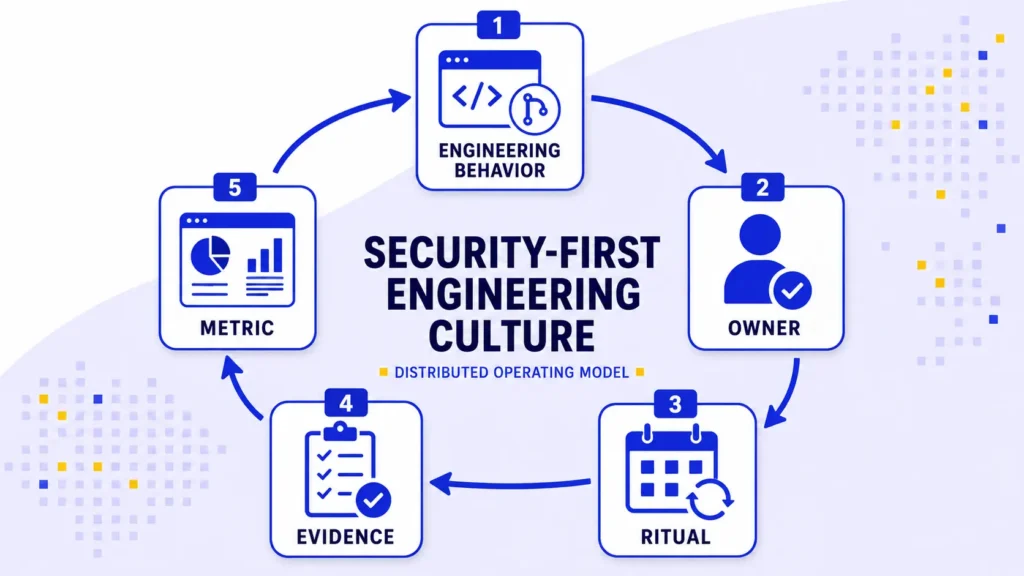
What security-first engineering culture looks like in practice
Security-first engineering culture is visible when a developer knows the required action before release, with evidence in the pull request, work item or risk record.
This is the cultural part of what DevSecOps means for EU technology leaders: responsibility moves into delivery work while specialist authority remains clear. The NIST Secure Software Development Framework gives producers and purchasers a common vocabulary for secure development.
| Delivery point | Visible engineering behavior | Evidence to retain |
|---|---|---|
| Planning | A high-risk story receives a short threat review before implementation. | The work item records the asset, likely misuse case and review owner. |
| Pull request | Risk labels trigger the agreed reviewer or control. | The approval, finding and remediation decision remain attached to the change. |
| Vulnerability triage | Severity, exploitability and product context determine the next action. | The ticket has an owner, due date and release effect. |
| Risk exception | An authorised person accepts a defined risk for a limited period. | The record includes rationale, compensating control, expiry date and approver. |
| Release | The release decision follows the published rule for unresolved findings. | The release record links to checks, approvals and any valid exception. |
Low-risk work can follow automated rules. Human review should focus on architecture changes, sensitive data paths, new trust boundaries and findings that could change a release decision. The tooling belongs in the DevSecOps pipeline stages and controls guide; culture determines whether people apply those controls consistently.
Why distributed teams need explicit security rituals
Distributed teams need explicit rituals because informal context does not travel reliably across time zones or organisations. A written rule lets the next engineer continue without reconstructing the decision.
Write decisions for the next time zone
A security handoff should state the risk, owner, next action and deadline. “Security is checking this” is not a handoff. “AppSec reviews the authentication change by 14:00 CET; release stays blocked until the ticket records approval or an exception” is actionable. Use chat for alerts; keep the durable record beside the engineering work.
Reserve live overlap for decisions, not status reporting
Use shared hours for disputed severity, a new threat path or an exception that changes release risk. Routine status can stay asynchronous. A recurring 30-minute triage window is more useful than another general security meeting.
Keep accountability internal when execution is external
External engineers can run reviews, collect evidence and remediate findings. The client should name who approves risk criteria, exceptions and release policy. NIS2 Article 21 covers supply-chain relationships, secure development, vulnerability handling and control-effectiveness checks, including third-party maintenance.
Access, repository context and first-quarter milestones belong in a separate remote DevSecOps onboarding plan. This article covers the habits that continue after onboarding.
Roles that make security culture operational
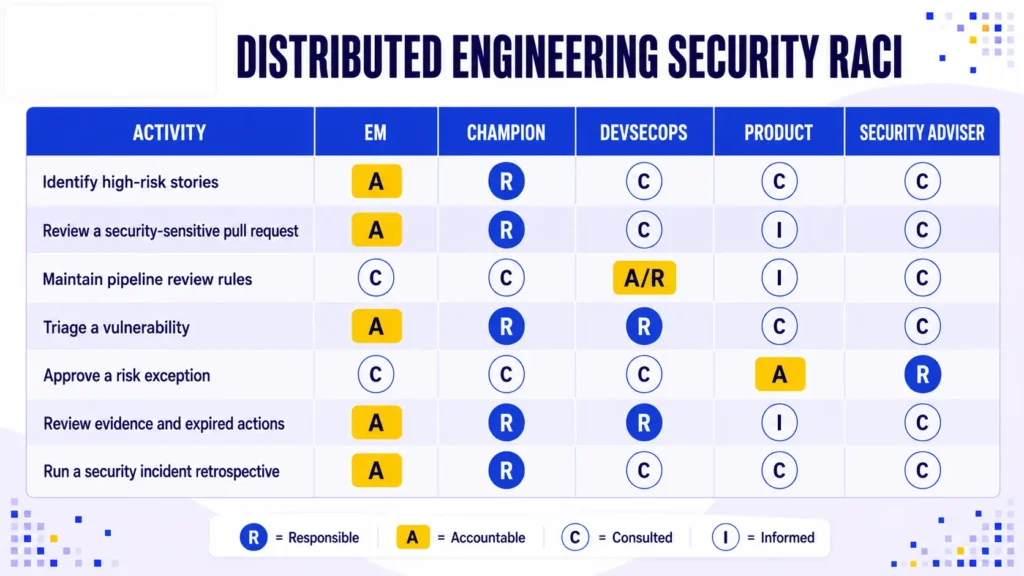
Five roles can make distributed-team decisions explicit: Engineering Manager, security champion, DevSecOps engineer, Product Owner and security adviser. Each activity needs one accountable role.
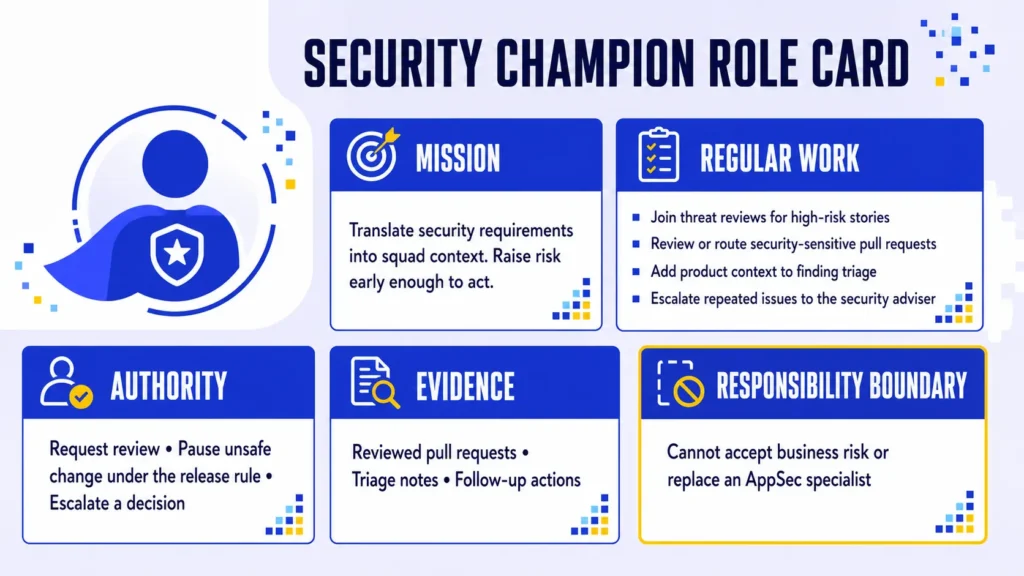
Security champion role card
Mission: translate security requirements into squad context and raise risk early enough to act.
Regular work:
- Join threat reviews for high-risk stories.
- Review or route security-sensitive pull requests.
- Add product context to finding triage.
- Escalate repeated issues to the security adviser.
Authority: request a review, pause an unsafe change under the release rule and escalate a decision. A champion cannot accept business risk or replace an AppSec specialist.
Evidence: reviewed pull requests, triage notes and follow-up actions.
RACI for distributed engineering security decisions
| Activity | EM | Champion | DevSecOps | Product | Security adviser |
|---|---|---|---|---|---|
| Identify high-risk stories | A | R | C | C | C |
| Review a security-sensitive pull request | A | R | C | I | C |
| Maintain pipeline review rules | C | C | A/R | I | C |
| Triage a vulnerability | A | R | R | C | C |
| Approve a risk exception | C | C | C | A | R |
| Review evidence and expired actions | A | R | R | I | C |
| Run a security incident retrospective | A | R | C | C | C |
The Product Owner is accountable for an exception only when that authority is delegated. If a CISO or risk committee owns acceptance, update the matrix. External engineers cannot accept client risk without written authority.
Rituals to embed security into sprint rhythm
Security culture becomes repeatable when the team gives each ritual a trigger, timebox, output and owner. A small calendar is easier to maintain than a long programme of meetings.
| Cadence | Ritual and timebox | Required output | Primary owner |
|---|---|---|---|
| Per high-risk story | Threat review, 15-30 minutes | Threat note, required control and reviewer | Security champion |
| Per flagged pull request | Risk review before merge | Approval, remediation request or escalation | Engineering Manager |
| Weekly | Vulnerability triage, 30 minutes | Owner, due date, release effect and escalation | DevSecOps engineer |
| Monthly | Exception and evidence review, 60 minutes | Expired exceptions closed; sample evidence checked | Engineering Manager |
| Monthly | Champion forum, 45 minutes | Repeated patterns and one agreed team action | Security adviser |
| Quarterly | Incident tabletop, 60-90 minutes | Decision gaps, owners and dated follow-up actions | Security adviser |
The calendar is a starting design, not a benchmark. Small teams may combine monthly reviews; multi-squad platforms may need separate forums. Change cadence after checking decision delay and missing evidence.
Teams introducing several practices at once should sequence them through a DevSecOps implementation roadmap rather than turning every control into an immediate release gate.
How to evaluate a distributed engineering partner’s security culture
A distributed partner supports a security-first culture only when its engineers work inside your decision system. Policies and certifications do not prove that a finding will reach the correct owner before release.
| Evaluation question | Strong evidence | Red flag |
|---|---|---|
| Who can block or approve a release? | Named client owner and written release rule | “Security is everyone’s responsibility” with no authority map |
| How are high-risk changes identified? | Agreed labels, triggers and required reviewers | Review depends on an engineer remembering to ask |
| Where are findings and decisions stored? | Records remain in the client’s delivery or risk system | Decisions stay in private chat or provider-only tools |
| How are exceptions controlled? | Named approver, rationale, compensating control and expiry | Permanent acceptance with no review date |
| How is distributed coverage handled? | Response expectations, escalation path and overlap window | No owner is available when a release decision is needed |
| What happens when the team changes? | Runbooks, decision history and evidence remain accessible | Security knowledge sits with one provider engineer |
The DevSecOps as a Service guide explains how managed support differs from team capacity. In a dedicated team, internal managers retain architecture, product and risk decisions while external engineers own agreed execution.
Need DevSecOps capacity without transferring release authority? Hire dedicated remote developers who can work inside your repositories, rituals and evidence process while your internal leaders keep control of product and risk decisions.
Metrics that show culture is working
Culture metrics should test whether the agreed behavior happens and improves decisions. Start with one application, set an internal baseline and review it monthly.
| Metric | Calculation | Useful control target |
|---|---|---|
| High-risk review coverage | Reviewed high-risk changes ÷ all tagged high-risk changes | 100% of changes covered by the published rule |
| Triage latency | Median time from finding to owned decision, split by severity | Within the team’s documented severity SLA |
| Critical finding age | Days open for unresolved critical findings | No item beyond SLA without a valid exception |
| Exception integrity | Exceptions with owner, approval, compensating control and expiry ÷ total exceptions | 100% complete records |
| Evidence completeness | Sampled high-risk releases with linked review and decision evidence ÷ sample size | No missing evidence in the monthly sample |
| Repeat finding rate | Recurring findings of the same root cause ÷ total findings | Downward trend after corrective work |
The OWASP Software Assurance Maturity Model provides a measurable improvement path across the software lifecycle. NIST SSDF adds outcome-based practices. Neither prescribes one threshold for every company.
Use delivery metrics to detect security work that creates delay. DORA’s current five metrics are change lead time, deployment frequency, failed deployment recovery time, change fail rate and deployment rework rate. Measure one service in context rather than ranking unrelated teams.
A good result is consistent review coverage, faster owned decisions, fewer expired risks and no rise in delivery rework.
How Sunbytes supports security-first distributed engineering
Sunbytes adds dedicated engineering capacity while the client retains product direction, risk acceptance and release authority. Netherlands-based accountability combines with a Vietnam delivery hub and four to five hours of working-time overlap for live decisions.
Dedicated DevSecOps engineers work in the client’s repositories, ticket flows and review rituals. Sunbytes supports DPA requirements, evidence routines and DORA-tracked signals, backed by its ISO 27001 certification. Teams are typically operational within two to four weeks when access and decision owners are ready.
In the TeamViewer dedicated-team case, Sunbytes formed an eight-person team that integrated with the internal development organisation. Regular code review became part of daily work while TeamViewer retained its standards and priorities.
If your assessment shows missing DevSecOps capacity rather than missing internal authority, talk to Sunbytes about dedicated remote developers. Start by defining the decisions the engineer may make, the decisions that stay internal and the evidence your team must retain.