

Vietnam is a delivery-fit decision before it is a rate decision. For European companies, IT staff augmentation from Vietnam works when internal product ownership is strong, senior external engineers can enter an existing delivery system, and the working day creates enough shared time for decisions.
The location is a poor fit when the buyer expects continuous real-time collaboration or has no one available to direct the work. This guide tests the operating model first, then covers the cost, security and regional factors that affect the final decision.
TL;DR
IT staff augmentation from Vietnam means adding Vietnam-based engineers to a European company’s existing team while the European buyer keeps control of priorities, architecture and releases. The model fits teams that can manage delivery across a planned 4-5 hour overlap window and want to start with one FTE before scaling to a multi-role team.
- Vietnam works best when the European company already owns the roadmap, backlog and technical decisions.
- A 4-5 hour shared window can support stand-ups, pull request reviews and escalation when both teams design their schedules around it.
- GDPR, IP ownership and access control must be settled before an engineer receives production or personal-data access.
- A pilot should scale only after delivery signals show that the first engineer is reducing backlog pressure without increasing review load.
Best fit: a European product team with an active roadmap, internal delivery leadership and a defined capacity or skills gap.
Watch out for: weak documentation, unclear decision rights and a meeting-heavy process that depends on full-day overlap.
What IT staff augmentation from Vietnam means
IT staff augmentation from Vietnam is a delivery model in which Vietnam-based specialists join a European company’s existing team for a defined period. The provider handles sourcing, employment administration and continuity; the buyer directs the work inside its own backlog, toolchain and engineering process.
That ownership boundary separates staff augmentation from project outsourcing. The buyer keeps priorities, architecture direction, acceptance criteria, code ownership and release approval. The setup may begin with one backend engineer, QA specialist or DevOps engineer, then grow into a multi-role dedicated team when the roadmap requires it.
Sunbytes’ IT staff augmentation complete guide explains the wider differences between staff augmentation, dedicated teams and outsourcing. This article stays with the narrower question: whether Vietnam is the right delivery location for a European team.
Why European companies consider Vietnam
European companies consider Vietnam because it adds a sizeable software and IT-services workforce to their hiring options without moving product ownership outside Europe. The useful advantage is variable capacity, not a cheap-rate promise.
The European talent pool is large. Eurostat reported 10.45 million ICT specialists in the EU in 2025, equal to 5.0% of employment. Yet a large pool does not make every senior role available when a roadmap needs it.
Vietnam adds another supply market. Vietnam’s Ministry of Science and Technology reported 12,500 software firms, 224,000 software workers and 84,000 IT-services workers in its 2024 figures. Provider vetting still has to confirm seniority, English communication and role fit.
In Sunbytes’ Netherlands-Vietnam model, senior Vietnam-based engineers are typically 40-60% more cost-effective than Netherlands-based equivalents at a similar experience level. The saving disappears when a European tech lead spends the week rewriting tickets or waiting for decisions.
The European IT staff augmentation cost guide covers rate and budget mechanics in detail. For a Vietnam delivery-fit decision, use cost as a filter only after role seniority, management load and expected sprint contribution are defined.
The 4-5 hour overlap rule
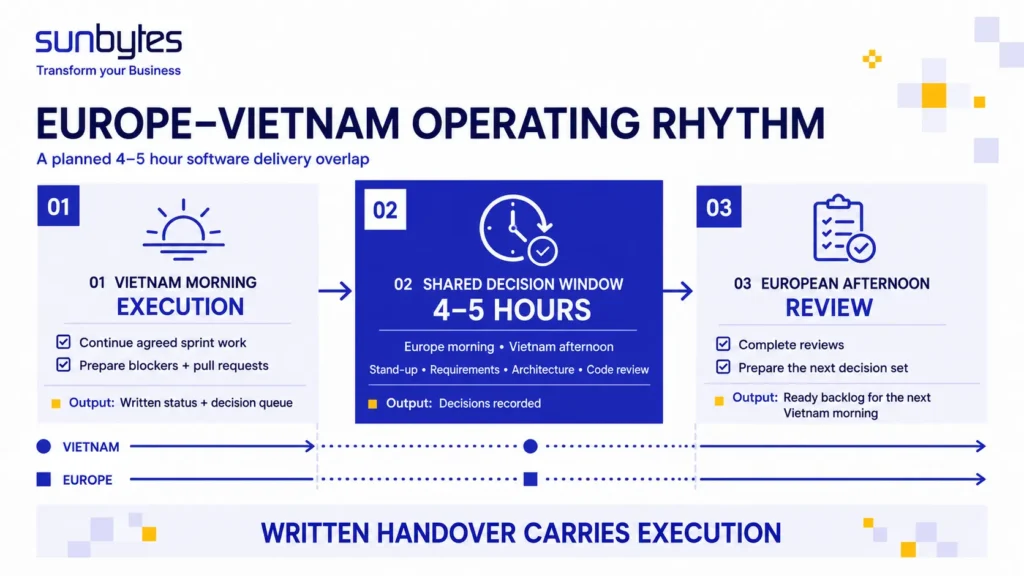
A 4-5 hour overlap is enough for a European-Vietnam augmented team when the shared window is reserved for decisions and review. It is not enough when the process expects every conversation to happen live.
Vietnam operates on UTC+7 throughout the year. European time zones and daylight-saving changes alter the natural overlap. Sunbytes uses a planned 4-5 hour Netherlands-Vietnam window where the role requires it; other European teams should calculate their own window before onboarding.
Use Vietnam’s morning for focused work, the shared European-morning/Vietnam-afternoon window for decisions, and the European afternoon for review and next-day preparation.
| Working period | Vietnam team | European team | Required output |
|---|---|---|---|
| Before overlap | Continue agreed sprint work; prepare blockers and pull requests. | Review overnight updates when the European day starts. | Written status and decision queue. |
| Shared 4-5 hours | Join stand-up, clarify requirements, review architecture and respond to feedback. | Set priorities, answer domain questions, review code and escalate blockers. | Decisions recorded in tickets or architecture notes. |
| After overlap | Handover complete before the Vietnam team signs off. | Complete reviews and prepare the next decision set. | Ready backlog for the next Vietnam morning. |
| Weekly review | Bring delivery and quality signals. | Approve changes to scope, ownership or team shape. | Agreed action list with owners and dates. |
The Netherlands staff augmentation guide shows how Dutch product ownership and Vietnam delivery capacity can work inside the same sprint system. For Europe-wide teams, the same principle applies: use synchronous time for decisions and written records for execution.
Vietnam works only when overlap, ownership and security are designed before the first engineer joins. Sunbytes can map the initial role, working window and delivery controls.
Hire dedicated IT resources from one FTE to a multi-role team →
Security and IP protection for Vietnam teams
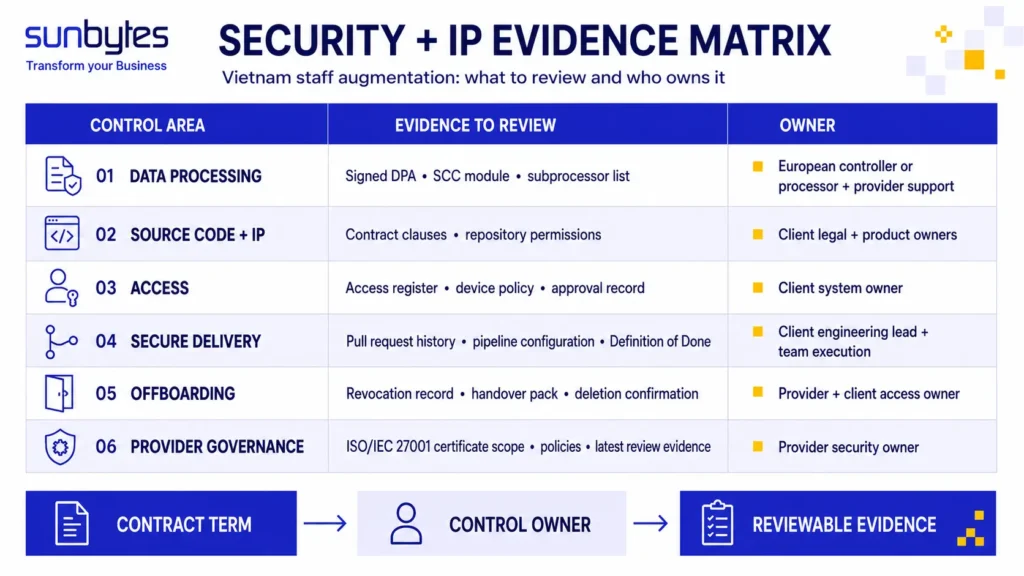
Security and IP protection depend on contract terms, access controls and evidence. Settle them before repository, production or personal-data access is granted.
If an engineer processes personal data for the buyer, GDPR Article 28 processor requirements may apply. For transfers outside the EEA, the European Commission requires international-transfer safeguards. Its Standard Contractual Clauses are one approved mechanism for relevant EU-to-third-country transfers.
The contract should assign work product, source code, documentation and project inventions to the client. An NDA does not replace an IP-assignment clause, data-processing terms or access rules.
| Control area | What to require | Evidence to review | Ownership |
|---|---|---|---|
| Data processing | DPA, processing instructions, subprocessor terms and a valid transfer mechanism where required. | Signed DPA, SCC module, subprocessor list. | European controller or processor with provider support. |
| Source code and IP | Client ownership of work product, confidentiality duties and reuse restrictions. | Contract clauses and repository permissions. | Client legal and product owners. |
| Access | Least privilege, MFA, managed devices and named approval for production access. | Access register, device policy and approval record. | Client system owner. |
| Secure delivery | Code review, branch protection, test expectations and release approval. | Pull request history, pipeline configuration and Definition of Done. | Client engineering lead with team execution. |
| Offboarding | Access removal, asset return, knowledge transfer and data return or deletion. | Revocation record, handover pack and deletion confirmation. | Provider and client access owner. |
| Provider governance | Information-security responsibilities and control scope. | ISO/IEC 27001 certificate scope, policies and latest review evidence. | Provider security owner. |
ISO/IEC 27001:2022 concerns information-security management systems. Certification can support due diligence when its scope covers the delivery organisation, but buyers still need engagement-level evidence for access, code review and offboarding.
The IT staff augmentation contract guide provides the deeper clause-level review. For this location decision, reject a provider that cannot show the contract, control owner and evidence source for each high-risk access path.
Vietnam vs other regions: what changes
Vietnam changes the collaboration pattern more than the ownership model. European companies trade some same-day overlap for access to a different talent market and lower variable delivery cost.
| Region | Typical overlap with Central Europe | Operating pattern | Strong fit when | Condition to test before selection |
|---|---|---|---|---|
| Vietnam | 4-5 hours in a planned Netherlands-Vietnam schedule; varies elsewhere in Europe. | Europe morning and Vietnam afternoon for decisions; written handover carries the rest. | The buyer has strong product ownership and can work asynchronously. | The team can close blockers inside the shared window. |
| Eastern Europe | Near-full working day for many EU markets. | Shared ceremonies and frequent same-day collaboration. | The product needs high synchronous contact across several roles. | The rate premium produces a measurable coordination benefit. |
| Local EU | Full or near-full working day. | Direct stakeholder access and local employment or supplier setup. | Domain access, language or local presence outweighs speed and variable cost. | The hiring or supplier timeline fits the roadmap. |
| LATAM | Europe afternoon and LATAM morning; range depends on country. | Later European collaboration window. | The company also works with North American stakeholders or can shift European meetings later. | The operating day does not push key decisions outside normal hours. |
Choose Vietnam when your team can direct the work, document decisions and use a compact shared window. Choose Eastern Europe when near-full-day collaboration reduces delivery risk. Keep strategic leadership local when stakeholder access or regulated decisions dominate.
Judge every region by reviewed, deployable work under your actual operating constraints, not by hourly rate alone.
How to start with a Vietnam augmented team
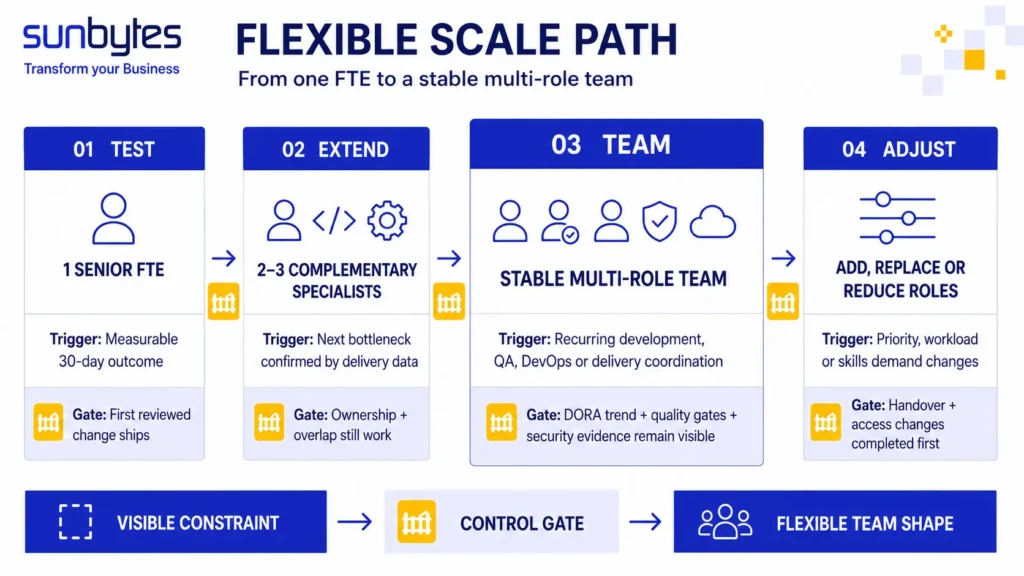
Start with the smallest team shape that can test the delivery system. For many European companies, that means one senior FTE with a 30-day outcome, not an immediate five-person team.
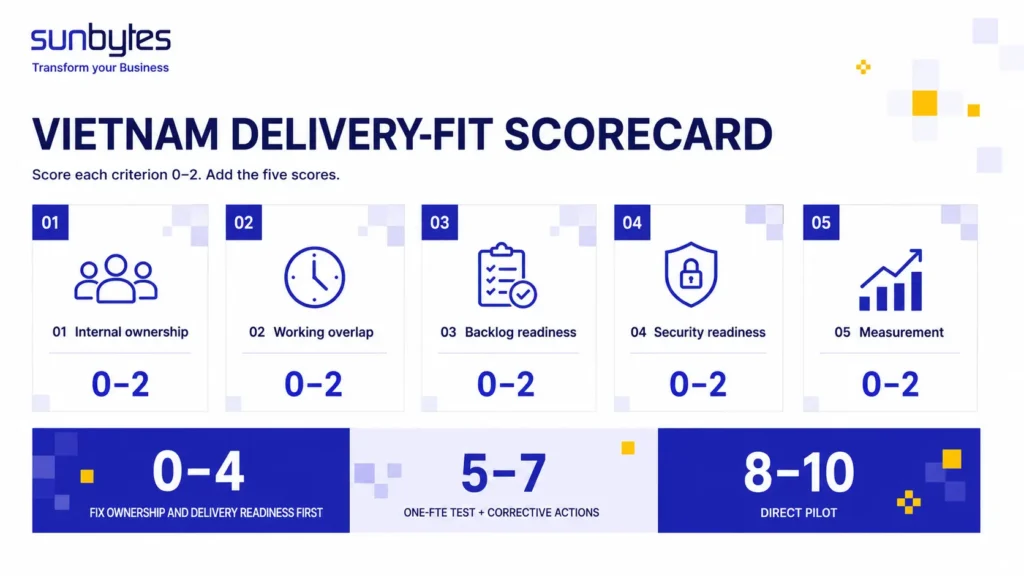
Score delivery fit before requesting CVs
Use the scorecard below before provider selection. Score each statement from 0 to 2: 0 means false, 1 means partly true, and 2 means consistently true.
| Fit criterion | 0 points | 1 point | 2 points |
|---|---|---|---|
| Internal ownership | No named product or technical owner. | Ownership exists but decision rights are incomplete. | Named owners control backlog, architecture and release approval. |
| Working overlap | The team needs continuous live contact. | Some work can move asynchronously. | Decisions fit inside a planned 4-5 hour window. |
| Backlog readiness | Work is still exploratory and undocumented. | First sprint is clear but later work is weak. | Priorities, acceptance criteria and dependencies are visible. |
| Security readiness | Access and data handling will be decided after start. | Basic policies exist but approvals are manual. | DPA, transfer mechanism, access path and offboarding owner are ready. |
| Measurement | Success means adding headcount. | Output targets exist without a baseline. | Delivery and quality signals are baselined before onboarding. |
A score of 8-10 supports a direct pilot. A score of 5-7 supports a one-FTE test with explicit corrective actions. A score below 5 means the company should fix ownership and delivery readiness first or choose a model in which the provider owns more of the delivery system.
Define the first 30-day outcome
Put the first role against the constraint holding delivery back. A backend engineer is the wrong first hire if the bottleneck is QA, cloud access or code review. Set one 30-day outcome, then track it through the application’s own DORA software delivery metrics, such as change lead time, deployment frequency, change fail rate and failed deployment recovery time.
Make the first engineer operational in 2-4 weeks
Sunbytes targets 2-4 weeks to make a matched senior engineer or initial team operational, depending on role scarcity, interviews, contract review and access. Operational means the engineer has the context, permissions and review route needed to contribute safely.
Cover repository access, environments, architecture context, coding standards, Definition of Done, incident contacts and the first review milestone. The guide to managing augmented IT teams covers the ongoing sprint controls.
Scale from one FTE only when the system works
Add the second role when the first engineer is shipping reviewed work and the next bottleneck is visible. Move to a dedicated team when development, QA, DevOps or delivery coordination becomes a stable need.
| Stage | Team shape | Scale trigger | Control gate |
|---|---|---|---|
| Test | 1 senior FTE | One role-specific constraint has a measurable 30-day outcome. | First reviewed change ships without increasing correction load. |
| Extend | 2-3 complementary specialists | The next bottleneck is confirmed by delivery data. | Ownership and overlap still work as headcount grows. |
| Team | Stable multi-role team | The roadmap needs recurring development, QA, DevOps or delivery coordination. | DORA trend, quality gates and security evidence remain visible. |
| Adjust | Add, replace or reduce roles | Priority, workload or skills demand changes. | Handover and access changes are completed before team shape changes. |
The practical threshold is sprint two. If the first engineer is still waiting for access, receiving contradictory priorities or creating more review work than delivered value, do not scale headcount. Fix the operating system first.
How Sunbytes supports European teams from Vietnam
Sunbytes combines Netherlands-based business accountability with an engineering hub in Ho Chi Minh City. European companies can start with one FTE, add complementary specialists and move to a dedicated team when the roadmap requires it.
The delivery model is built around senior engineering capacity, a planned 4-5 hour Netherlands-Vietnam overlap where required, ISO 27001-certified information-security management and DORA-tracked delivery signals. Sunbytes has delivered 300+ projects over 15+ years, and initial senior capacity can typically become operational within 2-4 weeks.
Product direction stays with the client. Sunbytes supports role design, vetting, onboarding and team changes while the client’s leaders retain roadmap, architecture and release decisions.
If your team has an active roadmap and a defined capacity gap: