

A temporary employee is scheduled to start in Vietnam on Monday. The staffing agency has identified the candidate, the contract process is underway, and your team is preparing for additional support.
On the start date, several practical issues can arise.
Common challenges include lack of system access for the new worker, unclear expectations for first-week deliverables, and uncertainty about payroll cut-off dates. There can also be confusion between the staffing agency and your team regarding daily supervision and division of responsibilities.
These gaps typically cause breakdowns in temporary employee management. The main issue is not usually the worker, but rather the absence of a clear support structure and defined processes.
For EU companies hiring in Vietnam, managing temporary staff through a staffing agency works best when the working model is clear before day one. If your team is still choosing between providers, start with how to choose the right staffing service before moving into daily management
TL;DR:
To effectively manage temporary employees in Vietnam, split ownership before day one. The staffing agency should handle employment administration, payroll coordination, attendance records, and local HR processes. Your company still owns the work: role clarity, access, daily supervision, quality review, timesheet approval, handover, and offboarding.
- Clarify ownership before day one. The staffing agency can support sourcing, contracts, payroll, and worker administration, but your manager still needs to own priorities, feedback, and output.
- Prepare access and check-ins early. Temporary employees lose value quickly when tools, permissions, or first-week expectations are unclear. Use a Day 1, Day 3, Week 1 check-in rhythm to catch blockers early.
- Control payroll, compliance, and offboarding. Confirm timesheets, payroll cut-off, overtime approval, data access, handover, and access removal before the assignment ends.
Best fit when your EU team needs short-term capacity in Vietnam through a staffing agency without building a full local HR operation.
Watch out for roles that become long-term, contractor-like, or fully integrated into your team. That may require Contractor of Record or Employer of Record instead.
What does it mean to manage temporary employees effectively?
Managing temporary employees effectively means providing short-term workers with the same operational clarity as permanent employees, but in a faster, more focused format.
A temporary employee may join for seasonal workload, project support, admin coverage, customer support, technical assistance, or a short-term delivery gap. In a staffing agency model, the agency may help with sourcing, screening, contracts, payroll, attendance records, and local HR administration.
The staffing agency can manage the employment layer. Your company still needs to define what good work looks like, who reviews it, and what must be handed over before the assignment ends.
Why temporary employees become hard to manage in Vietnam
Temporary employees usually become hard to manage when the assignment moves faster than the process around it.
The first issue is often the brief. Your team needs support now, so the request goes to the staffing agency quickly. But the role description is too wide, the expected output is unclear, or the manager has not decided what success looks like in the first week. The agency can find available candidates, but it cannot repair an unclear assignment.
The second issue is day-one readiness. A temporary employee can be legally ready to work and still unable to contribute. If email, laptop, system permissions, VPN, project tools, or internal documents are not prepared, the first week becomes admin recovery instead of productive work.
The third issue is split ownership. When payroll, HR records, task direction, and feedback are not assigned clearly, the temporary employee ends up waiting between two parties.
The fourth issue is compliance and data handling. In Vietnam, labor dispatch is regulated, and Decree 145/2020/ND-CP refers to a permitted list of occupations and job titles for labor dispatch in Appendix II. The decree also states that dispatching employees to work outside the permitted list can be grounds for license revocation. For EU companies, employee data moving between the EU company, the Vietnam agency, and the worker also needs basic data protection controls. GDPR Article 32 requires appropriate technical and organisational measures for security of processing.
The management system should make these points visible early: what role is being filled, who employs or dispatches the worker, who handles payroll, who approves hours, who can access employee data, and who removes access when the assignment ends.
Staffing agency vs your company: who owns what?
A temporary staffing model works best when both sides know their lane. If everything is “shared,” nothing is owned.
| Area | Staffing agency owns | EU company owns |
|---|---|---|
| Sourcing | Candidate search, availability, screening support | Role brief, must-have skills, final approval |
| Contract and admin | Employment or assignment paperwork, local HR records | Assignment scope, commercial approval |
| Payroll | Pay cycle, payslip process, statutory handling where applicable | Timesheet approval, budget sign-off |
| Onboarding | Employment admin, basic worker documentation | IT access, tools, manager intro, team context |
| Daily work | Escalation support if issues arise | Task assignment, supervision, output review |
| Compliance | Local staffing process and required agency records | Vendor due diligence, access control, data handling |
| Offboarding | Final pay and admin closeout | Handover, access removal, equipment return |
Agree this table before the worker starts, either in the service agreement, onboarding checklist, or assignment brief. The format matters less than one rule: every task needs one owner.
How to effectively manage temporary employees step by step
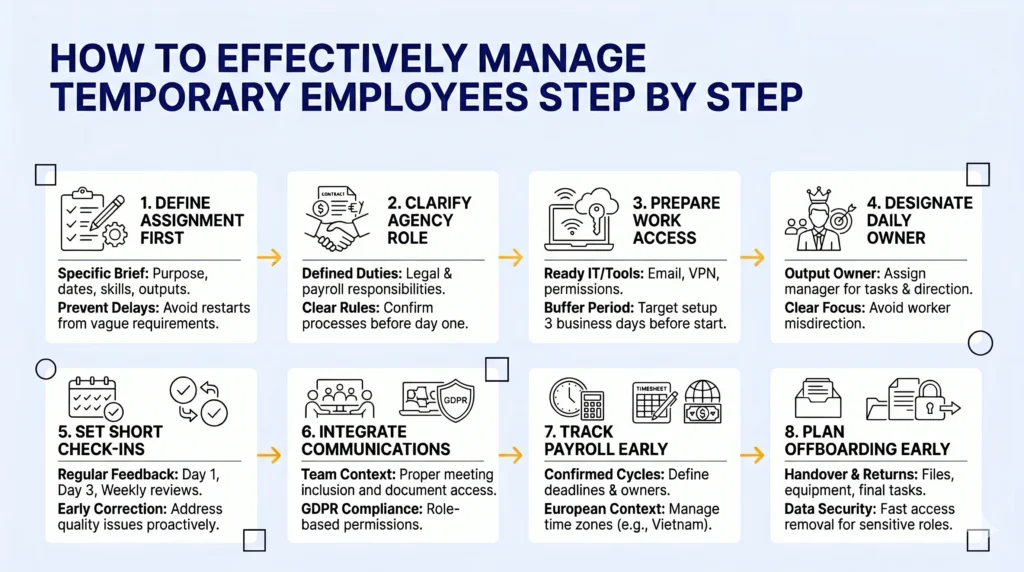
Step 1. Define the assignment before asking the agency to source
The assignment brief should be short, but it cannot be vague.
Before the staffing agency starts sourcing, confirm the role purpose, start date, expected duration, working location, required skills, reporting line, and first-week output. For technical or project-based roles, include the tools, working language, team structure, and handover expectation.
A clear assignment brief also protects your recruitment process. When the brief changes after outreach starts, the agency may need to restart the shortlist because the candidate pool has changed. That can add days or weeks, depending on the role.
A useful brief answers these questions:
- What work must be done in the first week?
- What work must be finished by the end of the assignment?
- Who approves priorities?
- Which skills are required from day one?
- Which skills can be learned on the job?
- What would make the assignment unsuccessful?
If your brief changes after sourcing starts, the agency may need to restart the shortlist. That can add days or weeks, depending on the role. The fastest temporary staffing process is not the one that starts first. It is the one that starts with a brief the manager can actually use.
Step 2. Confirm the staffing agency’s legal and payroll role
Before the worker starts, confirm exactly what the agency is responsible for.
For Vietnam, this should include the worker arrangement, contract or assignment paperwork, payroll flow, timesheet process, payroll cut-off date, attendance records, overtime approval, public holiday handling, and who answers worker questions about pay.
This is where EU companies often lose time. The hiring manager approves the candidate, but HR has not confirmed the payroll cycle. Or the agency sends a timesheet template, but no one inside the client company is assigned to approve it. At month-end, the worker’s pay depends on information that should have been agreed before day one.
If your team needs one workforce model across temporary staffing, payroll, EOR, and Contractor of Record in Vietnam, the operating rules should be clear before the worker starts.
Sunbytes’ Accelerate Workforce Solutions helps EU teams set the role, payroll flow, timesheet ownership, and offboarding process before day one.
Step 3. Prepare day-one access before the worker starts
The agency can prepare employment admin. Your team must prepare work access.
That means email, laptop, VPN, project tools, shared folders, communication channels, security permissions, and a first-day schedule. If the temporary employee needs client systems, development environments, ticketing tools, CRM access, or finance software, the approval path should start before the first day.
Set one deadline: access ready three business days before start.
Step 4. Assign one day-to-day owner
Every temporary employee needs one internal owner.
This person does not need to handle payroll, contracts, or agency communication alone. But they do need to own the work. They assign tasks, remove blockers, explain priorities, review output, and decide whether the assignment is on track.
Without this owner, temporary workers get pulled into small tasks from different people. The work feels busy, but no one can say whether the assignment is succeeding.
Use the responsibility split from the table, but keep one internal manager accountable for output. That person does not need to manage payroll or contracts. They need to keep the work moving.
Step 5. Set short check-in cycles
Temporary assignments need faster feedback than permanent roles.
A practical rhythm is:
- Day 1: confirm tools, tasks, reporting line, and first output.
- Day 3: check blockers, quality, and communication.
- End of week 1: review whether the assignment is on track.
- Weekly after that: review output, hours, scope, and risks.
- Final week: confirm handover, final timesheet, and access removal.
This rhythm protects both sides. The worker does not wait too long for feedback. The manager does not discover quality issues at the end. The agency can step in early if attendance, fit, or expectations need correction.
For short assignments, a late review is almost the same as no review. By the time the problem is clear, the assignment may be nearly over.
Step 6. Keep communication inside your team, not only with the agency
The staffing agency is part of the employment and admin structure. It should not become the only communication channel for work.
Temporary employees need enough team context to do the job well. They should know which meetings they join, which documents they can access, who approves decisions, and how to ask questions. If they work with your delivery team, they need the same working rhythm as the rest of the team, even if their contract is shorter.
This does not mean giving unnecessary access. It means giving the right access for the assignment.
For EU companies, this is also a data protection issue. Do not give broad system access just because the worker is temporary and time is short. Give access based on the role, document it, and remove it when the assignment ends. GDPR Article 32 expects security measures that fit the processing risk, including appropriate technical and organisational measures.
Step 7. Track payroll, timesheets, and compliance early
Temporary staffing becomes stressful when payroll questions appear after the work is already done.
Confirm the payroll cycle, timesheet deadline, approval owner, overtime process, public holiday handling, and final payment steps before the worker starts. If your team is in Europe and the worker is in Vietnam, also confirm the time zone used for deadlines and approvals.
The manager should not approve hours without knowing the assignment scope. HR should not chase approvals after the cut-off date. The worker should not have to ask three people whether their timesheet has been accepted.
A simple rule helps: the person who reviews the work should also approve the time, or at least confirm that the time matches the work delivered.
Step 8. Plan offboarding before the final week
Temporary work should not end with loose access and an unfinished handover.
Before the final week, confirm what must be handed over, where files should be stored, who receives the final notes, when access will be removed, how equipment will be returned, and whether the worker should be marked for future rehire.
Offboarding should cover both work and admin:
- Final timesheet submitted and approved
- Handover notes completed
- Files stored in the right location
- System access removed
- Equipment returned
- Agency confirms final payroll steps
- Manager records performance feedback
For sensitive roles, access removal should happen within 24 hours of the assignment ending. Faster is better when the worker handled customer data, code, finance records, or internal systems.
Temporary employee management checklist
Use this checklist before each temporary worker starts.
Before day one
- Assignment brief approved by the manager
- Staffing agency scope confirmed
- Payroll cycle and timesheet deadline agreed
- Overtime approval process confirmed
- IT access and equipment prepared
- Manager and buddy assigned
- First-day schedule shared
- Data access limited to role needs
During the assignment
- Day 1 task confirmed
- Day 3 blocker check completed
- Week 1 output reviewed
- Timesheets approved on schedule
- Agency notified early if fit or attendance issues appear
- Scope changes documented
- Access reviewed if responsibilities change
Before offboarding
- Final output accepted
- Handover notes completed
- Final timesheet approved
- Equipment returned
- System access removed
- Agency confirms final payroll/admin steps
- Rehire feedback recorded
Common mistakes EU companies make when managing temporary employees in Vietnam

The first mistake is treating the staffing agency as responsible for everything. The agency can support the worker setup, but it cannot manage your internal priorities. If your manager is not available, the worker loses direction.
The second mistake is sending a role brief that reads like a permanent job description. Temporary assignments need a sharper scope. A permanent hire can grow into a role. A temporary employee needs to understand the work quickly.
The third mistake is preparing access after the start date. This creates a poor first-week experience and wastes the capacity you hired for. Access should be ready before day one, with a named owner inside IT.
The fourth mistake is leaving temporary employees outside team routines. When they miss project updates, they make decisions based on outdated information. Invite them to the meetings and channels that affect their work, then remove access when the assignment ends.
The fifth mistake is ignoring timesheet ownership. If no one approves hours before the cut-off, payroll becomes a chase.
The sixth mistake is using temporary staffing for a role that no longer behaves like a temporary role. If the worker becomes long-term, fully integrated, and managed like an employee, the model may need to change. If the worker is project-based and independent, Contractor of Record may be a better option. And if the role becomes ongoing employment in Vietnam, Employer of Record(EOR) may be the better path.
When Contractor of Record may be a better fit than temporary staffing
Temporary staffing is a good fit when your company needs short-term capacity supplied and managed by a staffing agency. The agency helps with sourcing, assignment setup, payroll coordination, and local HR administration, depending on the service scope.
Contractor of Record fits a different situation. It is more relevant when the person is an independent contractor, the work is project-based, and the main need is contract, invoice, payment, and classification support.
The distinction matters because “temporary” does not always mean the same thing. A temporary employee, a dispatched worker, an independent contractor, and an EOR employee can all support short-term business needs, but they are not managed the same way.
A practical test:
If your company controls the person’s daily schedule, tools, methods, manager, and ongoing workload, do not treat the relationship casually as a contractor setup. If the person is independent, works by deliverables, and controls how the work is done, Contractor of Record may be worth reviewing.
When the role becomes long-term and employee-like in Vietnam, Employer of Record(EOR) may give the worker a clearer employment structure while helping your company avoid setting up a local entity too early.
How Sunbytes helps EU companies manage temporary workforce needs in Vietnam
Temporary staffing works best when the operating model is clear before the worker starts. That is where Sunbytes supports EU companies hiring in Vietnam.
Through Accelerate Workforce Solutions, Sunbytes helps international teams with recruitment, staffing support, Contractor of Record and Employer of Record services, payroll coordination, and workforce operations. The aim is not only to add people faster. It is to make sure the role, admin setup, payroll flow, and handover process are ready before the person begins work.
This matters when your EU team is managing across borders. A manager in the Netherlands or Germany should not have to chase local payroll details. A Vietnam-based worker should not have to guess who approves their timesheet. Your HR team should not discover during offboarding that access removal was never assigned.
Sunbytes is a Dutch company with a delivery hub in Vietnam. That gives EU companies a familiar governance mindset with local execution support in Vietnam. Accelerate Workforce Solutions is also strengthened by Sunbytes’ two other pillars. Digital Transformation Solutions helps define roles more clearly for technical and delivery teams. CyberSecurity Solutions supports safer onboarding, data handling, and access control when workforce information moves across markets.
With the right structure, temporary employees do not become an extra layer of management work. They become controlled short-term capacity that your team can actually use.Need temporary workforce support in Vietnam with clearer ownership from sourcing to offboarding? Explore Accelerate Workforce Solutions.
No FAQ questions found