

The leader you appoint in Vietnam shapes how your business there grows, how your team works and how well your headquarters can see what happens locally. The people best suited to that role are usually employed elsewhere and not applying, and a CV alone does not show whether they can lead a Vietnamese team and report to a headquarters abroad.
A headhunter in Vietnam, also called an executive search partner, gives you a structured and confidential way to find and assess these people. A good one does more than send profiles: they help you write the leadership brief, map who holds comparable roles in the market, approach people discreetly, assess leadership and fit, and support you through the offer until your new leader starts.
This guide explains how headhunting works in Vietnam, when it is the right route for your hire, what you should expect from a headhunter, and where to look when you compare providers.
TL;DR
Headhunting in Vietnam is the direct approach of employed managers and executives for a named role, followed by assessment, a shortlist and support up to the signed offer.
• Contingency headhunting suits manager and senior specialist roles: the headhunter is paid only when the hire starts.
• Retained headhunting suits director, GM, country manager and C-level roles: an exclusive mandate with a full market map and assessment.
• Vietnam-specific offer risks are the total package (13th-month pay, Tet bonus timing), the notice period of up to 45 days under the Labour Code 2019 and counter-offers in that window.
• Hiring before you have an entity is possible: the search can start now and a Vietnamese leader can be employed through an Employer of Record until your entity is ready.
What is headhunting?
Headhunting, also known as executive search, is a proactive form of recruitment in which a company or a specialised recruiter directly approaches top-tier professionals to fill senior, executive or highly specialised positions. Instead of waiting for applicants, the headhunter identifies who holds comparable roles in the market, contacts them personally and tests their interest before your company is named.
For a hire in Vietnam, a headhunter usually delivers five things:
- Market map: which companies employ people with the profile you need, and who holds those roles.
- Approach: a confidential first conversation with each person on the map, before your company is named.
- Assessment: experience, leadership and language tested against your written brief.
- Shortlist: in market practice often three to five assessed people for your decision-makers to interview.
- Offer support: the package negotiation, the resignation and the period until the first working day.
A headhunter and a recruiter differ mainly in who they approach and how. A recruiter works largely with people who apply or are already in a database; a headhunter goes after people who are not on the market. The full comparison of headhunter vs recruiter is covered in a separate article.
Contingency and retained headhunting: the two models
Headhunting in Vietnam runs on two models, contingency and retained, and they differ in four ways: when the headhunter is paid, whether the mandate is exclusive, how much of the market is covered, and what you receive besides CVs. Each model fits a different kind of role, so the useful question is which one matches the seniority, confidentiality and scarcity of the position you are filling. Table 1 sets the two side by side.
| Criterion | Contingency headhunting | Retained headhunting |
|---|---|---|
| When the headhunter is paid | Only when the hire starts | In stages during the search |
| Exclusivity | Usually none; several agencies can work the role | One headhunter holds an exclusive mandate |
| Market coverage | Candidates the headhunter can reach through existing networks and databases | A market map of everyone holding comparable roles |
| What you receive | Profiles of interested candidates | Market map, assessment report per finalist, progress reporting |
| Confidentiality | Harder to control when several agencies approach the market | Controlled by one party |
| Typical roles | Manager and senior specialist | Director, general manager, country manager, C-level |
Contingency headhunting for manager and senior specialist roles
Contingency headhunting is a model in which the headhunter is paid only when your new hire starts, usually without exclusivity. It fits manager and senior specialist roles in Vietnam where comparable people are found across many companies and the search does not need to stay confidential.
The strength of contingency is that you carry no cost until someone is hired, and the headhunter draws on candidates they can already reach. The trade-off is depth: the search covers the headhunter’s existing network rather than the whole market, and when several agencies work the role, you receive CVs without an overview of who was approached. Contingency works best when the role is clearly defined and you are comfortable comparing profiles from more than one source.
Retained headhunting for director, GM and C-level roles
Retained headhunting is a model in which one headhunter holds an exclusive mandate, is paid in stages and maps the full market for the role. It fits director, general manager, country manager and C-level roles in Vietnam, where only a small number of people hold comparable positions and most of them are not looking.
The strength of a retained search is coverage and evidence: the headhunter approaches every relevant leader, not only those already known to them, and reports back on who was contacted, who declined and why. That reporting gives your decision-makers a view of the market alongside the shortlist. The trade-off is commitment before the hire, which is why the model is used for roles that report to headquarters or carry profit-and-loss responsibility. Retained vs contingency headhunting goes deeper into the choice, and the cost section below covers how fees are structured under each model.
When a headhunter in Vietnam is worth it
A headhunter in Vietnam is worth it when the role calls for people who are employed elsewhere, when the appointment must stay confidential, when the decision needs local market evidence, or when the leader has to start before your entity exists. When none of the four applies, your own team can often fill the role through a job post and its network.

The right people are already employed
The managers you need most in Vietnam rarely apply for jobs: they are busy running a profit-and-loss, a plant or a sales region, often for one of your competitors. They move through referrals and direct approaches, so a job post leaves the strongest part of the market untouched. A headhunter reaches them by name and puts your role in front of people who would otherwise never see it.
The signal is in the applicant list. When a post on VietnamWorks or LinkedIn draws mostly junior or off-profile applicants for a senior role, the people with the right experience are not on the job market, and a direct approach adds reach that a job post cannot give.
The appointment is confidential
Replacing a general manager, entering Vietnam before an announcement or hiring a leader from a competitor cannot run on a public ad. A headhunter approaches people without naming your company until they are interested and have agreed to keep the conversation private.
The clearest signal is that the current incumbent does not know yet. In that case your company name stays out of every first conversation, and you see names only once people have agreed to go further.
The decision needs local market evidence
A senior appointment in Vietnam is easier to decide with current local evidence: salary levels for the role, a candidate’s reputation in the sector and movement between competitors. A headhunter working in the market gathers that evidence for your decision-makers in Amsterdam, Tokyo or Seoul: a market map, salary data for the role and references from former managers.
With that evidence, your headquarters interviews three assessed leaders, each with references, instead of ten unfiltered CVs. Salary bands for these roles are covered in manager salaries in Vietnam.
The role starts before your entity exists
The search for a leader in Vietnam can start before your entity exists. A Vietnamese leader can be employed through an Employer of Record (EOR) while the entity is set up, then moved to your own payroll. The route is set out in hiring a senior manager without an entity.
What makes headhunting in Vietnam different
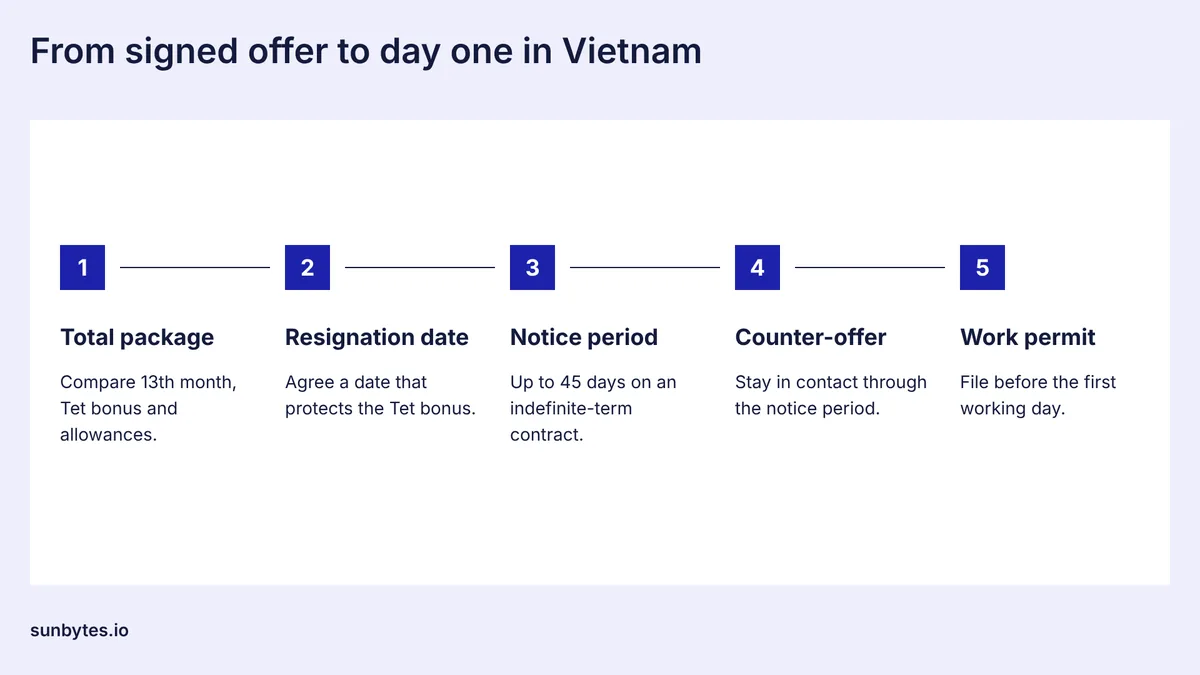
Headhunting in Vietnam differs from Europe less in how people are found than in what happens after the offer: the total package, the notice period and counter-offers decide whether your chosen leader actually starts. Five points deserve attention, from the first approach to the first working day.
Senior people are reached through networks, not job ads
Senior people in Vietnam are reached through referrals, former colleagues and business associations such as EuroCham, JCCI (Japanese chamber) and KoCham (Korean chamber). A headhunter’s value is the ability to open those conversations credibly and confidentially.
A shortlist that also includes people who are not active on job boards shows that the search has covered the wider market. How the brief, mapping and shortlist stages work in practice is covered in how to work with a headhunter.
Offers are compared on the total package, not base salary
Senior candidates in Vietnam compare offers on the total package: a 13th-month salary, the timing of the Tet bonus, allowances, and for expatriates housing, a car or school fees. Building the offer around the full package from the start makes it easier to compare with the candidate’s current one.
A 13th-month salary and a Tet bonus are not required by the Labour Code 2019; they come from company policy or the employment contract. Where a policy pays the Tet bonus only to people employed on the payout date, a resignation before Tet can cost your candidate that bonus, so the start date and a possible sign-on payment belong in the same conversation.
Notice periods and counter-offers move start dates
Under Article 35 of the Labour Code 2019, an employee who resigns must give at least 45 days’ notice on an indefinite-term contract, 30 days on a fixed-term contract of 12 to 36 months, and 3 working days on a contract under 12 months; some sectors have different periods set by the government.
Your candidate’s current employer has that full notice period to make a counter-offer, and a senior person is the one most likely to receive one. Keep in contact through the notice period and agree the start date in writing. Legal limits on approaching competitors’ staff are covered in poaching and non-compete rules in Vietnam.
Market reality: the 45-day window
Signing the offer is not the finish line. During up to 45 days of notice, your candidate’s employer knows they are leaving and has every reason to match or beat your offer. Plan for a counter-offer from day one: agree the start date in writing, keep weekly contact, and settle package questions before the resignation, not after.
Leaders must work for the market and for headquarters
A general manager in Vietnam has to lead a Vietnamese team and report to a headquarters abroad, and both sides of the role have to work. Some candidates bring deep local leadership experience, others bring experience of reporting to a European or Japanese headquarters, and the role usually needs both.
Assess reporting experience as closely as market experience, and agree in the brief how often and in what form your new leader will report. The role profile is set out in hiring a country manager in Vietnam.
Foreign managers need a work permit before day one
A foreign manager needs a Vietnamese work permit, or a confirmed exemption, before the first working day, so the permit belongs in your offer plan, not your onboarding plan. New rules apply from 5 December 2026 under Decree 393/2026/ND-CP; applications filed before that date still follow the old Decree 219/2025/ND-CP.
What the change means for your hire:
- Moving your own manager to Vietnam gets stricter. An intra-company transfer now only works for managers, executive directors and experts who have worked for your company for at least 12 months in a row. Check that tenure before you announce the move.
- Some executive hires get easier. An executive director who heads a functional area now needs two years of experience instead of three.
- Your foreign leader has to work for you. Employers must use foreign workers for their own business, not place them with partners or clients, so decide at offer stage which company employs your expatriate leader.
Crucial tip: start the permit when the offer is signed
A work permit that is still pending on the planned start date delays your leader’s first working day. Collect degrees, experience letters and the criminal record check while the candidate is serving notice, so both run in parallel.
Hiring a manager or director in Vietnam and not sure which model fits? Our recruitment team looks at the role, the level and whether you have an entity yet, then tells you how we would run the search. See our recruitment services.
Headhunting services by role level and function
Headhunting services in Vietnam differ by role level: manager and senior specialist roles usually run on contingency, while director, general manager and country manager roles usually run as a retained search. Table 2 shows what to assess at each level.
| Role | Typical model | What to assess | Read more |
|---|---|---|---|
| Manager or senior specialist | Contingency | Team size managed, results in a comparable company, English level | retained vs contingency headhunting (planned) |
| Director | Retained | Functional depth, reporting to a regional or global head | retained vs contingency headhunting (planned) |
| General manager or country manager | Retained | Profit-and-loss ownership, reporting to headquarters, local leadership | hiring a country manager in Vietnam (planned) |
| Plant or factory manager | Retained or contingency | Plant size, safety and quality record, Japanese or Korean language where needed | headhunting plant managers (planned) |
| Senior engineer or tech lead | Direct hire or dedicated team | Architecture ownership, team leadership, English | headhunting tech leads in Vietnam (planned) |
Cost and choosing a headhunter in Vietnam
Headhunting fees in Vietnam are usually a share of the hire’s first-year pay, and the two models differ mainly in when you pay: contingency on the start date, retained in stages. Market ranges and how each structure works are set out in headhunting fees in Vietnam.
Choosing a headhunter comes down to sector depth, the model they offer, confidentiality and whether they can also employ your hire if you have no entity. A selection checklist is in how to choose a headhunting partner.
Hiring a senior manager before you have a Vietnamese entity
Yes, you can hire a senior manager in Vietnam before your entity exists: you headhunt the leader, employ a Vietnamese hire through an Employer of Record, and move the contract to your own entity once it is registered. For a foreign leader, check the employment set-up against Decree 393 at offer stage. The full route is in hiring a senior manager without an entity.
How Sunbytes supports headhunting in Vietnam
The five points above, the package, the notice period, the counter-offer, the fit between market and headquarters and the work permit, are the stages that decide when your new leader starts, and they are where Sunbytes works with you after the shortlist.
Sunbytes has been building teams in Vietnam since 2011, as a Netherlands-headquartered company with its own team in Ho Chi Minh City. We headhunt managers and executives for foreign companies, and when you have no entity yet, we can employ your new Vietnamese leader through our Employer of Record service. Candidate data is handled within Sunbytes’ ISO 27001-certified management system.
Every role is different, so our recruitment team advises on the approach and cost per case. Talk to our recruitment team about the leader you need in Vietnam.