

Paying contractors in Vietnam may seem simple initially, but compliance requirements can quickly introduce complexity. It is important to understand who is responsible for tax obligations, how local law distinguishes contractors from employees, and when a flexible arrangement may create legal risk. Many companies only address these issues after encountering challenges such as delayed payments, unclear agreements, or classification concerns during an audit. This guide provides practical steps how to pay contractors in Vietnam compliantly from the outset and helps you identify when it may be necessary to adjust your current approach.
TL;DR
- Foreign companies pay contractors in Vietnam through service agreements and invoice-based payments, and ensure proper classification to avoid tax and labor law risks.
- The most reliable approach is to follow a defined process: outline the scope of work, prepare a contract, choose an appropriate payment method, and handle taxes according to regulations. It is important to keep documentation at each stage.
- When teams grow or contractor roles become ongoing, the contractor model may no longer meet compliance requirements. In these cases, using an Employer of Record or Contractor of Record can help ensure ongoing compliance.
What does it mean to pay contractors in Vietnam?

Paying contractors in Vietnam involves engaging individuals as independent service providers rather than as employees. This approach does not create a local employment relationship under Vietnamese labor law. The distinction is important because it determines who is responsible for taxes, how payments are managed, and whether your arrangement will meet compliance requirements if reviewed by authorities.
Who qualifies as a contractor in Vietnam
In Vietnam, a contractor usually works as an independent service provider. This can be as an individual freelancer or through a registered business. Contractors deliver work according to a specific scope, timeline, and outcome. They are not part of your internal team. Instead, they decide how to complete the work, receive payment per project or milestone, and can work with several clients at once.
It is important to keep this distinction clear. If your arrangement with a contractor starts to look like an employment relationship, the legal classification may change. This can happen even if your contract still calls the person a contractor.
Contractor vs employee in Vietnam
The line between contractor and employee is defined by control and dependency, not by what the contract says.
In Vietnam, a relationship is likely considered employment if:
- You define working hours or require fixed schedules
- The contractor works exclusively for your company
- You provide equipment, tools, or internal systems as standard
- The role becomes ongoing rather than project-based
In these situations, the arrangement is likely to be viewed as a labor relationship rather than a service agreement, regardless of the contract wording. That shift marks the beginning of compliance exposure.
How local laws in Vietnam affect contractor payments
Paying contractors in Vietnam involves more than just making payments. Local labor classification rules and tax obligations directly affect how you should structure these arrangements. The setup you choose at the beginning determines who is responsible for compliance and whether your payments will be accepted by local authorities if reviewed.
Contractor vs employee classification risk
The main challenge is not the payment method itself, but how the working relationship is structured. Sometimes, a contractor arrangement looks compliant because it is based on invoices, does not use payroll, and does not include benefits. However, if the contractor is working in a way that is similar to an employee, this can create compliance risks.
This risk can develop over time. Even if payments are processed as usual, if the contractor is working set hours, reporting to a manager, and following the company’s daily processes, the arrangement may already be misclassified. In these cases, the way payments are made is less important than how the work is actually performed.
For a deeper breakdown of how this risk develops, see our guide to contractor misclassification in Vietnam.
What happens if contractors are reclassified
If a contractor is reclassified as an employee, the change applies to the entire period of their engagement. Authorities will review the full history of the working relationship and apply employment obligations from the beginning, not just moving forward.
This typically means the company becomes responsible for unpaid social insurance contributions, personal income tax withholding, and any mandatory benefits that should have been provided under a labor contract. This situation often affects more than one contractor. If one position is reclassified, authorities may review other similar roles using the same criteria. This can increase the company’s overall exposure to compliance issues.
Tax obligations in Vietnam
In a compliant contractor setup, the contractor is responsible for declaring and paying their own personal income tax in Vietnam. Payments are typically made against invoices, and the foreign company does not run local payroll or withhold taxes as it would for employees.
However, this only holds if the contractor is correctly classified. Once a relationship crosses into employment territory, tax responsibility shifts. The company is then expected to handle income tax withholding and social insurance contributions in line with Vietnamese labor regulations.
This is why payment structure and legal classification must align. Paying a contractor involves more than just transferring funds. It is important to make sure the arrangement matches the actual working relationship.
How to pay international contractors in Vietnam (step-by-step)
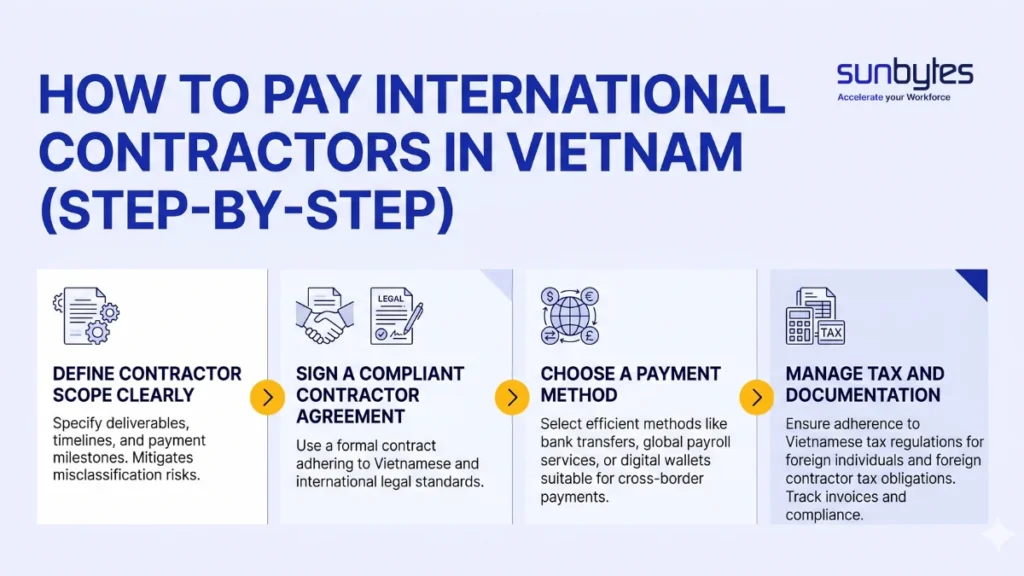
Ensuring compliant payments to contractors in Vietnam starts with the structure you put in place before issuing any invoices. If the contractor’s scope is not clearly defined, the agreement is incomplete, or the payment process is not documented, compliance risks can arise well before any legal issue is identified.
Step 1 – Define contractor scope clearly
Begin by defining the contractor relationship to support independent status from the outset. The work should be linked to a clear scope, specific deliverables, and a set timeline, rather than an ongoing role within your daily operations.
Many companies encounter issues at this stage. If a contractor is engaged to support a project but the brief resembles a job description, the relationship may appear flexible but function as employment in practice. Defining a clear scope from the beginning makes it easier to maintain the correct legal distinction.
A practical way to assess the relationship is to consider whether the individual is being engaged to deliver a specific outcome. If so, the contractor model may be appropriate. If the person is filling an ongoing role within your organization, this may indicate an employment relationship.
Step 2 – Sign a compliant contractor agreement
After defining the scope, prepare a written contractor agreement before any work starts. In Vietnam, this agreement should clearly reflect a genuine service relationship and avoid any terms that could be interpreted as employment.
The contract should specify the services to be delivered, payment terms, timeline, ownership of work, confidentiality requirements, and conditions for ending the engagement. It is also important to avoid language that suggests employment, such as assigning internal titles, setting fixed working hours, or including supervision terms that indicate direct managerial control.
A well-drafted agreement does not eliminate all risk, but it provides essential structure for your contractor model. Without written documentation, you may be relying on informal understanding, which can be difficult to support if the relationship is later reviewed under labor law.
Step 3: Choose a payment method
Once the agreement is signed, select a payment method that is practical for both parties and scalable as your contractor base grows. For a single contractor, a direct bank transfer may be sufficient. For multiple or recurring contractors, choose a payment method that supports proper documentation, timely payments, and ongoing compliance.
It is important not to prioritize convenience over compliance. While a fast payment tool may address speed, it may not provide the documentation needed for audits. A low-cost transfer may be suitable for a single freelancer, but it may not meet the needs of a larger group of long-term contractors. The best payment method depends on payment frequency, the number of contractors, and the level of employment risk.
The payment method you choose should align with your actual contractor working model, not just your intended approach.
Step 4 – Manage tax and documentation
The final step is to maintain documentation that demonstrates the contractor arrangement is genuine and consistent. This includes keeping signed agreements, invoices, payment records, and clear records of the contractor’s scope and deliverables.
This is important because contractor compliance is usually reviewed after the fact, such as during a dispute, audit, or classification review. Without a clear paper trail, payment records alone may not be sufficient to demonstrate compliance.
Maintaining discipline in documentation is essential. Even if payments are made each month correctly, compliance issues can arise if the records do not accurately reflect how the work was performed.
Contractor payment methods for Vietnam

After you have set up the contractor relationship properly, the next step is to decide how you will make payments. This choice is important because it impacts not only how funds are transferred but also the quality of your documentation, how taxes are managed, and how easily your contractor model can grow in the future.
There is no one-size-fits-all solution. The best payment method for your situation depends on factors like the number of contractors you work with, how often you need to pay them, and how similar your contractor arrangements are to traditional employment.
Common contractor payment methods in Vietnam
Direct international bank transfer (SWIFT)
This is the most straightforward approach. You transfer funds directly from your company account to the contractor’s bank account in Vietnam.
This method is a good fit if you only need to pay a few contractors from time to time. While the process itself is straightforward, it is important to keep careful records of invoices, payments, and exchange rates. Be aware that fees can add up quickly if you make frequent transfers.
As your contractor team grows, this approach can become difficult to manage. Handling payments, tracking invoices, and keeping documentation consistent for many contractors can quickly become a significant administrative burden.
Digital payment platforms (PayPal, Wise)
Platforms such as PayPal or Wise can make international payments easier by streamlining the transfer process and offering automatic transaction records.
They are often used when speed matters. Contractors receive funds faster, and companies avoid some of the complexity of international banking systems.
It is important to note that while these platforms are designed for efficient transactions, they do not address compliance needs. You will still need to manage documentation separately, and they do not help reduce the risk of contractor misclassification. Depending on how many payments you make, fees can also become a concern.
Contractor payroll providers (Contractor of Record)
A Contractor of Record (COR) provider can help by managing contractor payments within a structured compliance framework. This usually includes support with contract management, invoice processing, and payment execution, all within a clear and consistent system.
This approach is especially useful if your contractor relationships are ongoing, involve higher amounts, or are similar to employment in practice. By using a standardized system, you can simplify documentation and reduce the time spent on administrative tasks.
It does not eliminate classification risk entirely, but it introduces structure where manual methods often fail.
Comparison of contractor payment methods in Vietnam
| Payment method | Best for | Strengths | Limitations |
|---|---|---|---|
| Direct bank transfer (SWIFT) | Small number of contractors, ad hoc payments | Simple setup, widely available | High fees, manual tracking, poor scalability |
| Digital platforms (PayPal, Wise) | Frequent payments, need for speed | Faster transfers, easier transaction records | Limited compliance support, fees at scale |
| Contractor of Record (COR) | Ongoing contractor relationships, scaling teams | Structured documentation, operational consistency | Service fees, less flexibility than ad hoc methods |
Common mistakes when paying contractors in Vietnam
Most issues do not arise from the payment itself, but from the small decisions made around it. In Vietnam, risk often increases when international practices are used without adapting to local tax, banking, and legal requirements.
Getting tax handling wrong (FCT and payment structure)
Tax risks can remain hidden until a review takes place. Certain cross-border services are subject to Foreign Contractor Tax (FCT), and if this is not withheld correctly, your company may become liable for the unpaid amount.
Payment structure matters just as much. Setting a “net” payment without calculating the gross amount, or excluding benefits like travel and accommodation from the taxable base, can create shortfalls.
It is safer to clarify the tax position before making the first payment, rather than after.
Payment failures caused by local banking details
In Vietnam, most failed payments are due to small details rather than a lack of funds.
Names must match bank records exactly, including accents and order. Incorrect SWIFT or branch codes can delay or misroute funds. Sending USD to a VND-only account forces conversion at unfavorable rates.
Weak contract structure and payment terms
Large upfront payments are hard to recover if issues arise. Payments based only on time, without clear deliverables, reduce both your control and legal protection.
It is best to use bilingual contracts and link payments to specific milestones, with acceptance criteria clearly written into the agreement.
Poor verification and documentation discipline
Even when payments are correct, they can still cause problems if proper records are not kept.
Transferring funds without first verifying the contractor’s legal and tax status creates unnecessary risk. Missing invoices, unclear deliverables, or unauthorized signatures can make it harder to defend your arrangements if they are reviewed.
Each payment should be clearly linked to a signed contract, an invoice, and confirmed work.
Hiring and paying contractors in compliance with Sunbytes
If contractor arrangements result in unclear tax treatment, inconsistent payments, or roles that closely resemble employment, the underlying issue is the structure of the engagement, not just the payment method.
Sunbytes addresses these challenges by offering a model that aligns with how your team operates. With roots in the Netherlands and a delivery hub in Vietnam, Sunbytes supports more than 300+ international projects with hiring, payroll, and workforce operations. Our Accelerate Workforce Solutions approach combines local compliance with reliable, transparent processes.
Sunbytes provides both Contractor of Record (COR) and Employer of Record (EOR) services, depending on your needs. COR helps standardize contracts, invoices, and payments for project-based work. If roles become ongoing and integrated into your team, EOR offers a compliant transition to employment. Sunbytes manages contracts, payroll, tax, and statutory requirements locally, while you continue to direct the work.
Transitioning between COR and EOR is a simple process. You can adjust the model as your team changes, without needing to rebuild your existing structure.
With support from Digital Transformation Solutions and Cybersecurity Solutions, Sunbytes helps ensure your hiring and payment model grows with your team. This approach keeps workforce management integrated with your operations, rather than creating extra administrative steps.