

Mass recruitment fails when it is run as a scaled-up version of normal hiring. The job postings go up later than planned. The screening queue builds faster than the team can clear it. Onboarding happens individually, which means the last cohort completes orientation the week after peak begins. By the time headcount is in place, the production window it was needed for is already partially over.
TL;DR
- Mass recruitment fails when companies treat it as normal hiring at volume. The bulk recruitment process has different bottlenecks: not the application rate, but pre-qualification speed, onboarding capacity, and how early the staffing partner was briefed.
- The 8 strategies in this article address the actual failure points: late briefing, individual onboarding, weak yield rate tracking, and no contingency pool for dropouts. Each strategy has a specific mechanism, not a general recommendation.
- For peak season staffing at volume, the fastest path is a staffing agency that holds an active pre-qualified pool in the exact location you need. An agency sourcing from scratch after receiving your brief adds 3 to 4 weeks before the first offer can go out.
Why mass recruitment fails when run like normal hiring
Most companies approach peak season with the same process they use for individual hires, just with more job postings. That process is not designed for volume and it fails for predictable reasons.
The three most common peak-season hiring failures
Briefing too late: The most common cause of a missed peak-season headcount target is a brief that arrives at the staffing partner four to six weeks before the start date. For a talent pool that does not already exist in the right location, sourcing, screening, and onboarding 100 workers in four weeks is not possible. The providers who deliver on short timelines already had the candidates.
Individual onboarding at volume: Running onboarding one-by-one when you need 50 workers by a specific date means the process that works for permanent professional hires becomes the bottleneck for peak operations. The first worker starts on day one. The 50th starts on day 20.
No contingency pool: An offer acceptance rate of 80% on 100 roles means 20 gaps on day one. Without a contingency pool of pre-qualified candidates, those 20 gaps persist through the peak window while replacement sourcing begins.
Why time-to-fill compounds differently at volume
In individual hiring, a two-week delay means one role is empty for two additional weeks. At volume, a two-week delay in the first cohort means the entire production plan based on that headcount date shifts by two weeks. If peak production runs for eight weeks, a two-week delay represents 25% of the peak window lost to understaffing.

The compounding happens because high volume recruiting has a critical path that individual hiring does not. The first cohort needs to be onboarded and produced before the second cohort arrives. If cohort one is late, training capacity for cohort two is consumed catching up.
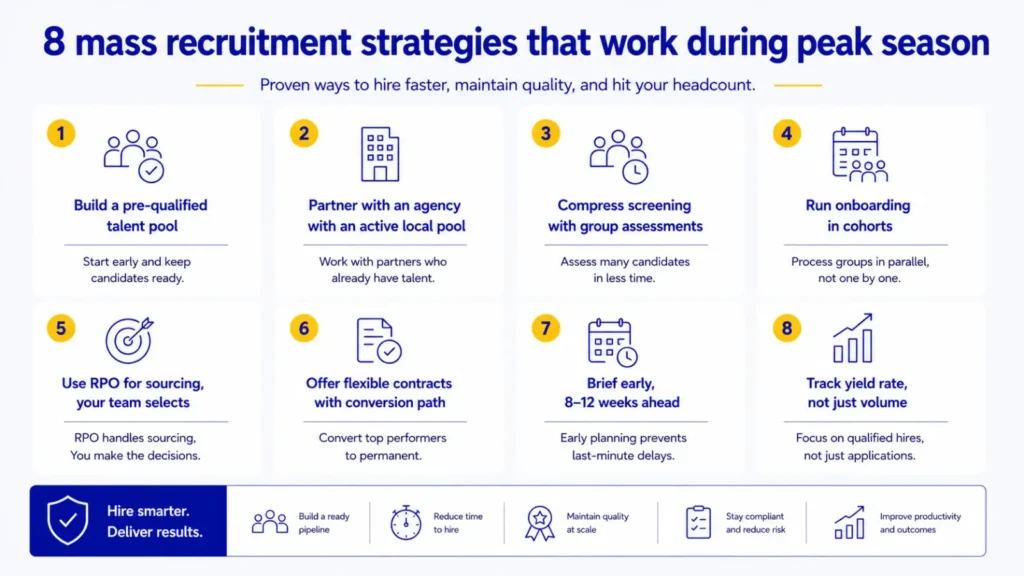
8 mass recruitment strategies that work during peak season
Each strategy below addresses a specific failure point. The mechanism column explains what changes in the process, not just what the outcome is.
| Strategy | Primary failure it fixes | Lead time required | Impact |
|---|---|---|---|
| 1. Pre-qualified talent pool | Late availability of candidates | 8 to 12 weeks | High |
| 2. Agency with active local pool | Sourcing time from scratch | 8 weeks | High |
| 3. Group assessments | Individual screening bottleneck | 2 weeks | Medium |
| 4. Cohort onboarding | Sequential onboarding delay | 1 week | High |
| 5. RPO for sourcing layer | Internal team capacity constraint | 4 weeks | Medium |
| 6. Flexible conversion contracts | Low offer acceptance rate | Before offer | Medium |
| 7. 8 to 12 week briefing window | Late start to pool activation | 12 weeks | Very high |
| 8. Yield rate tracking | Undersized application funnel | Before sourcing begins | Medium |
1. Build a pre-qualified talent pool before peak season begins
A talent pool is a database of candidates who have been screened, indicated interest in the type of work you are offering, and are available during the period you need them. The key word is pre-qualified: they have already cleared the screening step that consumes the most time during active sourcing.
For manufacturing roles, a pre-qualified pool in the relevant industrial zone means the first cohort can be selected and offered within 48 hours of receiving the brief. Without a pre-qualified pool, the same step takes two to three weeks. The pool does not build itself during the four weeks before peak. It builds during the eight weeks before that.
Mechanism: Run a light-touch sourcing and pre-qualification campaign 8 to 12 weeks before peak. Candidates who pass basic screening are held in the pool, not offered until the brief is confirmed.
2. Partner with a staffing agency that holds an active local pool
If your company does not have the capacity to build a pre-qualified pool directly, work with a staffing agency that already has one. The Dutch electronics manufacturer in the opening case onboarded 180 workers in 4 weeks because the staffing partner held an active pool in the target industrial zone. The agency did not source those workers during the engagement. It had maintained those relationships before the brief arrived.
Mechanism: In the evaluation meeting, ask how many pre-qualified candidates in this location type are available right now. The answer separates agencies with genuine pools from those who will start sourcing after you sign.
3. Compress screening with structured group assessments
Individual screening interviews are the primary time constraint in high volume recruiting. Running 200 individual 30-minute interviews takes 100 hours of recruiter time before any offer is made. Group assessments run 20 to 30 candidates simultaneously, reducing time-per-candidate by 60% to 80% while generating better structured evaluation data.
Mechanism: Replace individual screening interviews with structured 90-minute group sessions of 20 to 30 candidates. Two assessors can evaluate 25 candidates per session. Four sessions cover 100 candidates in a single day.
4. Run onboarding in cohorts, not individually
Cohort-based onboarding treats the first day as a production process. Forty workers arrive at 8am. Document collection runs in parallel stations: one for ID verification, one for health certificate review, one for social insurance registration initiation. By 1pm, all 40 have completed induction. By the end of the day, all are registered and provisioned.
Mechanism: Design the onboarding day as a parallel-process flow, not a sequential queue. Each step runs simultaneously for all workers in the cohort, not one by one.
5. Use RPO for the sourcing layer while your team handles selection
Recruitment Process Outsourcing for the sourcing layer means an external team handles job posting, application review, initial screening, and candidate pool management. Your internal team receives pre-screened shortlists and handles final selection only.
Mechanism: Split the hiring process at the shortlist handoff point. Everything upstream of the shortlist is RPO. Everything downstream is internal. Define the shortlist criteria before sourcing begins, not during.
6. Offer flexible contracts that convert to permanent for top performers
A temporary contract that explicitly offers a conversion pathway to permanent employment attracts a higher-quality candidate than one that does not. Workers evaluating multiple seasonal opportunities will choose the one that offers a credible path to stability.
Conversion-ready contracts also reduce re-recruiting costs for the next peak cycle. A worker who converted to permanent after the first peak season is already trained and does not need to be re-sourced for the second cycle.
Mechanism: Include a conversion clause in the temporary contract: workers who meet performance criteria at the end of the fixed term will be offered a permanent role. State the criteria clearly.
7. Brief the staffing partner 8 to 12 weeks before peak, not at the start
The 8 to 12 week briefing window is the single most impactful change a company can make to its peak-season hiring outcome. It is also the one most consistently ignored until the year a missed target makes it impossible to ignore again.
At 8 to 12 weeks out, the staffing partner can begin pool activation, pre-qualification, and candidate warming. Candidates identified at this stage are ready for offer within days of brief confirmation. At 4 weeks out, the same pool-building work cannot be completed in time.
Mechanism: Put the staffing partner brief date on the production calendar as a fixed milestone, the same way the production start date is fixed. Brief delay equals production delay.
8. Track yield rate, not just applications
Yield rate is the percentage of applicants who make it through to day one. A yield rate of 40% means that for every 100 applications, 40 workers start. To hit a target of 200 starters, the funnel requires 500 applications, not 200. Planning based on the target headcount rather than the target headcount divided by the yield rate is how companies run out of pipeline two weeks before peak.
Mechanism: Calculate your historical yield rate from the last two peak cycles. Apply it to the headcount target to determine the required application volume. Work backward to the sourcing budget and timeline needed to generate that volume.
Planning a peak-season hiring push? Talk to us about your peak-season hiring plan. Explore Accelerate Workforce Solutions
Mass recruitment planning timeline: what to do 12 weeks out
The timeline below reflects the sequence that produces a ready workforce on the production start date. Each milestone is a hard trigger, not a guideline. The mass recruitment process guide covers the full workflow for structuring the brief, managing cohort flow, and coordinating with a staffing partner at each stage.
See the mass recruitment process guide for a detailed breakdown of the brief-to-hire workflow at volume.
| Milestone | Key actions | Output |
|---|---|---|
| 12 weeks out | Confirm headcount and role profiles. Brief staffing partner. | Pool activation begins. Sourcing scoped. |
| 8 weeks out | Activate pre-qualified pool. Begin outreach and group screening. | Confirmed pool of pre-qualified candidates. |
| 6 weeks out | First offers issued. Acceptance rate tracked. Contingency pool sized. | Cohort 1 offer confirmed. Contingency pool active. |
| 4 weeks out | Cohort 1 onboarded. Cohort 2 in final screening. | Cohort 1 operational. Cohort 2 offer stage. |
| 2 weeks out | Contingency pool confirmed for dropouts. Replacement SLA set at 48 to 72 hours. | No gap risk for day-one headcount. |
| Day one | Full headcount operational. SHUI registration complete. Payroll running. | Production starts on schedule. |
12 weeks out: confirm headcount, define role profiles, brief staffing partner
This is the planning gate. Headcount numbers, role profiles, location, shift structure, compensation range, and language requirements are confirmed at this stage. The staffing partner brief goes out with enough specificity that pool activation can begin immediately.
Brief the staffing partner on the high-end estimate. Adjust as confirmation comes in. The cost of early pool activation on a number that later adjusts downward is lower than the cost of starting pool activation two weeks late because confirmation was delayed.
8 weeks out: activate talent pool, begin outreach and screening
The staffing partner activates its pre-existing pool, begins outreach to warm candidates, and runs group pre-qualification sessions. Candidates who pass are held in the confirmed pool with a start date. The internal team sets up onboarding infrastructure: document collection stations and induction materials.
4 weeks out: first cohort onboarded, second cohort in screening
The first cohort is onboarded four weeks before the peak start date, which gives them time to reach operating productivity before peak demand arrives. The second cohort is in the final screening and offer stage.
Any dropout from the first cohort is replaced from the pre-qualified contingency pool, not by restarting sourcing. The replacement cycle at this stage should be 48 to 72 hours, not two weeks.
2 weeks out: contingency pool confirmed for dropouts
Two weeks out, the contingency pool of pre-qualified candidates ready to replace dropouts is confirmed and sized. Typical dropout rates in the final two weeks before a start date run between 5% and 15% depending on the market and competing opportunities. A contingency pool sized at 20% of the confirmed headcount target absorbs most dropout scenarios.
Mass recruitment in Vietnam: what is different for EU companies
The 8 strategies above apply to mass recruitment in any market. Vietnam has specific legal requirements that affect how temporary staffing at volume is structured and how social insurance registration works for large cohort onboarding.

Legal requirements for labor leasing at volume in Vietnam
Temporary staffing in Vietnam is regulated as labor leasing under Decree 145/2020/ND-CP. The licensed provider is the legal employer during the assignment period. The client directs daily work. The leasing contract cannot exceed 12 months per worker, and only roles on the Ministry’s approved occupation list qualify. For assembly workers, production technicians, and logistics operators, these roles typically qualify. For specialist or management roles, verify before structuring the engagement as labor leasing.
How SHUI registration works for large cohort onboarding
Every worker employed under a labor contract must be registered with Vietnam Social Security for SHUI from day one of the contract. Employer contributions are 21.5% of gross contractual salary. For cohort onboarding of 50 or more workers, SHUI registration is submitted in batches through the VSS online portal. Planning the batch submission as part of day-one onboarding, not as a follow-up task, prevents retroactive contribution liability.
How Sunbytes handles mass recruitment for international manufacturers
The Dutch electronics manufacturer in the opening case briefed Sunbytes at the 8-week mark with a confirmed headcount and location. The talent pool was already active in the industrial zone. Cohort onboarding was structured as a parallel-process day. 180 workers were operational in week 4. The remaining 20 were placed by week 6 from the contingency pool.
Sunbytes is a Dutch-founded technology and workforce company founded in 2011, with 300+ client projects across 20+ countries.
- Through Accelerate Workforce Solutions, Sunbytes holds active talent pools across industrial zones. Labor leasing license held. Cohort onboarding is managed as a parallel-process flow. SHUI registration was submitted from day one. Payroll on time every cycle. Offboarding within 24 hours. ISO 27001 certified. DPA on all engagements.
- For mass recruitment of engineers, quality technicians, and technical supervisors, Digital Transformation Solutions sources from sector-specific talent networks alongside the volume ops pool.
- Onboarding 200 workers generates significant personal data flow between client and staffing provider. CyberSecurity Solutions embeds applicable data protection requirements into the mass onboarding process, ensuring volume does not create data handling shortcuts.