

A temporary employee fills a role for a defined period, with the expectation that the arrangement ends when the need ends. That sounds simple. In practice, the legal definition, the cost structure, and the compliance obligations vary significantly depending on how the arrangement is structured and where the worker is based. Sunbytes works with international companies to structure temporary employment compliantly across multiple markets.
TL;DR
- A temporary employee is engaged for a defined period or project rather than on an open-ended basis. The arrangement can be structured through a staffing agency, a fixed-term contract, or an Employer of Record.
- The main advantage of temporary staffing for employers is workforce flexibility without long-term commitment. A Dutch logistics company avoided EUR 18,000 in early termination costs by using a staffing agency for its Q4 peak rather than hiring 15 workers directly on short-term contracts.
- Legal obligations for temporary workers differ by market. In the EU, the Temporary Agency Work Directive requires equal treatment of agency workers after 12 weeks. Employers who skip compliance at the start often pay for it at the end.
What is a temporary employee?
“A temporary employee is a worker engaged for a fixed period or defined project. The arrangement ends when the need ends. No expectation of continued employment exists beyond the agreed term.”
The term covers a wider range of structures than most employers expect. What is a temporary worker? A temporary worker, a fixed-term employee, and a contingent workforce member are all variations of the same core concept: the employment relationship has a built-in endpoint. Before choosing between structures, it helps to understand how temporary employment differs from contractor and freelancer arrangements that look similar on the surface.

Temporary employee vs contractor vs freelancer: the key differences
These three arrangements are often confused because they all describe non-permanent workers. The differences are legal, not just semantic.
| Temporary employee | Contractor | Freelancer | |
|---|---|---|---|
| Employment contract | Yes, fixed-term or via staffing agency | No, service agreement | No, per-project agreement |
| Social insurance | Employer or agency pays | Worker pays own or via COR | Worker handles own tax |
| Duration | Defined period, extendable | Project or milestone-based | Short-term, per deliverable |
| Cost structure | Agency fee or employer contributions | Day rate or milestone fee, no social insurance | Per-project, higher hourly, lower total |
| Conversion to permanent | Common, via conversion fee or direct offer | Possible, requires structure change | Less common, typically role redefined first |
| Integration | High, follows employer direction | Medium, defined scope | Low, output-based |
| Misclassification worker risk | Low if structured correctly | High if duration extends | Low if scope stays defined |
Temporary employee vs contractor vs freelancer: the key legal and structural differences. The classification that applies depends on the working conditions, not the contract label.
How temporary employment is defined under labor law
In the EU, the Temporary Agency Work Directive (2008/104/EC) defines a temporary agency worker as someone employed by a staffing agency and assigned to a user company. The core principle is equal treatment: after 12 weeks on assignment, a temporary worker must receive pay and conditions equivalent to a permanent employee doing the same role.
In markets with fixed-term contract rules, the number of consecutive contracts before a permanent offer is required is typically limited by statute. Planning the conversion or exit before hitting that limit, rather than after, avoids the situation where a contract has technically become permanent without the employment relationship being structured for it.
In Vietnam, temporary agency work is regulated as labor leasing under Decree 145/2020/ND-CP. The licensed staffing provider holds the employment contract during the assignment period, the client directs daily work, and assignments cannot exceed 12 months per worker. Only roles on the Ministry’s approved occupation list qualify for labor leasing.
Types of temporary employment arrangements
Temporary employment takes four main forms. Each has a different employment structure, compliance profile, and ideal use case. Choosing the wrong type for your situation creates the problems the right type would have prevented.
A practical overview of how staffing services and employment structures differ across models is covered in the Sunbytes staffing services guide.
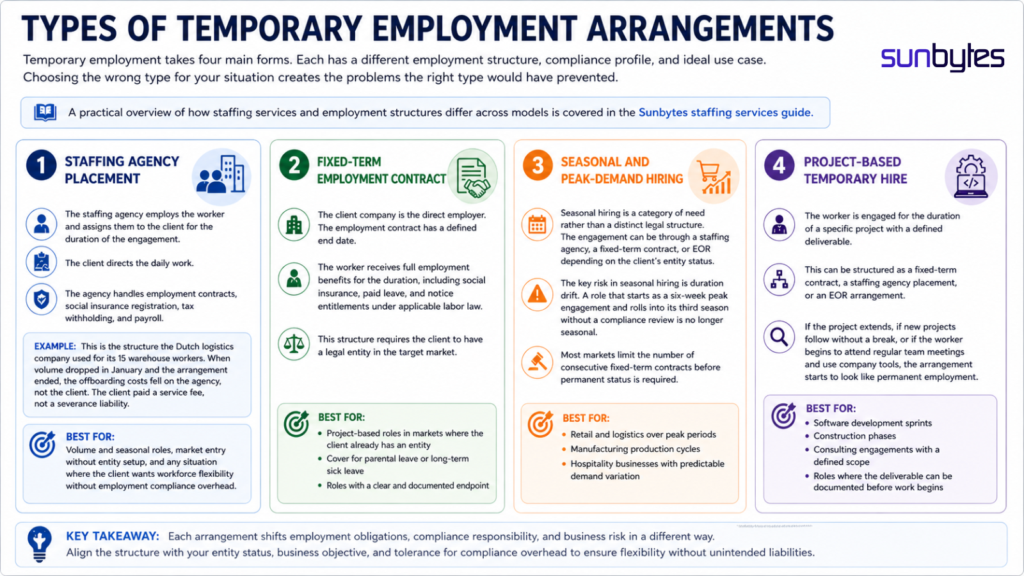
Temporary Employment Arrangements Are Structured into Four Main Types
Staffing agency placement
The staffing agency employs the worker and assigns them to the client for the duration of the engagement. The client directs the daily work. The agency handles employment contracts, social insurance registration, tax withholding, and payroll.
This is the structure the Dutch logistics company used for its 15 warehouse workers. When volume dropped in January and the arrangement ended, the offboarding costs fell on the agency, not the client. The client paid a service fee, not a severance liability.
Best for: Volume and seasonal roles, market entry without entity setup, and any situation where the client wants workforce flexibility without employment compliance overhead.
Learn more: The Definition Of Staffing Service And The Best Option In Vietnam Market
Fixed-term employment contract
The client company is the direct employer. The employment contract has a defined end date. The worker receives full employment benefits for the duration, including social insurance, paid leave, and notice entitlements under applicable labor law.
This structure requires the client to have a legal entity in the target market. It is appropriate when the company already has an HR function capable of managing compliance and the role has a genuinely defined endpoint.
Best for: Project-based roles in markets where the client already has an entity, cover for parental leave or long-term sick leave, and roles with a clear and documented endpoint.
Seasonal and peak-demand hiring
Seasonal hiring is a category of need rather than a distinct legal structure. The engagement can be through a staffing agency, a fixed-term contract, or EOR depending on the client’s entity status.
The key risk in seasonal hiring is duration drift. A role that starts as a six-week peak engagement and rolls into its third season without a compliance review is no longer seasonal. Most markets limit the number of consecutive fixed-term contracts before permanent status is required.
Best for: Retail and logistics over peak periods, manufacturing production cycles, and hospitality businesses with predictable demand variation.
Project-based temporary hire
The worker is engaged for the duration of a specific project with a defined deliverable. This can be structured as a fixed-term contract, a staffing agency placement, or an EOR arrangement.
Project-based temporary hires are common in technology, construction, consulting, and media. If the project extends, if new projects follow without a break, or if the worker begins to attend regular team meetings and use company tools, the arrangement starts to look like permanent employment.
Best for: Software development sprints, construction phases, consulting engagements with a defined scope, and roles where the deliverable can be documented before work begins.
Examples of temporary employees by industry
Temporary employment is not sector-specific. The structures look different across industries, but the underlying mechanics are the same: defined duration, compliance held by whoever holds the employment contract, and an endpoint that is known at the start.
| Industry | Typical temporary hire | Common structure | Typical duration |
|---|---|---|---|
| Manufacturing | Assembly workers, quality technicians | Staffing agency placement | 1 to 6 months, peak-season |
| Technology | Software developers, QA engineers | Fixed-term or EOR | 3 to 12 months, project-based |
| Retail | Sales assistants, stock operatives | Staffing agency placement | 6 to 12 weeks, seasonal |
| Finance | Compliance analysts, audit support | Fixed-term or COR | 3 to 6 months, regulatory cycle |
| Logistics | Warehouse operators, drivers | Staffing agency placement | Q4 peak, 6 to 10 weeks |
| Professional services | Project managers, interim executives | EOR or COR | 6 to 18 months, transition or project |
Benefits of hiring temporary employees for employers
The case for temporary staffing is not just cost. It is the ability to scale headcount in response to actual demand without creating employment obligations that outlast the need that generated them.
A practical comparison of which staffing models work without a local entity is covered in the Sunbytes staffing services guide. The guide explains how temporary staffing, EOR, and COR differ in practice.
Workforce flexibility without long-term commitment
Permanent employment creates obligations that run beyond the role: notice periods, severance calculations, and social insurance deregistration. Temporary staffing through an agency transfers these obligations to the provider. The client pays a service fee for the duration and ends the engagement when the need ends.
Faster time-to-fill for urgent or seasonal roles
Staffing agencies that operate in specific markets hold active talent pools. A provider with an established network in a local industrial zone can fill 30 assembly worker roles in two to three weeks because those candidates are already mapped and available. Recruiting directly without that network takes four to eight weeks for the same result.
Sunbytes typically fills volume roles in Vietnam within 2 to 3 weeks from brief, drawing from an active local talent pool across the major industrial zones.
Reduced permanent headcount cost and severance exposure
Permanent employment carries ongoing cost beyond salary: employer social insurance contributions, statutory leave accrual, and severance provisions if the role ends involuntarily. Temporary staffing through an agency moves these to the agency’s structure. If the need ends, the arrangement ends. The worker does not accrue severance against the client.
Trial period before offering permanent employment
A client that places a worker through a staffing agency for three months before deciding on a permanent offer has run a genuine evaluation under real conditions. Most providers accommodate the conversion with a fee or a step-down in the service arrangement. The trial period reduces the risk of a permanent hire that does not work out.
What employers need to know: legal obligations for temporary workers
The flexibility of temporary employment does not mean the obligations disappear. They shift depending on the structure. How direct hiring compares to agency staffing on compliance responsibility is covered in the direct hiring vs staffing agencies guide.
Equal treatment: temporary vs permanent employee rights
In the EU, the Temporary Agency Work Directive establishes equal treatment after 12 weeks. Pay, working time, rest periods, and access to collective facilities must match what a comparable permanent employee receives. The qualifying period can be reduced by collective agreement in some member states.
The principle applies across most markets with established labor law frameworks. Temporary workers are not a cost-reduction mechanism for permanent roles. They are workers with time-limited contracts who retain statutory protections during the engagement period.
Fixed-term contract limits and renewal rules
Most markets limit the number of consecutive fixed-term contracts before permanent status applies. In the Netherlands, the chain rule limits temporary contracts to three within a two-year period, after which the employment relationship automatically becomes permanent. Similar rules exist across EU member states with varying thresholds.
This rule is often triggered accidentally when companies roll over project or seasonal hires without reviewing the contract history. Planning the conversion or the exit before the limit is reached avoids involuntary permanent employment.
Social insurance obligations for temporary workers
| Structure | Who registers social insurance | Who pays employer contributions | Client direct obligation |
|---|---|---|---|
| Staffing agency placement | Agency registers | Agency pays | None (agency holds employment) |
| Fixed-term contract | Client registers | Client pays | Full compliance, same as permanent |
| EOR | EOR registers | EOR pays, billed to client | None (EOR holds employment) |
| COR | Not applicable | Not applicable | None (no employment relationship) |
How to choose the right temporary employment structure
The right structure depends on your entity status, the engagement duration, and whether the role is genuinely temporary or permanent in practice.
| Your situation | Recommended structure | Why |
|---|---|---|
| No legal entity in target market | EOR | EOR employs on your behalf. No entity setup required. Compliant from day one. |
| High-volume seasonal or peak demand | Staffing agency placement | The agency holds employment. You scale up and down without severance liability. |
| Short project with defined deliverable | Fixed-term contract or EOR | Fixed-term if you have a local entity. EOR if you do not. |
| Specialist contractor, project-based | Contractor of Record (COR) | COR absorbs classification risk. No employment relationship created. |
| Ongoing role, wrong structure in place | Convert to EOR or permanent employment | Rolling temporary contracts for permanent roles create retroactive liability. |
Need temporary workers without the compliance overhead?
Sunbytes manages temporary staffing engagements through its own legal entity, handling social insurance, payroll, and employment compliance so you can scale headcount without building a local HR function.
Explore Accelerate Workforce Solutions
How Sunbytes supports temporary workforce needs
Temporary employment is straightforward when the arrangement ends on schedule. The complications arise when it extends, when compliance was not structured correctly at the start, or when the client has no local entity and tries to hold employment directly in a market without the required infrastructure.
Sunbytes is a Dutch-founded technology and workforce company established in 2011, with more than 300 projects delivered across over 20 countries.
- Through Accelerate Workforce Solutions, Sunbytes employs temporary workers under its own legal entity and manages all statutory responsibilities internally. This includes social insurance, payroll processing, and offboarding. Employment contracts are issued within 48 hours. Payroll is delivered on time in every cycle. Offboarding is completed within 24 hours.
- For companies with short-term demand in engineering or technical operations, Digital Transformation Solutions draws from pre-qualified talent networks. Candidates are identified early in the process, before the employment and compliance structure is finalized.
- Temporary worker data and documentation are exchanged between the client and the staffing entity throughout the engagement. CyberSecurity Solutions ensures that all relevant data protection requirements are applied from the first document exchange and maintained across the full lifecycle.
FAQs
Let’s start with Sunbytes
Let us know your requirements for the team and we will contact you right away.