

As businesses evolve in today’s dynamic market environment, effectively scaling projects remains critical to achieving sustainable growth. IT Staff augmentation, an agile and strategic approach, allows organizations to expand their capabilities by temporarily integrating external specialists directly into their existing teams.
Given its flexibility, this model supports companies in quickly adapting to market changes without the long-term commitments and overheads.
TL;DR
- IT staff augmentation enables businesses to scale engineering teams quickly without long-term hiring risks, helping maintain speed, quality, and full delivery control.
- Through IT resource and staff augmentation, companies can instantly access specialized talent, close critical skill gaps, and reduce engineering time-to-hire from months to weeks.
- At Sunbytes, as a one stop partner, we handle comprehensive talent acquisition, development, and security for your tech projects so you can scale efficiently while staying focused on product growth.
What is IT staff augmentation?
IT staff augmentation is a hiring model where you bring external specialists directly into your team, under your management, inside your sprint, using your tools, for a defined period. The provider handles sourcing, HR, payroll, and compliance. You handle the work.
That distinction matters. With outsourcing, you hand off a deliverable and wait. With staff augmentation, you keep full control over what gets built and how. The external engineer is accountable to you, not to a vendor’s project manager.
When it makes sense: you have an active project, a specific skill gap, and a timeline of 3 to 12 months. You need someone who can start contributing in week one, not month three.
When it doesn’t: your team has no internal capacity to onboard and direct someone new. In that case, a dedicated team or managed delivery model is worth considering instead.
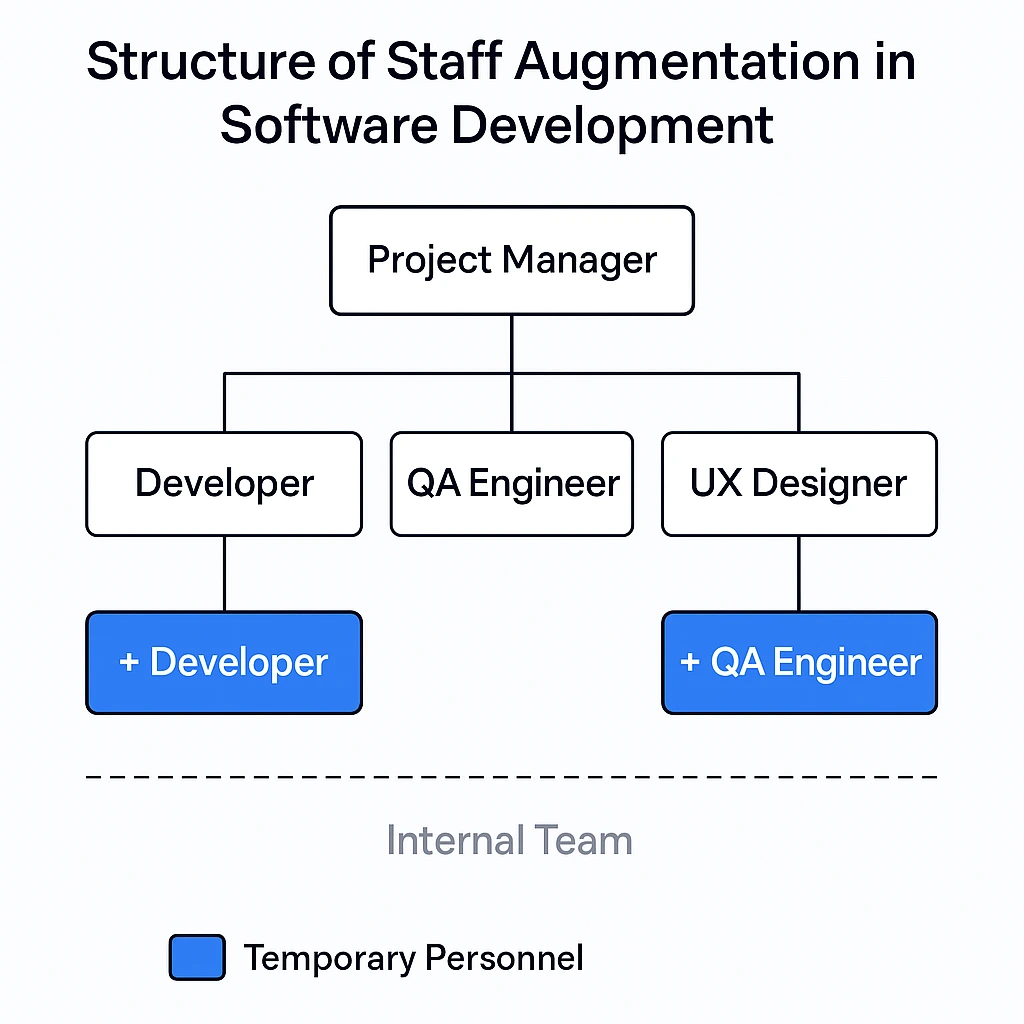
Example of Staff Augmentation Structure
Read more:
The Difference between IT Staff Augmentation, Dedicated Teams, and IT Outsourcing
These three models get conflated constantly. They are not interchangeable.
| Dimension | IT Staff Augmentation | Dedicated Teams | IT Outsourcing |
| Who manages the work | You | You set direction; provider manages team | Vendor owns delivery |
| Team setup | Individual specialists join your team | Full squad: devs, QA, PM | Project or workstream delegated entirely |
| Cost model | Pay per resource, per month | Higher setup; efficient over 12+ months | Low |
| Your control level | Full | High on direction, lower on daily ops | Vendor assumes full responsibility for deliverables and outcomes |
| Time to start | 2–4 weeks per person | 4–8 weeks for full team | Varies |
| Right duration | 3–12 months | 12 months or more | Short task or long project |
If you are still deciding which model fits your situation, this breakdown of IT outsourcing models covers the decision criteria in detail.
Where staff augmentation actually pays off
Not every situation calls for augmentation. The cases below are where it consistently delivers a return. If you want a fuller diagnostic — signals that your team is ready for it versus signals that it will create more friction — read when to use IT staff augmentation.
You are scaling faster than your hiring process
When a product gains traction, internal teams become the bottleneck before the hiring pipeline catches up. Traditional recruitment in the Netherlands runs 60 to 90 days on average. That is too slow when your next sprint starts in two weeks.
Staff augmentation compresses time-to-productivity. A pre-vetted engineer, matched to your stack, can be onboarded and contributing in under three weeks.
You need a skill that does not exist locally
Cloud architecture, ML engineering, security compliance, data platform design — these roles are scarce in most EU markets. Building a local hiring process for a six-month need is rarely worth the cost.
Augmentation gives you access to that skill without the permanent overhead.
You are bridging a gap while a permanent hire is in progress
You have approved the headcount. The job is posted. But your delivery date is in six weeks. An augmented engineer keeps the project moving while the permanent hire goes through the interview process.
You are a startup protecting cash flow
Permanent headcount adds fixed cost before you have confirmed revenue. Staff augmentation is pay-as-you-go: you scale up when the project demands it, scale back when it does not. No redundancy costs, no notice periods. For a more detailed look at how this model compares against building an in-house team, see dedicated teams vs in-house teams.
The financial logic
The pay-per-resource model removes a set of costs that permanent employment always carries: employer tax contributions, equipment, training budget, recruitment fees, office space, and the severance risk if the role is no longer needed in 18 months.
For a six-month senior developer engagement, the total cost difference between augmentation and a direct hire — factoring in recruitment, onboarding lag, and employer costs — is typically 30 to 50% in favour of augmentation. The exact figure depends on seniority, tech stack, and geography.
What the model does not remove: your management overhead. You are still responsible for direction, onboarding quality, and integration with your existing team. If that capacity does not exist internally, the savings disappear in friction.
What actually makes an augmentation engagement work
Most failed engagements share the same root cause: the client treated the augmented engineer as an external contractor rather than a team member. The best practices for staff augmentation cover this in depth. The short version:
- Write the role description before you brief a provider. Vague briefs produce mismatched candidates. Specify: tech stack, seniority level, expected weekly hours, duration, and what good looks like at 30 and 90 days.
- Onboard as if they are permanent. Access, documentation, codebase orientation, team introduction, first sprint goals — all on day one. Engineers who spend their first two weeks waiting for credentials deliver nothing.
- Set measurable outputs. Story points per sprint, PR review turnaround, bug resolution rate. Not because augmented engineers need more monitoring, but because clear KPIs remove ambiguity about whether the engagement is working.
- Include them in the team, not beside it. Retrospectives, standups, architecture discussions. Engineers who understand context make better decisions. Engineers who are kept at arm’s length execute instructions and nothing more.
- Review monthly, not at the end. A 30-day check-in catches misalignment early. A 90-day review catches it too late.
For the ongoing management side, once the engineer is in place and working, how to manage IT staff augmentation for high performance covers the operational detail.
How to select an IT staff augmentation provider
Most providers will send you CVs. Fewer will technically vet the candidates themselves. Fewer still will stay involved after the placement starts.
Questions worth asking before you sign anything:
- Who conducts the technical screening — the provider’s engineers, or a third-party test platform?
- What is the process if the candidate is not the right fit after two weeks?
- Does the provider have experience in your specific tech domain, or do they cover everything broadly?
- What does their standard DPA look like for EU client engagements?
- Is there a dedicated account lead, or do you communicate through a ticket system?
For Dutch and EU companies, two additional checks matter. First: does the provider operate under GDPR with Standard Contractual Clauses in place for any cross-border data flows? Second: who owns the IP produced by the augmented engineer? It should always be you. Confirm this in the contract before work begins.
If you want a structured way to run this evaluation, the checklist for finding reliable IT staff augmentation companies gives you a step-by-step framework.

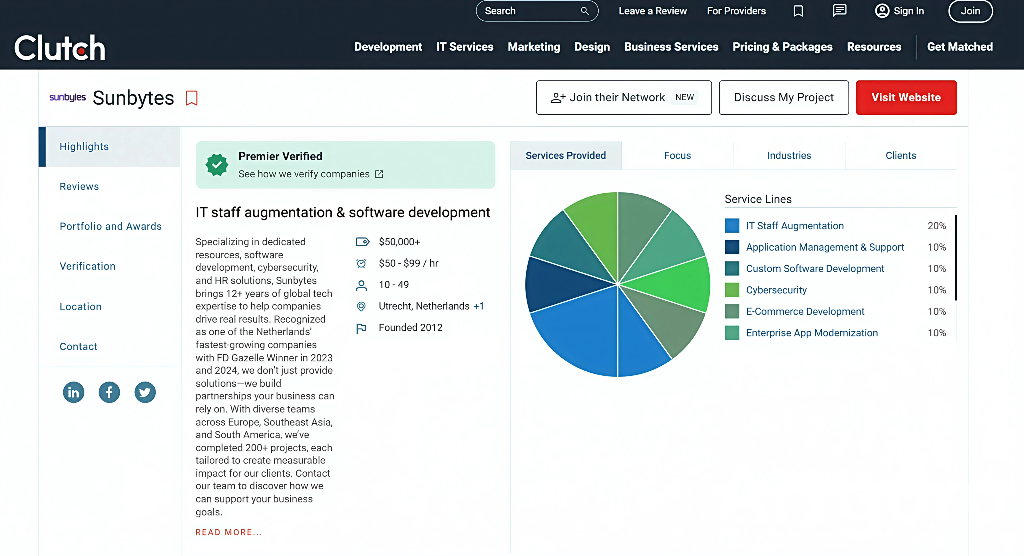
Working with a Vietnam-based provider from the Netherlands
Sunbytes operates with engineering teams in Ho Chi Minh City and account management based in the Netherlands. For Dutch clients, the practical questions are usually the same:
- Timezone: Vietnam is GMT+7. With NL on GMT+1 or GMT+2, there are 4 to 5 hours of overlap during the NL workday. That is enough for a daily standup, sprint ceremonies, and same-day feedback on pull requests. It is not enough if your process requires continuous real-time collaboration.
- Language: English is the working language for all technical communication. Dutch client-facing communication goes through the NL account team.
- Compliance: All Sunbytes engagements operate under a signed DPA. Cross-border NL–VN data flows are covered by Standard Contractual Clauses under GDPR Article 46. IP is assigned to the client as standard.
- Cost: Vietnam-based senior engineers are typically 40 to 60% more cost-effective than Netherlands-based equivalents at the same experience level. Sunbytes developers carry an average of seven or more years of experience. The company is ISO 27001 certified.
Implementation: what the first 30 days should look like
- Week 1: Role definition signed off internally. Brief sent to provider. Technical screening begins.
- Week 2: Candidate shortlist reviewed. Technical interview with your engineering lead. Decision made.
- Week 3: Onboarding starts. Access provisioned. Codebase walkthrough. First sprint planned together.
- Week 4: First deliverables reviewed. Early feedback given. Rhythm established.
The 30-day mark is the right time to ask: is this person contributing at the level we expected? If not, is the issue the candidate, the onboarding, or the brief? Most problems at this stage trace back to the brief.
Ready to design the right team?
Tell us the role, the stack, and the timeline. We will come back within 24 hours with matched candidates and a concrete proposal. Contact Sunbytes!