

Technical debt rarely shows up on a balance sheet, but it quietly slows delivery, inflates costs, and increases risk with every release. Research shows that technical debt can cost up to $306,000 per year per 1M lines of code, consuming thousands of engineering hours that could otherwise drive innovation.
Over time, what once enabled speed becomes the very thing that blocks it, causing missed deadlines, fragile systems, and frustrated engineers. Most organizations don’t lack talent; they lack a clear way to see, measure, and control the debt they’ve already built.
This article will walk you through how to identify, quantify, and systematically reduce technical debt to restore velocity, improve system reliability, and scale with confidence.
TL;DR
- Technical debt is the “interest” paid in future rework when choosing a quick, sub-optimal solution today over a better long-term approach.
- It falls into a Technical Debt Quadrant (Deliberate vs. Inadvertent) and spans several functional domains, including code, architecture, infrastructure, and even “people debt” caused by knowledge silos.
- Detecting debt requires a systematic audit: use static code analysis for “code smells,” monitor testing metrics, and calculate your Technical Debt Ratio (TDR) to quantify the scope of the problem.
- Unmanaged debt leads to slower release cycles, security vulnerabilities, and decreased developer morale/talent retention.
- Effective reduction involves strategic refactoring, creating a dedicated debt backlog, and allocating a fifth of every sprint to paying down debt to maintain long-term velocity.
- In the AI era, teams can accelerate technical debt management by leveraging AI for code analysis, automated refactoring suggestions, and faster root-cause detection, turning reactive cleanup into a more proactive, data-driven process.
What is technical debt?
Technical debt is the hidden cost of choosing speed over sustainability in software development. The term was first introduced by Ward Cunningham to describe a simple idea: when teams take shortcuts to deliver faster today, they incur “interest” in the form of extra work later.
In practice, this means writing code that works now, but is harder to maintain, scale, or extend in the future. That “interest” shows up as slower releases, more bugs, and increasing complexity over time.
Not all technical debt is bad. While Good (deliberate) debt is a strategic trade-off, shipping fast to validate an idea, with a clear plan to refactor later, Bad (unintentional) debt happens when teams lack time, standards, or expertise—leading to messy systems that compound problems over time.

What are the Different Types of Technical Debt?
Technical debt takes different forms depending on why it was created and where it exists in your system, understanding both dimensions is key to managing it effectively. It falls into two high-level categories based on intent: Strategic and Functional Categorization.
1. Strategic Categorization
This dimension focuses on intent, whether the debt was a conscious trade-off or an unintended consequence.
- Deliberate (Planned) Debt: This is a strategic decision. Teams knowingly take shortcuts to meet deadlines, validate ideas, or respond to market pressure, fully aware that cleanup will be required later. Done right, this can be a growth enabler. Done poorly (without a plan to repay), it becomes a long-term liability that compounds quickly.
- Inadvertent (Unintentional) Debt: This type of debt emerges without clear intent, often due to lack of experience, unclear requirements, or evolving technologies.
It’s more dangerous because it’s usually invisible until it causes friction, teams don’t realize the cost until systems become harder to maintain, extend, or debug.
2. Functional Categorization
While strategic intent explains why debt exists, functional categorization shows where it lives, and where it slows you down. It can be categorised into 4 specific kinds: Implementation & Quality Debt, Architectural & Structural Debt, Documentation & Requirements Debt, and Operational & Human Debt.
A. Implementation & Quality Debt
This is the most visible and commonly recognized form of technical debt, it sits directly in the codebase and affects day-to-day development.
- Code & Design Debt: Poorly structured code, inconsistent patterns, and quick fixes that ignore long-term maintainability. Over time, even small changes require disproportionate effort because the system lacks clarity and cohesion.
- Defect Debt: Known bugs that are intentionally deferred. While acceptable in the short term, they accumulate and create instability, especially when new features are built on top of unresolved issues.
- Test & Test Automation Debt: Missing unit tests, low test coverage, or outdated automation frameworks. This slows down QA, reduces confidence in releases, and increases the risk of regression with every deployment.
B. Architectural & Structural Debt
This layer is deeper, and more expensive to fix. It affects how the system is designed and how components interact at scale.
- Architecture Debt : Fundamental flaws in system design, tight coupling, poor scalability, or outdated patterns. These issues limit flexibility and often require significant rework, such as application modernization, to resolve.
- Service & Infrastructure Debt: Legacy infrastructure, misconfigured cloud environments, or inefficient service communication (especially in microservices). This leads to performance issues, higher operational costs, and increased failure risk.
- Build & Deployment Debt: Inefficiencies in CI/CD pipelines, manual steps, slow build times, or unreliable deployments. This directly impacts release velocity and makes continuous delivery difficult to sustain.
C. Documentation & Requirements Debt
This type of debt is less visible in code but equally damaging, it creates confusion and misalignment across teams.
- Documentation Debt: Missing, outdated, or inconsistent documentation (e.g., APIs, system architecture, onboarding materials). This increases dependency on individuals and slows down knowledge transfer.
- Requirement Debt: Features built on incomplete, ambiguous, or constantly shifting requirements. This often leads to rework, misaligned expectations, and products that don’t fully meet business needs.
D. Operational & Human Debt
Technical debt doesn’t just live in systems, it lives in how teams operate.
- People Debt: Knowledge silos where critical information is held by a few individuals. This creates risk, reduces scalability, and slows down onboarding or problem resolution.
- Process Debt: Inefficient workflows, lack of agile discipline, or poor communication practices. Even with strong engineering, weak processes can create friction that compounds over time.
The goal is not just to identify debt, but to pinpoint where it originates and how it spreads, so you can address the root cause, not just the symptoms.
What are the Causes of Technical Debt?
Most organizations don’t create debt because they want to, but because speed, uncertainty, and misalignment make it inevitable. Here are 5 most common root causes leading to technical debt:
1. Business Pressures and Tight Deadlines
The most common driver is speed. Teams are pushed to ship faster to meet market demands, satisfy stakeholders, or hit revenue targets.
In these situations, writing “good enough” code becomes the default. While this accelerates short-term delivery, it often bypasses proper design, testing, and documentation—creating debt that must be paid later with interest.
2. Lack of Documentation and Standards
Without clear coding standards, architectural guidelines, or up-to-date documentation, teams make inconsistent decisions.
Over time, this leads to fragmented systems where different parts of the codebase follow different logic, patterns, or assumptions, making maintenance and scaling significantly harder.
3. Lack of Skill or Knowledge Sharing
Technical debt often reflects gaps in expertise. Less experienced developers may choose suboptimal solutions, while more experienced team members may not have time to review or mentor.
When knowledge is not shared effectively, teams repeat mistakes, duplicate work, and create dependencies on specific individuals.
4. Poor Initial Architecture Choices
Early-stage decisions made under uncertainty can become long-term constraints. Choosing the wrong architecture, overengineering too early, or underestimating scalability needs can result in systems that are difficult to extend or integrate, forcing costly rework down the line.
5. Delayed Refactoring
Refactoring is often deprioritized in favor of new feature development. What starts as a temporary workaround becomes permanent as teams move on to the next task. Over time, these unresolved issues accumulate, increasing system complexity and slowing future development.
6. Technical Dept in the AI era
AI is accelerating development, but also amplifying technical debt when used without control. Recent research shows that over 15% of AI-generated code commits introduce issues, with nearly a quarter of those persisting over time, contributing directly to long-term technical debt.
Code generated by AI tools can introduce inconsistencies, hidden bugs, or misaligned patterns if not properly reviewed and integrated. At the same time, rapidly evolving AI stacks and tools can lead to premature adoption and unstable architectures.
Without clear governance, AI shifts technical debt from being human-made and visible to machine-assisted and harder to detect, making disciplined review, standardization, and oversight more critical than ever.

What are the warning signs of technical debt?
Technical debt rarely announces itself, it shows up as friction. If your team is slowing down despite doing more work, chances are the system is carrying more debt than you can see. There are 4 warning signs of technical debt for you to be aware:
- Longer release cycles: What used to take days now takes weeks. Small changes require extensive testing, coordination, or rework because the system is no longer predictable.
- Increasing number of bugs in “fixed” features: Issues keep resurfacing in areas that were already resolved. This is a sign of fragile code, poor test coverage, or deeper architectural problems.
- Developer frustration and burnout: Engineers spend more time debugging than building. Morale drops as simple tasks become unnecessarily complex, leading to disengagement and higher turnover risk.
- “Code Smells” and rigidity in the codebase: The system becomes harder to modify, tight coupling, duplicated logic, and unclear structure make even minor updates risky and time-consuming.
These signals often appear gradually. The earlier you recognize them, the easier it is to intervene before technical debt starts to impact delivery, cost, and team performance at scale.
What are the Hidden Consequences of Technical Debt?
Technical debt quietly reshapes how your entire organization operates. The real cost isn’t in the code itself, but in the compounding impact on speed, decision-making, and long-term competitiveness. Some hidden consequences include:
- Reduced Agility and Velocity: At first, the impact feels small, slightly longer development cycles, more dependencies between teams. But over time, every change requires more coordination, more testing, and more caution.
Launching new features, entering new markets, or integrating with partners becomes harder, not because the ideas are complex, but because your system can’t adapt fast enough. - Higher Maintenance Costs: Engineering teams spend 25–42% of their time dealing with technical debt, significantly reducing capacity for new development. Technical debt shifts engineering effort away from innovation into maintenance. Instead of building new capabilities, teams spend increasing time Fixing regressions, Navigating legacy code, and Working around system limitations. This creates a hidden tax on every new initiative.
- Security Vulnerabilities: Technical debt weakens your security posture not through a single failure, but through accumulated exposure, making it harder to enforce standards, apply patches, or conduct reliable code reviews. In many cases, vulnerabilities persist not because they are unknown, but because the system is too complex or fragile to safely fix.
- Decreased Team Morale and Talent Retention: Engineers want to build, not constantly fix. When most of their time is spent dealing with brittle systems and unclear logic, frustration builds quickly. Over time, this leads to: Lower productivity, Reduced ownership, and Higher turnover. And when experienced developers leave, they take critical system knowledge with them, amplifying the very debt that caused the problem in the first place.
What is the Step-by-Step Process to Identify Technical Debt?
To spot technical debt, follow this 5-step process:
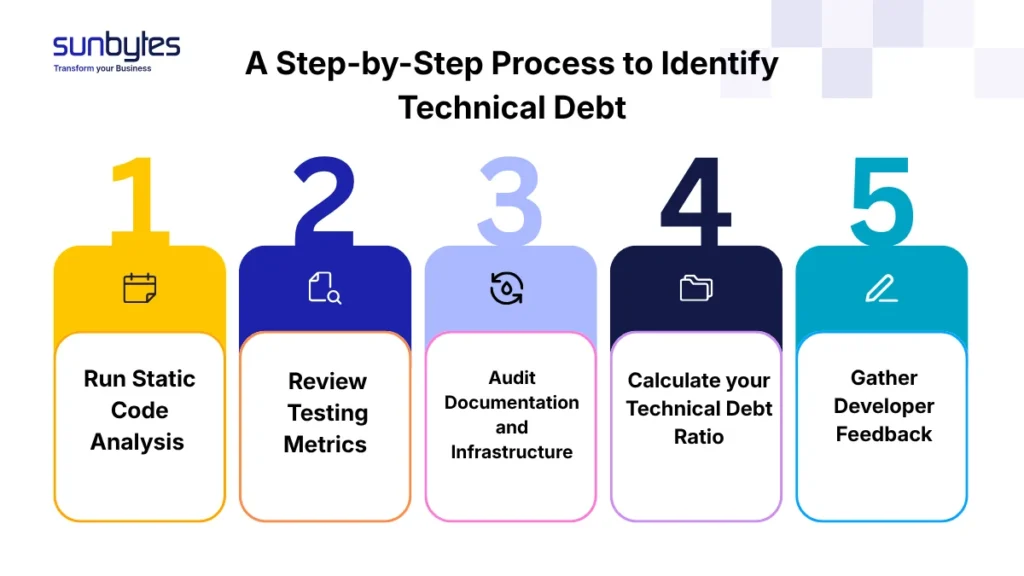
Step 1: Run Static Code Analysis
Start at the code level. Use static analysis tools to scan for:
- Code smells
- Duplicated logic
- Complexity hotspots
This gives you a baseline view of implementation debt, highlighting areas where maintainability is already compromised. More importantly, it helps you move from subjective opinions (“this code feels messy”) to objective, measurable issues.
Step 2: Review Testing Metrics
Next, assess how reliable your system actually is. Look at:
- Bug density
- Test coverage
- Regression frequency
Low coverage or frequent regressions signal hidden debt, especially in areas where changes consistently break existing functionality. This step reveals where your system lacks safety nets, making every release riskier.
Step 3: Audit Documentation & Infrastructure
Technical debt often lives outside the codebase. Review:
- API documentation
- System architecture diagrams
- Infrastructure configurations
- CI/CD pipelines
Gaps or inconsistencies here create friction across teams, slowing onboarding, increasing dependency on individuals, and making systems harder to evolve.
Step 4: Calculate your Technical Debt Ratio (TDR)
To understand the scale of the problem, you need a quantifiable metric. The Technical Debt Ratio compares:
- The cost to fix existing issues
- The cost to build the system
A higher TDR indicates that a significant portion of your engineering effort is tied up in resolving past decisions rather than creating new value. This helps leadership prioritize debt reduction as a business decision, not just a technical one.
Step 5: Gather Developer Feedback
Finally, talk to the people closest to the system. Engineers can quickly identify:
- Fragile components
- Bottlenecks in workflows
- Areas they actively avoid touching
This qualitative input is critical, it surfaces issues that tools can’t detect, especially around architecture, processes, and team dynamics.
Identifying technical debt is not a one-time audit. It’s an ongoing discipline that combines automated insights with human experience, giving you a clear, actionable view of where debt exists and where it hurts the most.
If navigating these steps feels overwhelming, Sunbytes’ expert development teams can perform a comprehensive audit to help you prioritize and resolve your most critical technical debt.
How to Manage and Reduce Technical Debt
The goal isn’t to eliminate technical debt completely, but to control it systematically so it doesn’t erode your delivery speed and product quality over time. Here are 5 approaches you can consider:
1. Creating a Technical Debt Backlog
If debt isn’t visible, it won’t be prioritized. Treat technical debt like any other work by maintaining a dedicated backlog:
- Log issues as they are discovered
- Categorize by impact (velocity, risk, cost)
- Prioritize alongside feature development
This shifts debt from being an afterthought to a managed, trackable asset.
2. The “Boy Scout Rule”
Small, consistent improvements prevent large-scale problems. The principle is simple: leave the code cleaner than you found it.
This approach:
- Reduces accumulation of new debt
- Encourages ownership across the team
- Embeds quality into daily development, not just dedicated refactoring cycles
Over time, these incremental changes compound into meaningful system improvements.
3. Strategic Refactoring.
Not all debt should be addressed immediately. The key is to refactor with intent, not reactively.
Focus on:
- High-impact areas (frequently changed or business-critical components)
- Bottlenecks that slow down delivery
- Fragile modules that introduce recurring bugs
While refactoring helps at the code level, larger structural issues often require a more holistic approach. Explore more about how app modernization reduces technical debt.
4. Automated Testing and CI/CD Integration
Speed without reliability creates more debt. Strong testing and automation ensure that improvements don’t introduce new problems.
Key practices include:
- Expanding unit and integration test coverage
- Automating regression testing
- Streamlining CI/CD pipelines for faster, more reliable releases
This creates a safety net, allowing teams to refactor and iterate with confidence.
Explore more:
- What is Automated Testing
- What is the difference between Automated vs Manual Testing
5. Manage Tech Debt with AI
AI is changing how teams approach technical debt, but only when used deliberately. Applied correctly, AI can:
- Detect code smells and anomalies faster
- Suggest refactoring opportunities
- Identify root causes across large codebases
This shifts debt management from reactive cleanup to proactive, data-driven optimization.
However, without proper review and governance, AI can also introduce inconsistencies, so it must be integrated into a controlled, well-defined engineering process.
If you want a deeper breakdown, explore our guide on How to Manage Tech Debt in the AI Era, where we detail how to operationalize AI without introducing a new layer of risk.
How Sunbytes Can Help You Manage Technical Debt
Managing technical debt requires more than ad-hoc fixes, it demands a structured approach, the right expertise, and consistent execution. Sunbytes helps organizations minimize technical debt from the start by embedding best practices in architecture, development, and testing—so teams can move fast without compromising long-term system health. When debt already exists, we provide dedicated engineering support to assess, prioritize, and resolve critical issues without disrupting your core product roadmap.
Beyond short-term fixes, Sunbytes enables organizations to address technical debt at scale. Whether it’s refactoring legacy systems, improving CI/CD pipelines, or modernizing architecture, we help transform fragmented, high-maintenance systems into scalable platforms. This approach not only reduces operational friction but also prevents the hidden 10–20% cost increase that technical debt adds to every new feature and release.
Why Sunbytes?
With 15 years of experience supporting global clients, Sunbytes combines strategic thinking with hands-on execution—helping teams turn technical challenges into scalable, secure, and high-performing systems by our three main pillars:
- Digital Transformation Solutions: We design, build, and modernize digital products with senior engineering teams—covering custom development, QA/testing, and ongoing maintenance—so your systems evolve without accumulating unnecessary debt.
- Cybersecurity Solutions: We strengthen your security posture through practical, integrated services—reducing risk and ensuring compliance without slowing down development or delivery speed.
- Accelerate Workforce Solutions: We help you scale efficiently by providing the right talent and team structures—ensuring you have the capacity and expertise to manage technical debt while continuing to grow.
If technical debt is slowing your roadmap or increasing delivery risk, now is the time to take control. Contact Sunbytes to assess your current state and build a clear, actionable path forward.
FAQs
Technical debt is not inherently bad, it depends on how it’s used. Deliberate technical debt can be a strategic tool to accelerate time-to-market or validate ideas quickly. However, when left unmanaged or created unintentionally, it becomes a liability that slows development, increases costs, and introduces risk. The key is to take on debt intentionally and repay it systematically.
The 80/20 rule suggests that a small portion of your system (around 20%) is responsible for the majority (80%) of your technical debt impact. In practice, this means you don’t need to fix everything—focus on:
- High-impact modules
- Frequently changed components
- Areas causing recurring issues
Targeting these hotspots delivers the highest return on effort.
A common benchmark is allocating 10–20% of each sprint to technical debt reduction. However, the right number depends on your current situation:
- Low debt → maintain with small, continuous improvements
- High debt → may require dedicated sprints or a focused team
The goal is consistency, small, regular investment prevents large, disruptive overhauls later.
Technical debt is sometimes referred to as:
- Code debt
- Design debt
- Engineering debt
While the terms vary, they all point to the same concept: the future cost created by suboptimal technical decisions made today.
Let’s start with Sunbytes
Let us know your requirements for the team and we will contact you right away.


