

AI coding tools can create technical debt when a team accepts generated code faster than it reviews, tests and documents it, and most of that debt does not look broken. AI technical debt shows up as code that works in production but that nobody on the team can explain, change safely or trace back to a decision. The risk rises when a product moves from a vibe coding prototype to paying users without an independent check of the code, dependencies and critical user flows.
This article covers four practical types of AI technical debt, a five-step framework, the KPIs to track and the signals that call for outside help. For the wider picture, see the founder’s guide to AI-generated code in production.
TL;DR
AI technical debt is the future cost of changing code that an AI tool produced faster than your team could understand, test or document it. Technical debt is the extra work you pay later for a shortcut taken now, a metaphor from Ward Cunningham’s 1992 OOPSLA experience report. Teams manage AI technical debt by listing it, ranking it by business risk, adding review guardrails and fixing it in planned lanes.
- AI technical debt takes four practical forms: comprehension debt, hidden dependency debt and pattern divergence debt in any AI-assisted codebase, plus model obsolescence debt in products that call an AI model at runtime.
- A five-step framework keeps the debt under control: build an AI debt inventory, prioritise by business risk, add AI-specific review and documentation guardrails, create remediation lanes and set a monthly review cadence for the debt backlog.
- Five KPIs show whether the debt is shrinking: review overhead, maintenance friction, knowledge concentration, dependency and security exposure, and delivery impact. Act when one moves the wrong way two months in a row.
- Outside help is useful when critical modules have no clear owner, security evidence is missing for a customer or supplier review, or the remediation work exceeds what the team can absorb in two quarters.
Does AI cause technical debt?
AI coding tools cause technical debt when they add code faster than a team reviews, tests and documents it. GitClear’s 2026 Maintainability Gap analysis of 623 million code changes found that copy/pasted lines rose from 9.4% of changed lines in 2022 to 15.7% in the first half of 2026. Over the same period, moved code, the clearest signal of refactoring, fell from 21% to 3.8% of changed lines. More new code is being added, and less existing code is being cleaned up.
Technical debt is the extra effort a team pays later because of a shortcut taken earlier, such as skipping tests or copying a function instead of reusing it. A refactor changes the structure of code without changing what it does, and it is the usual way to pay that debt down. The classic causes and types are covered in the guide to identifying and managing technical debt. AI-generated code adds new causes on top of those.
How AI-generated code compounds technical debt
AI-generated code can compound technical debt when the assistant uses the existing codebase as context. Assistants that read the surrounding files tend to reuse the patterns they find, including the inconsistent ones, so one shortcut can become the template for the next files. Duplicated logic also multiplies the cost of every fix: a bug in copied code has to be fixed in every copy, and a missed copy becomes a regression, a bug that breaks something that used to work.
The compounding slows when every AI-written change passes the same review, test and documentation bar as code written by hand. It speeds up when output volume rises and that bar stays where it was.
What are the four types of AI technical debt?
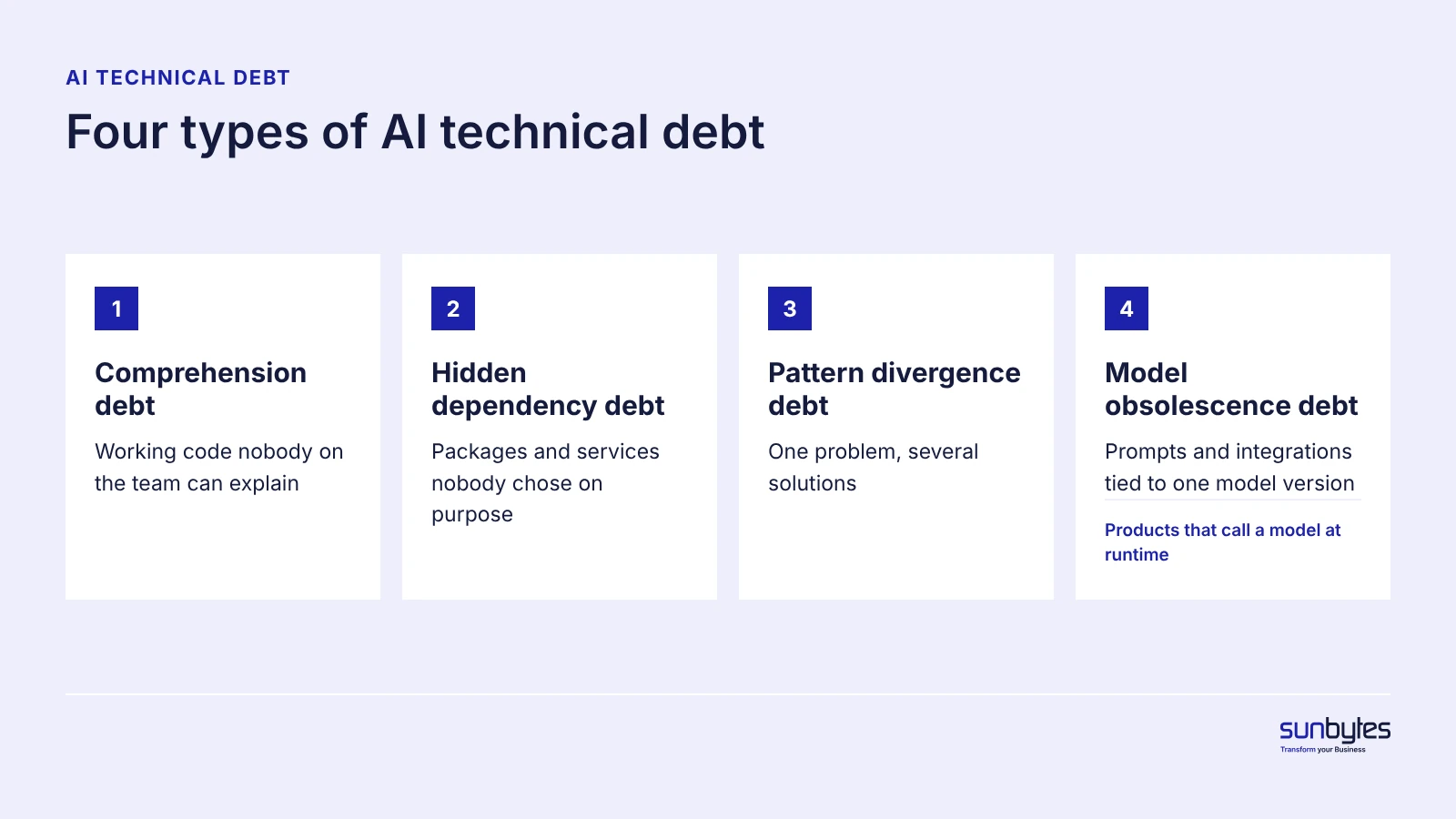
AI technical debt falls into four practical types: comprehension debt, hidden dependency debt, pattern divergence debt and model obsolescence debt. The first three apply to any codebase that an AI tool helped write; model obsolescence debt applies only when the product calls an AI model while it runs. Each type has its own early signal and first fix, set out in Table 1.
Comprehension debt
Comprehension debt is code in production that nobody on the current team can explain, such as a payment webhook that retries three times for reasons nobody knows. The cost appears when that code has to change. In the Stack Overflow 2025 Developer Survey, 66% of respondents cited AI solutions that were almost right as a frustration, while 45% said debugging AI-generated code was more time-consuming. The early signal is a code review where the only answer to “why does this work?” is “the AI wrote it”.
Hidden dependency debt
Hidden dependency debt is the libraries, packages and services that an AI tool added without anyone choosing them on purpose, such as three date libraries in one repository. Some suggested packages do not exist at all: a USENIX Security 2025 study on package hallucinations of 576,000 generated code samples found that 5.2% of packages recommended by commercial models, and 21.7% of those from open-source models, were invented. Attackers can register those invented names, so an unchecked install turns a debt item into a security finding.
Pattern divergence debt
Pattern divergence debt is the same problem solved in several different ways across one codebase. An AI-built product often has four ways to validate an email address, three error-handling styles and two competing approaches to user permissions, each generated in a different session. GitClear’s 2026 data shows duplicated code blocks, runs of five or more repeated lines, rising from 40.3 per million changed lines in 2023 to 73.0 in 2026 so far, an 81% increase. Because many companies build with the same few models, one flawed pattern can also appear in many codebases at once; one agreed pattern per problem means that flaw is fixed in one place.
Model obsolescence debt
Model obsolescence debt applies when a product depends on an AI model at runtime: prompts, response handling and integrations can fail or change behaviour when a model version is retired. It does not apply in the same way to code that was written with AI but runs without calling a model. OpenAI’s API deprecations page gives generally available models at least six months’ notice, specialised variants at least three months and preview models as little as two weeks, and safety or compliance issues can shorten those timelines. Record the model version, owner, replacement options and deprecation notices, and test migrations before the retirement date.
| Type | What it looks like | Early signal | First fix |
|---|---|---|---|
| Comprehension debt | Working code nobody on the team can explain | Review answers such as “the AI wrote it” | Written explanation and tests for each critical flow |
| Hidden dependency debt | Packages and services nobody chose on purpose | Duplicate or unmaintained libraries in the lock file | Approved dependency list; remove duplicates |
| Pattern divergence debt | One problem, several solutions | A fix that has to be applied in many places | One agreed pattern per problem; refactor towards it |
| Model obsolescence debt (products that call a model at runtime) | Prompts and integrations tied to one model version | No record of which model version a live feature calls | Model register with owner, replacement option and deprecation alerts |
How does AI technical debt affect the business?
AI technical debt reaches the business through slower feature delivery, more failed releases and security findings that stall larger deals. The 2024 DORA report found that a 25% increase in AI adoption was associated with an estimated 7.2% drop in delivery stability and a 1.5% drop in delivery throughput. DORA (DevOps Research and Assessment) is Google Cloud’s long-running research programme on software delivery performance. Lower stability means more releases that have to be rolled back or patched, and each one takes time from the roadmap.
For a founder or COO, the impact shows up in three places. The roadmap slips because engineers spend sprints on fixes instead of features. Customer trust drops when releases break things users depend on. Sales cycles stretch when a larger customer sends a security questionnaire and the team cannot say what its own code depends on.
How do you estimate AI technical debt in your own product?
No public study measures the total technical debt that AI tools create, so estimate it from your own codebase rather than from a headline percentage. Rate each module on four points: criticality (whether it handles payments, login, personal data or a core workflow), test coverage of its critical paths, ownership (whether a named person can explain and change it) and estimated remediation effort in engineering days. Criticality and ownership set the order; the effort estimates, added up, give the size of the debt in engineering days rather than as an abstract score. A critical module with low test coverage and no owner goes to the top of the list whatever its effort, and the AI debt inventory in step one of the five-step framework records these four points for every module.
How do you manage AI technical debt?
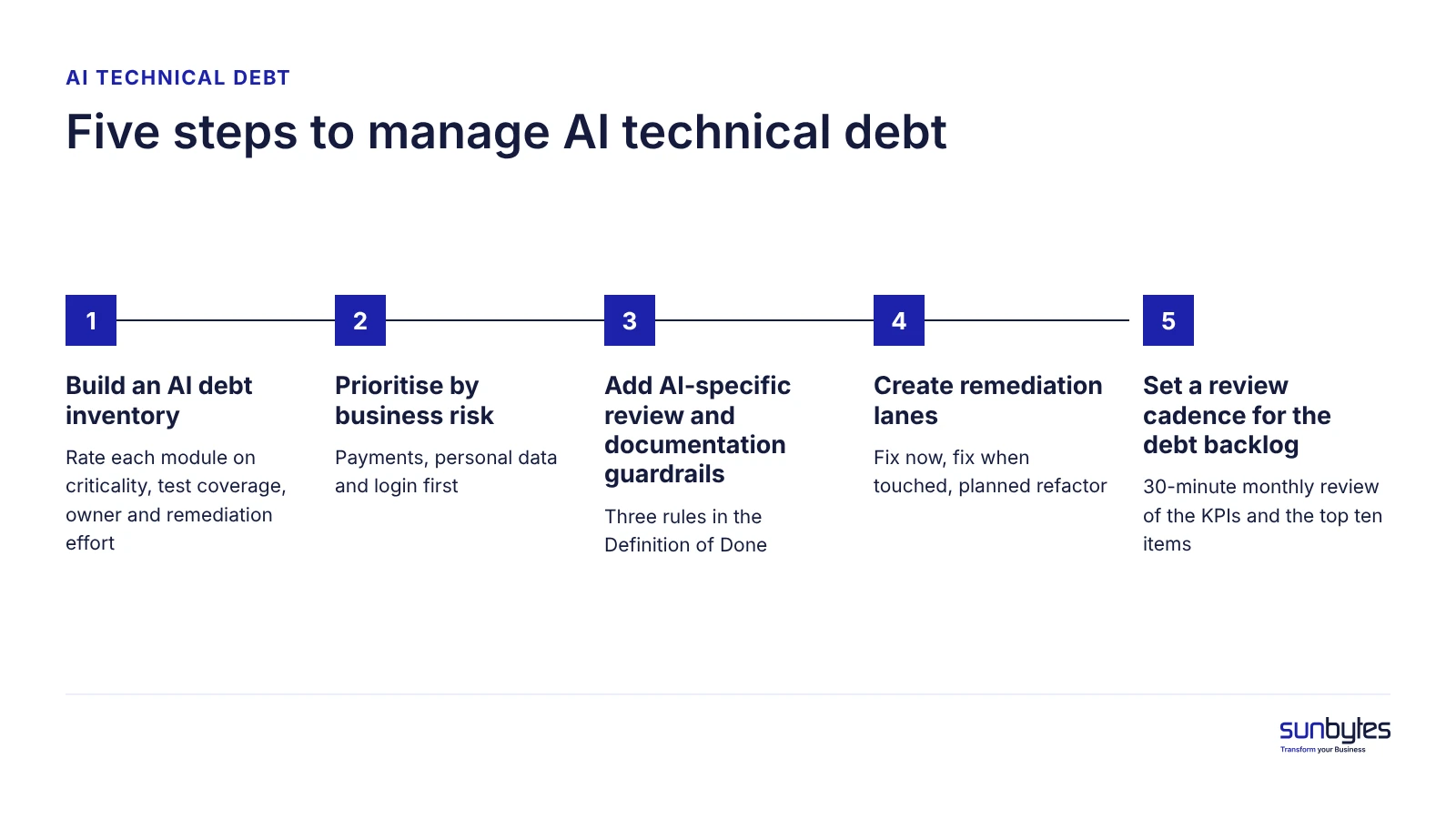
Teams manage AI technical debt with a five-step framework: build an AI debt inventory, prioritise by business risk, add AI-specific review and documentation guardrails, create remediation lanes and set a review cadence for the debt backlog. Three things need to be in place before step one: access to the full repository, the production incident log for the last 90 days and one named person who owns the result. As a planning example for a small codebase, steps one and two take about two weeks; larger products need longer, and steps three to five then run continuously.
1. Build an AI debt inventory
An AI debt inventory is a list of every module in the product, rated against the four debt types. Record each module’s criticality, test coverage, owner and estimated remediation effort, plus its dependencies and whether an AI tool wrote most of it. The inventory is done when every module has a rating and an owner, and the most common mistake is listing only the modules that already cause incidents, because quiet modules carry debt too.
2. Prioritise by business risk
Prioritising by business risk means ranking each debt item by what breaks if it fails, not by how untidy the code looks. Put modules that handle payments, personal data or login at the top, followed by modules that change every sprint. NIS2 Directive Article 21(2)(e) requires covered essential and important entities to manage security in the acquisition, development and maintenance of their systems, including vulnerability handling. Software suppliers to those entities may face the same expectations through contracts and procurement, and code that processes personal data also falls under GDPR Article 32.
3. Add AI-specific review and documentation guardrails
AI-specific guardrails are rules that stop new debt from entering while the old debt is paid down. Three rules cover most cases: every AI-generated change has a human reviewer who can explain it, new dependencies need approval against an agreed list, and each pull request records which AI tool and model produced the code. Add the three rules to the team’s Definition of Done, so a change that fails one goes back however urgent the feature.
Tools catch known patterns while people judge intent and design, as the comparison of automated and manual code review explains. For payment, login and personal data flows, a secure code review by specialists adds the security layer that a feature review does not cover.
4. Create remediation lanes
Remediation lanes sort fixes by urgency. A “fix now” lane takes confirmed high-risk issues, ranked by exploitability, data sensitivity, exposure and business impact. A “fix when touched” lane cleans up modules the next time a feature changes them. A “planned refactor” lane holds structural work, often with the strangler fig pattern: new code is built around the old module and replaces it piece by piece, so feature work never stops for a rewrite.
5. Set a review cadence for the debt backlog
A 30-minute monthly review of the KPIs and the top ten debt items keeps the backlog visible for most SME teams, with an independent check before a major release. The cadence matters because AI magnifies the habits a team already has: the 2025 DORA report describes AI’s primary role in software development as an amplifier of an organisation’s existing strengths and weaknesses.
| If your team cannot explain a critical flow or produce evidence for a customer security review, start with an independent AI-built product review. You receive prioritized findings and can decide whether to fix them in-house or bring in delivery support. |
Which KPIs matter for AI technical debt?
Five KPIs show whether AI technical debt is shrinking: review overhead, maintenance friction, knowledge concentration, dependency and security exposure, and delivery impact. Set a baseline for each in the first 30 days and act when a KPI moves the wrong way two months in a row. Delivery impact uses two of DORA’s software delivery metrics, change failure rate and recovery time, because the 2024 DORA report linked higher AI adoption to lower delivery stability.
| KPI | What it measures | Warning sign |
|---|---|---|
| Review overhead | Time from opening a pull request to approval, plus rework comments per AI-assisted change | Rising for two months: reviewers struggle to understand what they approve |
| Maintenance friction | Engineering days per sprint spent on fixes, workarounds and rework, taken from the sprint board | A growing share of each sprint goes to unplanned work |
| Knowledge concentration | Critical modules that only one person, or nobody, can explain | Any critical module that nobody can explain |
| Dependency and security exposure | Unpinned, unmaintained or unapproved packages, plus open critical findings and days open | Critical findings open for longer than one sprint |
| Delivery impact | DORA change failure rate and time to recover from a failed release | Either metric rising while release volume stays flat |
Where does AI help reduce technical debt?
AI coding tools help reduce technical debt on narrow, well-defined tasks where a human checks each result: explaining unfamiliar code, writing missing tests, drafting documentation and suggesting small refactors. The 2024 DORA report associated a 25% increase in AI adoption with a 7.5% increase in documentation quality, a 3.4% increase in code quality and a 3.1% increase in code review speed. Those gains matter most for comprehension debt, the type that depends most on explanation and documentation.
Can AI suggest small incremental refactors that fit a tech debt roadmap?
AI can suggest small incremental refactors that fit a technical debt roadmap when each roadmap item is specific: one module, one target pattern and a set of tests that must still pass afterwards. A prompt such as “move all email validation in the billing module to the shared validator and keep every existing test green” gives the tool a clear boundary, and a human still approves each change. AI suggestions are a poor fit for changes that cross several modules or alter the data model, where one wrong step creates more debt than it removes.
Where does AI make technical debt worse?
AI makes technical debt worse when it writes large volumes of code that nobody reviews line by line, especially in agent workflows that change many files in one run. In the SusVibes benchmark (ICML 2026), 57% of the tested solutions from SWE-Agent with Claude 4 Sonnet were functionally correct, while only 11.8% met the benchmark’s security criteria. The result comes from 186 security-sensitive tasks, not a random sample of AI-built products. In a live codebase, rank findings by exploitability, data sensitivity, exposure and business impact; confirmed high-risk exposure belongs in the “fix now” lane.
The second pattern is speed without understanding. A team that ships many AI-built features a month with light review adds comprehension, dependency and pattern debt at the same time, and the first sign is usually a release that breaks something unrelated. When that happens twice in one quarter, change the review rule before the next feature ships.
How do you manage debt without slowing the roadmap?
Teams manage AI technical debt without slowing the roadmap by putting the debt work inside the normal sprint instead of running it as a separate project. The 2024 DORA report concluded that AI adoption alone does not improve software delivery: basics such as small batch sizes and strong testing still decide the result. Two practices keep sprint-based debt work from being pushed aside.
A named owner for the debt backlog. One person, often the tech lead, keeps the inventory current and brings the top three debt items to every sprint planning session. Without an owner, debt items sit in a backlog column that nobody opens.
Protected remediation capacity. A fixed share of each sprint is written into the sprint plan for debt work, so urgent features cannot quietly absorb it. As a starting point, reserve one engineering day in ten and adjust once the KPIs show a two-month trend.
What does a 30-60-90 day plan look like?
A 30-60-90 day plan for AI technical debt moves from visibility in the first month, to control in the second, to a steady routine by day 90. Table 3 is a planning example for a team of three to ten engineers working on the debt alongside feature work; a larger codebase needs longer phases. GitClear’s 2026 data reports a 15% rise in two-week code churn, code revised within two weeks of being written, so a falling two-week churn rate by day 90 is one of the clearer signs the plan is working.
| Period | Focus | Done when |
|---|---|---|
| Days 1–30 | Build the inventory, set KPI baselines, stop unapproved dependencies | Every module is rated and owned; the three lanes are agreed |
| Days 31–60 | Clear the “fix now” lane, add the guardrails to every pull request, start the first planned refactor | The first monthly debt review has taken place |
| Days 61–90 | Read the two-month KPI trend, decide refactor or rebuild for the top modules, set up the model register where relevant | The monthly review runs as a routine |
When should you bring in outside help for AI technical debt?
Outside help for AI technical debt is useful when critical modules have no clear owner, security evidence is missing or the same team cannot objectively assess its own implementation. Table 4 matches common situations to a path.
NIS2 Directive Article 21(2)(d) requires covered essential and important entities to address supply-chain security, including security-related aspects of direct supplier relationships. Software providers serving these entities may therefore face security questionnaires or contractual assurance requirements, even if the providers themselves are not directly in scope of NIS2.
| Situation | Recommended path | Why |
|---|---|---|
| Debt sits in a few modules that the team can explain, and tests can be added | Fix in-house | The team has the context; outside help adds cost without new information |
| Comprehension debt in payment, login or personal data flows that nobody owns | Independent review first, then fix | An outside reviewer assesses the code without the team’s own assumptions |
| Open security findings or missing evidence before a large deal or a supplier questionnaire | Independent review plus secure code review | The customer asks for evidence from someone outside the team |
| The inventory holds more remediation work than the team can absorb in two quarters | Add engineering capacity | The roadmap stops if the same people do both |
Refactoring or rebuilding is a separate decision. A rebuild replaces a component from scratch instead of improving the existing code, and it is worth considering only when the architecture blocks a fix the product needs, such as access control per customer. The signals that decide between the two are set out in the article on rebuild vs refactor. An independent review’s scope and price depend on codebase size, the number of integrations and the amount of personal data involved.
How Sunbytes helps with AI technical debt
The inventory in step one is often the hardest step to run internally, because the team has to assess code it built itself.
Sunbytes starts with an independent AI-built product review: a written inventory of comprehension, dependency, pattern and model debt, ranked by business risk and delivered separately from any remediation work.
When the findings include payment, login or personal data flows, Cybersecurity Solutions adds the secure code review and the evidence a customer security questionnaire asks for. When the remediation lanes hold more work than your team can absorb, a dedicated software development team takes on the refactors within your roadmap. Keeping the review separate from the fix means the findings are not shaped by who gets paid to fix them.
Sunbytes has delivered 300+ projects for clients in 20 countries under an ISO/IEC 27001-certified information security management system.
Do you know which modules in your product nobody can explain? Start with an AI-built product review.