
Choosing a mobile app development company in Europe is not only about comparing portfolios, hourly rates, or delivery locations. The right partner must prove technical ownership, GDPR readiness, secure delivery practices, senior engineering involvement, and a support model that continues after launch.
This 12-point checklist helps Dutch and European CTOs, Heads of Product, and technical leads evaluate app development vendors before signing a contract. It covers compliance, team structure, communication, pricing, IP ownership, and post-launch continuity.
TL;DR
- Choose a vendor that can prove GDPR/AVG compliance, ISO 27001-guided security practices, and clear data processing terms before the project starts.
- Do not compare vendors by day rate alone. Compare team composition, senior oversight, QA process, documentation, and post-launch support.
- Ask how the team will communicate in English, what overlap hours they have with Amsterdam, and who owns the code at each sprint milestone.
- Treat discovery, compliance documentation, and senior engineering involvement as selection gates, not optional extras.
The checklist below covers 12 criteria, with the questions to ask each vendor before you sign.For earlier planning context, see our full guide to application development.
What makes a good mobile app development partner in Europe?
A good mobile app development partner in Europe gives you more than developers. The right vendor gives you a delivery system: technical decisions are documented, compliance risks are addressed early, and the same team stays close enough to the product to reduce rework across sprints.
Technical credibility should be visible before the contract is signed. A vendor should be able to explain the frameworks they recommend, the architecture trade-offs behind those choices, and how they handle API integration, testing, security, and post-launch maintenance. A logo wall is not enough.
Compliance and security are baseline requirements for European app projects. If your app processes personal data, the vendor should understand GDPR, Dutch AVG expectations, ISO 27001 practices, and NIS2 obligations where regulated sectors are involved.
Communication is also part of delivery quality. For Dutch teams working with a cross-border vendor, English-language documentation, sprint ceremonies, Jira or Confluence discipline, and a clear response SLA matter as much as technical skill.
Engagement structure affects ownership. A project-based vendor may work well for a short, fixed-scope MVP. A dedicated team model is usually stronger when the roadmap will evolve, compliance evidence must be maintained, or the product will continue after launch.
The 12-point checklist below lets you score each vendor across these dimensions.
The 4 biggest mistakes European companies make when choosing an app partner

Choosing on day rate alone
A €45/hour developer in one market and a €45/hour developer in another market can represent very different delivery realities. One quote may include senior architecture review, QA, documentation, and sprint governance. Another may only include coding time.
A cheaper team that needs heavy correction is not cheaper. Rework often appears after sprint two or three, when architecture gaps, unclear acceptance criteria, or weak testing start slowing delivery.
Not verifying GDPR and ISO credentials before starting
Compliance should not be checked after development starts. If a vendor cannot explain how they handle GDPR Article 28 DPA terms, access control, secure SDLC, incident response, or ISO 27001-guided practices during selection, the risk is already visible.
For Dutch companies, this matters because AVG expectations and buyer due diligence often require evidence, not reassurance. A vendor who treats GDPR as a legal clean-up task at the end is not ready for EU-market app delivery.
Treating discovery as optional
Some teams want to start development immediately because the app idea feels clear. That usually creates the wrong kind of speed.
Discovery defines user flows, data flows, technical constraints, backlog priorities, integration risks, and compliance requirements before full development starts. A vendor who skips discovery is often optimising for a faster billing start, not for the right product.
Confusing “has built apps before” with “knows your domain”
A vendor with 50 consumer app projects is not automatically the right partner for fintech, healthcare, logistics, or B2B workflow software. Domain constraints change the technical work.
A fintech app may require PSD2 or PCI-DSS awareness. A healthcare app may require HL7/FHIR awareness, secure patient data handling, or medical workflow constraints. Generic mobile experience does not replace domain-specific delivery judgement.
The complete checklist: 12 criteria for evaluating an app development company
GDPR compliance by design
Your vendor should show how privacy-by-design affects architecture, not only privacy policy wording. Ask about consent management, data minimisation, retention rules, SCCs for international transfers, and the GDPR Article 28 Data Processing Agreement.
Question to ask: Can you show us a GDPR Article 28 Data Processing Agreement from a recent project?
ISO 27001 certification or security roadmap
ISO 27001 is a strong signal that the vendor has structured information security practices, including access control, incident response, risk management, and documented processes. If the vendor is not certified, they should still be able to show a dated security roadmap and evidence of current controls.
Question to ask: Do you hold ISO 27001 certification? If not, what is your information security framework and audit schedule?
NIS2 awareness for regulated sectors
NIS2 matters when your app supports essential or important sectors such as healthcare, finance, infrastructure, digital platforms, or managed services. A vendor does not need to turn every project into a compliance programme, but they should understand how NIS2 affects secure development, access control, incident handling, and supplier risk.
Question to ask: How do you address NIS2 obligations for EU companies in your development process for clients in regulated sectors?
Dedicated team vs project model
The engagement model affects continuity, cost control, and ownership. A project model works for a fixed scope. A dedicated team engagement model works better when your roadmap is expected to change, the codebase needs long-term ownership, or your internal team wants direct access to the delivery team.
Question to ask: Do you offer dedicated team engagements? What is the minimum commitment, and how is team composition maintained?
Senior engineer involvement
Many proposals include senior profiles, but the actual work may be delivered mostly by junior engineers. Ask who reviews architecture, who joins sprint ceremonies, and what the senior-to-junior ratio looks like.
Question to ask: Who will be the lead architect on our project, and can we speak with them before signing?
English-language SLA and communication standards
For Dutch teams, communication quality determines delivery speed. Written English in Jira, Confluence, Slack, GitHub, sprint notes, and technical documentation must be clear enough for your internal team to make decisions without translation loss.
Question to ask: What is your written English standard for project documentation, and what is your SLA for urgent issue response?
Timezone and overlap hours
Timezone overlap matters because sprint ceremonies need real conversation. The Netherlands and Vietnam usually have a 4–5 hour daily overlap, which makes Amsterdam morning and Ho Chi Minh City afternoon workable for standups, planning, and review sessions.
Question to ask: What are your core overlap hours with Amsterdam, and how do you structure sprint ceremonies?
Post-launch support model
A common failure mode is that the vendor launches the app, closes the project, and treats support as a new procurement process. Strong vendors define bug-fix SLAs, maintenance retainers, documentation standards, and release support before launch.
Question to ask: What does your post-launch support model look like, and what documentation do you hand over at project close?
Domain experience relevant to your sector
Mobile app development is not the same in every industry. A healthcare app, fintech app, logistics app, and internal B2B workflow app each create different security, integration, compliance, and user experience constraints.
Question to ask: What mobile apps have you built in our sector, and what regulatory or operational constraints did you navigate?
Verifiable case studies
A logo wall is not proof. A useful case study should explain the client problem, the technical challenge, the team structure, the outcome, and ideally a reference contact.
Question to ask: Can you provide a named case study with a client reference contact we can speak with?
IP ownership and code escrow
Your contract should define who owns the source code, when ownership transfers, how repositories are accessed, and what happens if the engagement ends. This is especially important when vendors use subcontractors or shared delivery teams.
Question to ask: Who owns the IP at each sprint milestone, and in what format is source code handed over?
Transparent pricing and scope change process
Dutch buyers distrust hidden fees for good reason. A credible proposal should explain what is included, what is excluded, how scope changes are priced, and when a contract amendment is required.
Question to ask: How do you handle scope changes, what is the process, and how are they priced?
Ready to compare vendors against these 12 criteria? See how Sunbytes approaches Software Development services for European companies.
Why GDPR and ISO compliance must be non-negotiable in your vendor selection
If your mobile app processes personal data from EU users, the app development company will usually act as a processor. That means a GDPR Article 28 DPA should be part of vendor selection, not something requested after the project starts.
For Dutch companies, GDPR also means AVG awareness. The legal requirements are based on the same regulation, but the local enforcement context matters. A vendor working with Dutch clients should understand Autoriteit Persoonsgegevens expectations and should be able to discuss data processing clearly.
ISO 27001 is not only a certificate to place in a proposal. In practice, it signals whether the vendor has a documented information security management system, access control discipline, audit routines, and incident response procedures. For enterprise buyers, this becomes part of procurement due diligence.
NIS2 adds another layer for regulated sectors. If your app supports healthcare, finance, infrastructure, digital services, or supply-chain-critical workflows, the vendor should understand how security controls are designed, tested, documented, and maintained.
For a complete checklist on the compliance side, read our guide to GDPR compliance for mobile apps.
Engagement model: dedicated team vs project-based outsourcing
Project-based outsourcing and dedicated teams solve different problems.
A project-based model works when the scope is stable, the app is short-term, and the expected output can be clearly defined before development starts. It can be the right choice for a one-off MVP, a prototype, or a small app with limited post-launch roadmap.
A dedicated team model works better when the product will keep changing. The same engineers stay close to the codebase, sprint context, architecture decisions, and business priorities. That continuity reduces handover loss and makes it easier to change direction without restarting vendor alignment.
For European companies, the key question is not only “Which model is cheaper?” The better question is: “Will the same team stay accountable for the product after the first release?”
For a full comparison, see dedicated development team vs project-based outsourcing.
Red flags: 7 warning signs in an app development proposal

Fixed-price contract with no change management process
A fixed price is not a problem by itself. The problem is a fixed price with no process for requirement changes, scope clarification, or backlog reprioritisation. That usually turns every product decision into a commercial dispute.
No named technical lead
If the proposal does not name the architect, tech lead, or senior engineer responsible for technical decisions, you are not evaluating the team. You are evaluating a sales document.
Portfolio with no verifiable client references
Logos are useful for orientation, but they do not prove delivery quality. Ask for a named case study, measurable outcome, and reference contact where possible.
Discovery phase priced at zero or missing
A vendor who skips discovery may be trying to make the proposal look easier to approve. Discovery should define scope, data flows, architecture risks, integrations, and compliance requirements before full delivery begins.
No mention of GDPR or data handling
For any app targeting European users, no mention of GDPR, AVG, DPA, data storage, or third-party processors is a disqualifying signal. A competent vendor raises data handling before you ask.
Subcontracting without disclosure
Subcontracting is not always wrong, but it must be disclosed. You need to know who accesses your codebase, who processes data, and whether subcontractors are covered in the DPA.
Day rate without team composition breakdown
A day rate means little without the team sheet. Ask how many senior engineers, mid-level engineers, QA specialists, designers, and delivery managers are included. A low day rate with weak senior oversight often creates higher rework cost later.
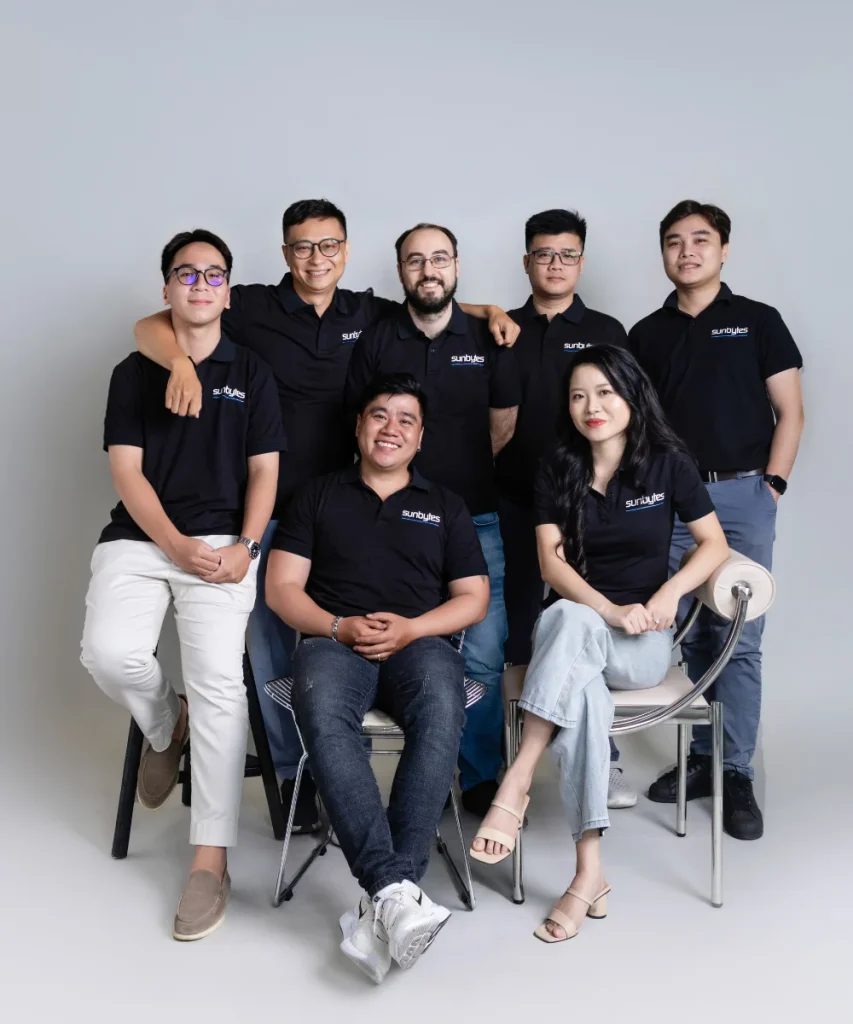
How Sunbytes approaches mobile app development for European companies
Choosing an app development company is not only a technical decision. The team must be able to ship the product, protect the delivery environment, and keep the people working on your codebase stable enough to retain context after the first release.
At Sunbytes, we design and staff dedicated senior development teams for European companies in 2–4 weeks. This is the Digital Transform Solutions layer: the architecture, delivery process, sprint rhythm, and engineering ownership needed to move from roadmap to working product without losing control of the codebase.
That delivery works because the supporting layers are already built into the model. Accelerate Workforce Solutions supports the people side of delivery: dedicated team setup, compliant employment structure, onboarding, and operational continuity, so engineers can focus on shipping instead of administrative friction. Cybersecurity Solutions supports the risk side of delivery: ISO 27001-guided practices, GDPR-aligned data handling, and a signed Article 28 DPA where required, so security and compliance are considered during delivery rather than added at the end.
Sunbytes is headquartered in the Netherlands, with a delivery hub in Ho Chi Minh City. That gives Dutch teams a practical 4–5 hour daily overlap with Amsterdam for standups, planning, sprint reviews, and technical decision-making.
Across 15+ years and 300+ projects, our focus is not only to provide developers. It is to create the delivery structure around the app: senior ownership, stable team composition, clear documentation, secure practices, and continuity after launch.Explore our Software Development services.