
The useful question is not whether outsourcing works. It is whether your product roadmap, delivery scope, and engineering requirements are stable enough for project-based software outsourcing.
In a dedicated development team vs outsourcing decision, the engagement model should match how often requirements, priorities, and technical decisions will change during development. If the roadmap is likely to evolve, a dedicated development team gives you continuity, product knowledge, sprint flexibility, and closer control over delivery. If the scope, timeline, and acceptance criteria are fixed, a project-based outsourcing model may be cleaner and easier to manage.
This guide compares both software development models by control, cost structure, team continuity, compliance, delivery rhythm, and roadmap fit. It also includes a six-question decision matrix to help you choose the right model before evaluating software development providers.
TL;DR
- Choose a dedicated development team when requirements will change, the roadmap is longer than three months, or architecture decisions need continuity.
- Choose project-based outsourcing when scope, timeline, and acceptance criteria are fixed before development starts.
- Contract price is not the same as total cost. Rework, onboarding, context loss, and change requests can make a fixed project more expensive across release cycles.
- If your product handles EU personal data, continuity matters because access rules, audit trails, and security decisions need to stay active across sprints.
How a dedicated team model works in practice
A dedicated development team gives you an external engineering team allocated to your product over an ongoing period. Your company keeps product direction, backlog priority, acceptance criteria, and roadmap ownership. The external team owns delivery execution, technical input, sprint output, and codebase continuity.
This model works through long-term product context. The same engineers stay close to the codebase, join roadmap discussions, support sprint planning, and document architecture decisions as requirements change. For a full breakdown of roles, setup, and onboarding, see the dedicated software development team guide.
When using offshore software development, the operating cadence matters as much as the contract. A 4 to 5 hour Netherlands-Vietnam timezone overlap gives enough shared time for sprint planning, stand-ups, backlog refinement, technical review, and release alignment without forcing a full night-shift model. Explore how Sunbytes builds dedicated development teams for long-term product delivery.
How project-based outsourcing works
Project-based outsourcing gives a software development vendor responsibility for a defined scope. The work is usually managed through a statement of work, a milestone plan, a fixed-price estimate, or an agreed-upon delivery package.
This model works when the output is clear. The vendor estimates the scope, assigns the right team, delivers the agreed work, and closes the project. For a broader explanation of outsourcing routes, see the Sunbytes guide to software development outsourcing and the comparison of IT outsourcing models.
The trade-off is change handling. If product learning changes the scope, the project needs a new estimate, change request, or revised delivery timeline. That is not a flaw in project-based outsourcing. It is the cost of using a fixed delivery structure for work that may not stay fixed.
Dedicated development team vs outsourcing: side-by-side comparison
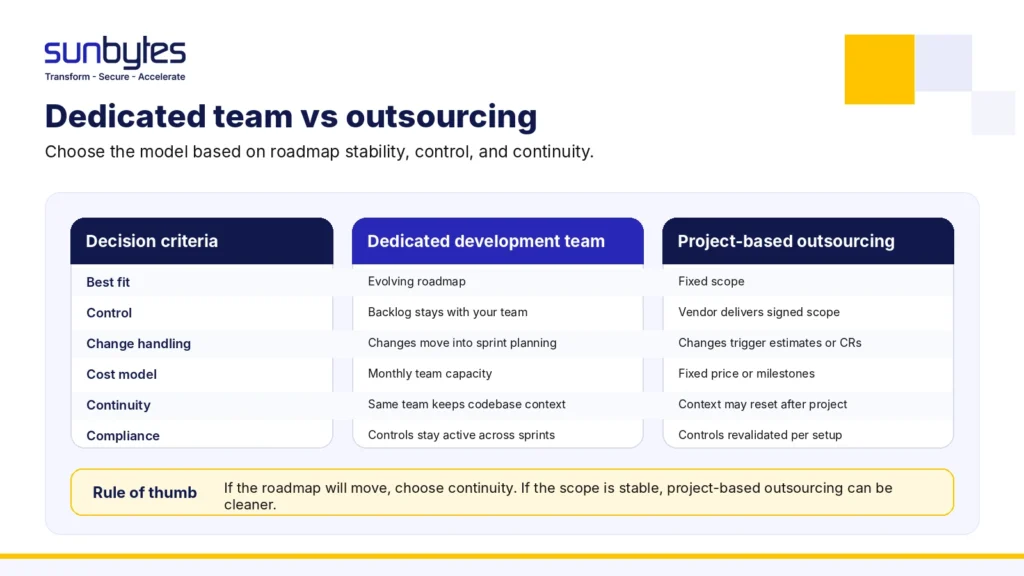
The main difference is how each engagement model handles change. A dedicated development team is built for an evolving product roadmap. Project-based outsourcing is built for a signed scope.
For Dutch and EU companies, the decision also depends on compliance continuity. If the product handles EU personal data, the delivery team needs to keep security decisions, access rules, and data-handling context active across sprints. GDPR Article 32 requires security measures appropriate to processing risk, which makes continuity more than a delivery preference when personal data is involved.
| Criteria | Dedicated development team | Project-based outsourcing |
|---|---|---|
| Best fit | Evolving roadmap | Fixed scope |
| Typical duration | 3+ months, multi-release product work | Short, defined project or milestone package |
| Client control | High. You keep backlog ownership. | Medium. Vendor delivers against agreed scope. |
| Change handling | Changes move into sprint planning. | Changes usually trigger re-estimation or change requests. |
| Architecture involvement | Continuous across releases. | Mostly upfront or milestone-based. |
| Cost model | Monthly team capacity, often per role or team structure. | Fixed-price or milestone-based project cost. |
| Cost orientation | Often EUR 3,000 to 8,000+ per developer per month, depending on seniority and setup. | Often EUR 20K to 300K+, depending on scope and complexity. |
| Rework risk | Lower when the same team keeps codebase context. | Higher when ownership is unclear or specs change. |
| Compliance continuity | Easier to maintain across sprints. | Must be reset or revalidated per project setup. |
| Best warning sign | Team lacks product direction. | Scope changes after sign-off. |
For Dutch companies already considering software development in Vietnam, the model decision should also account for time zone overlap, product ownership, backlog control, and delivery cadence. See the guide on Dutch companies outsourcing to Vietnam for the regional delivery context.
Decision matrix: which model fits your situation?
Use this matrix before comparing software development providers. Choose the engagement model first. Vendor evaluation comes after the model decision.
Answer yes or no to the first five questions. Then answer the sixth question separately.
| Question | Why it matters | What your answer implies |
|---|---|---|
| 1. Will your requirements change during development? | Fixed-scope contracts create overhead at every pivot. | Yes points to dedicated team. |
| 2. Is your project timeline longer than three months? | Longer product work benefits from accumulated codebase knowledge. | Yes points to dedicated team. |
| 3. Does your product handle EU personal data or operate under GDPR or NIS2 expectations? | Compliance context needs to persist across sprints, access changes, and releases. | Yes points to dedicated team. |
| 4. Do you need the team to join architecture decisions? | A dedicated team can challenge assumptions and propose technical alternatives. | Yes points to dedicated team. |
| 5. Will team size need to change based on sprint priorities? | Dedicated teams can adjust capacity within the same operating setup. | Yes points to dedicated team. |
| 6. Can you write a complete requirements document today and sign it off with no major changes? | Project-based delivery needs a stable specification. | No points to dedicated team. |
Read the result like this:
- Four or five yes answers to questions 1 to 5: choose a dedicated development team.
- Two or three yes answers: evaluate further before signing either model.
- Zero or one yes answer: project-based outsourcing likely fits.
- A no answer to question 6: default to a dedicated team unless the remaining uncertainty is small.
This matrix prevents a common mistake: using project-based outsourcing for a product that is still learning from users. If each sprint changes the roadmap, the contract becomes the bottleneck.
Once you know the dedicated team model fits, the next step is provider evaluation. That is a separate decision. Use the Sunbytes guide on how to choose a dedicated software development team when you are ready to compare vendors.

When a dedicated team model works best
A dedicated development team works best when delivery needs continuity. The same team keeps product context, architecture decisions, security assumptions, release history, and codebase knowledge across multiple sprints.
The model is strongest in three situations.
Your roadmap will change
A changing roadmap does not mean weak planning. In product development, it often means the team is learning from users, market timing, technical constraints, or internal stakeholders.
A dedicated team absorbs that learning through sprint planning. New priorities move into the backlog. Technical trade-offs are discussed with the same engineers who understand the existing codebase.
Project-based outsourcing can also handle change, but the change has to pass through the contract structure. Rework often adds 30 to 40% to the original estimate when ownership is unclear or the specification changes after sign-off. In a dedicated model, some correction work can be handled inside the sprint rhythm instead of becoming a new commercial negotiation.
Architecture decisions need continuity
Architecture choices compound. A database decision in sprint two affects reporting in sprint eight. An API shortcut in month one can slow integration work in month six.
This is where a dedicated team earns its cost. The team keeps the “why” behind technical decisions, not only the ticket history. That matters when the product needs to ship new features without breaking what already works.
DORA metrics make that discipline visible. Deployment frequency, lead time for changes, change failure rate, and mean time to recovery give CTOs a way to inspect delivery health instead of relying only on status updates.
A change failure rate above 15% is a useful warning signal. It means releases are creating too much correction work. At that point, the issue is not only velocity. It is architecture discipline, test coverage, ownership clarity, or release governance.
Compliance context has to stay active
For EU products, compliance is not a document outside delivery. Access control, data handling, audit trails, security reviews, and release procedures are delivery decisions.
If your product falls under NIS2-related cybersecurity expectations, Article 21 of the NIS2 Directive requires risk-management measures that include incident handling, supply chain security, access control, and risk assessment policies.
A dedicated team can keep those controls active across sprints. A project model can still work, but every new scope, vendor handoff, or delivery reset increases the chance that evidence, access rules, or security context needs to be rebuilt.
For product teams building apps that handle personal data, see the Sunbytes guide to GDPR compliance for mobile apps for the compliance layer behind delivery.
Case evidence: SandGrain
SandGrain, a Dutch company, used a dedicated team model for a multi-year product build. The team included seven roles across development, QA, testing, DevOps, and project coordination.
The project produced a functional prototype after three sprints. Across the engagement, the team supported 15 releases, fixed 196 bugs, and created 3,380 test cases, including 1,777 automated tests.
Those numbers show the real function of the model. A dedicated development team does not only add capacity. It preserves product and delivery context long enough for architecture, testing, and release quality to improve across cycles.
If your roadmap will change during development, the delivery model needs to absorb that change without contract renegotiation.
Sunbytes dedicated teams are operational in 2 to 4 weeks, DORA-tracked from sprint one, and structured for backlog flexibility across multiple release cycles.
When project-based outsourcing makes more sense
Project-based outsourcing makes more sense when the work is short, fixed, and fully specified.
Use it for a defined migration, small integration, landing page, contained feature build, or technical task where acceptance criteria are clear before work starts. If the project can be delivered in under eight weeks and does not need post-launch product evolution, the project model can be faster to contract and easier to close.
The model becomes weaker when the product is still in discovery. If stakeholders are still debating workflows, user roles, technical constraints, or market positioning, the specification will change. That change has a cost.
A good project-based outsourcing setup has three conditions:
| Condition | What it means |
|---|---|
| Scope is fixed | The deliverables are clear enough to estimate. |
| Acceptance criteria are stable | The vendor knows what “done” means before work starts. |
| Post-launch work is limited | The product will not need a long release roadmap after delivery. |
If one of those conditions fails, do not force the project model. Use a discovery sprint first, or move to a dedicated team model where the backlog can change without breaking the contract.
Total cost of ownership: dedicated team vs project model
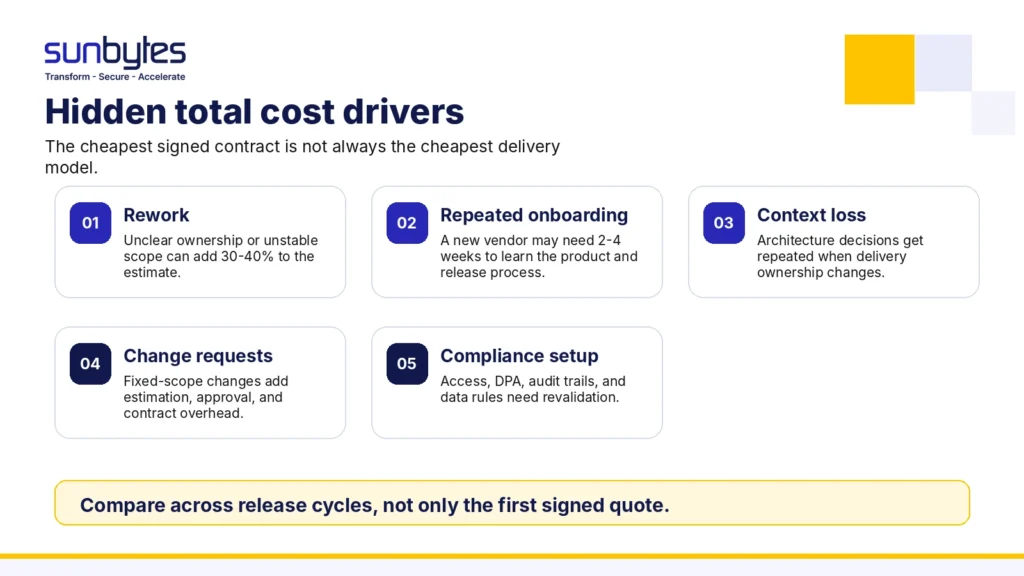
The cheapest signed contract is not always the cheapest delivery model.
Project-based outsourcing can look cheaper because the cost is attached to a defined output. Dedicated teams can look more expensive because you pay for monthly engineering capacity. The useful comparison is total cost of ownership.
The hidden costs usually sit in five places.
| TCO driver | Why it changes the cost |
|---|---|
| Rework | Unclear ownership or unstable scope can add 30 to 40% to the original estimate. |
| Repeated onboarding | A new vendor may need 2 to 4 weeks to understand the product, codebase, and release process. |
| Context loss | Architecture decisions get repeated when the delivery team changes. |
| Change requests | Fixed-scope changes create estimation, approval, and contract overhead. |
| Compliance setup | Access, DPA, audit trails, and data-handling rules need to be recreated or revalidated. |
A broad orientation is enough here. Dedicated teams may range from EUR 3,000 to 8,000+ per developer per month depending on role, seniority, and operating setup. Project-based outsourcing may range from EUR 20K to 300K+, depending on scope.
Do not choose the model on those ranges alone. A fixed-price project that needs repeated change requests can cost more than a dedicated team over three or four release cycles.
For detailed budget planning, use the Sunbytes guide to mobile app development cost and the IT staff augmentation cost breakdown. This article helps you choose the model, not build a rate card.
How to switch from project-based outsourcing to a dedicated team
Switching from project-based outsourcing to a dedicated team works best when the handover is treated as a sprint, not a meeting.
A meeting transfers opinions. A handover sprint transfers delivery context.
The new dedicated team needs six things before taking ownership:
| Handover item | Why it matters |
|---|---|
| Architecture decisions | Shows why the product is built the way it is. |
| Backlog status | Separates planned work from unresolved ideas. |
| Known defects | Prevents the new team from rediscovering old issues. |
| Deployment process | Shows how releases move from code to production. |
| Access model | Reduces delays and security gaps. |
| Documentation | Keeps decisions available after people change roles. |
Switching is easier when the same vendor retains product knowledge. It is harder when the project vendor closes the engagement without leaving current documentation, test coverage, or deployment notes.
A practical switch usually needs one setup sprint, one shadow sprint, and one ownership sprint. By the third sprint, the dedicated team should be able to plan, ship, and explain the next release without waiting for the old project team.
How Sunbytes structures dedicated team delivery
Sunbytes structures dedicated team delivery through three connected layers: Digital Transformation Solutions for product delivery, Cybersecurity Solutions for secure-by-design controls, and Accelerate Workforce Solutions for the people operations behind the team.
The delivery layer builds senior tech teams around the product roadmap, not only individual roles. Teams can become operational in 2 to 4 weeks, with ISO-guided delivery and DORA-tracked sprint outcomes such as deployment frequency, lead time for changes, change failure rate, and mean time to recovery.
The security layer prepares access control, DPA handling, audit trails, and role-based permissions before development starts. ISO/IEC 27001 provides the control framework behind this setup.
The workforce layer handles contracts, onboarding, payroll coordination, and people operations, as well as delivery setup, so the team has the access, structure, and support needed from the first sprint.
Recurrent Ventures shows how this model works over time. Sunbytes supported the company with a dedicated team of six engineers for more than six years, delivering WordPress VIP solutions across nine publishing brands, including PopSci, Futurism, OutdoorLife, The War Zone, The Drive, Bob Vila, Task & Purpose, We Are The Mighty, and Domino.